 SS
SS

Key Takeaways
- A Site Reliability Engineer (SRE) resume should highlight skills in maintaining system reliability, reducing toil, and leading incident responses.
- The resume format should resemble that of a software engineer, emphasizing operational reliability expertise rather than administrative tasks.
- Include a summary that quantifies experience with specific metrics related to availability, incident response, and reliability improvements.
- Use technical skills relevant to SRE roles, such as programming, observability tools, incident management, and cloud infrastructure.
- Incorporate strong action-oriented bullet points that demonstrate measurable impacts on reliability and operational efficiency.
A site reliability engineer resume in 2026 must show that you can keep systems running reliably at scale - reducing toil, defining SLOs, leading incident response, and building the automation and observability that prevents future outages. SRE is a discipline, not just a job title - your resume must show discipline: measured reliability improvements, systematic incident reduction, and engineering solutions to operational problems.
SRE roles sit between software engineering and operations. Your resume should look like a software engineer's resume with operational reliability expertise added - not a system administrator's resume with a title change.
Before applying, run your resume through the ATS score checker. For related roles, read the DevOps engineer resume guide and cloud engineer resume guide. Use ATS-friendly resume templates.
Best SRE Resume Format
Your resume after optimization
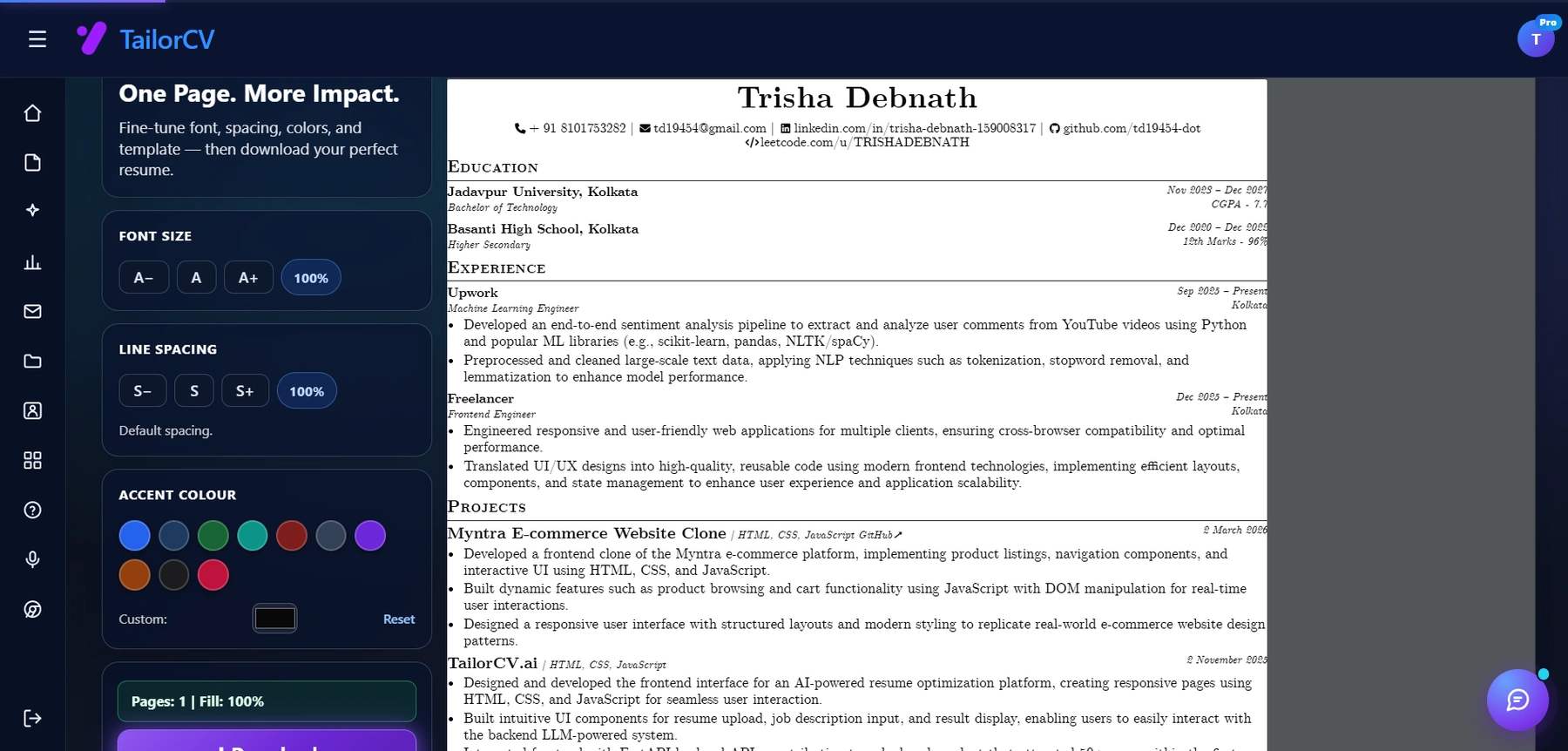
Font size, spacing, accent colour and template are all adjustable, with a live page counter.
One to two pages. SRE roles are senior-leaning - two pages are acceptable for candidates with significant reliability improvement history.
SRE Resume Summary
Formula:
Site Reliability Engineer with X years of experience maintaining [availability metric] for [system scale or user count]. Led [incident response / SLO definition / toil reduction] efforts. Reduced [MTTD/MTTR/on-call incidents/toil hours] by [metric].
Example for Experienced SRE
Site Reliability Engineer with 5 years of experience maintaining 99.95%+ availability for distributed microservices platforms serving 4M+ daily active users. Defined and implemented SLO/SLI/error budget frameworks for 12 services. Reduced mean time to detect (MTTD) from 28 minutes to 4 minutes and mean time to recover (MTTR) from 2.2 hours to 38 minutes through observability improvements and automated runbooks.
SRE Technical Skills
Programming and Automation: Python, Go, Bash, Ansible, custom tooling Observability: Prometheus, Grafana, Datadog, ELK Stack, Jaeger, Splunk, OpenTelemetry, PagerDuty Incident Management: On-call process design, runbooks, blameless postmortems, incident command, SLA management SLO/SLI/Error Budget: Defining and tracking SLOs, error budget burn alerts, service level agreements Cloud and Infrastructure: AWS/GCP/Azure, Kubernetes, Docker, Terraform, Helm, ArgoCD CI/CD: GitHub Actions, Jenkins, ArgoCD, Spinnaker Performance Engineering: Load testing (k6, Locust), capacity planning, performance profiling Chaos Engineering: Chaos Monkey, Gremlin, LitmusChaos, failover testing
Best ATS Keywords for SRE Resume
- SLO / SLI / SLA / error budget
- Incident response
- MTTD / MTTR reduction
- On-call management
- Blameless postmortem
- Observability
- Prometheus / Grafana / Datadog
- Kubernetes
- Toil reduction
- Automation
- Reliability engineering
- Capacity planning
- Chaos engineering
- Alert tuning
- Runbook
- Load testing
- Python / Go scripting
- 99.9% / 99.99% availability
- Disaster recovery
How to Write SRE Resume Bullet Points
Formula:
Reduced / Built / Defined / Led + [reliability system or process] + [service scale or team context] + [MTTD, MTTR, availability, toil, or incident rate result]
Weak Bullet Points
- Worked on on-call rotations
- Managed Kubernetes clusters
- Set up monitoring and alerting
- Led incident response
Strong Bullet Points
- Defined SLO framework for 15 critical services including latency, availability, and error rate SLIs with Prometheus-based burn rate alerts - reducing false alert volume by 72% and improving on-call response quality.
- Led blameless postmortem process redesign following 3 severity-1 incidents, introducing structured action tracking that reduced repeat-incident rate from 41% to 8% over 6 months.
- Built a runbook automation system in Python that resolved 34% of common on-call alerts automatically, saving the on-call engineer an estimated 8 hours per week of manual remediation.
- Improved mean time to detect (MTTD) for high-severity incidents from 28 minutes to 4 minutes by implementing distributed tracing with Jaeger, structured logging with the ELK Stack, and custom Grafana dashboards.
- Led chaos engineering program using Gremlin to test failure scenarios across 8 production services - identified 6 unhandled failure modes and drove fixes that improved overall system resilience score from 62% to 88%.
SRE Resume Example
Senior Site Reliability Engineer Fintech Platform | Jan 2022 - Present
- Maintained 99.97% availability for a payment processing platform handling $420M in annual transaction volume across 3 production regions.
- Defined SLO/SLI framework and error budget policy for 12 critical payment services, enabling data-driven reliability investment decisions versus reactive firefighting.
- Reduced on-call alert volume by 68% through systematic alert tuning, deduplication, and routing optimization - reducing on-call burden from 6 wakeups/week to 1.9.
- Led post-incident reviews for all Severity 1 and Severity 2 incidents, producing action items tracked to completion - contributing to a 55% reduction in incident recurrence rate.
- Implemented GitOps-based deployment automation with ArgoCD, achieving deployment failure rate under 0.5% and enabling same-day rollback for any production issue.
Common SRE Resume Mistakes
Mistake 1: Ops-focused, not engineering-focused
SRE is engineering, not operations administration. Show Python automation, Go tooling, platform engineering work, and code-based solutions - not just ticket management.
Mistake 2: No reliability numbers
"Maintained high availability" is meaningless without the number. Show 99.95%, 99.99%, or whatever your tracked availability was.
Mistake 3: No MTTD/MTTR improvement story
Reliability improvements are SRE's core value. Every resume should show at least one incident detection, response time, or recurrence reduction metric.
Mistake 4: No SLO/error budget experience
In 2026, SRE candidates without SLO/SLI/error budget experience are at a disadvantage for senior roles at engineering-mature companies.
Related Guides
- DevOps Engineer Resume
- Chemical Engineer Resume
- Civil Engineer Resume
- Cloud Engineer Resume
- Consultant Resume
- Customer Service Resume
- Cybersecurity Engineer Resume
- Data Engineer Resume
- Electrical Engineer Resume
- Embedded Systems Engineer Resume
- Game Developer Resume
- Machine Learning Engineer Resume
- Mechanical Engineer Resume 2026 - Complete Guide with Examples
- QA Engineer Resume 2026 - Complete Guide with Examples
- Software Engineer Resume for FAANG in 2026
Make This Practical
Once you draft this resume, test it against a real job post with the free ATS score checker. Then improve fit using Resume Matching With Job Description, polish the layout with ATS-friendly resume templates, and make the bullets stronger with How to Write Resume Bullet Points.
A complete application needs more than one document. Pair the resume with a targeted letter from the AI cover letter generator, practice role-specific questions with the AI mock interview tool, and publish proof of work with the portfolio website builder when your role benefits from projects or case studies.
Conclusion
A strong SRE resume in 2026 shows systematic reliability improvements: SLO ownership, MTTD/MTTR reduction, toil elimination, and production incident reduction. Do not just describe your on-call duties - show what got better because of your engineering work.
Use the TailorCV ATS score checker to compare your resume against the job description. Then prepare for technical and system design interviews with the interview preparation guide.
Frequently Asked Questions
What key skills should I highlight on my SRE resume in 2026?
When crafting your SRE resume, focus on showcasing skills related to SLOs, SLIs, and SLAs, as well as your experience in incident management and automation. Emphasize measurable impacts, such as reductions in MTTD and MTTR, to demonstrate your effectiveness in improving system reliability. For a broader perspective on essential skills for various roles, check out our Top Skills to Add to Your Resume in 2026.
How do I structure my SRE resume for best results?
A well-structured SRE resume typically includes a header, summary, technical skills, work experience, projects, and education. Aim for one to two pages, ensuring that the content is concise and directly relevant to the role. For more detailed guidance on projects and their importance, refer to our blog on Fresher Resume Projects That Get Interviews.
What is the significance of ATS keywords in my SRE resume?
In 2026, many companies use Applicant Tracking Systems (ATS) to filter resumes. Including relevant ATS keywords related to SRE, such as "incident response" or "reliability engineering," can significantly increase your chances of getting noticed by hiring managers. Use our Free ATS score checker to ensure your resume is optimized for these systems.
How can I demonstrate my incident management experience effectively?
To effectively showcase your incident management experience on your SRE resume, include specific examples that highlight your role in leading incident response efforts and reducing incident frequency. Use metrics to quantify your achievements, such as the percentage decrease in incidents or the time saved through improved processes. For a deeper dive into analyzing job descriptions, check out our Job Description Analysis Checklist Before You Apply.
What distinguishes an SRE resume from other technical resumes?
An SRE resume should reflect a balance between software engineering and operational expertise, emphasizing reliability and system performance. Unlike a traditional system administrator's resume, it should demonstrate a proactive approach to reducing toil and improving SLOs. For insights on crafting resumes for other technical roles, visit our guide on DevOps Engineer Resume 2026 - Complete Guide with Examples.
What is your resume scoring right now?
Scan it against a job description and get your ATS match score in about a minute.
Drop your resume here or choose a file
PDF only. Max 2 MB.
We never share your data or use it to train AI models.

Templates that keep this structure intact
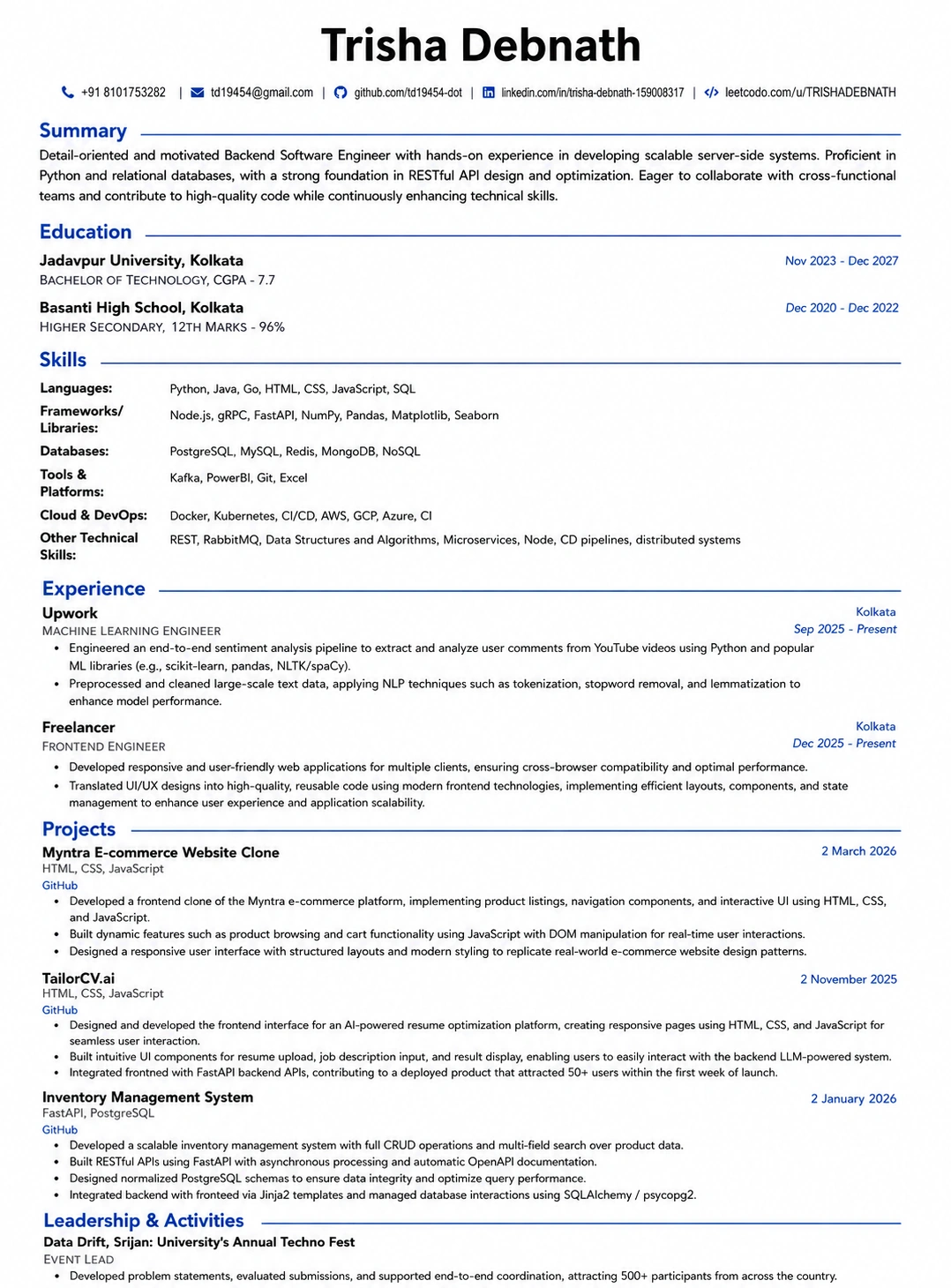
This template is ATS-tested — start from it and the formatting rules in this guide are already handled.
Was this guide useful?
Be the first to rate it.