 TD
TD
Key Takeaways
- Canadian resumes are concise (1–2 pages), achievement-focused, and tailored to each job.
- Never include a photo, age, marital status, religion, or your SIN — Canadian anti-discrimination norms mean these are left off.
- Most Canadian employers use an ATS, so clean formatting and job-specific keywords are essential.
- Canadian-style spelling and metrics, plus clear evidence of results, help you fit local expectations.
- Tailoring each application to the job description is the biggest driver of getting interviews.
A Canadian resume follows conventions that differ from resumes in India, the UK, the Middle East, and many other regions — and those differences matter. Canadian employers and the Applicant Tracking Systems they use expect a specific format, and submitting a resume in your home-country style is one of the most common reasons newcomers and international applicants get overlooked.
This guide shows you exactly how to write a Canadian resume in 2026: the right format and length, what to include (and crucially, what to leave out), how to make it ATS-friendly, and examples you can adapt whether you're a newcomer, a student, or an experienced professional.
Why Canadian Resume Conventions Exist
Understanding why Canadian resumes look the way they do makes the rules easier to follow. Canada has strong human-rights and anti-discrimination legislation, and employers are careful to avoid any information that could enable bias — which is why photos, age, marital status, religion, gender, and nationality are deliberately left off. This isn't just etiquette; including them can actively make an employer uncomfortable, because it introduces information they're trained not to consider. Similarly, the emphasis on concise, achievement-focused content reflects a results-oriented business culture and the widespread use of ATS software that rewards clean, scannable, keyword-relevant resumes. When you strip out personal details and lead with quantified results, you're not just following a format — you're speaking the language of Canadian hiring.
What Makes a Canadian Resume Different
If you're coming from another job market, note these key differences up front:
- No personal photo. Unlike Malaysia or parts of Europe, Canadian resumes never include a photo.
- No personal identifiers. Leave off age, date of birth, marital status, gender, religion, nationality, and your Social Insurance Number (SIN). Canadian employers avoid these to comply with anti-discrimination law.
- Concise length. One page for students and early-career; up to two pages for experienced professionals.
- Achievement-focused. Bullet points emphasise measurable results, not just duties.
- Canadian English. Use Canadian spelling (e.g. "organization," "labour") and metric units where relevant.
Getting these right immediately signals that you understand the Canadian workplace.
The Structure of a Canadian Resume
1. Header
Your name, city and province (full address not required), phone number, professional email, and LinkedIn URL. No photo, no personal details.
2. Professional Summary
Two to four sentences summarising your experience, top skills, and value. Tailor it to the role.
Results-driven Financial Analyst with 4 years' experience in Toronto's banking sector. Built forecasting models that improved budget accuracy by 20% and automated reporting that saved 15 hours a month. Advanced Excel, SQL, and Power BI.
3. Work Experience
Reverse-chronological order. For each role: job title, company, city/province, and dates. Then achievement bullets using action verb + task + measurable result. Quantify with dollars, percentages, and timeframes.
4. Education
Degree, institution, and graduation year. If you studied outside Canada, you can note a Canadian equivalency assessment (e.g. WES) if you have one. Recent graduates place education near the top.
5. Skills
A dedicated section for technical skills, tools, and certifications — clean keywords for the ATS and quick scanning for the recruiter.
6. Optional Sections
Certifications, licences, volunteer experience (valued in Canada), projects, and professional affiliations, as relevant.
You can build this structure quickly and cleanly with the TailorCV resume builder.
The Professional Summary: Your Most Valuable Lines
The professional summary sits at the top of your resume and is the first thing a recruiter reads — so it deserves real care. In two to four sentences it should answer: who you are professionally, what your standout strengths and achievements are, and what you bring to this role. Avoid vague, generic openers like "hardworking professional seeking a challenging opportunity"; they waste your best space and say nothing. Instead, lead with specifics and a number:
Data Analyst with 5 years' experience turning complex datasets into business decisions for Canadian retailers. Built dashboards that cut reporting time by 50% and models that improved forecast accuracy by 20%. Skilled in SQL, Python, and Power BI.
Tailor this summary to each posting, mirroring the role's priorities. It's the single highest-leverage paragraph on your resume — the hook that makes a busy recruiter keep reading.
Handling the Education Section as an Internationally Trained Candidate
If you earned your degree outside Canada, the education section deserves extra thought. List your degree, institution, and graduation year as normal, and — importantly — note any Educational Credential Assessment (ECA) you've completed, such as a WES report confirming Canadian equivalency. This small addition removes a real source of employer uncertainty by translating your qualification into terms they recognise. If your profession is regulated (nursing, engineering, accounting, teaching, and others), also note any Canadian licensing, registration, or bridging programs in progress. Recent graduates should place education near the top; experienced professionals move it below their work experience, where a single clear line usually suffices. For the full newcomer strategy around credentials, see how to get a job in Canada as a newcomer.
The Value of Volunteer Experience
One distinctly Canadian feature worth embracing: volunteer experience is genuinely valued on a resume here, far more than in many other countries. It demonstrates community engagement, provides Canadian references, and — for newcomers especially — offers a legitimate way to show "Canadian experience" while building your network. If you've volunteered, include it as its own section (or within experience if directly relevant), described with the same achievement-focused bullets you'd use for paid work. A newcomer who volunteers with a local organisation, contributes real skills, and quantifies the impact turns that experience into a genuine asset on the page and a source of Canadian references off it.
Beating the ATS in Canada
Most Canadian employers — banks, tech companies, government, and large firms — screen resumes with an Applicant Tracking System before a human reads them. To pass:
- Use a single-column, standard layout — no tables, text boxes, images, or headers/footers for key content.
- Use standard section headings (Work Experience, Education, Skills).
- Submit a text-based PDF you can highlight and copy (unless Word is requested).
- Mirror the job description's keywords truthfully.
We cover the full mechanics in how ATS works in Canada, and you can test any resume against a specific posting with the free ATS score checker. For the exact terms to include, see best resume keywords for Canadian jobs.
Action Verbs and Quantifying Impact
Two habits do most of the heavy lifting on a strong Canadian resume: leading with action verbs and quantifying results. Start each experience bullet with a verb that conveys ownership — led, built, delivered, increased, reduced, launched, streamlined, achieved, managed, implemented — rather than passive phrasing like "responsible for." Then attach a number wherever you can: dollars, percentages, volumes, timeframes, headcounts. Even roles that feel hard to measure usually yield a metric — people served, time saved, error rates reduced, targets hit, satisfaction scores. "Reduced customer wait times by 30% by redesigning the intake process" tells a Canadian recruiter far more than "handled customer intake." Numbers make your achievements concrete and credible, and they're what make a busy reader stop and take notice.
Tailoring: Why One Resume Isn't Enough
Sending the same resume everywhere is the top mistake. Both the ATS and the recruiter match you against that posting. For each application:
- Highlight the required skills and phrases in the job description.
- Rewrite your summary and top bullets to reflect them (truthfully).
- Adjust your skills section so the most relevant terms appear.
The TailorCV resume optimizer automates this — rewriting your resume to match a specific Canadian job while keeping it ATS-safe.
Canadian vs American Resume
Canadian and US resumes are similar but not identical — spelling, some formatting norms, and terminology differ. If you're moving between the two markets, read our detailed breakdown of the Canadian vs American resume so you don't accidentally submit the wrong style.
Example: Newcomer to Canada
PRIYA SHARMA
Toronto, ON | +1 416-555-0123 | priya.sharma@email.com | linkedin.com/in/priyasharma

PROFESSIONAL SUMMARY
Project Coordinator with 5 years' international experience in IT delivery, now based
in Toronto. Delivered 12+ projects on time and 8% under budget. Skilled in Agile,
Jira, and stakeholder management. Credential assessed by WES (Bachelor's equivalency).

WORK EXPERIENCE
Project Coordinator — GlobalTech, Bengaluru, India        2021–2025
- Coordinated cross-functional teams of up to 15 across 12 software projects.
- Cut average delivery time 8% by streamlining sprint planning.
- Managed stakeholder reporting for projects worth over CAD $2M equivalent.

EDUCATION
Bachelor of Engineering (Computer Science), 2020 — WES-assessed Canadian equivalency

SKILLS
Agile, Scrum, Jira, MS Project, stakeholder management, risk management

CERTIFICATIONS
Certified Scrum Master (CSM)
Note how this newcomer resume drops all personal identifiers, uses Canadian formatting, notes credential assessment, and quantifies achievements — exactly what Canadian employers expect. Newcomers should also read our guide to getting a job in Canada as a newcomer.
Choosing a Resume Format: Chronological, Functional, or Hybrid
Most Canadian resumes use one of three structures, and picking the right one matters:
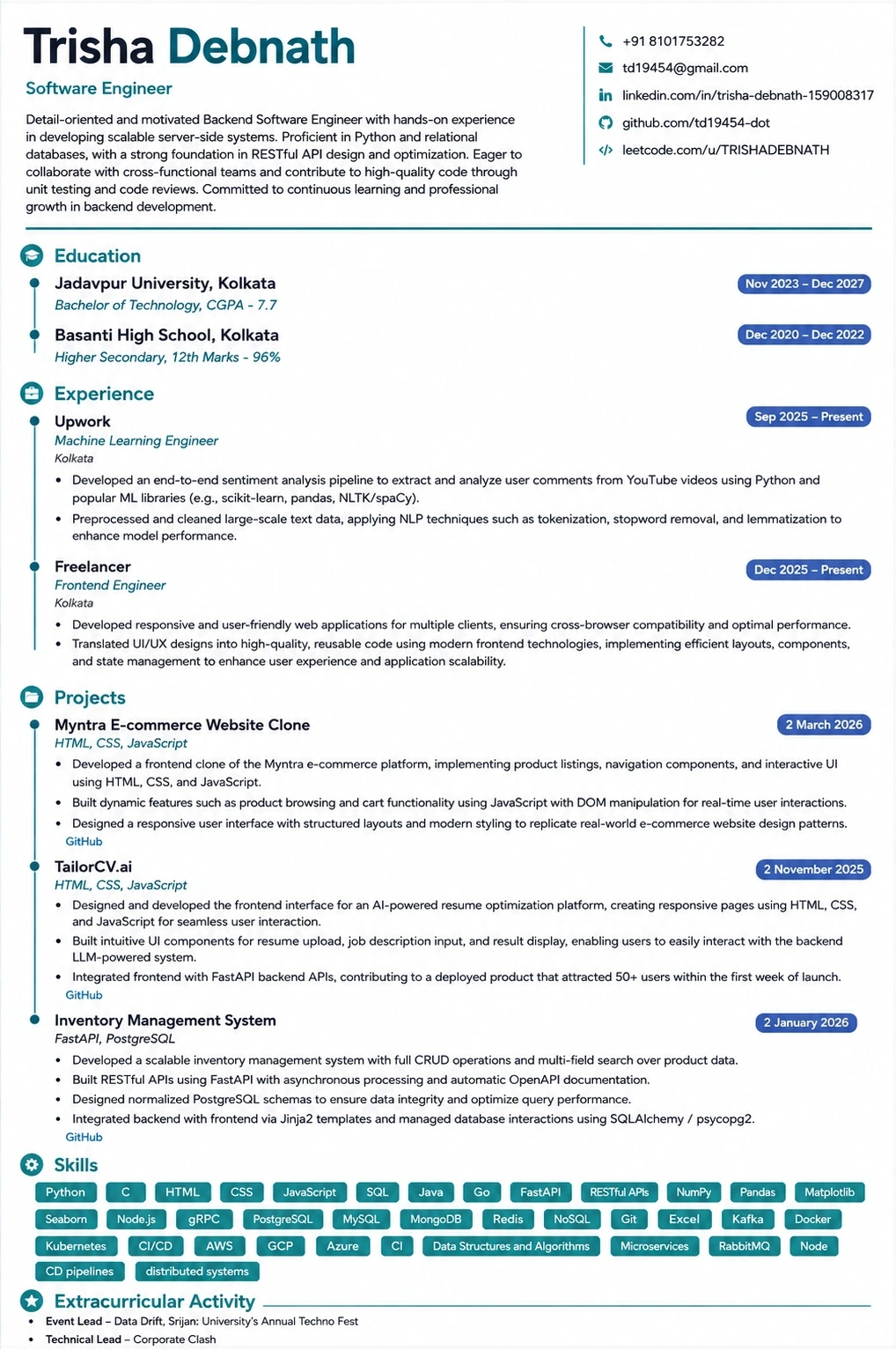
Your resume after optimization
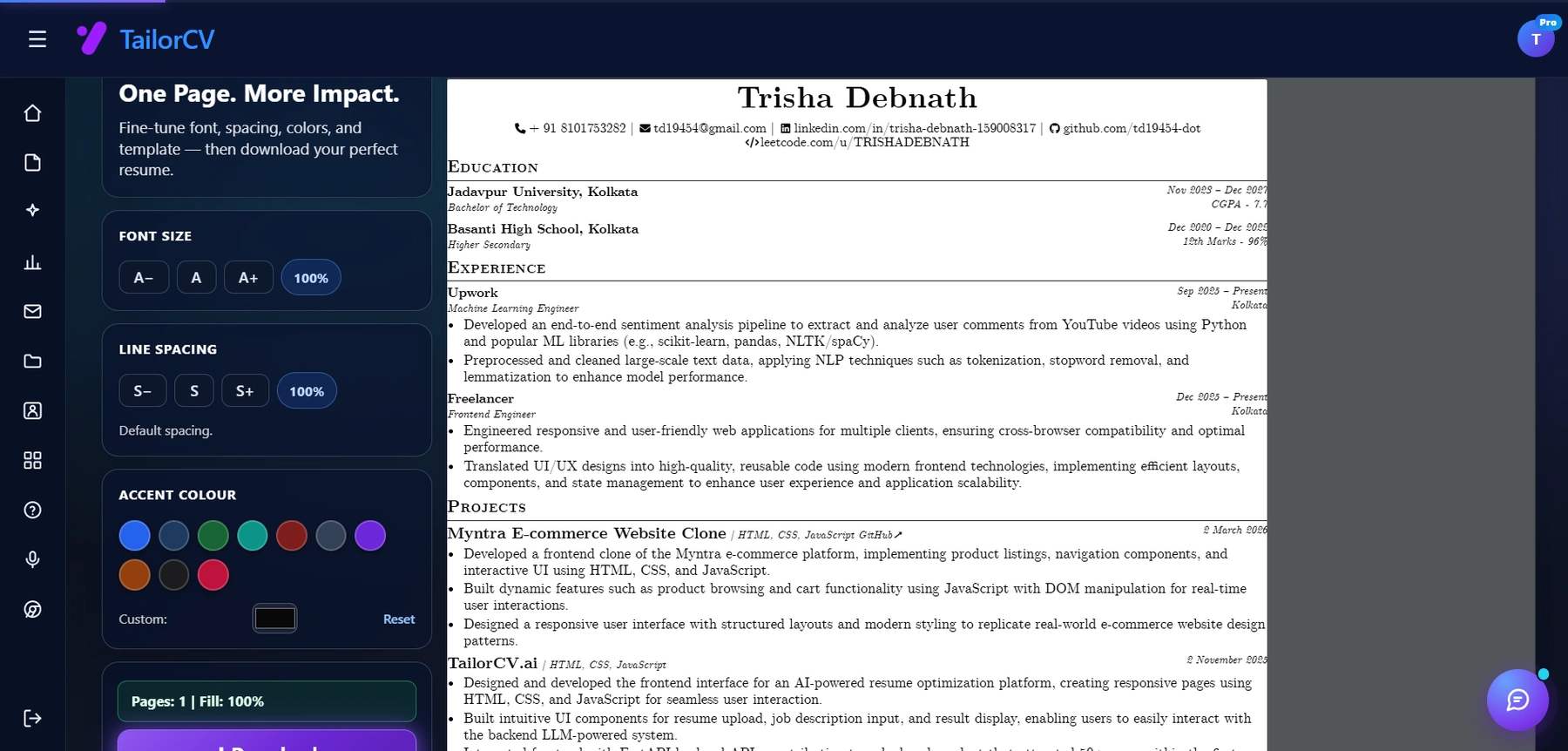
This is the resume after tailoring - the content is already matched, and these controls are how you fit it onto one page.
- Reverse-chronological (the default and most recommended): lists your work history from most recent backward. Canadian employers and ATS parse it easily, and it works best when you have a steady, relevant work history.
- Functional (skills-based): groups your experience by skill rather than timeline. It can help hide gaps or a career change, but many Canadian recruiters are wary of it because it obscures your history, and ATS parse it poorly. Use sparingly.
- Hybrid (combination): leads with a strong skills/summary section, then follows with a reverse-chronological history. This is often the best choice for newcomers and career changers — it foregrounds relevant skills while still giving the clear timeline employers want.
For most people, reverse-chronological or a hybrid is the safe, effective choice. Avoid a purely functional resume unless you have a specific reason, and even then test how it parses with the ATS score checker.
Writing Achievement Bullets That Land
The single biggest quality difference between a weak and a strong Canadian resume is the experience bullets. Canadian employers want results, not responsibilities. Use the formula action verb + what you did + measurable result:
- Weak: Responsible for managing social media accounts.
-
Strong: Grew the company's LinkedIn following by 60% in six months through a targeted content strategy.
-
Weak: Handled customer service inquiries.
- Strong: Resolved 40+ daily customer inquiries with a 95% satisfaction rating, reducing escalations by 25%.
Lead each bullet with a strong verb — led, built, delivered, increased, reduced, launched, streamlined, achieved — and quantify wherever you can with dollars, percentages, volumes, or timeframes. Even in roles that feel hard to measure, you can usually find a number: people served, time saved, error rates reduced, targets hit. Numbers are what make a Canadian recruiter stop and read.
Tailoring Your Resume for Different Situations
Your emphasis should shift depending on where you are in your career:
- Students and new graduates: keep it to one page. Lead with education, then feature internships, co-op placements, part-time work, volunteer roles, and academic projects — each described with an achievement bullet. Emphasise transferable skills and reliability.
- Experienced professionals: lead with a strong summary and your work experience. Two pages are fine; make every line earn its place, and foreground your most impressive, relevant results.
- Career changers: use a hybrid format, lead with transferable skills, and reframe past achievements in the language of your target field. A brief, confident summary explaining your direction helps.
- Returning to work after a gap: focus on skills and recent upskilling, address the gap briefly and matter-of-factly (in the cover letter if not the resume), and highlight any volunteering, freelancing, or courses that kept you current.
A Second Example: Experienced Professional
DAVID CHEN
Vancouver, BC | +1 604-555-0198 | david.chen@email.com | linkedin.com/in/davidchen

PROFESSIONAL SUMMARY
Marketing Manager with 8 years' experience leading digital campaigns for Canadian
retail and e-commerce brands. Grew online revenue 140% in two years and managed
budgets up to CAD $1.5M. Expert in SEO, paid media, and analytics.

WORK EXPERIENCE
Marketing Manager — RetailCo, Vancouver, BC              2020–Present
- Led a team of 6 across content, paid media, and CRM, growing online revenue 140%.
- Reduced customer acquisition cost by 32% by restructuring paid campaigns.
- Launched a loyalty program that lifted repeat purchase rate by 28%.

Digital Marketing Specialist — BrandCo, Calgary, AB      2017–2020
- Managed CAD $600K annual ad budget at a consistent 4x return.
- Increased organic traffic 85% through an SEO and content overhaul.

EDUCATION
Bachelor of Commerce (Marketing), University of British Columbia, 2016

SKILLS
SEO, Google Ads, Meta Ads, GA4, HubSpot, content strategy, team leadership
Notice the pattern: a summary that leads with the strongest numbers, experience bullets that pair action with measurable results, and a skills section mirroring what a Canadian marketing job description would ask for.
Formatting Details That Matter in Canada
Small choices affect both parsing and the human impression:
- Length: one page for students/early-career, two for experienced. Rarely more.
- Fonts: clean, standard fonts (Calibri, Arial, Georgia) at a readable size.
- Consistency: uniform date formats, bullet styles, and spacing throughout.
- File format and name: submit a text-based PDF unless Word is requested, named professionally (e.g. "David_Chen_Resume.pdf").
- Canadian spelling: "organization," "labour," "centre," "programme" where appropriate — small signals of local fit.
- Contact details in the body, never the header/footer, so the ATS reads them.
A Note on Bilingual (English/French) Resumes
Canada is officially bilingual, and while English is sufficient for most roles outside Quebec, French ability is a genuine asset — and sometimes a requirement, particularly in Quebec, federal government roles, and bilingual customer-facing positions. If you speak French, list it clearly in your skills/languages section with an honest proficiency level. For roles in Quebec or explicitly bilingual postings, you may need a French-language version of your resume; ensure it's professionally accurate, as errors in a formal French document undercut your candidacy. Even conversational French can widen your options meaningfully across Canada.
Common Canadian Resume Mistakes
- Including a photo or personal details. A clear signal you're unfamiliar with Canadian norms — leave them off.
- Home-country format. Long CVs, unusual layouts, or non-metric units feel out of place.
- Listing duties, not results. Quantified achievements are what stand out.
- Ignoring the ATS. Fancy templates and image-based PDFs get filtered.
- Not tailoring. A generic resume underperforms badly.
- Non-Canadian spelling. Small, but it subtly signals fit.
After the Resume
A strong resume gets the interview; the rest of your application seals it:
- Add a targeted cover letter — see the Canadian cover letter guide.
- Optimise your LinkedIn — see LinkedIn optimization for Canadian job seekers.
- Network effectively — much of Canadian hiring happens through connections; see networking to find jobs in Canada.
- Prepare for interviews — see interview tips for Canada and rehearse with the AI mock interview.
- International students should read getting a job in Canada as an international student.
Frequently Asked Questions
Should I put a photo on my Canadian resume? No. Canadian resumes never include a photo, and you should also leave off age, marital status, religion, and your SIN.
How long should a Canadian resume be? One page for students and early-career candidates; up to two pages for experienced professionals. Keep every line relevant.
Do I need to get my foreign degree assessed? It helps. A credential assessment (e.g. WES) lets employers understand your qualification's Canadian equivalency; note it on your resume if you have one.
How do I know if my resume will pass the ATS? Run it against the specific job description with a free ATS score checker to see your match and missing keywords.
Should I use a chronological or functional resume in Canada? Reverse-chronological is the default and parses best; a hybrid (skills summary plus chronological history) works well for newcomers and career changers. Avoid a purely functional resume — many Canadian recruiters distrust it and ATS parse it poorly.
Do I need a French version of my resume? Not for most roles outside Quebec, where English is sufficient. But French is an asset across Canada and often required in Quebec, federal roles, and bilingual positions. If you provide a French resume, make sure it's professionally accurate.
How should I handle an employment gap on a Canadian resume? Focus on skills and recent upskilling, and address the gap briefly and matter-of-factly — often best in the cover letter. Highlight any volunteering, freelancing, or courses that kept you current, and keep a forward focus.
What file format should I submit? A text-based PDF (one you can highlight and copy) preserves formatting and parses well, unless the posting specifically requests Word. Never submit a scanned or image-based file, which the ATS can't read.
A Pre-Submission Checklist
Before you send any Canadian application, run through this quick check:
- unchecked: One to two pages, concise and relevant throughout
- unchecked: No photo, age, marital status, religion, nationality, or SIN
- unchecked: Contact details (city/province, phone, email, LinkedIn) in the body
- unchecked: A tailored professional summary leading with your strongest results
- unchecked: Achievement bullets with action verbs and quantified results
- unchecked: A clear skills section mirroring the job's keywords
- unchecked: Credential assessment (e.g. WES) noted if trained abroad
- unchecked: Canadian spelling throughout
- unchecked: Single-column, ATS-safe formatting — no tables or images for key content
- unchecked: Text-based PDF, professionally named
- unchecked: Tested against the posting with the ATS score checker
Tick every box and your resume is ready to compete. Then pair it with a tailored cover letter and an optimised LinkedIn profile for the strongest possible application.
Final Thoughts
A strong Canadian resume is concise, achievement-focused, ATS-friendly, and free of the personal details Canadian employers deliberately avoid. Follow the local format, quantify your results, mirror each job's keywords, and tailor every application.
Build yours with the TailorCV resume builder, tailor and test it with the ATS optimizer, and pair it with a strong cover letter and LinkedIn. Do that consistently, and you'll turn Canadian applications into interviews.
What is your resume scoring right now?
Scan it against a job description and get your ATS match score in about a minute.
Drop your resume here or choose a file
PDF only. Max 2 MB.
We never share your data or use it to train AI models.

Templates that keep this structure intact
This template is ATS-tested — start from it and the formatting rules in this guide are already handled.
Was this guide useful?
Be the first to rate it.