 SS
SS

Key Takeaways
- A Canadian cover letter is concise (one page, 3–4 paragraphs), professional, and tailored to the specific role.
- Its purpose is to connect your most relevant achievements to the employer's needs — not to repeat your resume.
- Tailoring to each job is essential; generic letters are easy to spot and dismiss.
- Use Canadian spelling and a professional but warm tone.
- Pair it with a Canadian-style, ATS-ready resume for the strongest application.
In Canada, a strong cover letter is often what turns a good application into an interview. Many Canadian employers — especially for professional, government, and competitive roles — read cover letters closely, using them to gauge your communication skills, your genuine interest, and your fit for the team. For newcomers, a well-written cover letter is also a chance to address "Canadian experience" head-on and show you understand the local workplace.
This guide shows you how to write a cover letter for Canadian jobs in 2026: the right structure, tone, and length; what to include; and complete examples you can adapt.
The Role of the Cover Letter in a Canadian Application
In the Canadian hiring process, the cover letter and resume play complementary roles. The resume gets scanned first — often by an ATS, then by a recruiter skimming for relevance — and it earns you a place on the shortlist. The cover letter is where a human, considering you more seriously, hears your voice: why you want this role, why this organisation, and how your background fits. For many roles it's read at the shortlist stage, and for professional, government, and competitive positions it can be decisive. That's why a generic letter is worse than useless — it signals you didn't care enough to tailor — while a specific, well-written one can tip a close decision in your favour. Think of the two documents as a pair: the resume proves you're qualified; the cover letter makes the case that you're the right person for this team.
Do You Need a Cover Letter in Canada?
Often, yes. While some listings mark it "optional," a targeted cover letter:
- Signals genuine interest in this organisation.
- Explains context a resume can't — a career change, a relocation, or (for newcomers) how your international experience transfers.
- Demonstrates the written communication Canadian employers value.
For professional roles, government positions, and competitive openings, a strong cover letter is a real advantage. When in doubt, include one.
What a Cover Letter Adds That a Resume Can't
It's worth being clear on why the cover letter matters, because that shapes how you write it. Your resume is a structured list of what you've done; your cover letter is where you connect the dots, add context, and make your case in your own voice. It can explain a career change or a relocation, translate international experience into Canadian relevance, convey genuine enthusiasm for a specific organisation, and demonstrate the written communication that Canadian employers prize. Where a resume answers "what have you done," the cover letter answers "why you, why here, and why now." Used well, it turns a qualified applicant into a memorable one — which is exactly why, for professional, government, and competitive roles, a strong cover letter is a real advantage rather than a formality.
The Right Structure
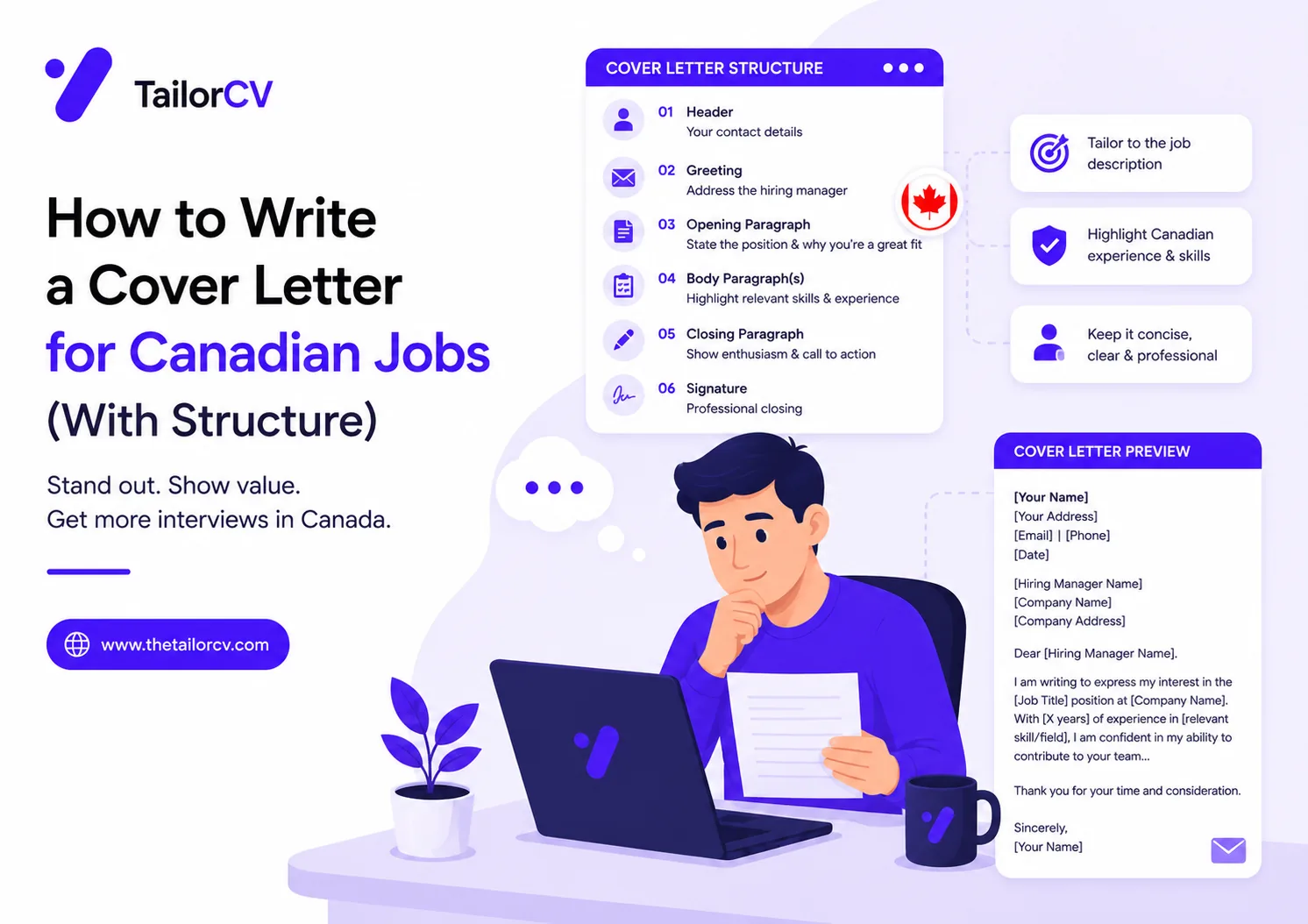
Keep it to one page, three to four short paragraphs.
What the finished letter looks like
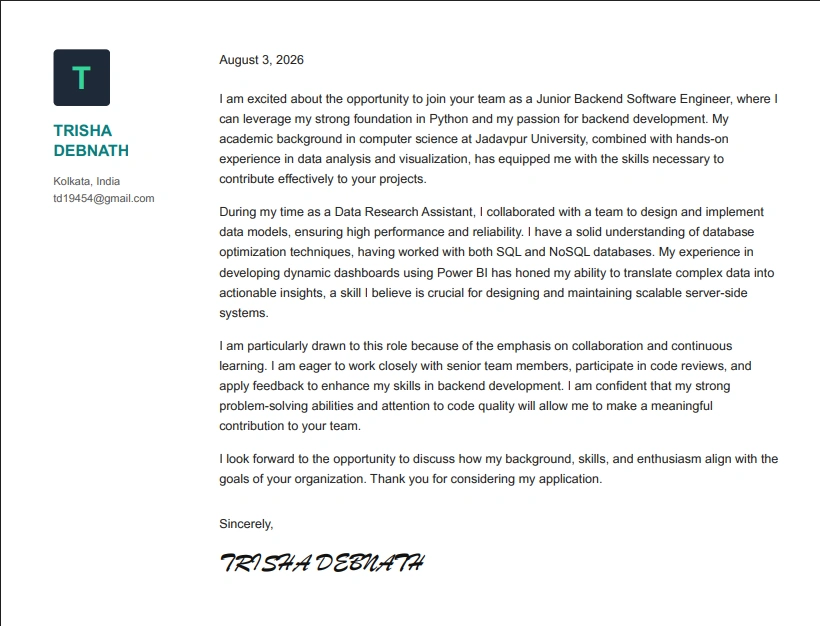
The same rules with a little more styling: the header is real text, not an image, so the layout stays readable to both a recruiter and a parser.
1. Header and Greeting
Your contact details and the date, then address a specific person where possible ("Dear Ms. Chen"). If no name is available, "Dear Hiring Manager" works. Avoid "To Whom It May Concern."
2. Opening — Hook
Name the role and lead with your single most relevant, impressive point.
I'm excited to apply for the Financial Analyst position at MapleCorp. In my previous role I built forecasting models that improved budget accuracy by 20% — exactly the kind of impact I'd bring to your finance team.
3. Body — Evidence
Connect two or three achievements to the job's requirements, using specifics and mirroring the posting's language. For newcomers, this is the place to translate international experience into Canadian terms.
Your posting emphasises financial modelling and stakeholder reporting. I've built models managing over CAD $2M in budgets and automated monthly reporting that saved 15 hours a month. I'm advanced in Excel, SQL, and Power BI.
4. Closing — Call to Action
Reaffirm interest, note availability, and invite the next step.
I would welcome the opportunity to discuss how I can contribute to MapleCorp's goals. Thank you for your consideration — I look forward to hearing from you.
Tailoring Your Letter to the Role Type
The core structure stays the same, but your emphasis should shift with the kind of role:
- Corporate and professional roles: lead with quantified achievements and business impact, and connect them to the company's goals.
- Government and public-sector roles: address the posting's stated qualifications point by point, thoroughly and precisely.
- Startups and small companies: convey adaptability, initiative, and genuine enthusiasm for the mission — smaller teams hire heavily on fit and drive.
- Creative roles: let a little personality and voice come through (while staying professional), and reference your portfolio.
- Entry-level and student roles: lead with enthusiasm, potential, and transferable skills from coursework, internships, and volunteering.
In every case, the letter should feel written for this employer — the surest sign of which is a specific, accurate detail about them that no template could contain.
Tone, Length, and Language
- Length: one page, three to four short paragraphs.
- Tone: professional and warm, confident but not arrogant.
- Language: Canadian spelling ("organization," "customize"). Clear, plain English.
- Formatting: match your resume's font and header for a polished, unified application.
Tailoring Is Non-Negotiable
A generic cover letter signals low effort. For each role:
- Name the company and the exact position.
- Reference something specific about the organisation or role.
- Match your two or three highlighted achievements to the posting's top requirements.
Writing each one by hand is slow. The TailorCV cover letter generator drafts a tailored letter from your resume and the job description in seconds, which you then personalise. Pair it with a resume tailored to the same posting using the resume optimizer.
Example: Newcomer to Canada
Priya Sharma
Toronto, ON | +1 416-555-0123 | priya.sharma@email.com

2 August 2026

Dear Ms. Chen,

I'm writing to apply for the Project Coordinator role at BuildRight Inc. As a project
professional with five years of international experience — recently relocated to
Toronto — I'm eager to bring my delivery track record to a respected Canadian firm.

In my previous role, I coordinated cross-functional teams across 12 software projects,
delivering them 8% under budget and improving on-time delivery by streamlining sprint
planning. I'm a Certified [Scrum Master](https://thetailorcv.com/blog/scrum-master-resume-2026), and my Bachelor's has been assessed by WES for
Canadian equivalency. I'm confident these skills transfer directly to your team's needs.

I would welcome the chance to discuss how I can contribute to BuildRight's projects.
Thank you for your time and consideration.

Sincerely,
Priya Sharma
Example: Experienced Professional
Daniel Roy
Vancouver, BC | +1 604-555-0199 | daniel.roy@email.com

2 August 2026

Dear Mr. Thompson,

I'm applying for the Senior Software Developer position at CloudNova. With seven years
building scalable web applications in Vancouver's tech sector, I'm excited by your
mission to simplify cloud infrastructure for small businesses.

At my current company, I led a re-architecture that reduced page load times by 45% and
supported a threefold increase in users. I work daily in TypeScript, React, and AWS, and
I've mentored a team of five. Your focus on performance and reliability aligns closely
with where I do my best work.

I'd be glad to discuss how my experience can support CloudNova's roadmap. Thank you for
your consideration.

Sincerely,
Daniel Roy
What Canadian Employers Look For in a Cover Letter
When a Canadian hiring manager opens your cover letter, they're scanning — often quickly — for a few specific signals. Write directly to them:
- Genuine interest in this organisation. They can tell whether you researched them. A single accurate, specific reference to their work, values, or mission beats a paragraph of generic praise.
- Relevant, evidenced ability. They want proof you can do this job, expressed as concrete results, not adjectives.
- Strong written communication. In Canada's professional culture, your cover letter is itself a communication sample — clear, well-organised, error-free writing is part of the message.
- Cultural fit. Canadian workplaces value collaboration, respect, and professionalism; a confident but warm, humble tone signals you'll fit.
- A reason to take the next step. Ultimately they're deciding whether to spend time on your resume and an interview. Make the value obvious.
Write as if the reader is busy and slightly skeptical — because they usually are — and you'll naturally lead with substance.
Addressing the "Canadian Experience" Question as a Newcomer
For newcomers, the cover letter is the ideal place to defuse the "Canadian experience" concern before it becomes a barrier. Rather than hiding your international background, frame it as an asset and connect it directly to the role. Translate your experience into Canadian terms and metrics, note any credential assessment (e.g. WES), and convey genuine commitment to building your career in Canada. A sentence like "My five years leading delivery teams internationally translates directly to the coordination and stakeholder-management this role requires, and I'm fully settled in Toronto and eager to contribute" addresses the concern head-on with confidence. For the full newcomer strategy, see how to get a job in Canada as a newcomer.
Cover Letters for Career Changes and Gaps
The cover letter is especially valuable when your resume raises a question:
- Career change: acknowledge the switch briefly and confidently, then focus on transferable skills and any steps you've taken to bridge the gap (a certification, a project, relevant coursework). Frame it as a deliberate, well-reasoned decision.
- Employment gap: a short, matter-of-fact sentence beats silence. Note what you did to stay sharp (freelancing, upskilling, volunteering) and pivot quickly back to your value. You owe reassurance and a forward focus, not a detailed justification.
Cover Letters for Government and Public-Sector Roles
Canadian government and public-sector applications deserve special attention, because they often read cover letters very closely — and some ask you to demonstrate specific selection criteria or "essential qualifications." For these:
- Address the stated criteria directly. If the posting lists required competencies, structure your letter to show how you meet each with concrete examples.
- Be thorough and precise. Public-sector processes value clear evidence over flair.
- Use professional, plain language and Canadian spelling throughout.
- Follow instructions exactly — public-sector applications are often screened strictly against stated requirements.
Treating the posting's requirements as a checklist to address, point by point, is frequently the difference between advancing and being screened out.
Example: Student / Entry-Level
Emma Tremblay
Ottawa, ON | +1 613-555-0177 | emma.tremblay@email.com

3 August 2026

Dear Ms. Patel,

I'm excited to apply for the Marketing Assistant position at BrightPath. As a
final-year Business student at the University of Ottawa with a summer internship in
[digital marketing](https://thetailorcv.com/blog/digital-marketing-resume-2026), I'm eager to bring my energy and skills to your team.

During my internship, I helped grow a client's Instagram engagement by 40% and
supported a campaign that generated over 500 new leads. My coursework in analytics
and consumer behaviour, combined with hands-on experience in Google Ads and Canva,
has prepared me to contribute from day one. I'm a quick learner, reliable, and genuinely
excited about BrightPath's creative approach.

I would welcome the opportunity to contribute and grow with your team. Thank you for
your consideration.

Sincerely,
Emma Tremblay
Notice how a candidate with limited experience leads with enthusiasm, translates coursework and an internship into relevant, quantified ability, and shows genuine interest in the company.
Words and Phrases That Strengthen Your Letter
- Lead with strong verbs: "delivered," "led," "grew," "launched," "improved," "achieved" — not "was responsible for."
- Be specific, not vague: "improved accuracy by 20%" beats "improved accuracy significantly."
- Sound confident, not arrogant: "I'm confident I can contribute to…" rather than overblown claims.
- Show, don't just tell: demonstrate strong communication through a clear, well-written letter and a concrete example.
- Avoid clichés: "hardworking team player" and "think outside the box" add nothing — replace with evidence.
How to Send Your Cover Letter
- By email: either put a short version in the body and attach the full letter, or make the email body your cover letter — never send a blank email with a bare attachment. Use a clear subject line ("Application for Financial Analyst – Priya Sharma").
- Through a portal: paste a clean version into the cover-letter field, checking that line breaks survive.
- When attaching: send a PDF named professionally (e.g. "PriyaSharma_CoverLetter.pdf").
- Match your resume's look so the two documents read as one polished application.
Generating the letter from a job description
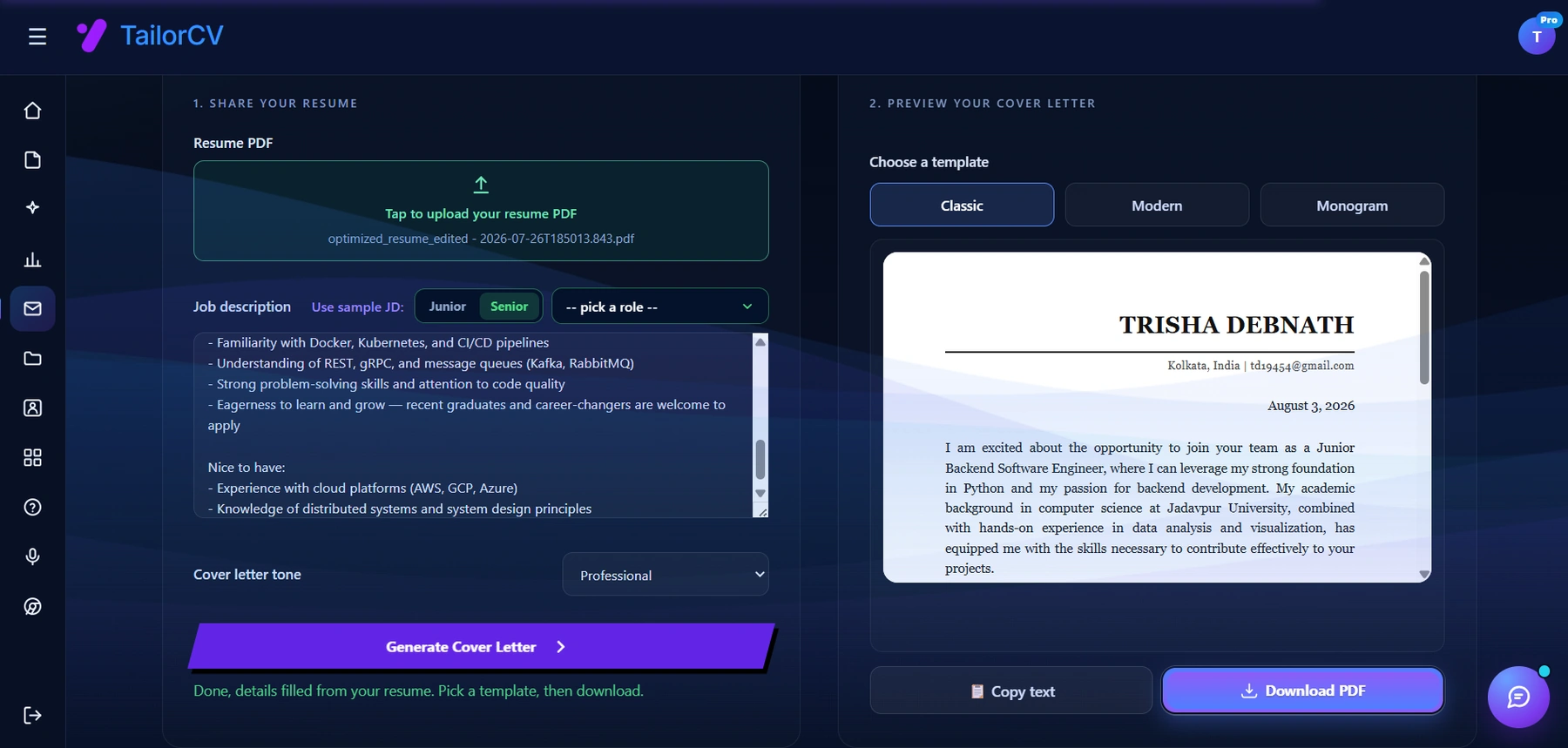
Having the preview beside the inputs is what makes this fast: change the tone or template and you see the result immediately.
A Proofreading Checklist
Before sending, confirm:
- unchecked: Correct company name and role title (double-check — the wrong name is an instant rejection)
- unchecked: Addressed to a named person where possible
- unchecked: One page, three to four short paragraphs
- unchecked: A strong opening hook, not "I am writing to apply for…"
- unchecked: Two or three quantified, relevant achievements
- unchecked: A specific reason you want this organisation
- unchecked: Canadian spelling throughout
- unchecked: Consistent fonts and header matching your resume
- unchecked: Zero typos (read it aloud, and have someone else check)
- unchecked: Saved as a professionally named PDF
Common Cover Letter Mistakes
- Repeating the resume. Add context and connect the dots instead.
- Being generic. No company name or specifics signals low effort.
- Too long. Keep it to one page.
- Typos or the wrong company name. An easy, avoidable rejection.
- Focusing on what you want. Lead with what you offer the employer.
- Non-Canadian spelling. Small, but it signals fit.
Following Up After You Apply
If you haven't heard back within one to two weeks, a brief, polite follow-up (by email or LinkedIn) reaffirming your interest is appropriate and occasionally makes the difference. Keep it short and courteous — a sentence or two restating your enthusiasm for the role and your availability — and don't chase repeatedly. One thoughtful nudge shows initiative; persistent messaging does the opposite. If you interviewed, a same-day thank-you note referencing something specific from the conversation is a small, high-impact habit that many Canadian candidates skip.
The Discipline of Tailoring
It's worth restating because it's the single biggest factor: a tailored cover letter beats a polished generic one every time. Employers read dozens of applications and can spot a template instantly. Tailoring doesn't mean rewriting from scratch each time — it means, for every role, naming the company and position, referencing something specific about them, and matching your two or three highlighted achievements to the posting's top requirements. The TailorCV cover letter generator makes this fast by drafting a tailored letter from your resume and the job description, which you then personalise with a genuine, specific detail about the employer. That combination — automated speed plus a human, specific touch — is what lets you apply widely without sacrificing quality.
How the Cover Letter Fits Your Application
- Start with a Canadian-style, ATS-ready resume — see the Canadian resume guide and test it with the ATS checker.
- Match the role's language — see best resume keywords for Canadian jobs.
- Optimise LinkedIn — see LinkedIn optimization for Canadian job seekers.
- Prepare for interviews — see interview tips for Canada and rehearse with the AI mock interview.
Newcomers should also read how to get a job in Canada as a newcomer.
Frequently Asked Questions
Do Canadian employers read cover letters? Many do, especially for professional, government, and competitive roles. A tailored letter is a low-cost way to stand out.
How long should a Canadian cover letter be? One page — three or four short paragraphs. Recruiters skim, so make every line count.
Should I use American or Canadian spelling? Canadian spelling ("organization," "labour," "customize"). It's a small detail that signals fit.
Can I reuse the same cover letter for every job? No. Tailor each one to the specific company and role — generic letters are easy to reject.
How do I address "Canadian experience" as a newcomer in my cover letter? Frame your international experience as an asset and connect it directly to the role, translating it into Canadian terms and metrics. Note any credential assessment (e.g. WES) and convey genuine commitment to building your career in Canada. Address the concern head-on with confidence rather than hiding your background.
How do I write a cover letter for a Canadian government job? Government postings often read cover letters closely and may ask you to demonstrate specific selection criteria. Address each stated requirement directly with concrete examples, be thorough and precise, use professional plain language, and follow the instructions exactly.
Should the cover letter go in the email body or as an attachment? Either works — put a short version in the body and attach the full letter as a PDF, or make the email body your cover letter. Never send a blank email with a bare attachment, and use a clear subject line naming the role.
How do I write a cover letter with little experience? Lead with enthusiasm and genuine interest in the company, translate coursework, internships, and volunteer work into relevant quantified ability, and emphasise transferable skills and a willingness to learn — exactly what employers want from entry-level candidates.
Common Questions Newcomers Have About Cover Letters
Newcomers often wonder whether a cover letter is worth the effort when they're applying to many roles, or whether it might draw attention to their international background. The answer is that a strong cover letter is usually an advantage, not a risk — especially for newcomers. It's your chance to control the narrative: to frame your international experience as an asset, address "Canadian experience" on your own terms, and convey genuine commitment to building a career here. Rather than hoping a recruiter interprets your background generously, you tell them directly why it's valuable. For competitive and professional roles, skipping the cover letter can quietly cost you; including a tailored one signals effort and communication skill. The key is to keep it specific and confident, connecting your genuine strengths to the employer's needs. Used this way, the cover letter becomes one of a newcomer's most useful tools rather than a chore.
Final Thoughts
A great Canadian cover letter is short, specific, and tailored — connecting your best achievements to the employer's needs while showing genuine interest and strong communication. Keep it to one page, lead with a hook, prove your value with numbers, and always customise it.
Draft a tailored letter fast with the TailorCV cover letter generator, pair it with a resume optimised for the same role using the resume optimizer, and submit an application Canadian employers take seriously.
Was this guide useful?
Be the first to rate it.