 SS
SS
Key Takeaways
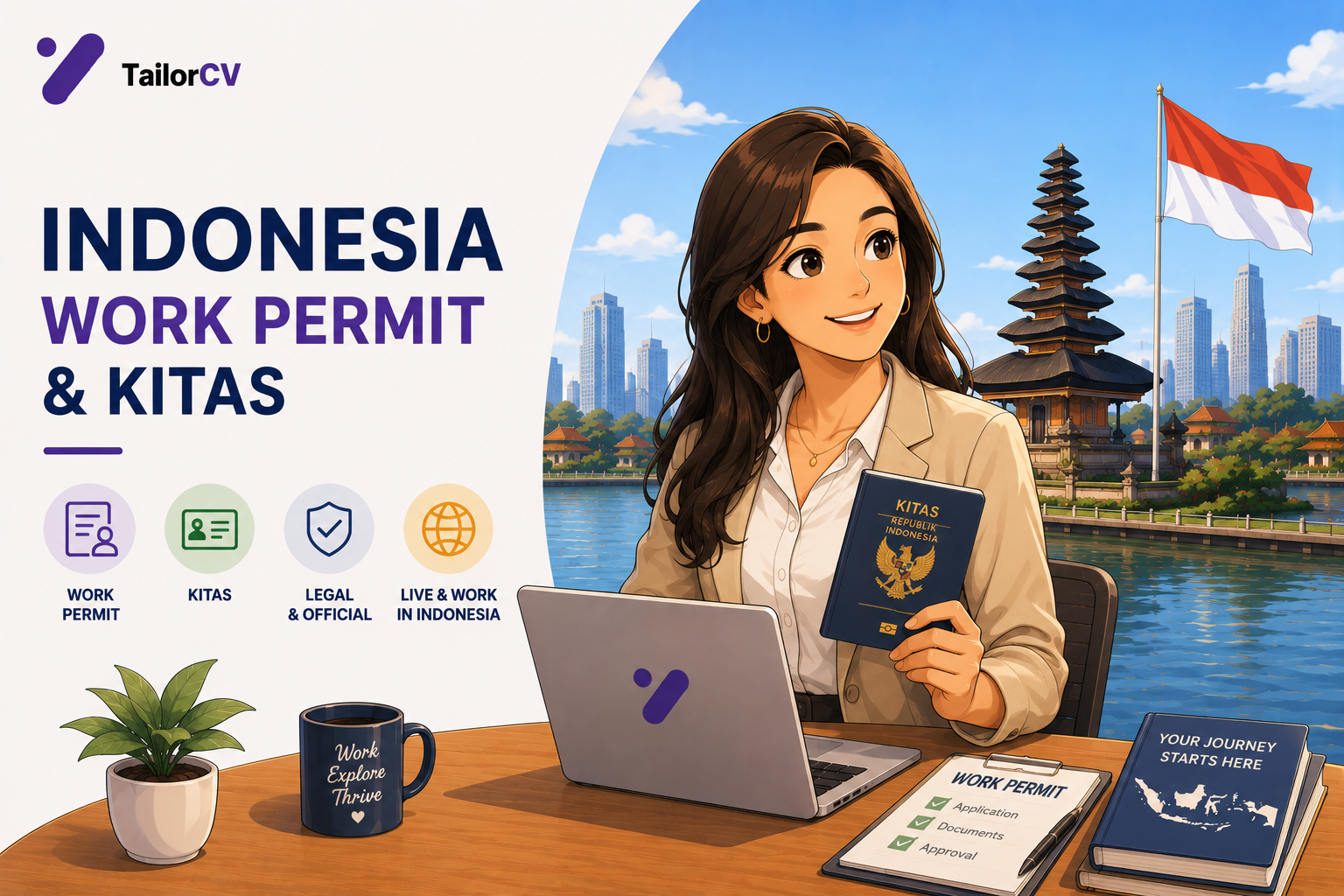
- Indonesian work authorisation runs through an employer-sponsored chain: RPTKA approval, then a visa, then a KITAS limited stay permit.
- The employer carries most of the process and their competence largely determines your timeline.
- A counterpart requirement frequently applies — an Indonesian employee designated to be trained toward the role.
- Certain positions are closed to foreigners entirely, and this should be checked first.
- KITAS is tied to the sponsoring employer, so changing jobs means a new permit rather than a transfer.
The chain
How the pieces fit together.
RPTKA — the foreign worker utilisation plan. The employer submits this to the Ministry of Manpower, setting out the position, the justification for employing a foreigner, the duration and the Indonesian counterpart arrangement. This is the foundational approval.
A levy is payable in connection with employing a foreign worker, calculated per position and period.
Visa issuance, on the basis of the approved plan, allowing entry for work purposes.
KITAS — the limited stay permit, issued after arrival, which is your residence status.
Registration with local authorities and the police reporting requirement.
MERP or re-entry provisions, allowing you to leave and return without your permit lapsing.
And renewals, aligned to the approved employment period.
The employer drives all of it. Your role is providing documents accurately and promptly, and choosing an employer who knows what they are doing.
The counterpart requirement
A distinctive feature worth understanding properly.
Indonesian regulations generally require a designated Indonesian employee to be assigned as a counterpart to a foreign worker, with the intention that knowledge is transferred and the position eventually localised.
Training obligations attach, and employers are expected to demonstrate that development is occurring.
Some positions have time limits on foreign occupation, reinforcing the transitional intent.
Practically, this shapes the role. You are expected to build local capability, not merely to perform the function.
It is worth engaging with genuinely. Foreign professionals who take counterpart development seriously tend to have better relationships with their teams and their employers, and those who treat it as a compliance box do not.
And it affects your career planning. A role explicitly intended to be localised has a horizon, which is worth knowing at the start rather than discovering later.
Restrictions and special cases
What to check.
Positions closed to foreigners. Certain roles, human resources being the most cited, are reserved for Indonesians. The list has been amended and should be checked currently.
Director and commissioner positions have their own arrangements in company structures.
Investor KITAS exists for shareholders meeting defined thresholds, which is a different route from employment.
Spouse of an Indonesian citizen carries provisions including, in defined circumstances, the right to work.
Retirement KITAS exists for those meeting age and financial conditions, without work rights.
Second home visa was introduced for longer stays with financial requirements.
And remote workers occupy an area that has been evolving, with Indonesia signalling intent to formalise it — the position should be verified currently rather than assumed.
Timelines and practical planning
What to expect.
RPTKA approval is the first gate and depends on the employer's preparation and the clarity of the justification.
Visa issuance follows, either through an Indonesian mission abroad or through an electronic process depending on the arrangement.
Entry and KITAS issuance after arrival, with biometrics.
Registration with local authorities and police reporting.
Total is generally measured in weeks to a couple of months for a well-prepared employer, and considerably longer for one figuring it out.
Do not resign until the approval chain is genuinely progressing.
Document legalisation should start immediately, since degrees and experience letters require authentication.
And build in buffer. Indonesian administrative timelines are not always predictable and planning to the minimum estimate creates avoidable stress.
Family and dependants
The arrangements that follow.
Dependants can obtain their own KITAS sponsored through your employment, covering a spouse and children.
A spouse's right to work is separate. A dependant KITAS does not confer permission to work, and a spouse seeking employment needs their own sponsored permit.
Spouses of Indonesian citizens have distinct provisions, including in defined circumstances the ability to work, which is a different and more favourable position.
Schooling is available through an extensive international school sector in Jakarta, which is excellent and expensive.
Healthcare should be covered by international insurance including evacuation, given the variation in provision outside Jakarta.
And dependant permits are tied to yours, meaning any change in your status affects the whole family — worth understanding before a job change.
Costs and who pays
The financial side.
The foreign worker levy payable in connection with employing a foreigner, calculated per position and period.
Visa and permit fees.
Document legalisation and translation, which varies by nationality.
Agent fees, since many employers use one for the process.
Practice on who pays varies, though for professional roles the employer usually covers it. Clarify at offer stage.
Dependant permits carry their own costs, which for a family adds up.
And renewal costs recur annually in most arrangements, which is worth factoring into a multi-year view.
Common problems
Five that recur.
Employer inexperience. A company that has not done RPTKA before will be slow and may get it wrong, and this is the most common source of delay.
Position restrictions discovered late. Checking whether the role is open to foreigners should happen before an offer, not after.
Document legalisation not started early enough, which gates everything.
Working before the KITAS is issued, which is not permitted even with an approved plan in progress.
And status lapsing during a job change, since KITAS is tied to the employer and a gap between permits is a genuine problem.
The prevention in all cases is choosing an employer who has done this before and starting your own document preparation immediately.
Comparing Indonesia regionally
Where it sits.
Against Vietnam. Both are employer-sponsored and document-heavy. Indonesia adds the counterpart requirement and position restrictions, making it somewhat more restrictive.
Against Thailand. Thailand's restricted occupation list is comparable; Indonesia's counterpart obligation is distinctive.
Against Malaysia and Singapore. Both are considerably more developed for skilled foreign employment with clearer criteria.
Against the Philippines. Similar structural approach with an English-language advantage there.
The pattern regionally is consistent: employer sponsorship, expertise justification, position restrictions and document-heavy processes. Indonesia sits at the more restrictive end, with the counterpart requirement being its most distinctive feature.
Long-term status
Where the routes lead.
KITAS is a limited stay permit, renewed in line with your employment.
KITAP — the permanent stay permit — becomes available after a qualifying period of continuous KITAS residence, subject to conditions, and it offers considerably more stability including longer validity.
Spouses of Indonesian citizens have a distinct and more favourable path, including toward KITAP with a shorter qualifying period.
Citizenship is genuinely difficult, requiring a long residence period and, notably, Indonesia does not generally permit dual nationality — which means naturalisation typically requires renouncing your existing citizenship. This is a significant consideration and it differs from most countries in this series.
For most foreign professionals, the realistic long-term position is renewed KITAS or eventually KITAP rather than citizenship.
And the transitional intent built into foreign employment — counterpart training, position time limits — means Indonesia is structurally less oriented toward permanent foreign settlement than many of its neighbours.
Questions to ask before accepting
The ones that determine whether this works.
"Have you sponsored a foreign worker before, and how recently?" Employer experience is the single biggest variable.
"Is this position open to foreigners?" Confirm rather than assume.
"What is the counterpart arrangement?" Who they are, what the training plan is, and what it means for your role.
"Is there a time limit on foreign occupation of this position?" Some roles have one, and it defines your horizon.
"Who handles and pays for the process?" Practice varies.
"What is a realistic start date?" Ask for a considered answer.
And "what happens at renewal?" Since KITAS renewal is annual in most arrangements and continued eligibility matters.
A note on agents
Widely used and worth understanding.
Most employers use an agent for permit processing, since the administration is involved and the requirements shift.
Good agents genuinely help, knowing current requirements and the particular offices involved.
Poor ones create risk, including handling documentation in ways that leave you exposed.
Improper arrangements exist — permits obtained on the basis of employment that does not reflect the actual role — and these put your status at risk rather than the agent's.
Ask who the agent is and whether your employer has used them repeatedly.
And retain visibility of your own documents, since passports being held for extended periods is normal in the process and knowing where yours is remains reasonable.
Mini checklist
- unchecked: Position confirmed as open to foreigners
- unchecked: Employer's experience with RPTKA confirmed
- unchecked: Counterpart arrangement understood
- unchecked: Duration and any localisation horizon clarified
- unchecked: Documents legalised early
- unchecked: KITAS versus visa distinction understood
- unchecked: Re-entry provisions arranged before travel
- unchecked: Police reporting obligation noted
- unchecked: Alternative routes checked if employment does not fit
Scenarios
Scenario 1: You have an Indonesian job offer
Confirm the employer has done RPTKA before, and ask about the counterpart arrangement and any time limit on the position. Both shape your role and your horizon.
Scenario 2: You are an investor or shareholder
The investor KITAS is a separate route from employment sponsorship, with its own thresholds and conditions, and it may suit better than an employment permit.
Scenario 3: You want to live in Indonesia without local employment
Look at the retirement KITAS if you qualify, the second home visa, or the evolving remote-work provisions — but verify the current position, as this area has been changing.
Tip: Ask about the counterpart arrangement and any time limit on the position before you accept. Indonesian foreign employment is explicitly transitional in intent, and knowing your horizon at the start is far better than discovering it in year three.
Do's and Don'ts
Do
- Confirm the position is open to foreigners
- Check the employer's RPTKA experience
- Engage genuinely with counterpart development
- Clarify any localisation timeline
- Arrange re-entry provisions before travelling
- Verify current regulations directly
Don't
- Assume any role can be filled by a foreigner
- Treat the counterpart requirement as paperwork
- Assume KITAS transfers between employers
- Work on a tourist or social visa
- Leave document legalisation late
- Rely on outdated regulatory summaries
Common Mistakes
- Not checking restricted positions. Some roles are closed entirely.
- Ignoring the counterpart obligation. It is genuine and it shapes the role.
- Assuming portability. KITAS is tied to the sponsoring employer.
- Working on the wrong visa. Social and tourist visas do not permit work.
- Underestimating employer dependence. Their competence determines your timeline.
- Using stale information. Indonesian regulations have been amended repeatedly.
Related Guides
Keep building on this with the related guides in this series:
- Working in Indonesia as a Foreign Professional
- Technology and Startup Jobs in Jakarta
- Bali Remote Work and Visas
- Vietnam Work Permits Explained
- Thailand Work Permits and Visas
You can also check your resume's ATS score for free, generate a tailored cover letter, or build a portfolio website in minutes.
Frequently Asked Questions
What is a KITAS?
The Indonesian limited stay permit, issued after arrival on the basis of an approved foreign worker plan, which forms your residence status while working there.
What is the RPTKA?
The foreign worker utilisation plan the employer submits to the Ministry of Manpower, justifying the position, its duration and the Indonesian counterpart arrangement. It is the foundational approval.
What is the counterpart requirement?
A designated Indonesian employee assigned to a foreign worker with the intention that knowledge transfers and the position is eventually localised. It is a genuine obligation, not paperwork.
Can I change employers on a KITAS?
Not by transfer. A new permit is required through the new sponsoring employer, which is a real constraint on job mobility.
Are there routes that do not involve employment?
Investor KITAS for qualifying shareholders, retirement KITAS for those meeting age and financial conditions, and a second home visa — plus evolving provisions for remote workers.
Who does the paperwork?
The employer, overwhelmingly. Your role is providing accurate documents promptly and choosing an employer who has done this before.
How long does an Indonesian KITAS take?
Weeks to a couple of months with a well-prepared employer, considerably longer with one learning the process. Document legalisation should start immediately as it gates everything.
Can my family get permits in Indonesia?
Dependants can obtain KITAS sponsored through your employment. A spouse's right to work is separate and requires their own sponsored permit, unless they are the spouse of an Indonesian citizen.
Why do Indonesian work permit applications go wrong?
Most commonly an inexperienced employer, position restrictions discovered after an offer, document legalisation started too late, or working before the KITAS is actually issued.
Can I settle permanently in Indonesia?
KITAP permanent stay is available after a qualifying period of continuous residence. Citizenship is difficult and Indonesia does not generally permit dual nationality, so naturalisation typically requires renouncing your existing one.
What is your resume scoring right now?
Scan it against a job description and get your ATS match score in about a minute.
Drop your resume here or choose a file
PDF only. Max 2 MB.
We never share your data or use it to train AI models.

Was this guide useful?
Be the first to rate it.