TD
TD
Key Takeaways
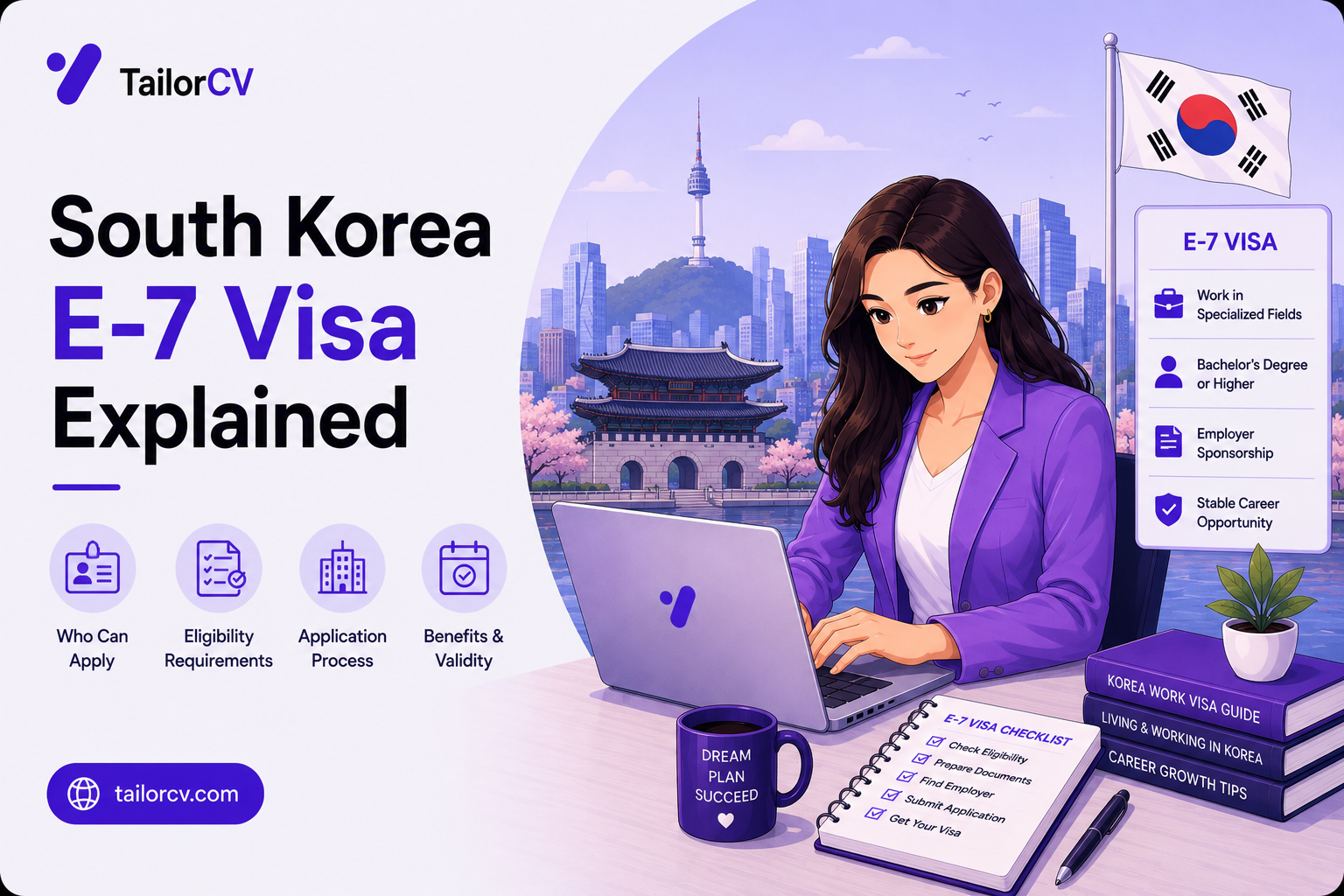
- E-7 is Korea's main professional employment visa, formally for foreign nationals of special ability, and it is tied to a specific occupation code.
- Your degree field, your experience and the job description must align with that code — this is the requirement that decides most applications.
- The general rule is a bachelor's degree plus one year of relevant experience, or a diploma plus more experience, though it varies by occupation.
- D-10 is the job-seeking visa; F-2-7 is a points-based residence visa; F-5 is permanent residency.
- Graduates of Korean universities are treated more favourably, which makes studying in Korea a genuine strategic route.
How E-7 actually works
The E-7 is not a general work permit. It is a permission to perform a specific occupation, and Korea maintains a detailed list of occupation codes it covers.
Three things must match. Your academic qualification, your work experience, and the duties in the job description all have to correspond to the same occupation code. A computer science graduate hired as a "marketing specialist" has a problem, even with a willing employer and a real job.
The general qualification rule is a bachelor's degree in a related field plus at least one year of relevant experience, or an associate degree or diploma with more years of experience, or substantial experience alone in certain occupations. The specifics vary by code.
Employer conditions apply too. There are requirements around the ratio of foreign to Korean employees at the company, and around the salary offered relative to Korean norms. A very small company may struggle to satisfy them.
Salary matters. The offered salary generally has to meet a threshold related to Korea's gross national income per capita, which prevents the visa being used to undercut local wages.
The occupation codes are published and revised by Korea Immigration Service. Check them directly, because this is the single point on which applications most often fail.
The visa types around it
| Visa | What it is for |
|---|---|
| E-7 | Professional employment in a designated occupation |
| E-2 | Foreign language instruction — the teaching route |
| E-9 | Non-professional employment under the Employment Permit System |
| D-10 | Job seeking — allows you to remain in Korea while looking for work |
| D-2 | Student visa |
| F-2-7 | Points-based long-term residence |
| F-5 | Permanent residence |
| F-6 | Marriage to a Korean national |
D-10 is the practical bridge for someone already in Korea. It lets you stay and look for work, and graduates of Korean universities are among those best placed to obtain it. Converting from D-2 to D-10 to E-7 is a well-trodden path.
The F-2-7 points system
The route from working in Korea to living in Korea on your own terms.
F-2-7 is a points-based residence visa scored across factors including age, education, Korean language ability, income, work experience and time in Korea. Reaching the threshold grants residence status that is not tied to a single employer.
TOPIK is a major scoring factor, which is one more reason language study pays. So is completing the KIIP — the Korea Immigration and Integration Program, a structured course in Korean language and society run by the government, which carries points and is genuinely useful.
Income and continuous employment score too, which rewards staying in one role rather than moving frequently early on.
F-5 permanent residence follows for those who meet its longer and more demanding requirements.
The strategic read: E-7 gets you into the country and tied to an employer. F-2-7 is what unties you, and language plus time is how you get there.
The application process, in sequence
Who does what, and in what order.
The employer usually initiates. For most E-7 applications the Korean employer applies to Korea Immigration Service for a Certificate of Confirmation of Visa Issuance on your behalf.
You then apply for the visa at a Korean embassy or consulate using that certificate, which is considerably faster than applying without one.
Documents you will need: passport, application form, photograph, apostilled degree certificate, transcripts, employment contract, evidence of experience, and often a criminal background check and health documentation.
On arrival, register. Foreign residents must complete alien registration and receive an Alien Registration Card (ARC) within the required period. Almost everything else — a bank account, a phone contract, national health insurance — depends on it.
Changing jobs is not free. An E-7 is tied to your employer, and moving requires reporting the change and, depending on circumstances, a fresh application. Do not resign before understanding the process.
Extensions are applied for before expiry, and continuous compliance — working in the registered occupation, at the registered employer — is what makes them straightforward.
Planning a realistic route in
Four honest paths, in rough order of reliability.
Study in Korea, then convert. D-2 to D-10 to E-7 is the most reliable route, because Korean graduates are treated favourably at every step and you are inside the country while it happens.
Come with a scarce technical skill. Semiconductors, displays, batteries, advanced materials, certain software specialisms. Where Korea genuinely needs the expertise, the occupation code and the employer's case both become easy.
Join a foreign multinational or an international-facing Korean company. Coupang, the global tracks, and foreign firms' Korean operations all have experience of the process and English-language environments.
Teach first, then pivot — carefully. E-2 gets you into the country and gives you time to build Korean, but converting from teaching to a professional E-7 requires a qualification and experience match that teaching itself does not provide. It is a way in, not a career ladder.
Special categories and easings worth knowing
The E-7 framework is not uniform, and several sub-tracks are more accessible than the general rule suggests.
E-7-1 covers professional occupations — managers, specialists and technicians — and is the main category most graduates use.
E-7-4 is a points-based route allowing skilled workers in certain categories to transition, with points for age, income, Korean ability and experience.
Korean university graduates benefit from easings on the experience requirement in a number of occupations, on the reasoning that a Korean degree already demonstrates integration and relevant training.
Occupations in national priority sectors are treated more favourably. Korea has actively sought foreign expertise in semiconductors, batteries, advanced materials, biotechnology and certain software fields, and policy in these areas has been loosened rather than tightened.
Top-ranked university graduates have been granted easings under certain schemes as well.
The instruction is the same throughout: these categories and their conditions change, and Korea Immigration Service is the only reliable source. What is true of the framework is that it is more flexible than the headline rule implies, and that people rule themselves out without checking.
What can go wrong, and how to prevent it
The failure modes are specific and mostly preventable.
The occupation code does not match. Fix it before applying for the job by checking which code the role would fall under and whether your degree supports it.
The employer does not meet the ratio requirement. Companies must maintain a ratio of Korean to foreign employees. A very small firm may simply not have the headcount to hire you, regardless of intent.
The salary is below threshold. Offered pay is checked against a benchmark tied to national income. An employer offering below it cannot sponsor you.
Documents are missing or unattested. Apostilles, translations and sealed transcripts each take time, and a missing one stalls everything.
Experience cannot be evidenced. Claimed experience needs employment certificates describing your actual duties. Get these from previous employers before you need them; ex-employers become slow correspondents once you have left.
The role changed after the visa. Working outside your registered occupation is a compliance problem, not a technicality. If your job evolves substantially, the change has to be reported.
Life on an E-7, practically
The visa is the start of a set of obligations and entitlements worth knowing.
Alien Registration Card first. Register within the required period after arriving. Banking, a phone contract, national health insurance and most online services in Korea require it, and Korean online identity verification is strict.
National health insurance is compulsory for registered foreign residents, and the coverage is genuinely good and inexpensive. Do not treat it as optional.
Report changes. Address, employer, and significant changes to your role all have to be reported to immigration within set periods.
Extensions are applied for before expiry, and a clean compliance record makes them routine.
Re-entry. Registered residents can generally leave and return, but check whether your situation needs a re-entry permit before booking a long trip.
Bring documents you might need again. Sealed transcripts, extra apostilled copies of your degree, and employment certificates. Obtaining a replacement from your home country while living in Korea is a genuinely tedious process, and having spares costs almost nothing.
Mini checklist
- unchecked: Target occupation matched to a published E-7 code
- unchecked: Degree field checked against that code
- unchecked: Experience requirement confirmed for your occupation
- unchecked: Employer's foreign-to-Korean ratio position checked
- unchecked: Salary threshold understood
- unchecked: Apostilled degree and transcripts obtained
- unchecked: Criminal background check obtained if required
- unchecked: D-10 considered if you are already in Korea
- unchecked: F-2-7 points estimated and TOPIK study planned
- unchecked: KIIP enrolment considered
Scenarios
Scenario 1: Your degree and the job title do not obviously match
This is the most common failure point. Work with the employer to describe the role in terms that match an occupation code your degree supports — or accept that this particular role is not a viable E-7 application.
Scenario 2: You are studying in Korea on a D-2
Plan the D-2 to D-10 to E-7 sequence deliberately. Korean university graduates are treated favourably at each step, and it is by a distance the smoothest route into the Korean labour market.
Scenario 3: You want to stop depending on an employer
Target F-2-7. Build TOPIK level, consider the KIIP course, keep continuous employment and income, and calculate your points against the current threshold rather than guessing.
Tip: Before applying for any job in Korea, check which E-7 occupation code it would fall under and whether your degree supports it. Employers frequently do not know this, and discovering the mismatch at the visa stage wastes everyone's time — including an offer you had already won.
Do's and Don'ts
Do
- Match role, degree and experience to one occupation code
- Check the published codes directly
- Obtain apostilled documents early
- Consider D-10 if you are already in Korea
- Build TOPIK level for F-2-7 points
- Look at the KIIP program
Don't
- Assume a willing employer is sufficient
- Apply for roles your degree field does not support
- Leave apostilles and background checks late
- Expect a very small employer to satisfy the ratio conditions
- Treat F-2-7 as automatic after time in Korea
- Rely on requirements quoted secondhand
Common Mistakes
- Mismatched occupation code. The single most common reason an E-7 application fails.
- Assuming employer willingness is enough. Ratio, salary and code conditions all apply regardless.
- Late documents. Apostilles and background checks come from your home country and take weeks.
- Ignoring D-10. For anyone already in Korea it is the natural bridge.
- Neglecting TOPIK. It is a major F-2-7 scoring factor and it opens the wider job market too.
- Treating residence as automatic. F-2-7 is a points application you have to make and pass.
Related Guides
Keep building on this with the related guides in this series:
- Working in South Korea as a Foreign Graduate
- Resume Format for South Korea
- Swiss Work Permits for Graduates
- The UAE Golden Visa Explained
- New Zealand's Post-Study Work Visa
You can also check your resume's ATS score for free, generate a tailored cover letter, or build a portfolio website in minutes.
Frequently Asked Questions
What is the E-7 visa?
Korea's main professional employment visa, tied to a specific occupation code. Your degree, experience and the job description must all correspond to the same code.
What qualifications do I need?
Generally a bachelor's degree in a related field plus at least a year of relevant experience, or a diploma with more experience. Requirements vary by occupation code.
What is the D-10 visa?
A job-seeking visa allowing you to remain in Korea while looking for work. It is the natural bridge for graduates of Korean universities moving toward an E-7.
What is F-2-7?
A points-based long-term residence visa scored on age, education, Korean ability, income and time in Korea. It is not tied to a single employer.
Does TOPIK affect my visa?
Yes, significantly. It is a major scoring factor for F-2-7, and the KIIP integration program carries points as well.
Why do E-7 applications get refused?
Most often because the occupation code, the applicant's degree field and the job description do not align. Check this before applying for the job, not after the offer.
What is your resume scoring right now?
Scan it against a job description and get your ATS match score in about a minute.
Drop your resume here or choose a file
PDF only. Max 2 MB.
We never share your data or use it to train AI models.

Was this guide useful?
Be the first to rate it.