
 SS

Key Takeaways
- A posting typically lists twelve to twenty requirements. Two or three of them decide the shortlist; the rest are filler, aspiration, or legal boilerplate.
- Repetition is the strongest signal. A requirement that appears in the title, the opening paragraph and the bullets is real. One that appears once near the bottom is not.
- Position matters as much as wording — the first three bullets of a requirements list carry far more weight than the last three.
- "Required" and "preferred" headings are less reliable than where and how often a term appears.
- Tailor to the three real requirements and ignore the rest. Matching all fifteen produces a resume written for a parser rather than a person.
You are looking at a posting with fifteen bullet points under "Requirements" and eight more under "Nice to have." You have forty minutes and four applications to send. Tailoring to all twenty-three is impossible, and trying produces a resume that matches everything weakly and nothing convincingly.
The short answer: two or three of those requirements decide whether you get shortlisted. The rest are noise. Your job before editing a single line is working out which is which — and the posting itself tells you, if you read it for structure rather than content.
Why Postings Contain So Much Filler
A job posting is rarely written by one person with one intention. Understanding who wrote which part tells you which parts to believe.
The hiring manager writes the two or three things the person must actually be able to do on day one. These are non-negotiable and they are usually stated plainly, early, and more than once.
HR or recruitment adds the standardised block: years of experience, degree requirements, the communication-and-teamwork paragraph. Some of this is real screening criteria and some is template text that appears on every posting the company publishes.
Legal and compliance add the boilerplate — equal opportunity statements, physical requirements, the "other duties as assigned" clause. None of it is screening criteria.
A previous version of the posting contributes whatever nobody removed. Postings get copied and edited, and requirements from a role that no longer exists survive for years.
That layering is why a posting can ask for fifteen things while the hiring manager cares about three. You are not reading a specification. You are reading a document assembled by several people with different agendas, and knowing who wrote which part tells you which requirements are real.
The Four Signals That Mark a Real Requirement
1. Repetition across sections
This is the strongest single signal, and it is nearly impossible to fake.
A genuine requirement appears in multiple places because multiple people independently thought it mattered. It shows up in the job title, again in the opening description, again in the requirements bullets, and sometimes again in the "what you'll do" section.
If "Python" appears in the title, in the first paragraph, and twice in the bullets, Python is real. If "Tableau" appears once in bullet fourteen, it is not deciding anything.
Count occurrences before you do anything else. Terms with three or more mentions are your shortlist.
2. Position within the list
Requirements lists are written top-down in rough priority order. This is not a rule anyone follows consciously, which is exactly why it is reliable — people naturally write the important thing first.
The first three bullets under "Requirements" carry most of the weight. The last three are frequently aspirational, copied from a template, or added by someone who was asked to contribute and had nothing pressing to add.
3. Specificity
Vague requirements are filler. Specific ones are real.
"Strong communication skills" appears on almost every posting ever written and screens nobody out. "Experience presenting technical findings to non-technical executive stakeholders" is specific enough that someone had a real situation in mind.
The more precise the requirement, the more likely a real person wrote it about a real need.
4. Consequence language
Watch for phrasing that ties the requirement to the work itself: "you will be responsible for," "this role owns," "the successful candidate will immediately."
That language marks a requirement connected to actual responsibilities rather than a wish list item. Compare "familiarity with SQL" against "you will own the reporting pipeline, which is built in SQL." The second is non-negotiable.
The Ranking Method
Four minutes, no tools.
| Step | Action | Time |
|---|---|---|
| 1 | Copy the posting into a plain text document | 20 sec |
| 2 | List every distinct requirement as a line | 90 sec |
| 3 | Mark each with its occurrence count across the whole posting | 60 sec |
| 4 | Mark each with its position — title, opening, top-3 bullets, or lower | 40 sec |
| 5 | Score and take the top three | 30 sec |
The scoring table
| Signal | Points |
|---|---|
| Appears in the job title | +4 |
| Appears in the opening paragraph | +3 |
| In the first three requirement bullets | +3 |
| Mentioned three or more times total | +3 |
| Mentioned exactly twice | +1 |
| Specific rather than generic wording | +2 |
| Tied to a named responsibility | +2 |
| In the last three bullets | −1 |
| Under "nice to have" or "bonus" | −2 |
| Generic soft skill with no context | −2 |
Take everything scoring 6 or above. There are almost always exactly two to four such items, which is the point — the method reduces twenty-three requirements to a number you can act on.
The weights are not precise science, and they do not need to be. What they encode is a single observation: requirements that several people independently thought worth writing down, in the places readers actually look, are the ones being screened against. Any scoring scheme that rewards repetition and position over volume will produce roughly the same shortlist.
A worked example
A posting for a Marketing Analyst, abbreviated:
Title: Marketing Analyst — SQL and Dashboarding
Opening: We're looking for an analyst who can turn campaign data into decisions. You'll own our reporting layer in SQL and build the dashboards the marketing leadership team uses weekly.
Requirements: 3+ years in analytics · Strong SQL · Experience with a BI tool (Tableau, Looker, or Power BI) · Excellent communication skills · Bachelor's degree · Familiarity with paid social platforms · Experience with Python a plus · Knowledge of attribution modelling · Comfortable in a fast-paced environment
Scoring the top candidates:
| Requirement | Title | Opening | Top-3 | Count | Specific | Total |
|---|---|---|---|---|---|---|
| SQL | +4 | +3 | +3 | +3 | +2 | 15 |
| Dashboarding / BI tool | +4 | +3 | +3 | +3 | +2 | 15 |
| 3+ years analytics | — | — | +3 | +1 | +2 | 6 |
| Communication | — | — | — | — | −2 | −2 |
| Python | — | — | — | — | +2 | 0 |
| Attribution modelling | — | — | — | — | +2 | 2 |
SQL and dashboarding are the shortlist. Years of experience is a threshold check. Everything else — including Python, which reads as impressive — is decoration.
If you tailored this resume to mention Python and attribution modelling while leaving SQL buried in a skills line at the bottom, you would have optimised for the wrong things entirely.
What to Do With the Three You Find
Finding them is half the work. The other half is making them impossible to miss.
Put each one in a place that gets read. The summary, the first bullet of your most recent role, and the skills line. Where keywords sit changes how much weight they carry.
Use the posting's exact words for them. If they say "dashboarding" and you say "data visualisation," a string-matching system misses it and a human has to do the translation. Exact match versus synonym covers when this matters and when it does not.
Give each one evidence, not just a mention. A skills-line entry is a claim. A bullet showing what you built with it is proof. The three real requirements deserve proof.
Leave the other twelve alone. This is the part people find hardest. A scan flags them as missing and the instinct is to address every flag, but most flagged terms should be ignored.
Common Mistakes
Treating "required" and "preferred" as reliable labels
These headings are less informative than they look. Plenty of postings list something under "required" that the hiring manager would happily waive, and something under "preferred" that is in practice non-negotiable. Position and repetition beat the heading every time.
Counting the requirements list only
The requirements section is one input. The title, the opening paragraph and the responsibilities section often matter more, because those are the parts the hiring manager actually wrote.
Assuming the longest requirement is the most important
Length usually signals that someone was padding. The critical requirement is often the shortest line in the list — "Strong SQL" — because nobody needs to explain it.
Over-reading a single posting
If you are applying to several similar roles, read three or four postings for the same title. The requirement that appears in all of them is the real one for that job market, not just for that employer. This also builds a reusable base version, which is what makes tailoring at volume sustainable.
Ignoring the gap between the title and the body
When the title says one thing and the body describes another, believe the body. Titles are often inherited from an old requisition or chosen for internal grading reasons, which is the same reason a non-standard internal title causes problems on your own resume.
Checking Your Ranking Against Reality
The method produces a shortlist in four minutes, but you can sanity-check it in one more.
Read your three back as a sentence. "They want someone who can do X, using Y, at Z level." If that sentence describes a coherent job, your ranking is probably right. If it describes three unrelated things, you have picked up filler.
Look at the job title again. Your top-scoring requirement should relate obviously to the title. When it does not, either the title is inherited from an old requisition or you have over-weighted something in the bullets.
Ask what the first interview question would be. Hiring managers open with the thing that matters most. If you cannot imagine them asking about your number one, it is not their number one.
Compare against the salary band. A posting paying at the top of a range for that title is usually buying depth in one specific thing. A posting at the bottom is usually buying breadth and willingness. That changes which of your three deserves the most space — and it is the same judgement that separates a good ATS score from a convincing resume.
Any of these that disagrees with your scoring is worth two minutes of rechecking. All four agreeing means you can start editing with confidence.
What This Looks Like at Different Levels
| Level | What the real requirements usually are | What to ignore |
|---|---|---|
| Graduate / entry | Named tools, a degree field, willingness to learn | Years of experience, "proven track record" |
| Early career | Two or three specific technical skills | Leadership language, strategy framing |
| Mid-level | Technical depth plus one ownership signal | Generic soft skills, tool lists beyond three |
| Senior | Scope, ownership, and one domain specific | Hands-on tool requirements, certifications |
| Career changer | Transferable capability plus one credible bridge | Anything requiring years in the target field |
A graduate scoring "8+ years of experience" as a real requirement will exclude themselves from roles they could get. A senior candidate optimising for a tool list will read as under-levelled. The scoring method is the same; what clears the bar differs.
When the Method Does Not Apply
Postings with no repetition at all. Some are so short or so generic that nothing repeats. Treat those as low-information — spend two minutes, not ten, and move on. Decoding a vague posting covers the ones worth persisting with.
Heavily regulated roles. In some fields a certification genuinely is binary regardless of where it appears in the posting. If a licence is legally required, its position in the list is irrelevant.
Internal applications. You know more than the posting does. Use what you know about the team.
Agency-written postings. Recruiters sometimes rewrite a client's posting, adding requirements the employer never specified. Repetition still works, but expect more noise.
Frequently Asked Questions
What if four or five requirements score above 6?
Take the top three anyway. If a posting genuinely has five equally weighted requirements, it is either a badly scoped role or a composite of two jobs. Tailor to the three highest and mention the others once.
Does this work for postings written by AI?
Mostly. AI-written postings tend to have more filler and flatter priority ordering, so repetition becomes more important than position. Postings written by AI have their own tells.
What if the posting lists twenty skills and all seem equally weighted?
That is usually a sign the list was assembled rather than written. When a JD lists twenty skills, fall back to the title and opening paragraph alone — those two sections are almost always written by the person who owns the role.
How many keywords should end up on my resume?
Fewer than the posting contains. The three real requirements plus whatever you genuinely have that overlaps — there is a workable number, and it is well below the full list.
Should I address requirements I do not meet?
Not on the resume. If a real requirement is genuinely missing, that is a separate decision about whether to apply, and there are honest ways to handle the gap.
How do I score something mentioned once but in the title?
Title mentions are worth +4 on their own, so it clears the bar. A term important enough for the title is real even without repetition.
Do bonus and "nice to have" sections ever matter?
Occasionally, as a tiebreaker between otherwise equal candidates. Never as a reason to restructure your resume.
What about requirements in the company description?
Ignore them. That section describes the employer, not the role, and its vocabulary is marketing language rather than screening criteria.
Is this different for contract roles?
Contract postings are usually more honest about what matters, because the client needs someone productive immediately. Expect fewer requirements and a higher proportion of real ones.
How long should the whole exercise take?
Four minutes the first few times, under two once it is habit. If it is taking ten, you are reading for content rather than structure.
Can a scan do this for me?
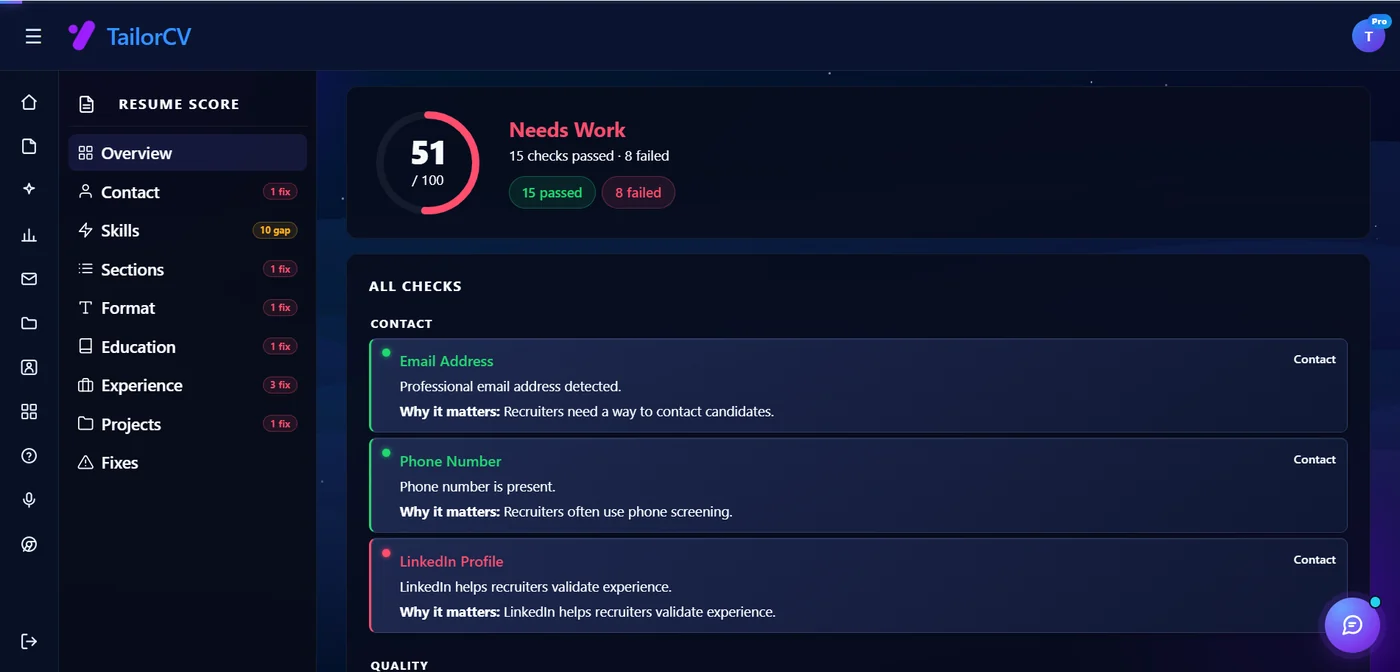
A scan extracts terms and tells you which are absent from your resume. It does not rank them by how much they matter, which is the judgement this method supplies. Use both: the scan for coverage, this for priority.
What if the posting repeats something I genuinely cannot claim?
Then it is a real requirement you do not meet, which is useful information. Better to know before you spend forty minutes tailoring.
Start With the Posting, Not the Resume
The instinct when you open a posting is to start editing. Four minutes of reading first changes what you edit and usually reduces how much editing you do.
Run the scoring once on your next application and notice how few requirements clear the bar. That short list is what your summary, your first bullet and your skills line should be built around.
Scan your resume against the posting to see which of those three are already present and which are missing entirely — then tailor to those three rather than to the full list.
Related: how to read a JD like a recruiter wrote it, which bullets to rewrite, and tailoring in ten minutes.
What is your resume scoring right now?
Scan it against a job description and get your ATS match score in about a minute.
Drop your resume here or choose a file
PDF only. Max 2 MB.
We never share your data or use it to train AI models.
Templates that keep this structure intact
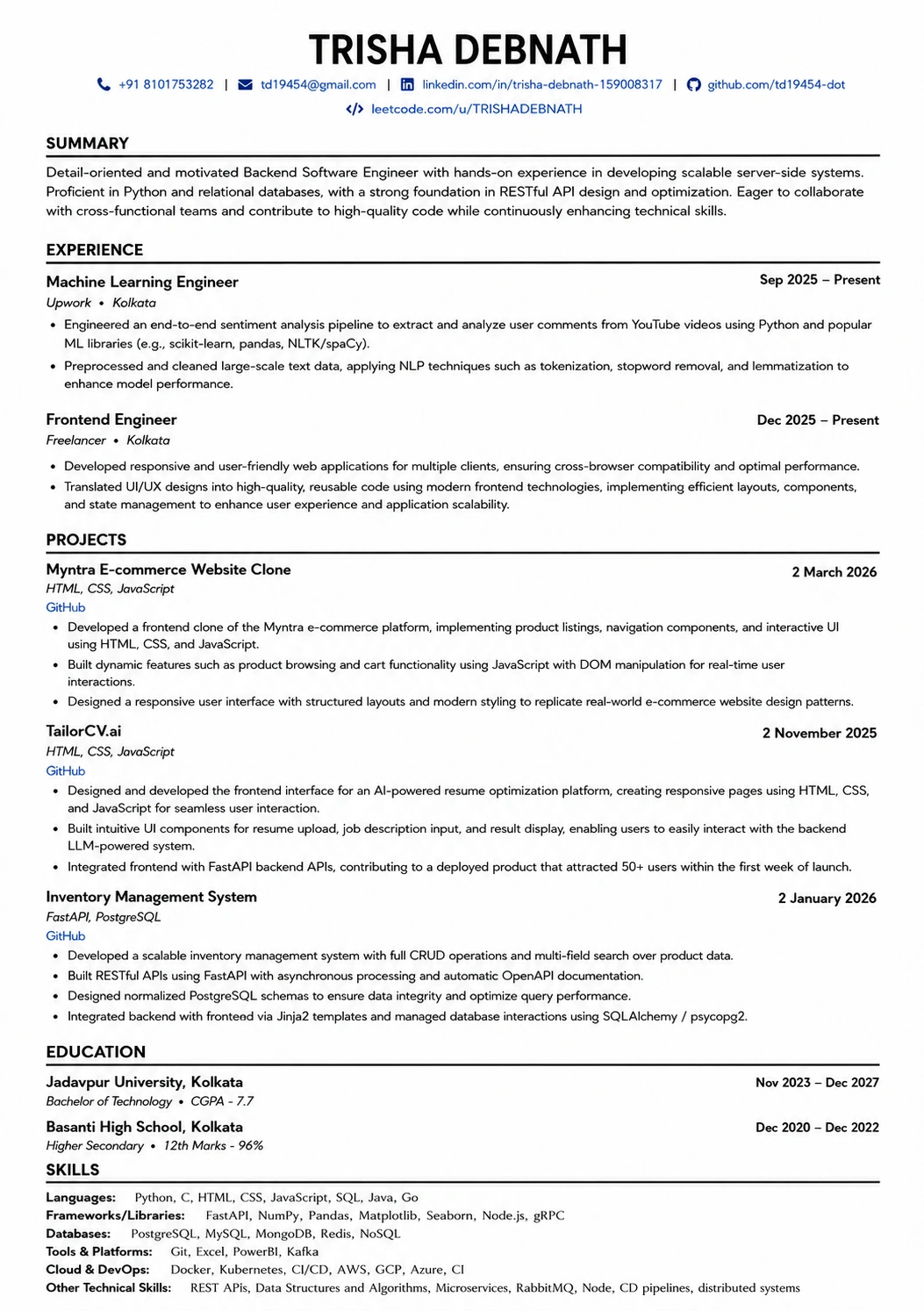
This template is ATS-tested — start from it and the formatting rules in this guide are already handled.
Was this guide useful?
Be the first to rate it.