 SS
SS

Key Takeaways
- "Not a fit" is deliberately vague — it protects the company legally and emotionally, and tells you almost nothing on purpose.
- It usually means one of five things: level mismatch, a specific missing requirement, budget, an internal candidate, or genuine interview performance.
- The stage you were rejected at narrows it considerably.
- You can ask for specifics, but expect most recruiters to decline or repeat the phrase.
- The resume-stage version and the post-interview version mean very different things.
"Not a fit" is the most common rejection phrase in hiring and the least informative. It is designed that way — specific feedback creates legal exposure and awkward conversations, so companies standardise on something vague. Here is how to read it anyway.
Why the Phrase Is Deliberately Empty
Recruiters are often coached not to give specific rejection reasons, for reasons that have nothing to do with you: avoiding discrimination claims, avoiding disputes, avoiding the recruiter's own liability for a subjective call. "Not a fit" satisfies the requirement to respond without creating any of that exposure.
So treat the phrase as a placeholder, not a diagnosis. The real reason exists — you just were not told it directly. The question is how to infer it.
The Stage Tells You the Most
Rejected before any interview, resume stage. "Not a fit" here usually means your resume did not evidence the role's core requirements clearly enough to reach a person, or it did reach a person who judged you against a level or specialisation mismatch. This is the stage most fixable with resume changes.
Rejected after a phone screen. Something in that 20-30 minute conversation did not land — often expectations (salary, location, start date) or a basic qualification check that revealed a gap the resume did not show.
Rejected after one or more interviews. This is the vaguest and least resume-related. By this point your qualifications were sufficient to reach interviews; the decision is now about interview performance, team chemistry, or a closer competing candidate.
Five Things It Usually Actually Means
1. Level mismatch. You were too junior or too senior for how the role was actually scoped, even if the title suggested otherwise. This is common and rarely stated directly because it can read as an insult in either direction.
2. A specific missing requirement. A licence, a tool, a certification, a language, an industry background — something concrete that "not a fit" is standing in for. If you suspect this, look back at the posting's stated requirements and be honest about which ones you did not clearly meet.
3. Budget. Your expected compensation exceeded what the role was actually funded for. Companies rarely say this directly because it can trigger a negotiation they do not want to have with someone they have decided not to hire.
4. An internal or referred candidate. A large share of roles are effectively filled before external interviews conclude. Nothing about your resume or performance caused this, and there was no way to know from outside.
5. Genuine interview performance. Sometimes the honest answer is that another candidate interviewed better, or that something in your answers raised a concern. This is the hardest to hear and the one people resist accepting, but it is real and worth considering honestly if the pattern repeats.
Should You Ask for Specifics?
You can, and occasionally it works. A short, professional request — "I'd appreciate any specific feedback that could help me in future applications" — sometimes yields something useful, particularly from smaller companies or recruiters you built rapport with.
Expect it to fail more often than not. Many recruiters are instructed not to provide specifics regardless of the relationship, precisely for the legal reasons above. Do not read a non-answer as confirmation of anything — it usually just means policy, not a hidden severe reason.
The Useful Diagnostic: Pattern, Not Instance
One "not a fit" tells you little. A pattern tells you a lot.
If you consistently get rejected before interviews, the issue is upstream of your interview performance — most likely your resume is not evidencing what postings ask for, or you are applying above your actual level. Scan your resume against a posting you were rejected from and check the missing-requirements list; it is a more specific answer than any recruiter will give you.
If you consistently get rejected after interviews, the resume did its job — you are reaching the stage where a human evaluates you directly. The pattern to examine is in your interview answers, not your resume.
If both are happening, work backward from the resume stage first, since it is more mechanically diagnosable.
What "Not a Fit" Does Not Mean
It is worth saying plainly: it does not mean you are unemployable, it does not mean the resume is fundamentally broken, and it does not mean anything personal happened. It is a stock phrase applied to a wide range of very different real reasons, most of which are either mechanical (resume matching) or entirely outside your control (budget, internal hire).
Treating every "not a fit" as a verdict on your worth is a worse use of the information than treating it as a data point to fold into a pattern.
What to Actually Do
After a resume-stage rejection: check the match against that specific posting. If required items are missing that you actually have, that is a fixable wording problem — see which missing skills actually matter.
After a phone-screen rejection: review what was asked and whether your resume set expectations the conversation did not confirm — years of experience, specific tools, availability.
After an interview-stage rejection: this is less about the resume and more about interview preparation and practice. If it keeps happening at this stage, that is where to focus.
In all cases: do not over-interpret one instance. Look for the pattern across several rejections before concluding anything.
When feedback does come with specifics, tailoring after the hiring manager gave feedback shows how to decode it into resume changes.
Frequently Asked Questions
Is "not a fit" ever about something I said wrong? Sometimes, particularly post-interview. It is also frequently about budget, level, or an internal hire — things unrelated to what you said.
Should I take it personally? No. It is a standardised phrase covering many different real reasons, most mechanical and some outside your control.
Can I push back or ask again? Once, politely, is reasonable. Pushing further rarely changes the outcome and can read poorly.
Does it mean my resume is bad? Only if the pattern is concentrated at the resume stage. If you are reaching interviews regularly, your resume is doing its job.
How do I know if it's a level mismatch? Compare the posting's stated years of experience and seniority language to your own background, honestly. See required vs preferred qualifications.
Get a More Specific Answer Than "Not a Fit"
If the rejection came before an interview, you can get a far more specific diagnosis than any recruiter will give you.
Scan your resume against the posting you were rejected from and read the missing-requirements list. That tells you, concretely, what a system reading your resume against that job would flag — which is usually closer to the real reason than the phrase you were given.
Free, about a minute. See also why your resume gets no responses and applied to 100 jobs, no interviews.
What is your resume scoring right now?
Scan it against a job description and get your ATS match score in about a minute.
Drop your resume here or choose a file
PDF only. Max 2 MB.
We never share your data or use it to train AI models.

Templates that keep this structure intact
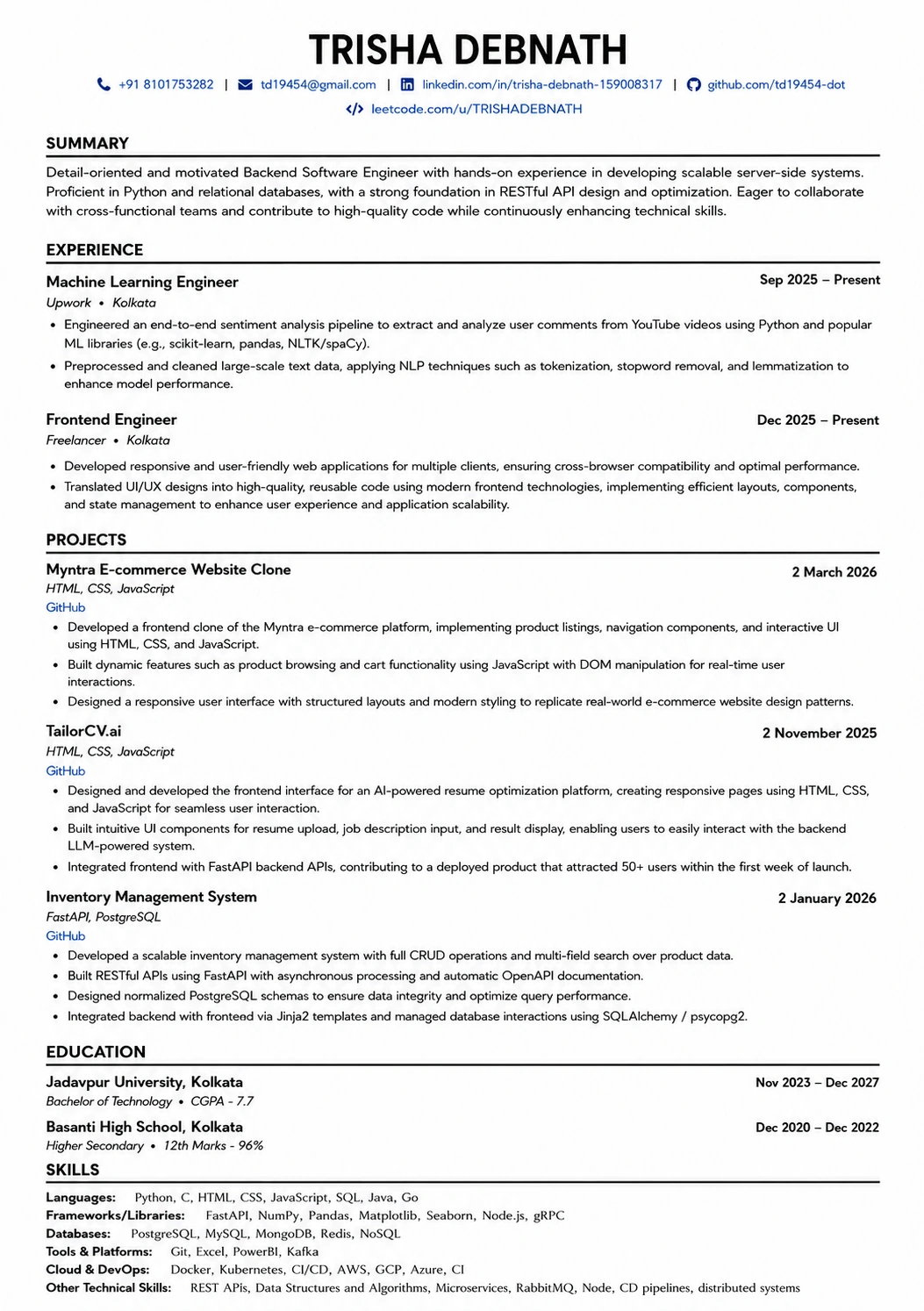
This template is ATS-tested — start from it and the formatting rules in this guide are already handled.
Was this guide useful?
Be the first to rate it.