 TD
TD
Key Takeaways
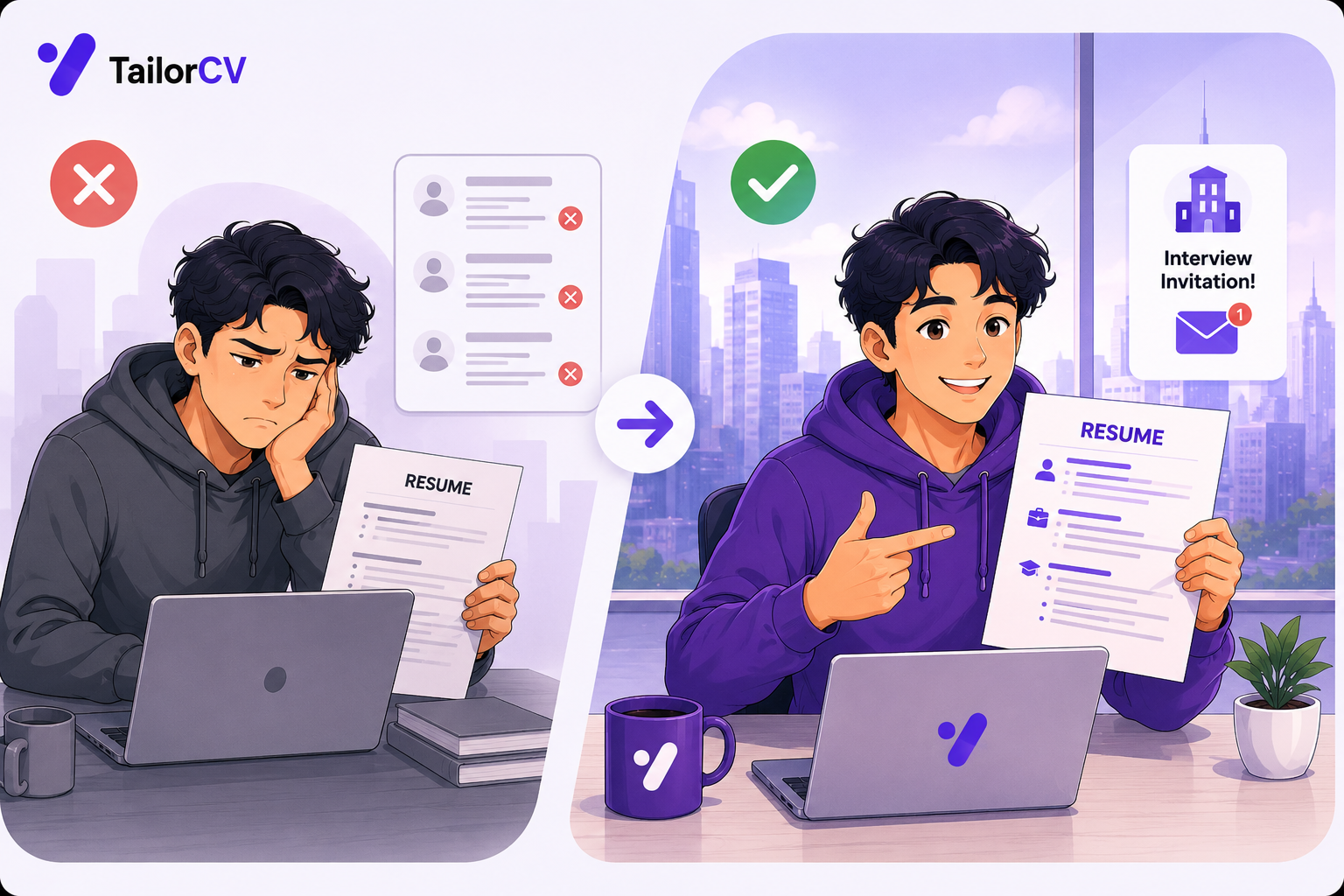
- A single resume is optimised for the average of all postings, which is a job that does not exist.
- Two postings with the same job title routinely require different things — that is where the match is lost.
- You do not need to rewrite the resume. Three sections carry almost all the matching weight.
- Tailoring is roughly a five-minute job once you know which three sections to touch.
- The test is not whether it reads well. It is whether it evidences what this posting asked for.
Using one resume for every application is the most common approach to job hunting and one of the least effective. It is not a laziness problem — it is a reasonable-seeming strategy that quietly fails, and the failure is invisible because rejections do not explain themselves.
Why One Resume Cannot Match Many Postings
Consider two real postings, both titled "Data Analyst":
Posting A asks for SQL, Tableau, stakeholder reporting, and experience in retail. Posting B asks for Python, dbt, experimentation, and experience in a product company.
A single resume can foreground SQL and Tableau, or Python and dbt. It cannot lead with both without becoming a list. Whichever you choose, you match one posting well and the other partially.
Now scale that to 50 applications. Your one resume is optimised for the average of every posting you send it to — and the average posting is not a real job with a real hiring manager. It matches everything a little and nothing enough to rank.
This is the mechanism behind why generic resumes underperform, and it gets worse as postings get more specific.
What It Actually Costs
The cost is not that your resume is bad. It is that it ranks below people whose resume addressed the posting directly.
In a competitive posting, the first-pass ranking is comparative. You are not being measured against a quality bar — you are being ordered against other applicants. A well-written generic resume loses to an adequately-written targeted one, because the targeted one evidences the specific requirements the requisition was built from.
Our post on applying to jobs with 100+ applicants covers what that ranking looks like in practice.
The Objection: "But My Experience Doesn't Change"
Correct — and this is the point people miss. Tailoring is not about changing your experience. It is about changing which parts of it are visible first, and describing them in the language the posting uses.
You have probably done a dozen things at your last job. A generic resume lists the five you consider most impressive. A tailored resume lists the five this posting cares about — which may be a different five, all equally true.
That is not spin. It is relevance.
The Three Sections That Carry the Weight
You do not need to rewrite your resume per application. Almost all matching weight sits in three places:
1. The summary (2-3 lines). This is the highest-leverage text on the page. Rewriting it to name the target role and the posting's two or three central requirements takes ninety seconds and moves the match more than any other single edit.
2. The skills section. Reorder it so the posting's required tools appear first. Add anything you genuinely have that the posting names and your resume currently omits. Remove nothing truthful — just reorder and fill gaps.
3. The top three bullets of your most recent role. These get read. Make sure they describe work relevant to this posting rather than whatever you were proudest of.
Everything below that — older roles, education, certifications — usually stays untouched. Our 5-minute tailoring guide walks through this sequence.
The Line You Must Not Cross
Tailoring means reordering and rewording things that are true. It does not mean adding skills you do not have.
If a posting asks for Kubernetes and you have never used it, the correct move is not to insert Kubernetes. It is to decide whether you have honest adjacent experience worth stating, or whether this is simply a gap. A resume that claims a skill you cannot discuss in an interview fails later and worse than one that never claimed it.
This is the constraint we build into our tailoring — it rewrites bullets to carry the posting's language only where your existing experience supports it, and it will not manufacture evidence. In a manual process, you have to hold that line yourself.
How to Know If This Is Your Problem
Take three postings you applied to and did not hear back from. Run each against your current resume and look at the missing-requirements list.
If the missing items are different each time — Posting A wanted Tableau, Posting B wanted dbt, Posting C wanted stakeholder management — then your resume is fine and the problem is purely that you are not tailoring. This is the good outcome, because it is the easiest to fix.
If the same items are missing every time, you have a real skills gap rather than a tailoring problem, and no amount of rewording fixes it. That is also useful to know.
If nothing extracted properly at all, you have a formatting problem underneath everything else — see ATS formatting mistakes.
A Realistic Workflow
Nobody sustains a full rewrite per application. What works is a base plus edits:
- Keep one strong master resume. Complete, well-formatted, everything on it true and well-written.
- Per application, copy it and edit three sections. Summary, skills order, top bullets. Five to ten minutes.
- Scan the tailored version against the posting before sending, to confirm the edit actually addressed the requirements rather than just reading differently.
- Keep the versions. You will apply to similar roles again, and a previous version is usually a better starting point than the master.
If you are applying at volume, this is where automation earns its place — our extension generates the tailored version from the job page itself, and versions are kept in My Resumes. But the manual version of this workflow works fine at five to ten applications a week.
Frequently Asked Questions
How different should each version be? Usually 10-20% of the text. Summary, skills order, and the top bullets of your most recent role. The rest stays.
Isn't this dishonest? No — you are choosing which true things to lead with. It becomes dishonest only when you add things that are not true.
How long should tailoring take? Five to ten minutes once you know which sections matter. Longer than that usually means you are rewriting more than necessary.
What if two postings are nearly identical? Reuse the version. That is the point of keeping them. See tailoring for two similar roles.
Does tailoring matter if I apply through a referral? Less for the filtering step, but the resume still gets read by a human who is comparing it to the role. Relevance still helps.
Find Out Which Problem You Have
The useful next step is not to start rewriting. It is to find out whether tailoring is actually your bottleneck.
Scan your current resume against a posting you want and read the missing-requirements list. If those items are things you have but did not write in the posting's words, tailoring is your fix and it is a fast one. If they are genuinely absent, you have learned something more important than any resume tip.
It is free and takes about a minute. See also how to match resume keywords to a job description and why your resume gets no responses.
Find out why your score is low
Scan your resume against the job description and see exactly which checks fail.
Drop your resume here or choose a file
PDF only. Max 2 MB.
We never share your data or use it to train AI models.

Templates that keep this structure intact
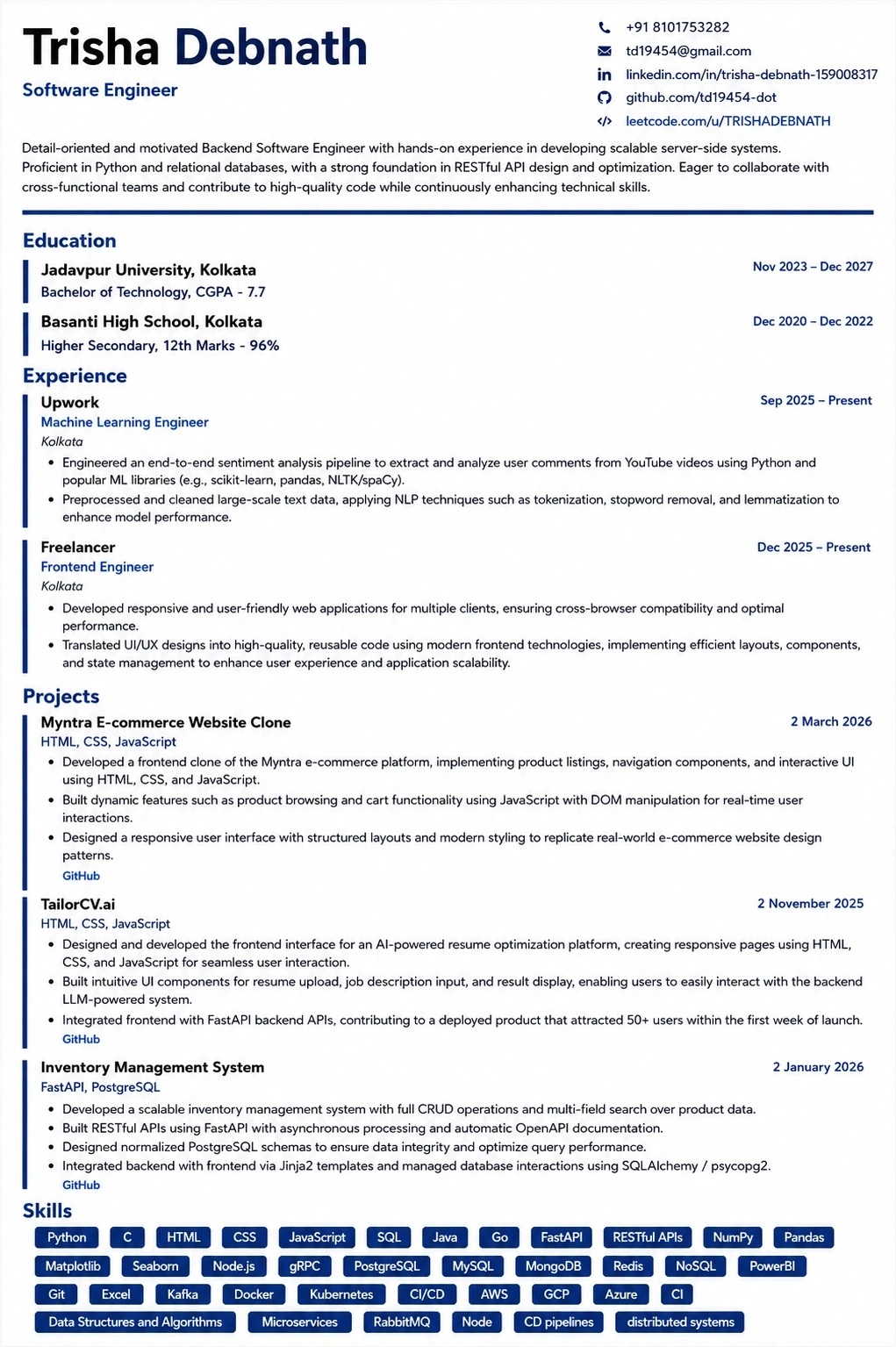
This template is ATS-tested — start from it and the formatting rules in this guide are already handled.
Was this guide useful?
Be the first to rate it.