TD
TD
Key Takeaways
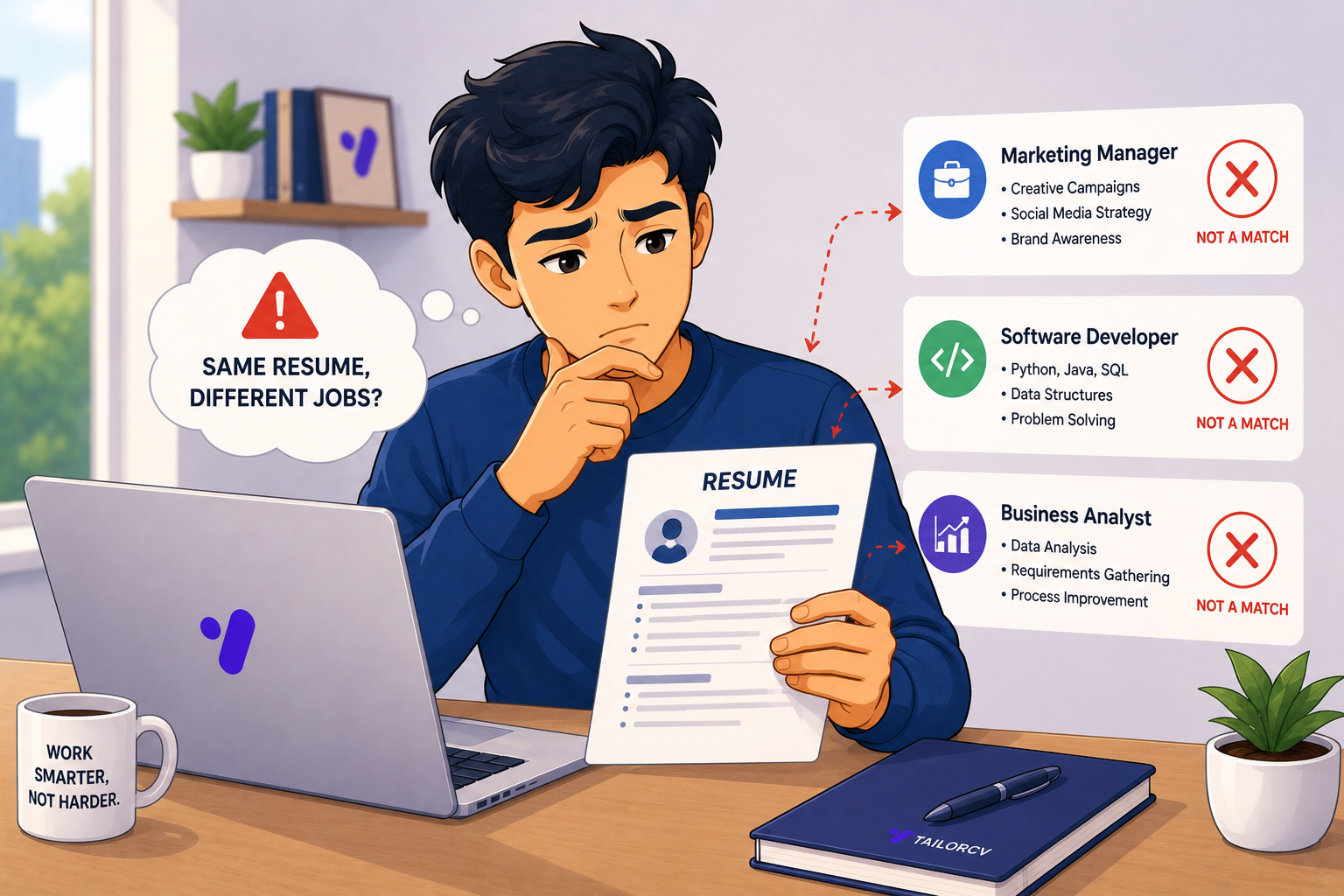
- A generic resume fails at two separate stages, automated screening and human skimming, for different reasons.
- Matching is done on specific language, and a general resume matches nothing precisely.
- The failure is silent. You receive no feedback telling you this is the cause.
- Tailoring is mostly reordering, not rewriting, and costs far less time than people assume.
- Volume cannot compensate. Fifty generic applications underperform ten tailored ones.
The two filters a generic resume fails
Where it actually breaks down.
The automated screen matches specific terms. It looks for the skills, tools and titles named in the posting, and a resume written in your own general vocabulary can describe exactly the right experience without matching any of them.
The human skim looks for relevance in seconds. A reader with a stack of applications is scanning for evidence this person fits this role, and a general profile forces them to do that work themselves, which they will not do.
Neither filter is looking for quality. Both are looking for fit, and a genuinely excellent general resume fails both while a modest specific one passes.
The two failures compound. Surviving the automated screen only delivers you to a human who finds nothing specific, which produces the same outcome one stage later.
And nothing tells you this happened. Rejections are silent or templated, so the candidate concludes the market is difficult rather than that the document is not doing its job.
What generic actually looks like
The patterns that mark a resume as untailored.
| Generic version | Tailored version |
|---|---|
| Experienced professional seeking a challenging role | Names the specific role and the core skill |
| Skills listed alphabetically or by comfort | Ordered by what this posting prioritises |
| Every bullet weighted equally | Most relevant achievement first |
| Your own terminology throughout | The employer's terms where they differ |
| Same summary for a year | Rewritten per role type |
| All roles described at equal length | Relevant roles expanded, others compressed |
The summary is the clearest tell. A summary that could open an application to any employer in your field is doing no work at all.
Skills ordering is the cheapest fix available and one of the most consequential, because both filters weight the top of a list far more heavily than the bottom.
And equal weighting across all experience signals that no thought was given to what this particular reader needs.
What tailoring actually involves
The work, which is smaller than its reputation.
Rewriting the summary takes about five minutes and changes the framing of everything below it. This is the highest-return edit available.
Reordering the skills list takes two minutes and requires no new writing at all, only judgement about what this posting prioritises.
Swapping vocabulary where the employer's term differs from yours is mechanical once you have extracted their language from the posting.
Adjusting the top three bullets of your most recent role takes ten minutes and covers the section most likely to be read closely.
Compressing irrelevant experience frees the space those changes need, and older roles almost always have space to give.
That is the whole job. Fifteen to twenty minutes, none of it requiring you to invent anything or start from a blank page.
What tailoring is not is rewriting your career from scratch for every posting, redesigning the layout, or maintaining thirty separate documents. The belief that it means those things is why people skip it.
Diagnosing your own resume
How to tell whether this is your problem.
Count the responses, not the applications. A response rate near zero across many applications is diagnostic on its own.
Compare your resume against one posting and count how many of its specific terms appear in your document. Under half is a clear answer.
Check whether your summary names any role. If it could open an application to any employer in your field, it is doing nothing.
Look at where your interviews came from. If they arrive only through referrals and never through applications, the document is failing the filters rather than your experience failing on merit.
Ask someone in your field to guess the role from your resume alone. If their guess is vague or wrong, the reader's will be too.
And check the ordering. If your skills list has been in the same order for a year, it has not been adapted to a single application in that time.
Mini checklist
- unchecked: Summary names this specific role
- unchecked: Skills reordered to the posting's priorities
- unchecked: Employer's vocabulary used where it differs from yours
- unchecked: Most relevant achievement placed first
- unchecked: Irrelevant older experience compressed
- unchecked: Title alignment checked against the posting
- unchecked: Required terms from the posting present
- unchecked: Time spent proportionate to the match quality
Scenarios
Scenario 1: You have sent forty applications and heard nothing
The volume itself is the diagnosis. Forty applications producing zero responses points at the document rather than the market, and the most likely cause is that none of them addressed a specific role.
Scenario 2: You get interviews but only from referrals
This is a clear signal. Referrals bypass both filters, so succeeding only there means your resume is failing the filters rather than your candidacy failing on merit.
Scenario 3: You apply to a narrow specialism where every role is similar
You still need tailoring, but far less. Build one strong version per role type and adjust the summary and skills order per application, which takes minutes.
Tip: Take your last rejected application and the posting side by side. Count how many of the posting's specific terms appear anywhere in your resume. If the answer is under half, you have found the reason for the silence.
Do's and Don'ts
Do
- Rewrite the summary for each role type
- Reorder skills for every application
- Use the employer's exact terminology
- Lead with the most relevant achievement
- Compress experience that does not apply
- Treat repeated silence as diagnostic
Don't
- Send one document to every employer
- Assume quality substitutes for fit
- Increase volume to fix a match problem
- List skills in a fixed personal order
- Keep the same summary for a year
- Expect feedback explaining the rejection
Common Mistakes
- Confusing quality with fit. Both filters test fit, not polish.
- Raising volume. It multiplies the same failure.
- A permanent summary. The clearest sign of an untailored application.
- Fixed skills order. The top of the list carries the weight.
- Waiting for feedback. It does not arrive.
- Blaming the market. Forty silent applications is a document problem.
Related Guides
Keep building on this with the related guides in this series:
- How to Tailor Your Resume for Every Job
- Why Your Resume Gets No Responses
- How to Match Resume Keywords to a Job Description
- How ATS Detects a Generic Resume
- How Recruiters Read Your Resume
You can also check your resume's ATS score for free, generate a tailored cover letter, or build a portfolio website in minutes.
Frequently Asked Questions
Why does one resume for every job fail?
It fails two filters. Automated screening matches specific terms from the posting, and human skimming looks for immediate relevance. A general document satisfies neither, however well written it is.
How much do I actually need to change?
Usually the summary, the skills order and the top few bullets. That is reordering and reframing rather than rewriting, and it takes fifteen to twenty minutes per application.
Can I make up for it with volume?
No. Volume multiplies the same failure. Ten tailored applications reliably outperform fifty generic ones and take less total time.
How do I know this is my problem?
Look at the pattern. Many applications with no responses, or interviews arriving only through referrals, both point at the document failing the filters rather than at your candidacy.
Does this apply in narrow fields?
Yes, but with less work. Where every posting is similar, one strong version per role type plus a per-application summary and skills adjustment is enough.
Will anyone tell me this is the reason?
No. Rejections are silent or templated, which is precisely why this failure persists for months without being diagnosed.
How long does tailoring a resume actually take?
Fifteen to twenty minutes for a posting you have already read — rewriting the summary, reordering skills, swapping vocabulary and adjusting the top three bullets. It is reordering rather than rewriting.
How do I know if my resume is too generic?
Count how many of a posting's specific terms appear in your document, check whether your summary names any role at all, and look at whether interviews arrive only through referrals rather than applications.
Find out why your score is low
Scan your resume against the job description and see exactly which checks fail.
Drop your resume here or choose a file
PDF only. Max 2 MB.
We never share your data or use it to train AI models.

Was this guide useful?
Be the first to rate it.