SS
SS

Key Takeaways
- AI-generated postings have recognisable tells: uniform structure, generic superlatives, and a lack of specific, idiosyncratic detail.
- They are not less legitimate than human-written ones — the role and company are usually still real.
- The genuine requirements are still there, just harder to distinguish from generated filler.
- The same triage that works on vague postings generally works here too, with one added check.
- The company's own site and other listings are your best source of specifics an AI-written posting omits.
More job postings are drafted with AI assistance than ever, and they carry a recognisable style. Knowing the tells helps you read past the generated filler to whatever real signal exists underneath.
The Tells
Uniform, symmetrical structure. Sections of suspiciously equal length, bullet points that all follow an identical grammatical pattern ("Manage the X. Own the Y. Drive the Z."), a rhythm that feels templated even before you notice why.
Generic superlatives with no specific referent. "Join our innovative, fast-growing team disrupting the industry" — language that could describe nearly any company in nearly any sector, with no company-specific detail attached to back up the claim.
A requirements list that reads like a composite of every similar posting ever written, rather than describing anything distinctive about this specific role. Real postings, even poorly written ones, usually contain at least one detail that could only come from someone who actually knows the team.
Oddly comprehensive coverage of every standard section — mission statement, day-in-the-life, growth opportunities, benefits summary, culture note — each present but each shallow, as if a checklist of "what a good job posting includes" was mechanically filled rather than genuinely written.
Repeated sentence structures across the "requirements" and "responsibilities" sections that mirror each other suspiciously closely, as if generated from the same underlying prompt rather than independently written to describe two different things.
This Does Not Mean the Job Isn't Real
An AI-assisted posting does not imply the role or company is illegitimate — using AI to draft a first pass of a job posting is now a common, unremarkable part of many hiring workflows, often followed by human editing of varying thoroughness. Treat this as information about how the posting was produced, not as a signal about whether to trust the opportunity itself.
What Gets Lost in AI-Generated Postings
The main practical problem is not deception — it is loss of specificity. A posting drafted primarily by AI from a brief prompt often fails to convey the genuinely idiosyncratic details that would help you tailor a strong application: the actual tools the team uses day to day, the specific problem the role exists to solve, the real scope and reporting structure. These get smoothed into generic, safe language instead.
This means the posting itself may be a weaker source of tailoring detail than a genuinely human-written one, even when it looks equally polished or more so.
How to Read Past It
1. Apply the same filler/signal triage as any vague posting. See decoding a vague job description — the same method for extracting real signal from generic language applies here.
2. Look specifically for the one or two details that could not have been generated generically. A specific tool name, a specific team size, a specific reporting line — these are more likely to be genuine human additions layered onto an AI-drafted base, and they are worth weighting more heavily than the surrounding generated text.
3. Check the company's other job postings for the same pattern. If every listing from this company shares the identical structural tells, that confirms a company-wide process rather than telling you anything specific about this particular role.
4. Look beyond the posting itself. The company's own website, recent news, LinkedIn posts from current employees, or a Glassdoor review mentioning the team can supply the specific context an AI-generated posting omits. This is often a better source of real detail than the posting text itself.
5. Do not assume required and preferred distinctions are meaningful here. AI-generated requirement lists sometimes apply "required" and "preferred" labels somewhat arbitrarily, copying the pattern of well-structured postings without the same underlying deliberate reasoning. Read the technical specificity of each item as a better guide than its label — see required vs preferred qualifications for the general method, applied here with slightly less confidence in the labels themselves.
Should You Tailor Differently for an AI-Written Posting?
Largely the same approach still applies — cover the specific, technical, named requirements; treat generic superlative language as filler; use the posting's own terms where genuinely true of you. The main adjustment is lowering your confidence in what the posting's structure and labelling tell you, and correspondingly raising the value of outside research about the actual role and team.
A Note on Your Own Resume
There is a related but separate question worth a brief mention: using AI to draft your resume carries its own considerations, covered in can recruiters tell if your resume was written by AI and ChatGPT resume mistakes. The short version — genericness, not AI use itself, is what actually costs you responses — applies symmetrically to both sides of this exchange.
Frequently Asked Questions
Does an AI-written posting mean the company is less serious about hiring? Not necessarily — many legitimate, well-run companies use AI to speed up drafting as part of an otherwise normal hiring process.
Should I be suspicious of a posting with these tells? Mild caution about the posting's informational value is reasonable; outright suspicion of the opportunity is usually not warranted based on drafting style alone.
How do I find the real requirements if the posting is mostly generic? Cross-reference the company's other listings, website, and any employee-authored content (LinkedIn, Glassdoor) for more specific, reliable detail.
Is it worth applying if the posting tells you almost nothing specific? Generally yes, if the title and company interest you — treat it similarly to any vague posting, applying with a resume tailored toward title and industry rather than granular requirements you cannot reliably identify.
Can I tell for certain if a posting was AI-written? Not with full certainty from the text alone — these are pattern-based tells, not proof. Treat your assessment as a reasonable inference rather than a confirmed fact.
Focus on What You Can Verify
Regardless of how a posting was drafted, the most reliable check remains whether your resume evidences the specific, verifiable requirements it does state.
Scan your resume against the posting and focus on the concrete, specific items in the missing list — these are more trustworthy signals than the posting's generic surrounding language, however it was produced.
Free, about a minute. See also decoding a vague job description and hidden requirements in job descriptions.
What is your resume scoring right now?
Scan it against a job description and get your ATS match score in about a minute.
Drop your resume here or choose a file
PDF only. Max 2 MB.
We never share your data or use it to train AI models.

Templates that keep this structure intact
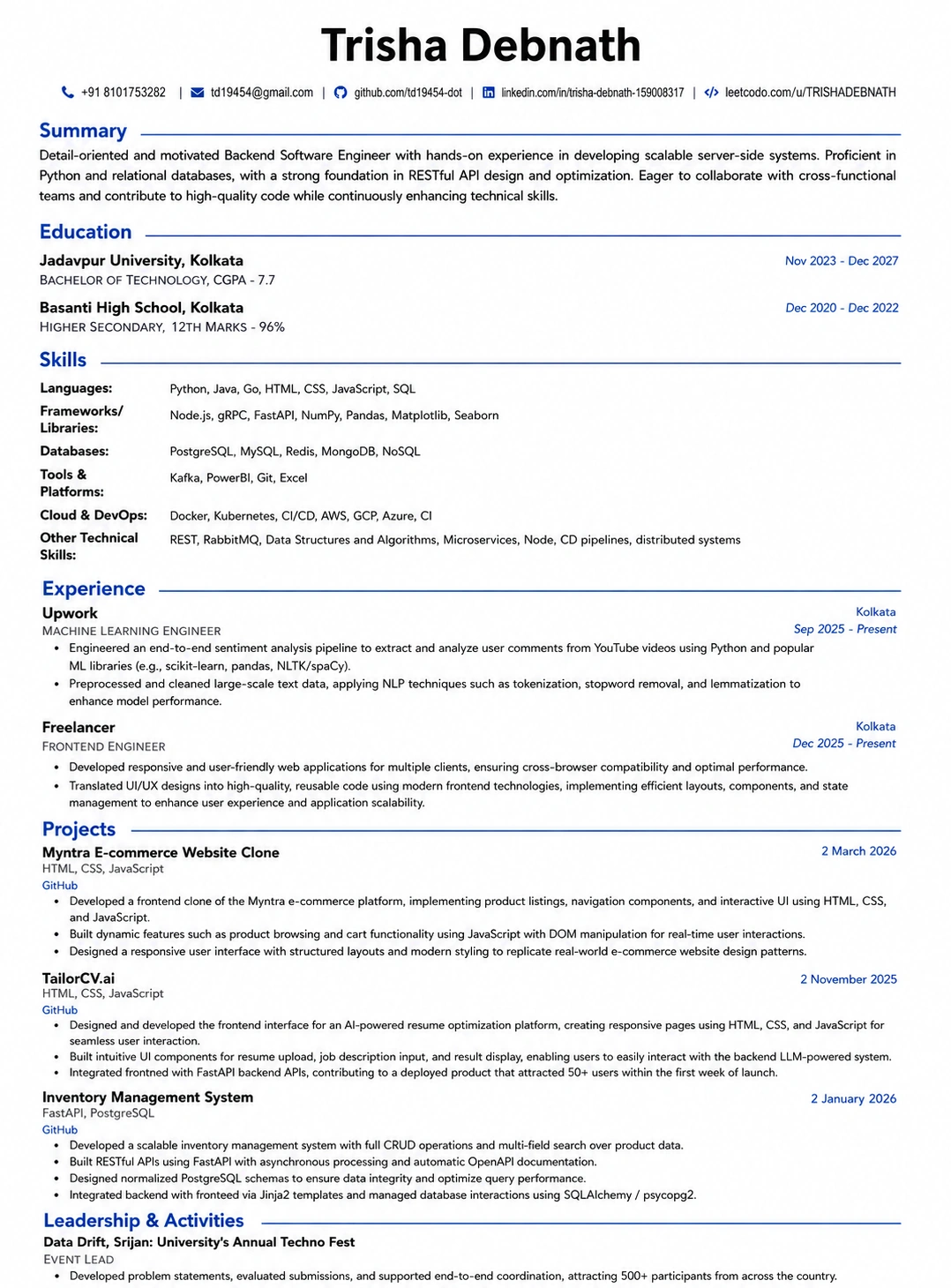
This template is ATS-tested — start from it and the formatting rules in this guide are already handled.
Was this guide useful?
Be the first to rate it.