 SS
SS

Key Takeaways
- When everything on your resume is relevant, you are competing with other qualified people. Tailoring shifts from "show I fit" to "show why me".
- Lead with what is distinctive for this company - scale, industry, a specific problem they have - not with what every candidate in your role has done.
- Match the company's context: startup vs enterprise, growth vs efficiency, building vs scaling. The same achievements read differently in each.
- Cut or compress the common, generic bullets. Relevance is not enough; each line should earn its space against your other relevant lines.
- Use the posting's specifics - named problems, products, tools - to choose which of your many relevant achievements goes first.
- A high match score here is expected and not a differentiator. The bullets' specificity decides whether you get the call.
Your background matches the posting almost line for line: same title, same tools, same kind of company. That sounds like there is nothing to tailor - but it means you are up against other people who match just as well. Tailoring here is about choosing: which of your many relevant achievements leads, what you cut, and how you show why you, specifically, fit this company better than another qualified candidate.
This guide covers how to find your differentiators, match the company's context, and trim a resume full of good-but-generic lines.
Why "Already Relevant" Still Needs Tailoring
A strong fit gets you into the shortlist conversation. It does not get you to the top of it.
Everyone on the shortlist looks like you
Recruiters filter for relevant experience first. By the time a hiring manager reads your resume, the others on their desk also have the right title, tools and industry. The question becomes: which of these people solves our specific problem?
Your best work may be buried under your most typical work
Experienced people often lead with their most representative bullets - the ones that describe the job. These are exactly what every other candidate has. Your distinctive achievements, the ones that answer "why you", may sit in bullet four or in an older role.
ATS scores converge
When every shortlisted resume has a high keyword match, the score stops separating candidates. High ATS score, no interviews explains why a high score alone is not enough, and ATS score vs recruiter judgment covers what separates candidates after that.
Step 1: Find What Is Distinctive for This Company
Not what is impressive in general - what is valuable to this employer.
Read the posting for the company's specific situation
Look past the standard requirements to the details that describe the company's moment:
| Signal in the posting | What it tells you | What to lead with |
|---|---|---|
| "Scale our platform from 1M to 10M users" | Growth-stage scaling problem | Your experience scaling a system or team |
| "Build the function from scratch" | Greenfield role | Things you set up from nothing |
| "Improve efficiency / reduce cost" | Efficiency mandate | Cost savings, process redesign |
| "Expand into new markets" | Market expansion | Launches, localisation, new-market work |
| "Recently acquired / integrating teams" | Integration work | Mergers, migrations, change management |
| Named product, tool or customer type | Their specific stack or market | Direct experience with it |
Reading the posting this way is covered in reading a JD like a recruiter.
Check the company beyond the posting
A few minutes on the company's site, recent news and team LinkedIn profiles often reveals their current priorities: a recent funding round (growth), a new market launch, a leadership change. How to research a company before an interview applies equally before you apply.
List your distinctive achievements
For each of your recent roles, write down achievements that are unusual in your field - larger scale, harder constraints, a rare combination, a first. These are your candidates for the top of the page.
Step 2: Match the Company's Context
The same achievement lands differently depending on the company's stage and priorities.
Your achievement: You rebuilt a company's customer onboarding, cutting setup time from three weeks to four days.
For a scaling startup: "Rebuilt customer onboarding to handle 5x growth without adding headcount - setup time cut from three weeks to four days."
For an enterprise focused on efficiency: "Redesigned the customer onboarding process across 3 teams, cutting setup time from three weeks to four days and support tickets during setup by 40%."
Same fact, different emphasis. The startup version stresses growth capacity; the enterprise version stresses process and cross-team coordination. For more on this dimension, see resume tailoring: startup vs enterprise.
Step 3: Reorder Around the Company's Top Problem
With a fully relevant resume, bullet order is your main tailoring tool.
The top two bullets decide the read
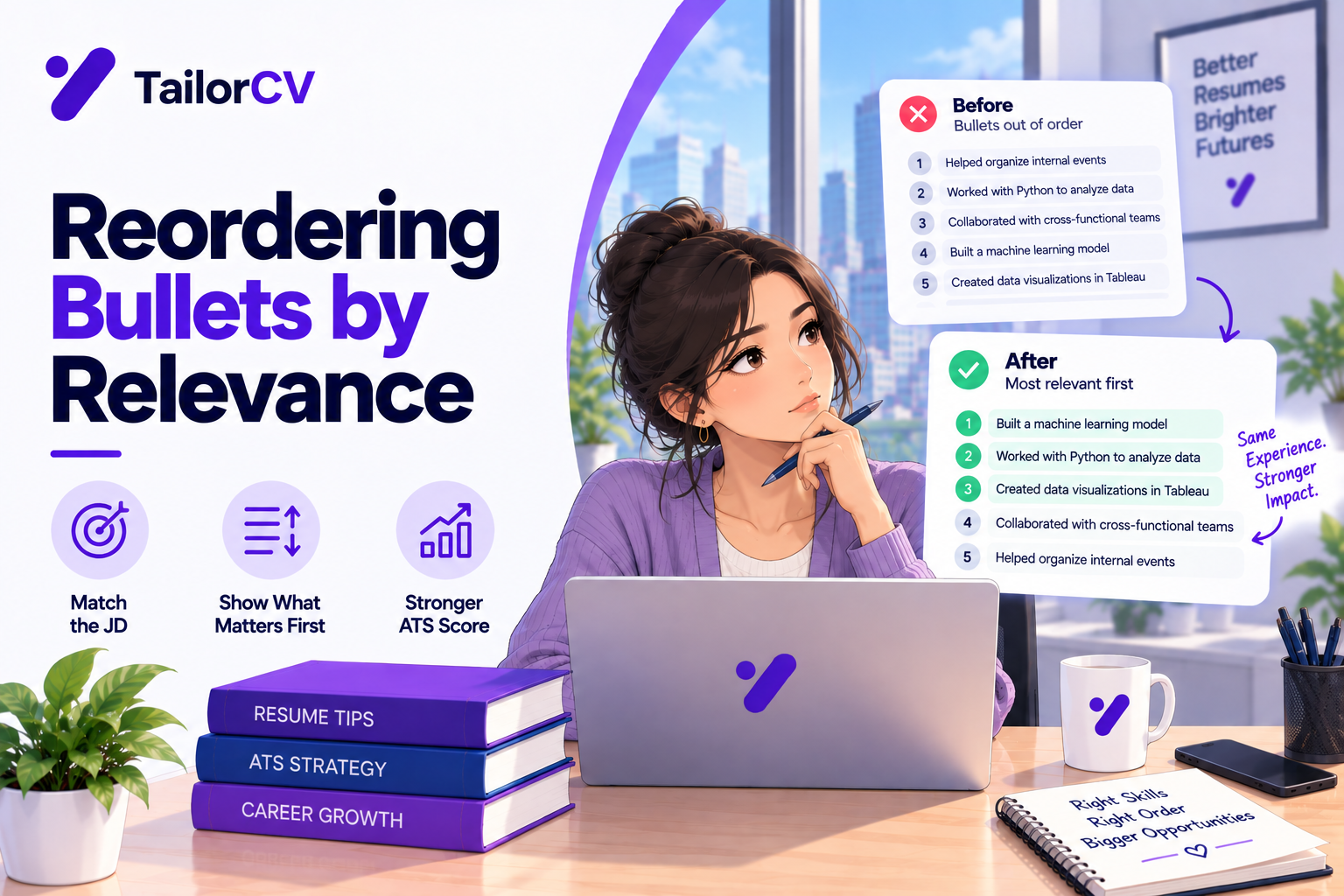
In each role, the first one or two bullets are what most readers take in. Put the achievement that answers the company's top problem first, even if a different bullet is more impressive in the abstract. Reordering bullets by relevance covers the method.
Rewrite the summary's first sentence
Your summary should name the company's problem and your matching achievement.
Generic (true for every candidate): "Product manager with 6 years of experience in B2B SaaS, skilled in roadmapping, discovery and cross-functional leadership."
Tailored: "B2B SaaS product manager who took a self-serve product from 2,000 to 18,000 paying teams - the scaling problem your posting describes for your collaboration suite."
Step 4: Cut the Generic Bullets
When everything is relevant, the problem is too much good material. Relevance is no longer the test; distinctiveness is.
The "any candidate" test
For each bullet, ask: could every other qualified candidate write this line? If yes, compress or cut it.
| Bullet | Any candidate could write it? | Action |
|---|---|---|
| "Managed the product roadmap for a B2B SaaS product" | Yes | Cut or fold into a stronger bullet |
| "Worked with engineering and design to ship features" | Yes | Cut |
| "Grew paying teams from 2,000 to 18,000 in 3 years" | No | Lead with it |
| "Ran 40 customer discovery interviews a quarter" | Somewhat | Keep if the posting stresses discovery |
| "Launched the first enterprise tier, ₹6 crore ARR in year one" | No | Keep near the top |
Merge duties into results
Many generic bullets are duties. Fold the duty into the result it produced.
Before: "Owned roadmap planning." / "Worked closely with sales on customer feedback." / "Launched enterprise tier."
After: "Built the enterprise tier from sales-team feedback on 30 lost deals - planned the roadmap, launched in 9 months, ₹6 crore ARR in year one."
Three generic lines become one distinctive line. Which bullets to rewrite has more on choosing.
What "Distinctive" Looks Like at Each Level
What separates qualified candidates changes as you become more senior.
| Level | What most qualified candidates show | What stands out |
|---|---|---|
| Early career (1-3 yrs) | Tools and tasks done well | A result you owned, or unusual scope for your level |
| Mid-level (3-7 yrs) | Ownership of projects | Results at scale, a first, a hard constraint overcome |
| Senior (7+ yrs) | Leadership and delivery | A transformation, a turnaround, building a function, multiplying a team |
An early-career analyst stands out with one owned result ("my model changed how the team allocated budget"). A senior leader stands out with a change they led across an organisation. Pick your lead achievement from the right column for your level.
Trimming a Skills Line When Every Skill Fits
A fully relevant candidate's skills section tends to grow into a list of 25 tools, all correct and none prioritised. That hides the ones this posting cares about.
Keep the posting's named tools first
Put the tools and methods the posting names at the front, in its spelling. Then add two or three others that support your distinctive achievements.
Cut the assumed skills
At your level, some skills are assumed. A senior analyst listing "Microsoft Excel" and "Google Sheets" takes space from something distinctive. The skills section guide covers what to leave out by level.
Let the cover letter carry the rest
If you have more distinctive material than the resume can lead with, the cover letter is the place for one more story - the second strongest match to their problem. A specific first line matters here; see cover letter opening lines that work.
Worked Example 1: A Data Analyst Applying to Another Analyst Role
Situation: Anjali has four years as a data analyst at an e-commerce company and is applying for a senior data analyst role at another e-commerce company. Everything is relevant.
Posting details that stand out: "own our marketing attribution", "work with a newly formed growth team", "move reporting from spreadsheets to a self-serve tool".
Her distinctive achievements: built a multi-touch attribution model; migrated 60 reports from Excel to Looker; trained 25 non-analysts to self-serve.
Before (top bullet): "Built dashboards and reports for business stakeholders using SQL and Looker."
After (top bullets): - "Built the company's first multi-touch attribution model in SQL, used by the growth team to reallocate about 15% of paid budget." - "Migrated 60 recurring reports from spreadsheets to self-serve Looker dashboards and trained 25 marketers and category managers to use them."
Both lead bullets map directly to the posting's specific problems. Her generic dashboard bullet is now gone - it was implied by the others.
Worked Example 2: A Senior Engineer Making a Lateral Move
Situation: Karan is a senior backend engineer applying to another senior backend role. His resume is full of relevant work: APIs, databases, cloud infrastructure, on-call.
Posting details: the company is migrating a monolith to services and mentions reliability problems during peak sales.
His distinctive achievements: led a monolith decomposition at his current company; cut peak-hour error rates during festive sales.
"Led decomposition of a Rails monolith into 7 services over 14 months with no customer-facing downtime."
"Cut error rates during festive-sale peaks from 2.1% to 0.3% by adding queue-based load shedding and capacity tests."
He moves his generic bullets ("Developed REST APIs in Go", "Participated in on-call rotation") to the bottom or cuts them. For engineers specifically, ATS mistakes tech professionals make covers other patterns.
Worked Example 3: A Teacher Moving Between Schools
Situation: Farida is an experienced maths teacher applying to another school. Every line on her resume is teaching experience.
Posting details: the school wants to improve board exam results and is introducing a new curriculum.
Distinctive leads: "Raised Class 10 maths board average from 68% to 79% over three years through weekly diagnostic tests and targeted revision groups." / "Piloted the new curriculum for two Class 8 sections and wrote the transition guide used by 6 colleagues."
Her generic lines ("Planned and delivered lessons", "Conducted parent-teacher meetings") are condensed into one line.
Worked Example 4: An Accountant Moving to a Bigger Firm
Situation: Suresh is a chartered accountant with six years at a mid-size audit firm, applying for a senior associate role at a Big Four firm's audit practice. Every line on his resume is audit experience.
What the posting emphasises: audits of listed companies, IFRS/Ind AS reporting, and "leading field teams".
His distinctive evidence: he led audits for two listed clients (rare at a mid-size firm), handled the firm's first Ind AS transition audit, and trained five article assistants a year.
Before (top bullets): "Conducted statutory audits for clients across manufacturing, retail and services." / "Prepared audit working papers and financial statements."
After (top bullets): - "Led the statutory audit for 2 listed manufacturing clients (combined revenue about ₹3,000 crore), managing field teams of 4-5." - "Ran the firm's first Ind AS transition audit and wrote the internal checklist now used on 12 clients." - "Train and review about 5 article assistants a year."
The generic audit bullets are merged or cut. What remains is exactly what separates him from other six-year auditors applying: listed-company work, Ind AS depth and team leadership.
Edge Cases
Two roles at the same company
If you are applying to two similar roles at one company, the distinctive angle for each may differ. See tailoring for two similar roles.
Your most distinctive work is old
A strong, distinctive achievement from an older role can move into your summary even if the role itself stays in chronological place. The summary then points the reader to it.
You are overqualified
Sometimes "everything is relevant" includes a lot of seniority the role does not need. In that case, trimming scope becomes part of tailoring; see overqualified resume: matching the job.
The posting is generic
If the posting gives no company-specific details, use the company research step to find their situation. If nothing surfaces, lead with your most distinctive achievement overall, and let the interview reveal which of your other strengths they care about most.
Common Mistakes
Leading with your most typical work
The bullets that best describe your job are the ones most like everyone else's. Lead with what is unusual.
Keeping every relevant line
A two-page resume of relevant but generic lines is less persuasive than one and a half pages of distinctive ones. One page or two: the decision helps set the length.
Not tailoring because the match is already high
A high match gets you considered alongside other high matches. The specific, company-matched bullets are what separate you.
Generic summary
"Experienced X with Y years in Z" is true for everyone on the shortlist. Make the first sentence specific to this company's problem.
How This Comes Up in Interviews
When every candidate is qualified, interviews become comparisons. Expect questions designed to separate you from similar candidates.
| Question | What they are really testing | How to answer |
|---|---|---|
| "Why should we hire you over someone with the same experience?" | Your distinctive value | One specific achievement that matches their situation |
| "What would you do in your first 90 days?" | Whether you understood their problem | Tie your plan to the problem in the posting |
| "Tell me about your most difficult project." | Depth beyond the resume | A story with a real obstacle and decision |
| "What's something you'd do differently from your current company?" | Judgement | A thoughtful improvement, not criticism |
Prepare your distinctive achievements as stories using the interview story bank method. The mock interview tool can simulate "why you over others?" style questions based on your resume.
How This Fits With Tailoring
When you already fit, tailoring is mostly selection and order:
- Read the posting and company for their specific situation.
- List your distinctive achievements.
- Match each achievement's framing to the company's context.
- Reorder so the achievement answering their top problem leads.
- Cut or merge generic bullets.
- Rewrite the summary's first sentence around their problem.
The free ATS scan will likely show a high match here - use it to confirm nothing important is missing, then focus on specificity. The AI resume optimizer can reorder and reword toward the posting's specific problems using only your existing achievements. For the stopping point, see how much tailoring is too much.
Quick Checklist
- Have you identified what is specific about this company's situation?
- Have you listed your three most distinctive achievements?
- Does the achievement answering their top problem lead your recent role?
- Does your summary's first sentence name their problem and your matching result?
- Have you cut or merged bullets any qualified candidate could write?
- Is your skills line trimmed to the posting's tools plus a few distinctive ones?
- Is the framing matched to their stage - startup, scale-up or enterprise?
Frequently Asked Questions
Do I need to tailor my resume if I'm already qualified?
Yes. Qualified candidates compete with other qualified candidates, so tailoring shifts to showing why you in particular fit this company - leading with distinctive achievements that match their specific problems.
How do I stand out when my experience matches the job exactly?
Lead with achievements that are unusual in your field and relevant to this company's situation - scale, a hard problem, a first - and cut generic lines every candidate could write.
What should I change on my resume for a lateral move?
Mainly bullet order and your summary. Put the achievements that answer the new company's top problems first, and rewrite your summary's first sentence around those problems.
Should I remove relevant experience from my resume?
Compress or remove relevant lines that are generic and add nothing distinctive. Keep relevant lines that show scale, results or rare experience.
How do I know what a company's biggest problem is?
Look for specific details in the posting - scaling, building from scratch, efficiency, expansion - and check recent news, the company site and team profiles for current priorities.
Is a high ATS score enough when I'm a strong fit?
It gets you considered, but it rarely separates you from other strong fits. Specific, company-matched achievements are what earn the interview.
How long should my resume be if everything is relevant?
Usually one page early in your career and up to two pages for experienced candidates. Being fully relevant does not justify more length - use the space for the most distinctive material.
Should I tailor my summary for every application?
For roles you care about, yes - at least the first sentence. It is the fastest way to show you understand the company's specific need.
What if I can't find anything distinctive about my experience?
Look at scale, constraints and firsts: the largest thing you handled, the hardest limitation you worked under, or something you did first at your company. Almost everyone has at least one.
Should I apply to roles where I'm a perfect match?
Yes - and tailor them carefully, because you will be competing with other strong matches. Perfect-fit applications still need distinctive evidence to stand out.
Can a resume be too relevant?
Not exactly, but a resume full of relevant yet generic lines can blend in with other candidates. The goal is relevant and distinctive, with the most company-specific evidence first.
How do I tailor for a competitor of my current company?
Lead with the achievements that match their current priorities, avoid sharing your employer's confidential details, and let your direct industry experience speak through specific results.
What to Do Now
Read the posting again and circle the details that describe this company's situation, not the job in general. Then list your three most distinctive achievements and match each to one of those details.
Put the best match at the top of your most recent role and in your summary's first sentence, and cut the bullets any candidate could write. Next, read what counts as relevant experience for the opposite problem, and same job posted twice with different wording for choosing between framings.
See what tailoring is worth on your resume
Score your current resume against a real job description before you change a word.
Drop your resume here or choose a file
PDF only. Max 2 MB.
We never share your data or use it to train AI models.

Start from a template that tailors well
Clean structure means swapping keywords per job takes minutes, not a re-layout every time.
Was this guide useful?
Be the first to rate it.