 TD
TD
Key Takeaways
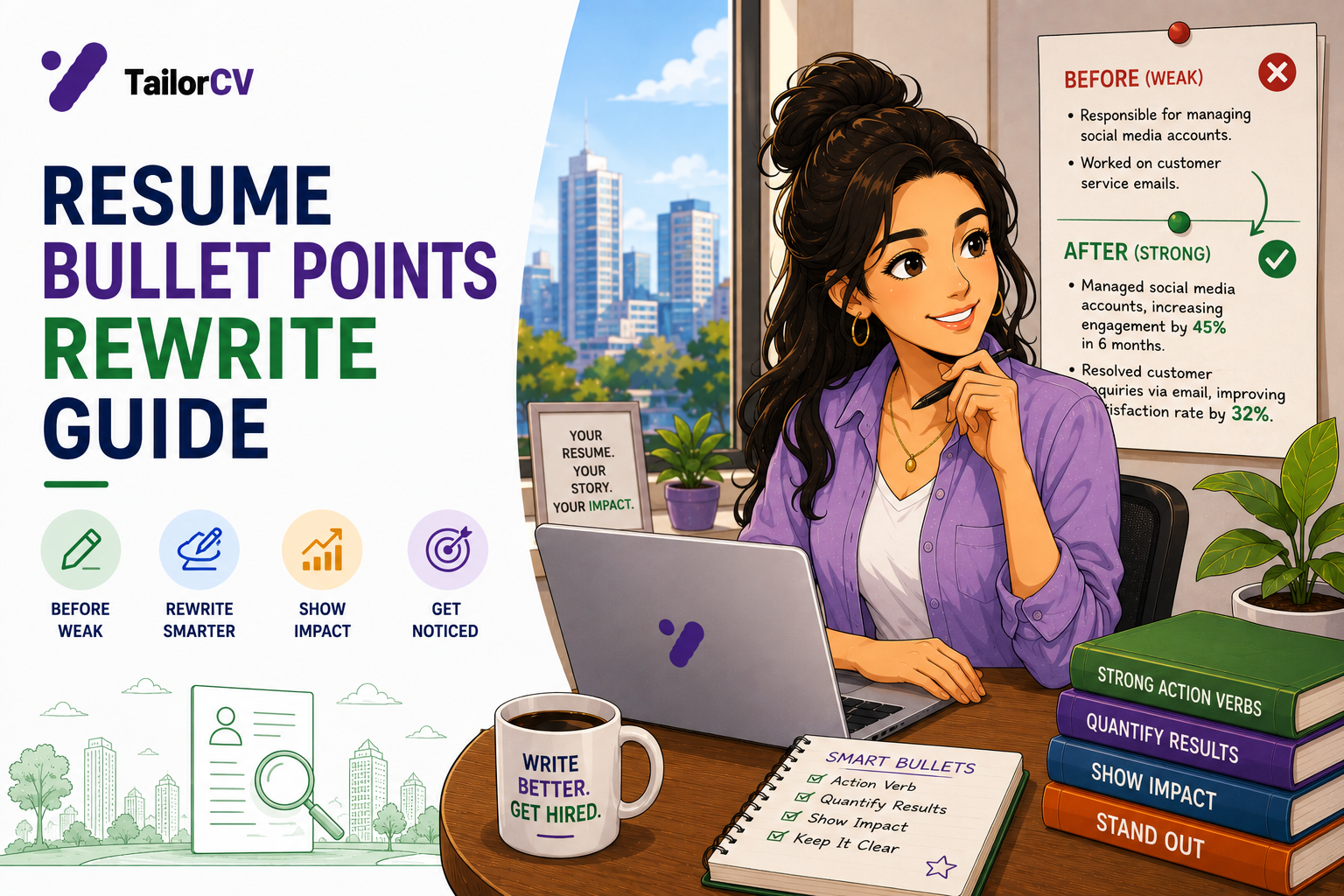
- Work from a list of what you did, not from the existing bullets, which anchor you to weak phrasing.
- Answer four questions per bullet — what, how, why it mattered, what changed.
- Write long, then cut. Editing a full answer produces better lines than composing a short one.
- Order matters as much as wording. Your strongest bullet belongs first.
- Rewrite per role, not per application, then reorder for individual postings.
The four questions
A structure that produces a usable bullet every time.
What did you actually do? Written plainly, as you would say it to a colleague, without resume vocabulary.
How did you do it? The approach, the tool, the decision you made. This is where your judgement becomes visible.
Why did it matter? The reason the work existed, which supplies the context a reader needs.
What changed? The outcome, measured if possible and described if not.
Answer all four in full sentences first. The temptation is to compose the final bullet immediately, which produces the same tired phrasing you started with.
Then compress. Most of the four answers collapse into one line, and the discarded material becomes your interview preparation, which is a second benefit of doing it this way.
Working through a role
The sequence for one job at a time.
| Step | What you do |
|---|---|
| List everything | Every project and responsibility, unfiltered |
| Mark the relevant | Against the kind of role you are targeting |
| Answer the four questions | For each marked item, in full sentences |
| Compress to one line each | Keep the result, cut the preamble |
| Rank by strength | Best evidence first |
| Keep the top three to five | The rest goes in your master document |
Listing everything first matters because memory is the binding constraint, and filtering while recalling loses material you would have used.
Ranking is where most of the value appears. People routinely bury their best achievement in position four, where it is not read.
And the discarded bullets are not wasted. They go into your master resume, ready for a posting where they turn out to be the relevant ones.
Length and rhythm
The mechanics of a readable bullet.
One to two lines is the working range. Three lines becomes a paragraph and stops being scanned.
Front-load the substance. The first six or seven words decide whether the rest is read, so the result or action belongs at the start rather than after a clause of setup.
Cut the preamble. In order to, as part of, working alongside the team to — all of it can go without losing meaning.
Vary the length slightly across a group of bullets, since five identically shaped lines read as a template.
Avoid semicolons and nested clauses, which slow a reader who is moving quickly.
Do not end with a full stop on some and not others. Consistency here is invisible when correct and distracting when not.
And read them aloud. Anything you stumble over is a line the reader will stumble over too, and it is almost always fixable by removing words.
Keeping bullets current
Maintaining them so the rewrite is not needed again.
Write the note when the work finishes, not two years later. A sentence recorded at the time preserves detail that memory will not.
Capture the number when it exists. Metrics become inaccessible when you leave, and reconstructing them afterwards is guesswork.
Save your performance reviews, which contain your achievements described by someone else, frequently in stronger terms than you would use.
Note the team size and scope at the time, since these change and the context matters for describing the work later.
Update the master document quarterly rather than during a job search, when time pressure produces worse writing.
And keep the four-question answers, not just the compressed bullets, because those full answers are what you need when an interviewer asks you to talk about the work.
Mini checklist
- unchecked: Everything you did listed before any editing
- unchecked: Items marked for relevance to the target role
- unchecked: Four questions answered in full sentences
- unchecked: Each answer compressed to one line
- unchecked: Bullets ranked by strength
- unchecked: Strongest bullet placed first
- unchecked: Three to five kept per recent role
- unchecked: Remainder stored in a master document
- unchecked: Every kept bullet defensible in conversation
Scenarios
Scenario 1: You cannot remember what you did two years ago
Reconstruct from evidence — old calendars, project folders, performance reviews, messages. Recall improves sharply with a prompt, and the detail recovered is usually better than what you would have invented.
Scenario 2: You have twelve good bullets for one role
Keep five and put the rest in your master document. A long list dilutes attention, and the strongest five outperform all twelve.
Scenario 3: Your role was mostly maintenance and support
Describe reliability, volume and improvement. Keeping something working at scale is real work, and the outcome is stability, reduced incidents or faster resolution.
Tip: Write the four answers as if explaining the work to a friend outside your field. That register strips out the jargon and the passive constructions automatically, and the resulting bullet is almost always clearer than one composed in resume language.
Do's and Don'ts
Do
- List everything before filtering
- Answer the four questions in full first
- Compress rather than compose
- Rank bullets by strength
- Lead each role with its best line
- Keep the offcuts for interview preparation
Don't
- Edit the existing bullets in place
- Compose short lines from scratch
- Keep every bullet you write
- Leave your best achievement in fourth position
- Use resume vocabulary while drafting
- Discard the material you cut
Common Mistakes
- Editing in place. The old phrasing anchors the new version.
- Composing short. Long-then-cut produces better lines.
- Keeping everything. Volume dilutes the strong material.
- Poor ordering. The best bullet buried where nobody reads it.
- Filtering while recalling. You lose material you would have used.
- Throwing away the cuts. They are your interview preparation.
Related Guides
Keep building on this with the related guides in this series:
- Weak Resume Bullets and How to Fix Them
- How to Quantify Achievements Without Numbers
- How to Write a Resume Summary
- Interview Story Bank and the STAR Method
- Resume Update Checklist Before Applying
You can also check your resume's ATS score for free, generate a tailored cover letter, or build a portfolio website in minutes.
Frequently Asked Questions
How do I rewrite a resume bullet?
Answer four questions in full sentences — what you did, how, why it mattered and what changed — then compress the answers into one line. Editing a full answer beats composing a short one.
Should I edit my existing bullets?
No. Start from a list of what you actually did, because existing phrasing anchors you to the weak version and makes genuine improvement much harder.
How many bullets should each role have?
Three to five for recent relevant roles and fewer for older ones. Keep the strongest and store the rest in a master document for future postings.
Which bullet goes first?
Your strongest and most relevant one. First position is read far more reliably than fourth, and most people bury their best material.
What if I cannot remember the details?
Reconstruct from calendars, project folders and performance reviews. Recall improves sharply once prompted, and the recovered detail is more specific than anything reconstructed from memory alone.
What do I do with the bullets I cut?
Keep them in a master resume. They become the relevant ones for a different posting, and the full four-question answers double as interview preparation.
How long should a resume bullet be?
One to two lines. Three becomes a paragraph and stops being scanned. Front-load the substance, since the first several words decide whether the rest gets read.
How do I keep my bullets current?
Write the note when the work finishes rather than years later, capture metrics while you still have access, save performance reviews, and update your master document quarterly rather than during a search.
What is your resume scoring right now?
Scan it against a job description and get your ATS match score in about a minute.
Drop your resume here or choose a file
PDF only. Max 2 MB.
We never share your data or use it to train AI models.

Was this guide useful?
Be the first to rate it.