 SS
SS
Key Takeaways
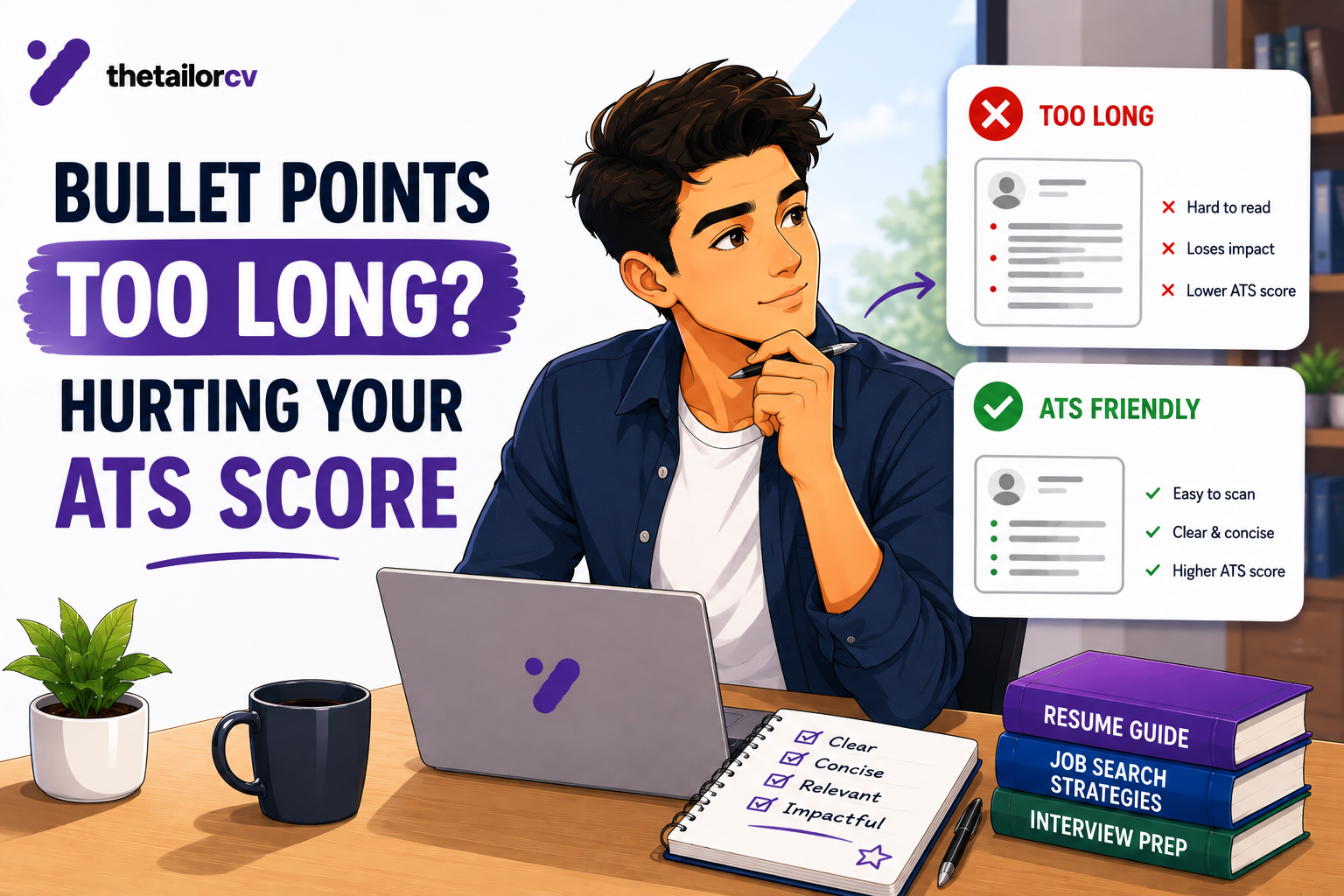
- There is no fixed word count. The real test is whether a bullet still reads in one breath.
- Long bullets usually fail because they contain two ideas, not because they are literally too long.
- Cutting a bullet in half often adds a number rather than removing information — the padding was the problem, not the content.
- One line per bullet on screen is a reasonable visual target; two is acceptable for a genuinely complex achievement.
- Matching does not reward length. A concise bullet with a real term in it matches as well as a long one.
"Keep your bullets to one line" is common advice with no explanation of why, so people either ignore it or cut good content to hit an arbitrary target. Here is the actual reasoning and a better way to check.
Why Length Becomes a Problem
It is not really about word count. A long bullet usually fails for one of two underlying reasons, and fixing the word count without fixing the reason does not help.
Reason one: it contains two ideas. A bullet describing both a responsibility and a separate achievement is really two bullets wearing one bullet point.
Managed the team's reporting process and also led a cross-functional initiative to redesign the onboarding flow, which improved new-hire ramp time.
That is two accomplishments. Split them and each gets its own attention:
Managed the team's weekly reporting process for a 12-person analytics group. Led a cross-functional redesign of the onboarding flow, cutting new-hire ramp time from 6 weeks to 4.
Reason two: it is padded with filler. Phrases like "responsible for," "worked on," "helped with," "in order to," and "on a regular basis" add length without adding information. Removing them often shortens a bullet by a third with zero loss.
The One-Breath Test
Read the bullet aloud in one breath, at a normal speaking pace. If you run out of breath or lose the thread before reaching the end, it is too long — not because of a word count, but because a reader's attention works the same way your breath does.
This test catches both underlying problems above without requiring you to count anything.
What Actually Matters for Matching
Length itself does not move a match score. A twenty-word bullet containing "built the ETL pipeline moving Salesforce data into Redshift" matches as well as a forty-word version saying the same thing with more padding around it. The evidence — the specific tool, the specific action — is what gets matched, not the sentence length.
This means shortening a bullet is safe from a matching perspective as long as you keep the specific nouns and verbs, and only cut the connective filler. See weak resume bullets for the broader pattern of what makes a bullet strong regardless of length.
Before and After
Too long, two ideas:
Was responsible for the day-to-day management of the customer support queue, handling escalations from junior staff and also took the initiative to build a new ticket categorisation system that was later adopted by the entire department, reducing average resolution time significantly.
Split and tightened:
Managed a customer support queue of 200+ weekly tickets, handling escalations from 4 junior staff. Built a ticket categorisation system, later adopted department-wide, that cut average resolution time from 48 to 19 hours.
Too long, padded:
Worked on a regular basis with the finance team in order to help ensure that monthly reports were completed on time and were accurate.
Tightened:
Delivered accurate monthly finance reports on a fixed weekly deadline for 18 consecutive months.
Notice the second version is not just shorter — it added a number, which the first version's length was hiding rather than earning.
A Reasonable Visual Target
As a rough guide rather than a rule: aim for bullets that occupy one line on the page, and treat two lines as an acceptable maximum for a genuinely complex, high-value achievement. Three lines or more almost always means either two ideas combined or padding that can be cut.
This varies by resume template and font size, which is exactly why a word count is the wrong tool — "one line" at 11pt Calibri is a different word count than at 10pt Georgia.
How to Cut a Bullet Without Losing the Substance
1. Find the connective filler and delete it. "Responsible for," "worked to," "helped with," "in order to," "on an ongoing basis." These add length and nothing else.
2. Check for two accomplishments. If you can insert "and separately" in the middle without it reading strangely, it is two bullets.
3. Replace a vague phrase with a specific number. Often the sentence that felt too long to shorten was actually vague, and adding a number lets you cut surrounding words while adding real information. See quantifying achievements.
4. Read it aloud. If it still runs long, it usually needs a genuine cut rather than another editing pass — decide what to remove rather than rephrasing the same content more densely.
When a Longer Bullet Is Justified
Not every long bullet is wrong. A senior or highly technical achievement occasionally needs the extra clause to be credible — a two-line bullet describing a genuinely complex, high-stakes project is fine if every word in it is doing work.
The test stays the same: does it contain one idea, and is every phrase adding information rather than transition? If yes, length is not the problem even at two lines.
Frequently Asked Questions
Is there an actual word limit for resume bullets? No official one. As a rough guide, most well-written bullets land between 15 and 25 words. Beyond 30, check for two ideas or padding.
Does a shorter bullet score lower on ATS matching? No — matching looks for specific evidence, not length. A concise bullet with the right term matches as well as a long one.
Should every bullet be exactly the same length? No, uniform length across every bullet can itself read as formulaic. Natural variation is fine; the target is clarity, not consistency.
What if I genuinely cannot shorten a complex achievement? Split it into two bullets rather than keeping one long one. Two clear, focused bullets beat one dense one.
Do recruiters actually notice bullet length? Indirectly — a long bullet gets skimmed rather than read, so the content inside it effectively disappears regardless of how good it is.
Check What Actually Matters in Your Bullets
Length is a readability issue for the human reader. Whether the content inside your bullets evidences what a specific posting is asking for is a separate, more important question.
Scan your resume against a posting and see whether your bullets — long or short — actually contain the terms and evidence the role requires. A concise bullet with the right specifics beats a long one without them.
Free, about a minute. See also weak resume bullets and how to quantify achievements.
What is your resume scoring right now?
Scan it against a job description and get your ATS match score in about a minute.
Drop your resume here or choose a file
PDF only. Max 2 MB.
We never share your data or use it to train AI models.

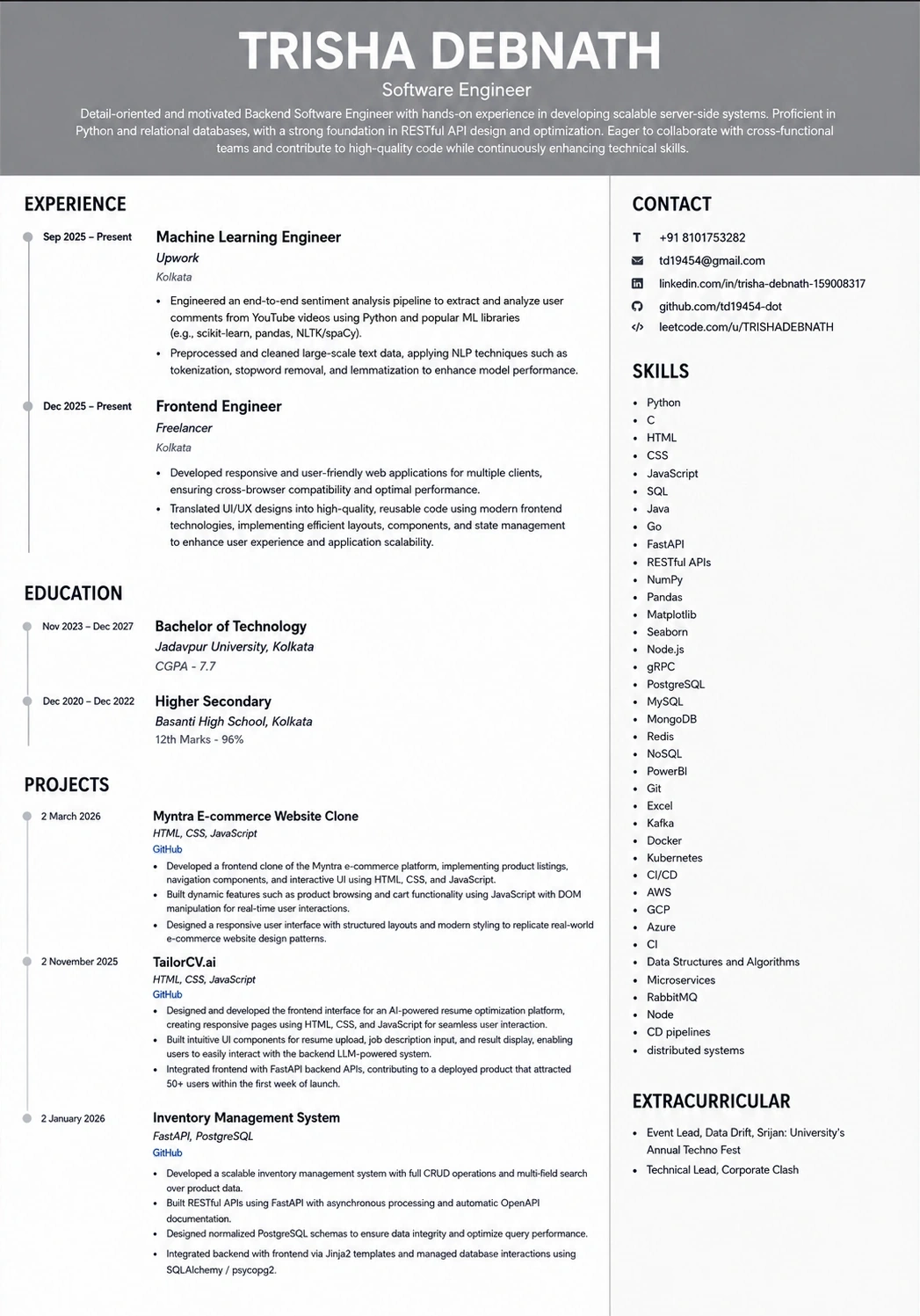
Templates that keep this structure intact
This template is ATS-tested — start from it and the formatting rules in this guide are already handled.
Was this guide useful?
Be the first to rate it.