 SS
SS

Key Takeaways
- Most "missing" experience is present under a different name - the gap is vocabulary, not capability.
- Work out what the requirement is really testing, then find where you have done that thing.
- Name the adjacent work in the employer's terms and let the evidence carry the weight.
- Adjacency has limits: tool families and comparable processes transfer, distinct disciplines and hard credentials do not.
- State the equivalence plainly rather than hoping the reader infers it.
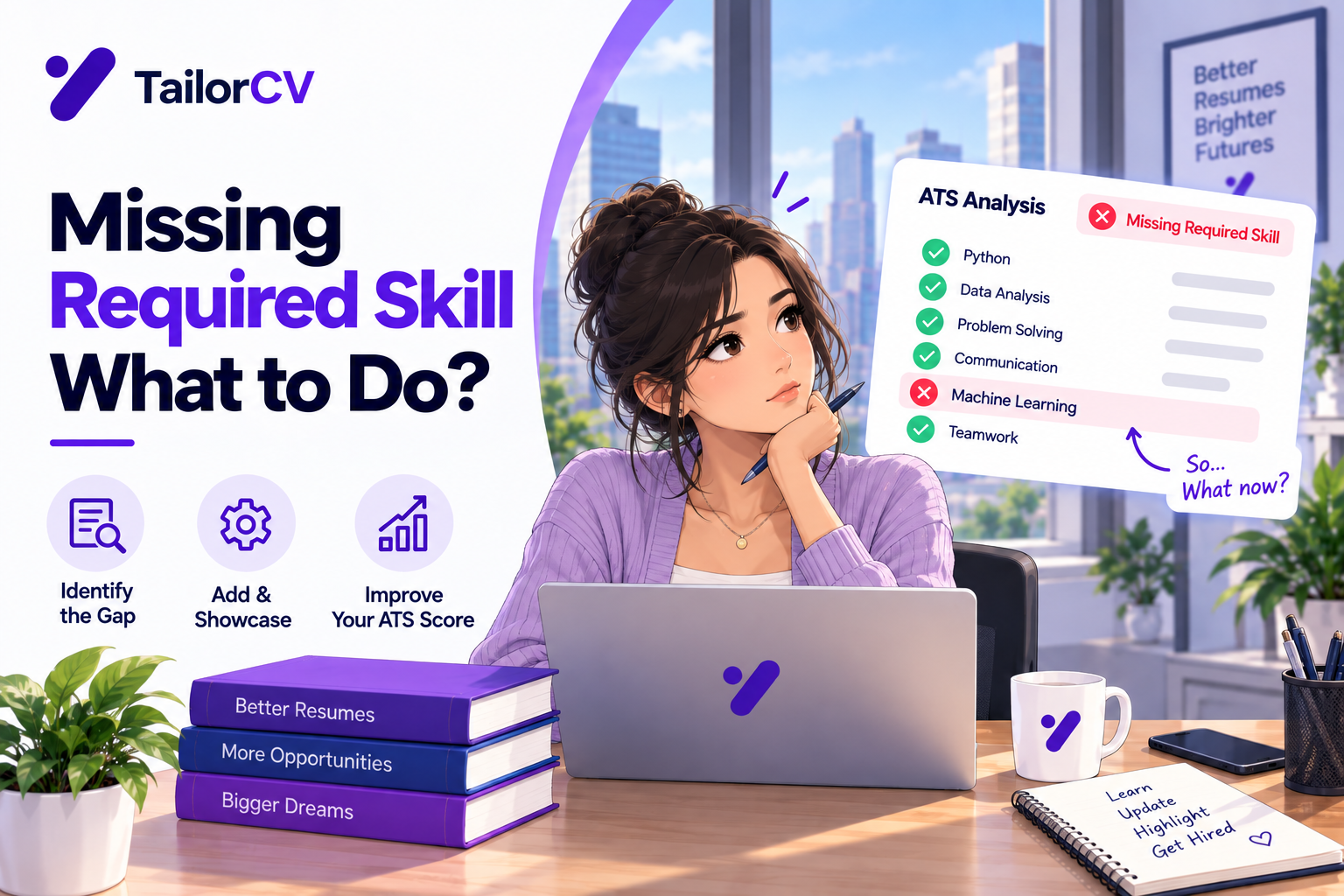
A posting asks for vendor management. You have never held that title. You have also spent two years running three agency relationships, negotiating their contracts and holding them to delivery dates.
That is vendor management. The employer will not know unless you say so in their language.
Find What the Requirement Is Testing
Requirements name a proxy for an underlying capability. Ask what the proxy is for.
| The posting asks for | What it is testing | Where you may have done it |
|---|---|---|
| Vendor management | Managing external delivery against terms | Agency, contractor or supplier relationships |
| Stakeholder management | Aligning people who do not report to you | Cross-team projects, client work, internal rollouts |
| P&L ownership | Decisions constrained by money | Budget ownership, cost reduction, pricing work |
| Change management | Getting people to adopt something new | System migrations, process rollouts, training |
| Data-driven decision making | Using evidence to choose | Any analysis that changed what your team did |
| Product sense | Judgment about what to build | Prioritisation, spec writing, scoping calls |
| Programme management | Coordinating work across teams | Multi-team launches, office moves, audits |
| Requirements gathering | Turning needs into specifications | Any system or process you helped scope |
| Process improvement | Making a workflow measurably better | Automation, handover redesign, cycle-time work |
| Client-facing experience | Operating with external accountability | Agencies, consultancies, support escalations |
| Technical leadership | Setting direction others follow | Standards, reviews, mentoring, architecture calls |
| Commercial awareness | Understanding what makes money | Pricing, margin, renewal or cost-saving work |
Once you see the capability, you usually find you have evidence. It is filed under a different label.
Doing the translation in five minutes
Take the posting's five to eight real requirements and write each one in the middle column yourself. Then search your own history for the third column.
Most people recover three or four matches they had already written off. The reduction method for finding those five to eight in the first place is in reading a posting like a recruiter wrote it.
Make the Equivalence Explicit
The common mistake is leaving the connection implied. A hiring manager scanning quickly will not construct the bridge for you.
Implied - reader must do the work: Coordinated with our three design agencies on campaign delivery.
Explicit - the equivalence is stated: Owned vendor management for three design agencies, negotiating scopes and holding delivery to contracted timelines across 12 campaigns.
Same events. The second names the capability the posting asked for, then evidences it. Nothing is overclaimed - "owned vendor management" is an accurate description of what happened.
Why implication fails
A reader spends a few seconds on your first pass and is not looking for hidden relevance. They are matching against a mental list.
Anything requiring inference is not on that list, which is why placement and vocabulary do more work than the underlying facts on a competitive posting.
Where Adjacency Works
Tool families. Tableau to Looker, Postgres to MySQL, Asana to Jira. Deep experience with one member is strong evidence for another, and employers generally accept it.
Comparable processes. Running a system migration is evidence for running a different system migration. The domain changes; the practice does not.
Scale and constraint. Managing a £2m budget is evidence for managing a £3m one. Leading eight people is evidence for leading twelve.
Regulated environment experience. Working under clinical governance transfers meaningfully to working under financial compliance - the skill is operating where rules are enforced.
Audience type. Presenting to executives is evidence for presenting to executives, whatever the subject.
The strongest form of adjacency
Scale and constraint transfer more convincingly than tools, because tools are learnable in weeks and judgement under constraint is not.
A candidate who has run a £2m budget is credible on a £3m one regardless of industry. That is worth leading with when your tooling does not match, and it is why scope lines often persuade where a title cannot.
Where It Does Not
Hard credentials. A licence, a clearance, a professional registration. You have it or you do not, and adjacency is not an argument.
Genuinely distinct domains. Marketing analytics does not transfer to clinical research because both involve data. The domain knowledge is the job.
Specific regulatory frameworks. Knowing GDPR is not knowing HIPAA. Named frameworks are usually required literally.
Depth at a stated level. If a posting requires deep expertise in one named system, having used five related systems shallowly does not substitute.
The test: would a practitioner in that field accept the equivalence? If a vendor manager would say "yes, that is the same work," the claim holds. If they would raise an eyebrow, it does not.
The practitioner test, applied
This is the single most useful check because it is answerable. You are not asking whether the claim is defensible in principle - you are asking whether someone who does the job daily would nod.
If you are unsure, the honest move is to state the smaller version. A partial claim that survives questioning beats a full one that does not, which is the same discipline that separates framing from fabrication.
A Worked Rewrite
An operations coordinator applying for a project manager role. The posting asks for project planning, stakeholder management, risk management and budget tracking.
Original: Helped organise the office move and kept everyone updated on what was happening. Tracked spending against what we had been allocated.
Everything relevant is there and none of it is legible.
Rewritten: Planned and delivered a 120-person office relocation across a four-month timeline. Managed stakeholders across five departments plus three external suppliers, maintained the risk register through two schedule changes, and tracked the £180k budget to a 4% underspend.
Same move, same person, same truth. Every term the posting asked for now has evidence attached. Nothing has been invented - the detail was always there, just unstated.
A Second Example: The Technical Case
The operations example is a vocabulary problem. Technical adjacency is different, because the reader is assessing depth rather than equivalence, and overclaiming is caught faster.
A backend engineer with Django experience applying for a role naming FastAPI, async Python, and REST API design.
Overclaimed: Expert in FastAPI, async Python, microservices and REST API design.
FastAPI appears nowhere in this person's history. One interview question ends it.
Honestly adjacent: Designed and shipped 30+ REST endpoints in Python (Django REST Framework), including the authentication and rate-limiting layers. Comfortable with async patterns from three years of Celery-based task orchestration; FastAPI experience is from personal projects rather than production.
The second version earns credit for REST API design and Python depth - both genuine, both central - while stating the FastAPI position accurately. A hiring manager reads competence and candour rather than a claim they must test.
That last clause costs nothing. Most technical hiring managers will take a strong adjacent engineer over a weaker exact match, provided they are not being misled about which is which.
Being Straight About the Gap
Where the adjacency is real but the title is genuinely absent, one line in the cover letter does more than any resume phrasing:
I have not held the project manager title. I have planned and delivered the relocation described above end to end, which covered the planning, stakeholder and budget responsibilities in your posting.
This reads as confidence rather than apology, and it pre-empts the objection the reader was already forming.
Where to put the acknowledgement
The cover letter is the right place for one sentence of it. The resume is not - a resume that explains its own gaps reads defensively.
If there is no cover letter, let the evidence carry it and leave the gap unmentioned. Naming a weakness nobody asked about is a common self-inflicted wound rather than honesty.
Edge Cases
The adjacency is real but a decade old
Currency matters. Date it plainly - "built the original reporting layer in Tableau (2018-2020)" - and let the reader weigh it.
Presenting old work as current capability is the version of this that gets caught, and it undermines the genuine claims beside it. Dating the claim also protects you at interview: a question about a tool you last used in 2019 is easy to answer honestly when the resume already said 2019, and awkward when it implied last month.
The same applies to scale. Work you did at a company that has since tripled in size should be described at the scale it actually was, not at the scale the name now implies. How far back a resume should go is partly a currency question for exactly this reason.
You did the work but not at the stated scale
State your real scale. Someone who has led four people applying to a role wanting twelve is a plausible stretch; someone claiming twelve is one reference check from a problem.
Scale gaps are usually forgiven when the trajectory is visible. Inflation is not. If you have gone from two reports to four to seven, say so across the roles - a visible slope answers the scale question better than any single number, because it tells the reader where you are heading rather than only where you have been.
Where the gap is large enough that trajectory does not close it, treat it as fit information. A role wanting twelve reports from someone who has led four is a genuine stretch, and deciding whether to apply is a better use of the judgement than finding a phrasing that obscures it.
The posting wants industry experience you lack
Domain knowledge is the hardest thing to claim adjacently, because it is often genuinely the job. Be honest about it and lead with the transferable practice.
Where the industry is heavily regulated, assume the requirement is literal. In healthcare, finance, defence and law, the domain knowledge is frequently the thing being hired, and a candidate without it is not a stretch but a mismatch. Sector-specific tailoring makes the distinction clearer than general advice can.
Outside regulated sectors the picture is friendlier. Most employers will take a strong practitioner from an adjacent industry, provided the transferable practice is stated in their vocabulary rather than yours.
Your evidence is from a personal project or volunteering
Legitimate evidence, and it counts - as long as the context is labelled accurately. Put it under Projects rather than Experience.
Side projects carry real weight for juniors and career changers and near-zero for senior candidates with long professional histories.
You are changing career entirely
Adjacency does the heavy lifting here and it has a ceiling. It makes transferable work visible, which matters, but it cannot substitute for domain knowledge where the domain is the job.
The full approach is in bridging two fields.
What This Looks Like at Each Level
Fresher. Almost everything is adjacent, because there is no direct experience yet. Coursework, projects and part-time work translate well when named in the target field's vocabulary.
Two to five years. The standard case. You have real evidence under your own industry's labels and the work is renaming it.
Senior. Adjacency shifts from tools to judgement - budget scale, team size, ambiguity, regulatory exposure. Lead with those rather than technology lists, because a senior reader is assessing decisions. A resume that reads as a list of technologies rather than owned outcomes is the most common reason strong senior candidates get no response.
Career changer. Adjacency is the entire application. Be explicit, be accurate about limits, and expect the domain gap to be the real question.
Common Mistakes
Mistakes that overclaim
Substituting the term without the evidence. Writing "vendor management" in a skills list with no bullet behind it is stuffing rather than coverage, and adjacency does not excuse it.
Claiming the family rather than the member. If you used MySQL, say MySQL. Writing "PostgreSQL" because they are both relational databases is substitution, not adjacency.
Stretching a genuinely distinct discipline. Data work is not all one field, and a practitioner will know immediately.
Mistakes that underclaim
Waiting to be asked. Adjacent evidence that is not stated is not read. The reader will not build the bridge.
Apologising for the gap on the resume. State what you did; let the absence speak for itself.
Assuming the title disqualifies you. Most people underestimate their coverage because they compare titles instead of capabilities, which is exactly what scanning against the posting corrects.
If the role combines two disciplines, tailoring for a hybrid role shows how to read which side it leans toward and lead with the right one.
Frequently Asked Questions
Is this the same as exaggerating?
No. Exaggerating claims work you did not do. This names work you did do using the vocabulary of the field you are applying to.
How do I know if an adjacency will be accepted?
Ask whether a practitioner would agree the underlying work is the same. Tool families and comparable processes usually pass; distinct domains and hard credentials do not.
Should I use the employer's exact term even if my industry calls it something else?
Yes, where it is accurate. You are writing for their reader, not documenting your industry's vocabulary.
What if I have the capability but only from a personal project?
Use it and label it accurately. Unpaid or self-directed work is legitimate evidence; misrepresenting its context is not.
Does this work for a complete career change?
Partly. It makes transferable work visible, which matters, but it cannot substitute for domain knowledge where the domain is the job.
Will a scanner credit an adjacent term I have not written?
No. Scanners match what is on the page, so adjacency only helps once you have written the equivalence explicitly. That is the whole reason to state it.
How many adjacent claims can one resume carry?
As many as are genuinely true, but concentrate them on the posting's central requirements. A resume where every line is a translation reads as someone reaching.
Should I explain the adjacency in the resume itself?
Briefly and inside the bullet, never as a separate note. "Owned vendor management for three agencies" is the explanation.
What if the recruiter does not recognise the equivalence?
Then it was not stated clearly enough, or it is genuinely a stretch. Name the capability in their words rather than yours and the recognition problem usually disappears.
Does a cover letter help with adjacency?
More than with almost anything else, because one sentence can make a connection the resume format cannot. Use it where the gap is a title rather than a capability.
Find the Overlap You Already Have
Most people underestimate their own coverage because they are comparing titles instead of capabilities.
Scan your resume against a posting and treat the flagged terms as a translation exercise - ask of each one "have I done this under another name?" That question usually recovers several matches before you write anything new.
Then rewrite the bullet where that work already lives, using the posting's word for it. If you would rather see those rewrites drafted first, the tailoring tool works from the same comparison.
Related: what to write when you lack a required skill and translating experience into a new industry's language.
What is your resume scoring right now?
Scan it against a job description and get your ATS match score in about a minute.
Drop your resume here or choose a file
PDF only. Max 2 MB.
We never share your data or use it to train AI models.

Templates that keep this structure intact
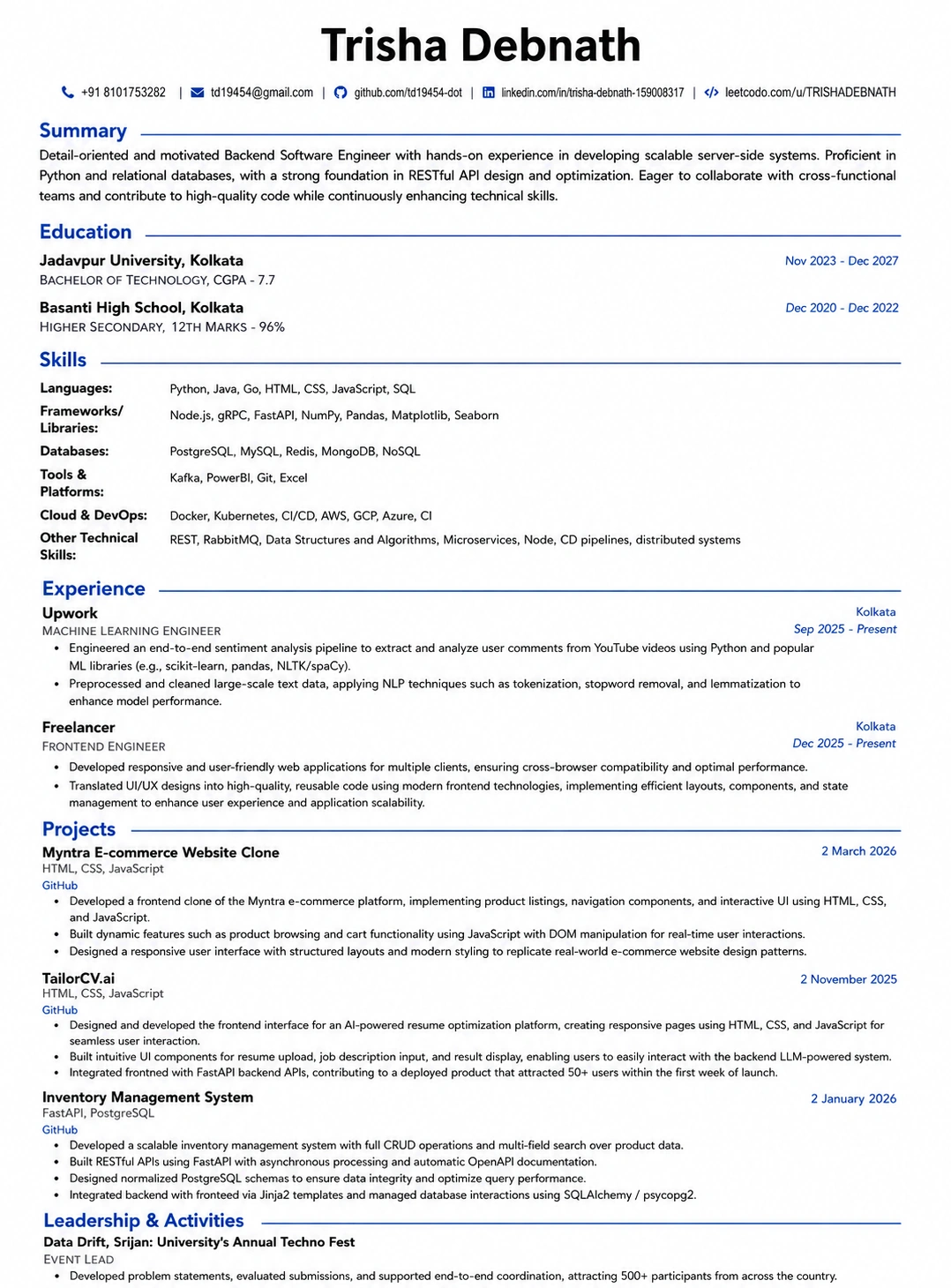
This template is ATS-tested — start from it and the formatting rules in this guide are already handled.
Was this guide useful?
Be the first to rate it.