TD
TD
Key Takeaways
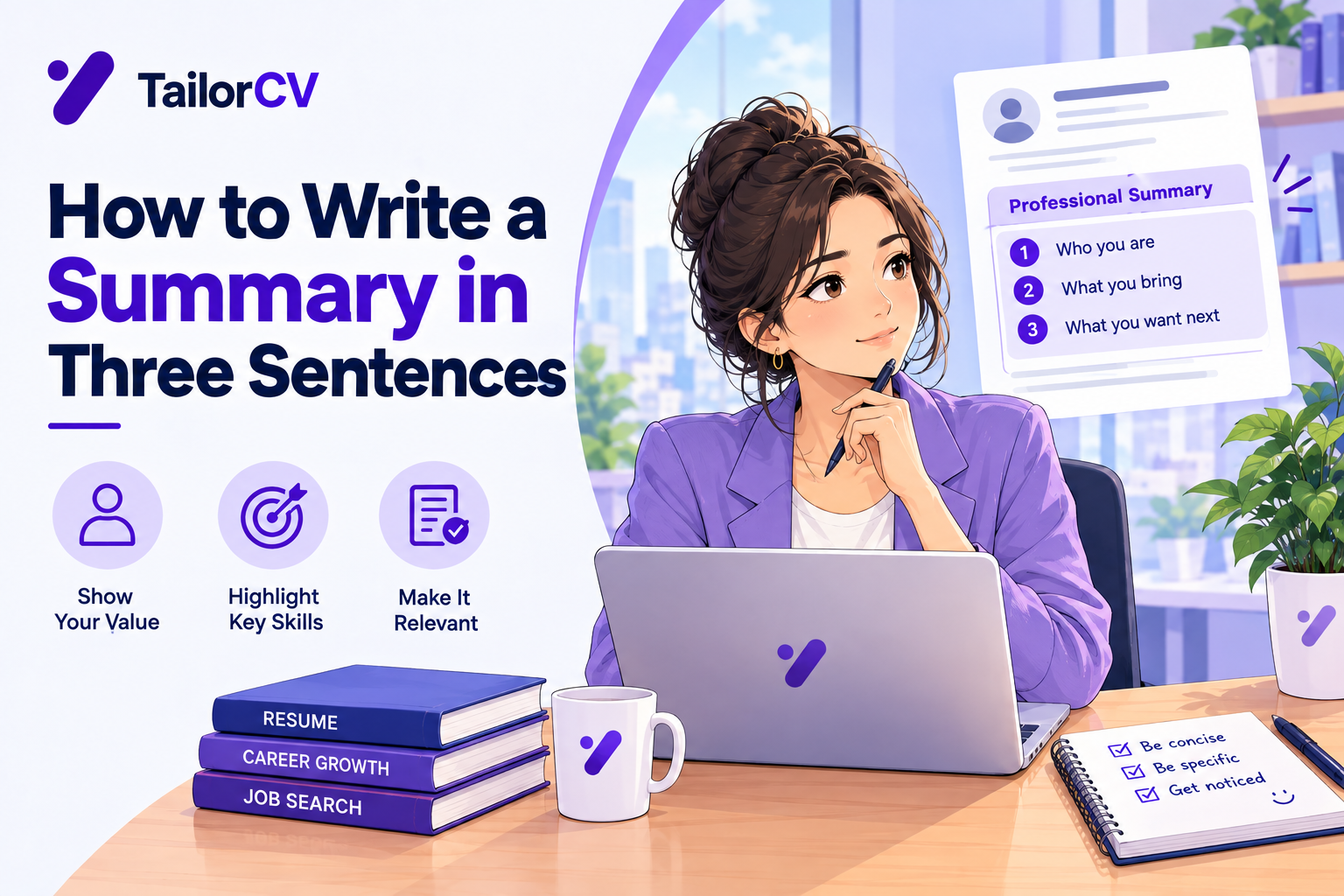
- Three sentences: what you are and how long, one specific proof point, and what you are aiming at. Nothing else fits.
- Sentence two carries the whole summary. Without a concrete detail, the other two are interchangeable with any candidate's.
- Write it last, after the bullets are tailored, so it can draw on what the resume actually shows.
- Banned outright: "results-driven," "proven track record," "passionate about," "detail-oriented." They signal that nothing specific follows.
- A summary is not an objective. Objectives state what you want; summaries state what you bring.
Your summary is the first thing anyone reads and the last thing anyone believes. Most are three lines of adjectives that would fit any candidate in any industry, which is why experienced recruiters skip straight to the experience section.
The short answer: three sentences, and sentence two is the one that matters. State what you are, prove it with one specific thing you did, then name the direction. If you cannot supply the specific thing, the summary is not ready and no amount of rewording fixes it.
Why Most Summaries Fail
Open almost any resume and the summary reads like this:
Results-driven marketing professional with a proven track record of delivering impactful campaigns in fast-paced environments. Passionate about data-driven strategy and committed to excellence. Seeking a challenging role where I can leverage my skills.
Three sentences, forty words, and not one fact. It would fit a graduate or a director, a B2B software company or a charity. It contains no information, and the reader — who has ninety of these — learns that in about two seconds.
The failure is not bad writing. The sentences are grammatical and the vocabulary is professional. The failure is that nothing in it could be false, which means nothing in it is informative.
Every phrase in that example belongs to a category the reader has learned to discount:
| Phrase type | Example | Why it fails |
|---|---|---|
| Self-assessed traits | Results-driven, detail-oriented | Unverifiable, universally claimed |
| Vague credentials | Proven track record | No content — track record of what? |
| Emotional claims | Passionate about, committed to | Not a qualification |
| Environment filler | Fast-paced, dynamic | Describes the employer, not you |
| Aspirational closings | Seeking a challenging role | States what you want, not what you offer |
The Three-Sentence Structure
Sentence one: what you are, and for how long
Your role category and your experience length, in plain terms, using the vocabulary the posting uses.
Backend engineer with six years building payment and billing systems.
Not "experienced technology professional." Name the thing. If the posting says "backend engineer" and your title is "software developer II," use theirs — that is a category description, not a title claim.
The experience length matters because it is the first filter most readers apply. Make them read it rather than count it from your dates.
Sentence two: one specific proof point
This is the whole summary. Everything else is framing.
One thing you did, with a number, a scale, or a named outcome. It should be the single most relevant achievement you have for this posting.
Led the migration of a legacy billing service to a distributed architecture, cutting failed transactions from 2.1% to 0.3% across 40,000 daily payments.
That sentence is not interchangeable with anyone else's. It survives a follow-up question. It tells a reader more than the other two sentences combined.
If you cannot write this sentence, the problem is not the summary — it is that the resume has no proof points in it, which is a bullet problem. Quantifying achievements is where to start, and there are options when you have no metrics.
Sentence three: the direction
What you are looking to do next, framed as capability rather than desire.
Now focused on payment infrastructure at scale.
Short. Present tense. No "seeking," no "opportunity," no "leverage."
This sentence is optional for a well-matched application and useful for a career change or stretch role, where it tells the reader how to read everything below it.
The Full Structure Assembled
Backend engineer with six years building payment and billing systems. Led the migration of a legacy billing service to a distributed architecture, cutting failed transactions from 2.1% to 0.3% across 40,000 daily payments. Now focused on payment infrastructure at scale.
Forty-three words. A reader knows what you are, has one verifiable reason to keep reading, and knows what you are aiming at.
Compare against the marketing example earlier. Same length, entirely different information content.
Before and After, Across Four Roles
Before (operations): Detail-oriented operations professional with experience in process improvement and a passion for efficiency.
After (operations): Operations coordinator with four years in process improvement and stakeholder management. Delivered a 120-person office relocation across four months on a £180k budget, 4% under. Now moving toward programme-level delivery.
Before (graduate): Recent computer science graduate seeking an entry-level software engineering role where I can apply my skills and grow.
After (graduate): Computer science graduate with two internships in backend development. Built and shipped a booking API used by 300 students at my university, handling 1,200 requests a day. Looking for a backend engineering role with production ownership.
Before (career change): Experienced teacher transitioning into instructional design, passionate about learning and development.
After (career change): Secondary teacher of eight years moving into corporate learning design. Designed a differentiated curriculum for 150 learners that lifted pass rates from 71% to 84% over two years. Now applying the same evidence-led approach to workplace training.
Before (senior): Senior leader with a proven track record of driving results across complex organisations.
After (senior): Engineering manager with eleven years, seven leading teams of 8–20. Rebuilt the platform team's delivery process, taking median cycle time from 18 days to 5 while headcount stayed flat. Now looking for director-level ownership of a multi-team platform organisation.
Every "after" follows the same structure and none is interchangeable with another.
What Never Belongs in a Summary
| Item | Why not |
|---|---|
| A list of skills | The skills section exists for this |
| Your job title verbatim | It is already on the page twice |
| What you want from an employer | That is an objective, and it is out of date |
| Soft-skill adjectives | Unverifiable and universally claimed |
| Anything you cannot defend | It is the first thing an interviewer probes |
| More than four sentences | It stops being a summary |
| Your whole career history | That is the experience section |
| References to being a fast learner | Reads as compensating for a gap |
The soft-skill row is the one people resist. If a posting asks for communication skills, the answer is a bullet showing communication doing work — not an adjective in the summary. Soft skills belong in evidence, not in claims.
Write It Last
The summary should be the final thing you write, not the first.
It is a summary of the document, and until the document is tailored you do not know what it is summarising. Writing it first means you commit to a framing and then either ignore it or spend time reconciling the bullets to it.
The efficient order: identify the posting's real requirements, reorder your bullets, make your two or three renames, then write the summary drawing on whatever is now in the top two bullets. That sequence takes the summary from the hardest part of tailoring to the easiest, because by then the material is chosen. It is the same reason the ten-minute routine puts the summary after the reading step rather than before it.
Choosing the Proof Point
Sentence two carries the summary, so choosing which achievement goes there is the only decision that really matters. Four tests, applied in order.
Does it address their top requirement? Relevance beats impressiveness. An achievement that speaks directly to the thing the posting repeats does more work than a bigger one that does not — the same logic that governs which bullet goes first.
Does it have a number, a scale, or a named outcome? Something checkable. "Improved the reporting process" is not a proof point; "cut month-end reporting from nine days to four" is.
Can you talk about it for two minutes? This is the first thing an interviewer asks about. If the achievement is real but you were peripheral to it, a follow-up question exposes that quickly.
Is it recent enough to be credible? Within about five years for most roles. Older than that and the reader wonders what you have done since.
If two achievements pass all four, take the one that requires less explanation. The summary has no room for context, so a proof point that needs a setup sentence is the wrong proof point.
When nothing passes the tests
Sometimes there is genuinely no quantified achievement available — early career, a support function, or work where outcomes are collective rather than individual.
Use scope instead of impact. How many systems, how many people, how often, how large. "Maintained the reporting layer for a 40-person sales organisation across three regions" has no outcome metric and is still specific enough to be informative.
What does not work is retreating to adjectives. A scope statement with real numbers beats "highly experienced in reporting" every time, even when the scope is modest.
What This Looks Like at Different Levels
| Level | Sentence one anchors on | Sentence two should show | Sentence three |
|---|---|---|---|
| Graduate | Degree and any internships | A built thing with real users | Target role, plainly |
| Early career | Role category and years | A delivered outcome with a number | Optional |
| Mid-level | Role category, years, specialism | Scope and measurable result | Optional |
| Senior | Years plus leadership span | Organisational change with a metric | Level being targeted |
| Career changer | Current field and the move | Transferable achievement, quantified | Essential — frames everything |
The career-change row is the only one where sentence three is mandatory. Without it, a reader spends the whole document trying to work out why a teacher is applying for a learning design role, and career-change resumes live or die on that framing.
Common Mistakes
Writing an objective and calling it a summary
"Seeking a role where I can grow" states what you want. Employers are reading to find out what you bring. The distinction is not pedantic — objective versus summary is a real difference in what the section is for.
Repeating the job title you already list
Your title appears in the experience section. Using the summary to restate it wastes one of three sentences.
Stuffing it with keywords
The summary is prime keyword real estate, which tempts people into cramming six requirements into it. The result reads as assembled and pushes out the proof point. Two of the posting's terms is the sensible ceiling — beyond that you are optimising past the point of usefulness.
Using the same summary for every application
The summary is the single most valuable thing to tailor, because it is the most-read. Reusing one across twenty applications forfeits the highest-return change available.
Making it five sentences
Four is the absolute maximum and three is better. At five it becomes a paragraph, and paragraphs get skipped.
Leading with years of experience
"Twelve years of experience in..." puts the least interesting fact first. Lead with what you are; the years can follow in the same sentence.
Frequently Asked Questions
Does everyone need a summary?
Most people, yes. The exception is a resume that already runs long with directly relevant experience, where the space is better spent on bullets. For career changers and anyone whose relevance is not immediately obvious, it is essential.
How long should it be in words?
Thirty-five to sixty. Below thirty-five it is usually missing the proof point; above sixty it stops being read as a summary.
Should it be in first person?
Neither first person nor third. Drop the subject entirely — "Backend engineer with six years" rather than "I am a backend engineer" or "Jane is a backend engineer."
Where exactly does it go?
Directly under your contact details, above experience. It should be the first thing after your name.
Does a summary help or hurt an ATS score?
Helps slightly, since it carries relevant terms in a parsed section. The real value is with the human reader, and the two do not score the same things.
What if I have gaps in my history?
The summary is not the place to address them. Use it to establish capability; the gap conversation belongs in the cover letter or the interview.
Can I use bullet points instead of sentences?
You can, and it usually reads worse — a bulleted summary looks like a second skills section. Prose is what distinguishes it from the rest of the page.
Should the summary name the company I am applying to?
No. That is cover-letter territory, and it creates a version-control hazard where the wrong company name ships.
What if my best proof point is from an old role?
Use it anyway. A strong specific from four years ago beats a weak generic from last month, and it gives the reader a reason to look further down the page.
How different should the summary be per application?
Sentence one changes vocabulary to match the posting. Sentence two changes to whichever proof point is most relevant. Sentence three rarely changes. That is about ninety seconds of work.
Should I use the posting's exact words in sentence one?
Where they describe what you genuinely are, yes. "Backend engineer" instead of "software developer II" is a category description, not a title claim — exact match versus synonym covers when the wording itself carries weight.
What if I am missing a skill the posting treats as central?
The summary is the wrong place to address it — those three lines are your strongest case, not an audit. There are four honest moves for a missing skill, and none of them is a summary disclaimer.
Can an AI-written summary work?
As a draft, yes. As a final version it usually reads as generic, because the model has no access to your specifics — which is exactly what makes AI-written resumes sound interchangeable. Supply the proof point yourself.
Does the summary need to mention my industry?
Only when the move is across industries, where sentence three has to frame it. Within an industry the experience section already establishes context.
How does this interact with a stretch application?
Sentence three does more work — it names the level you are targeting so the reader interprets the evidence accordingly. Tailoring for a role above your level depends heavily on that framing.
Start With Sentence Two
If the summary feels impossible to write, you are probably starting at the top. Start in the middle instead.
Pick the single most relevant thing you have actually done for this posting, write it out with its number attached, and then build the other two sentences around it. The framing is easy once the evidence has been chosen.
Scan the posting to see which of your achievements maps to its real requirements, then tailor the summary to lead with that one.
Related: how to write a resume summary, summary versus objective, and tailoring in ten minutes.
What is your resume scoring right now?
Scan it against a job description and get your ATS match score in about a minute.
Drop your resume here or choose a file
PDF only. Max 2 MB.
We never share your data or use it to train AI models.

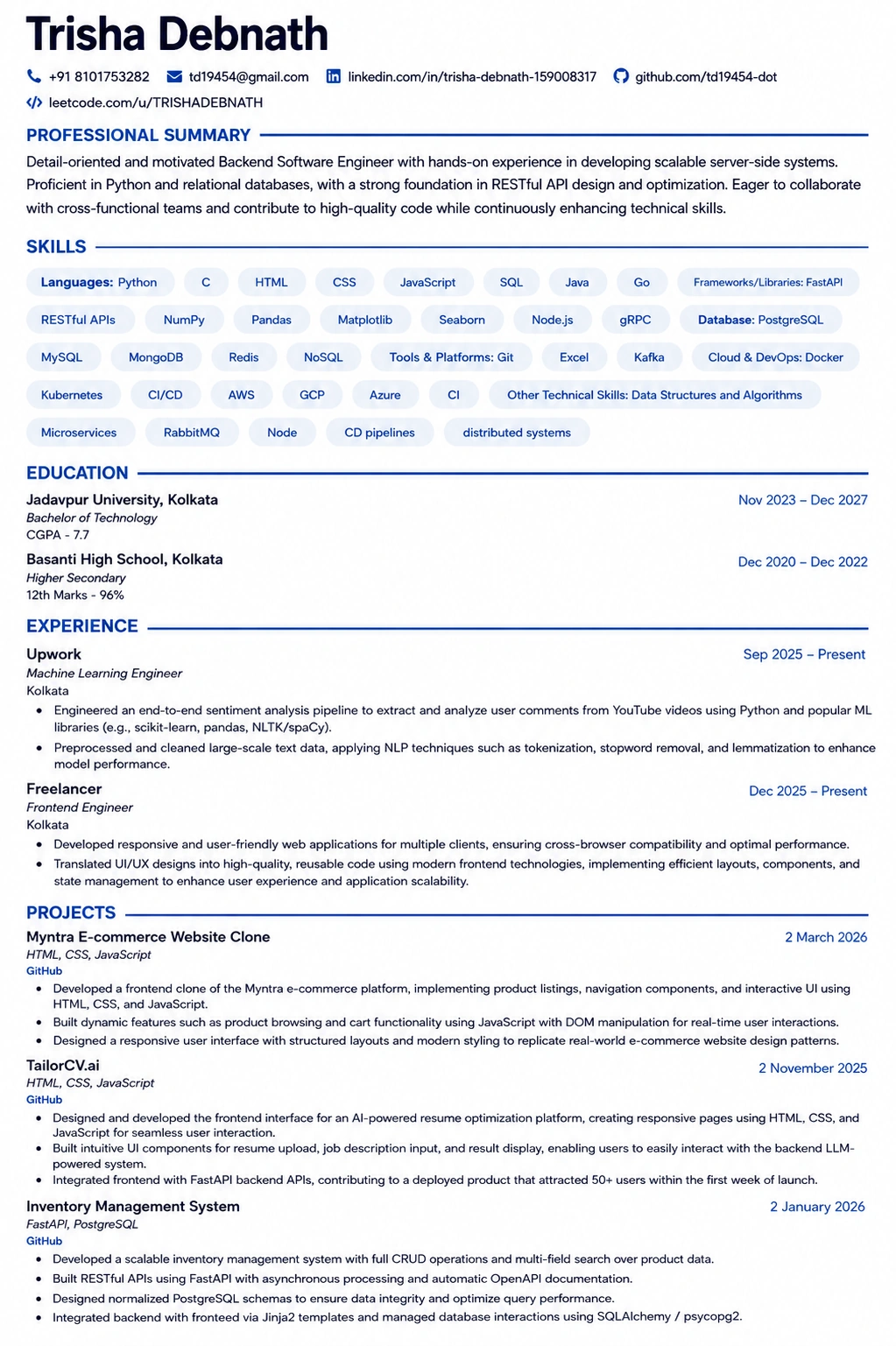
Templates that keep this structure intact
This template is ATS-tested — start from it and the formatting rules in this guide are already handled.
Was this guide useful?
Be the first to rate it.