 TD
TD

Key Takeaways
- Only three bullets are read closely on a first pass: the first two under your current role, plus whichever one a scanning eye lands on.
- Rewrite those three per application and leave the rest alone.
- Pick them by relevance to the posting's top-signal requirements, not by which you like best.
- Reordering is often enough - a well-written bullet in the wrong position needs moving, not rewriting.
- Anything below your second role is skimmed at best; rewriting there is near-wasted effort.
Twenty bullets on a resume, ten minutes to tailor. The arithmetic only works if you know which few matter.
What Actually Gets Read
The first pass on a resume is short. In that time a reader covers your name and title, your summary, and the first couple of bullets under your most recent role. If something there earns attention, they read on. If not, they move to the next candidate.
That produces a clear hierarchy:
Read closely: the first two bullets under your most recent role. Read if the top earned it: the rest of that role, and the first bullet of the previous one. Skimmed: everything else. Effectively unread on a first pass: anything on page two.
So the three bullets worth your tailoring time are the first two under your current role, plus the strongest one you have anywhere that is relevant to this specific posting.
Choosing Them
Step 1: Identify the posting's top two requirements. From the title and opening paragraph, not the bullet list.
Step 2: Find your best evidence for each. Search your whole history, not just your current role. The strongest proof might be two jobs back.
Step 3: Get that evidence into the top three positions. Usually by reordering. Occasionally by rewriting. If the evidence sits in an older role, name the capability in your summary so it registers early.
That is the whole selection method. It takes about two minutes.
Reorder First, Rewrite Second
A large share of tailoring problems are ordering problems wearing a rewriting costume.
Current role, as written: - Maintained weekly reporting for the sales team - Supported the annual planning process - Rebuilt the revenue model in SQL, cutting reporting time from two days to 40 minutes - Onboarded two junior analysts
Applying to a data engineering role, the third bullet is the one that matters and it is buried. Nothing needs rewriting — it needs to be first.
Check ordering before you touch any wording. It is faster and it is frequently sufficient.
When Rewriting Is Warranted
Three situations justify actually changing the text.
The bullet describes a duty rather than an outcome. These are weak for every application, so fixing them improves your base resume permanently.
Before: Responsible for the weekly sales reporting process.
After: Rebuilt weekly sales reporting from four manual spreadsheets into one automated dashboard, cutting turnaround from two days to 40 minutes.
The bullet uses your vocabulary instead of the employer's. Same work, their words.
Before: Worked with different teams to agree what the new system needed to do.
After: Ran requirements gathering across four departments, translating needs into the specification for the new system.
The bullet buries the relevant part. The evidence is there, in the second half of a sentence about something else. Lead with the part this employer cares about.
Before: Managed the team calendar and supported reporting, including building the dashboard the ops team now uses daily.
After: Built the operations dashboard now used daily by the ops team, replacing three manual reports.
What to Leave Alone
Bullets under older roles. They provide context and get skimmed. Rewriting them per application is effort with almost no return.
Bullets that are already strong and already relevant. If it states an outcome with a number and matches the posting, it is finished.
Bullets about genuinely irrelevant work. Do not stretch them toward the posting — that produces the forced phrasing readers notice. Either cut them or leave them short and plain.
Your whole second page. On a first pass it does not exist.
A Worked Pass
A marketing analyst applying for a growth role. The posting's opening paragraph emphasises experimentation and retention.
Current role bullets, original order: 1. Produced weekly and monthly campaign performance reports 2. Managed the marketing calendar across three channels 3. Ran A/B tests on email subject lines and landing pages 4. Supported the annual budget planning process
The relevant evidence is bullet 3, and it is understated. Two moves:
Tailored: 1. Ran 24 A/B tests across email and landing pages; the winning onboarding variant lifted week-one retention from 41% to 58% 2. Produced weekly and monthly campaign performance reports 3. Managed the marketing calendar across three channels 4. Supported the annual budget planning process
One bullet moved and rewritten to state the outcome. Three untouched. Under three minutes, and the reader now meets the relevant evidence first.
Frequently Asked Questions
How many bullets should each role have? Three to five for your current role, two to four for the previous one, one or two for older roles. More than that and the important ones get diluted.
Should I rewrite bullets permanently or per application? Fix duty-statements permanently — they are weak everywhere. Vocabulary changes are per application.
What if my most relevant work is from three jobs ago? Name the capability in your summary so it appears in the top third, and keep that bullet strong within its role. Do not reorder your employment history out of chronological order.
Is it worth rewriting bullets for a job I am unlikely to get? Reorder, do not rewrite. Ordering is the cheap move and captures most of the benefit.
Should every bullet have a number? No. Some outcomes are real without being measurable — "removed a recurring source of month-end errors" is concrete. Forcing numbers everywhere produces invented ones.
Find Which Evidence Is Missing
Choosing the right three bullets depends on knowing what this posting actually weighs.
Scan your resume against the posting — the terms it flags as missing usually point straight at which of your bullets need the employer's vocabulary, and which of your achievements are not surfacing at all.
Related: reordering bullets beats rewriting them and turning a duty into an achievement.
What is your resume scoring right now?
Scan it against a job description and get your ATS match score in about a minute.
Drop your resume here or choose a file
PDF only. Max 2 MB.
We never share your data or use it to train AI models.

Templates that keep this structure intact
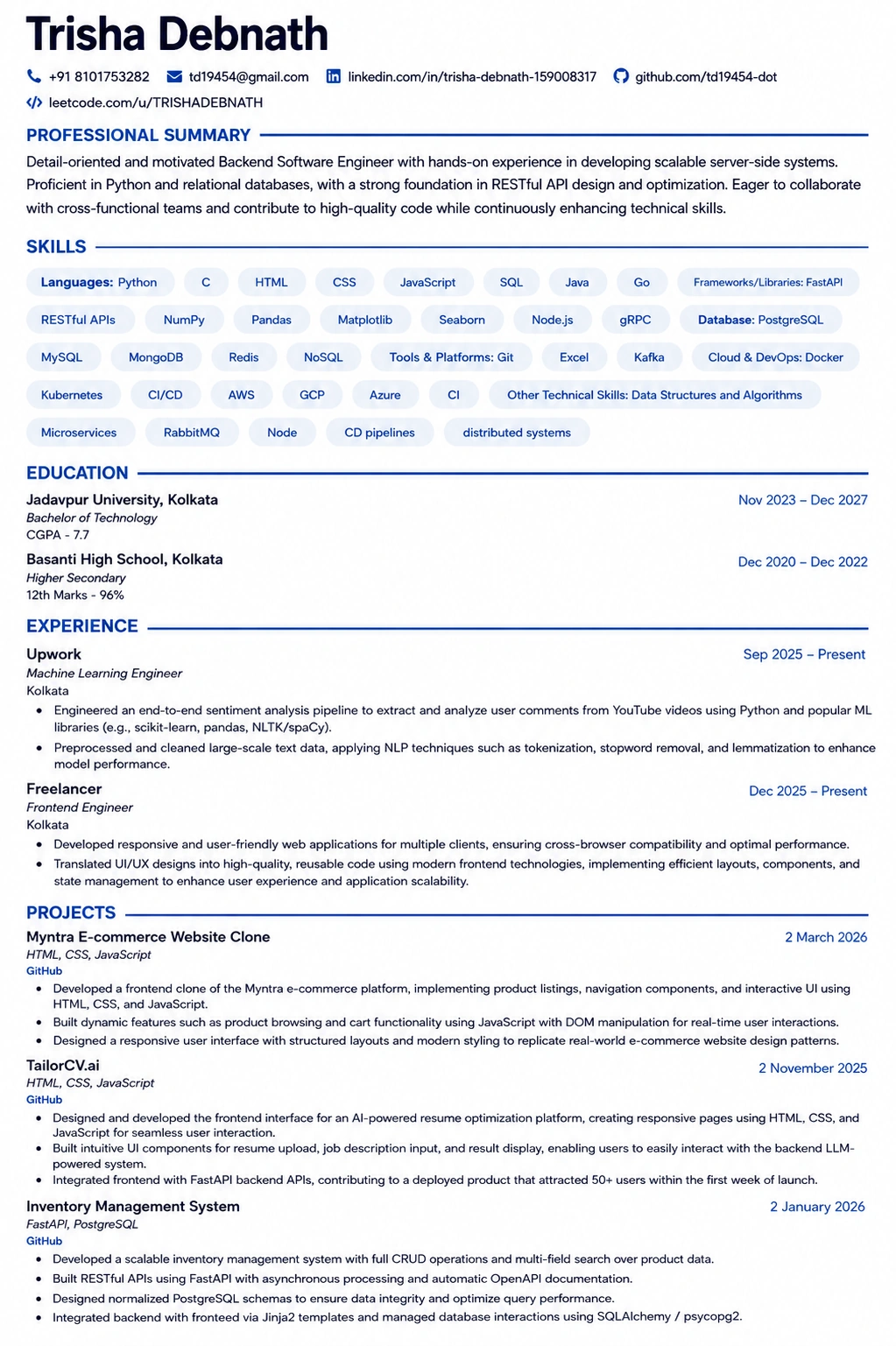
This template is ATS-tested — start from it and the formatting rules in this guide are already handled.
Was this guide useful?
Be the first to rate it.