TD
TD
Key Takeaways
- A fresher resume in India should be one page; two pages only once you have several years of experience.
- Percentage or CGPA is expected and should be stated plainly — omitting it reads as concealment.
- Projects carry more weight than they used to, particularly for technology roles, and deployed work beats described work.
- A photo is not required and is increasingly omitted; many companies prefer no photo.
- Automated screening is universal at large recruiters, so parseable formatting matters more than design.
The structure
Indian recruiters read fast and screening software reads first.
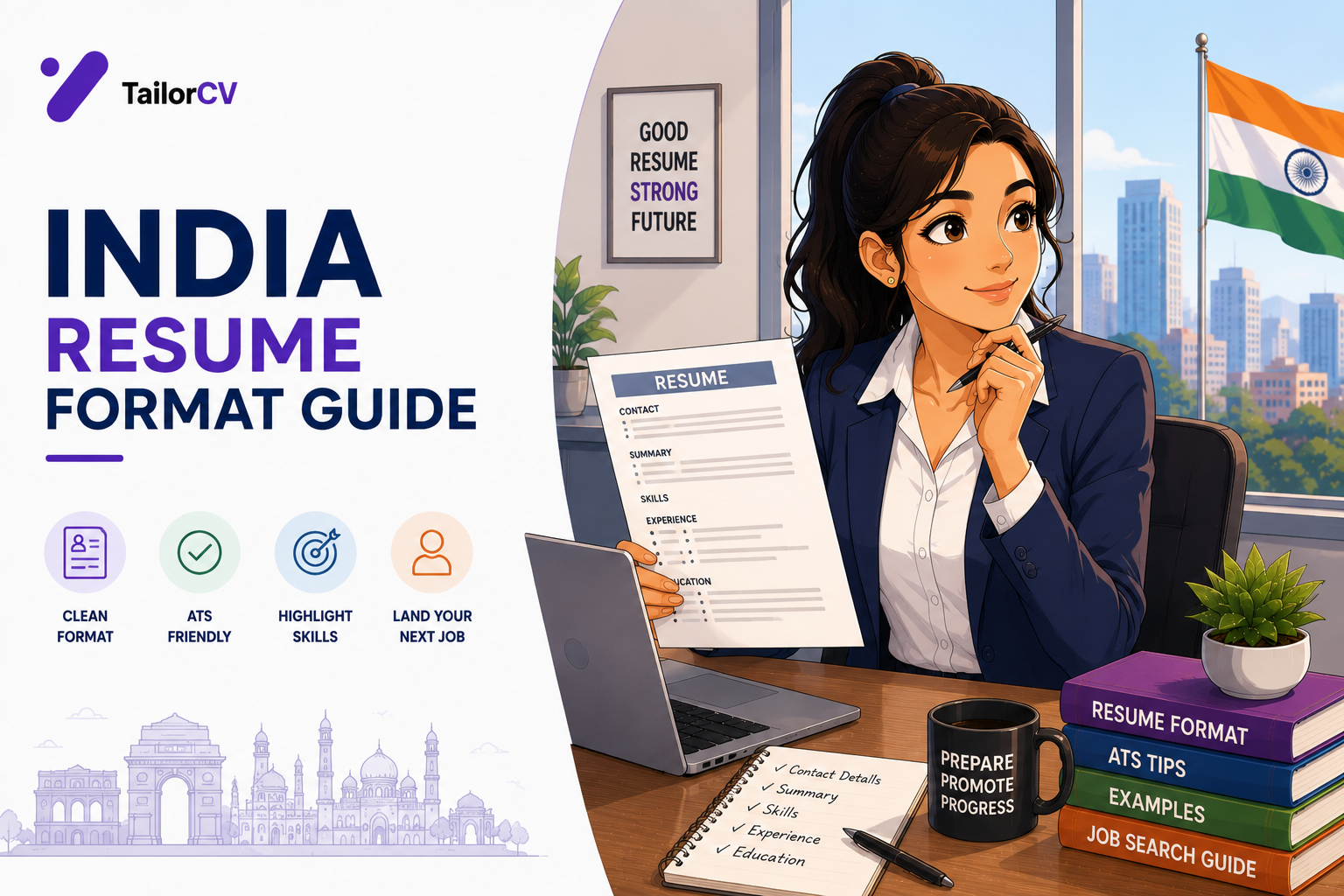
Contact details: name, phone, professional email, city, LinkedIn, and a GitHub or portfolio link for technical roles. No full address is needed.
A career objective is optional and usually weak. "Seeking a challenging role in a reputed organisation" appears on an enormous number of resumes and says nothing. Replace it with a two-line summary that states your specialisation and one concrete thing, or omit it.
Education, with degree, institution, year and your percentage or CGPA. State it — Indian recruiters look for it and eligibility criteria at large recruiters depend on it.
Technical skills, grouped and specific. Languages, frameworks, databases, tools. Do not list everything you have ever opened.
Projects, and for a fresher this is the most important section. More below.
Internships and experience, reverse chronological, with what you actually did and what came of it.
Certifications, which are common and useful in the Indian market.
Achievements and positions of responsibility, including competitive results, hackathons and college leadership roles.
No photo, no date of birth, no marital status, no father's name. These appear on older Indian resume templates and are not expected by modern recruiters, particularly at product companies and GCCs.
Projects, properly
The section that decides a fresher resume in technology.
Two or three projects, described properly, beat six listed by title.
Say what the problem was. "A web app" tells a reader nothing. "A tool that scrapes college notice boards and pushes updates to a Telegram channel, because students were missing deadlines" tells them how you think.
Say what you built and with what. Specific stack, specific approach.
Say what was hard. The interesting part of any project is the constraint you hit and what you did about it.
Link it. A deployed URL or a repository. Indian technical recruiters do click, and a project that runs outperforms one that is described.
Do not list tutorial projects as if they were original. A to-do app or a clone of a well-known site from a course is recognised instantly. If you built one, extend it into something of your own.
Team projects need attribution. State what you personally did.
Screening and the platforms
Practicalities that decide whether a human ever sees the document.
Naukri is the dominant job platform and its profile is searched directly by recruiters — completing it fully matters as much as the resume you upload.
LinkedIn matters for product companies, GCCs and startups.
Internshala for internships and fresher roles.
Company career portals for the large recruiters, all of which run applicant tracking systems.
Format for the parser. Single column, standard headings, no text inside images, no tables for layout, and a PDF whose text you can select. Design-heavy templates from resume builders frequently parse badly.
Mirror the job description's exact terms where they are genuinely true of you.
Run it through an ATS check once before you start applying rather than after a month of silence.
Adapting for different targets
One resume does not serve all three Indian markets well.
For IT services applications, foreground eligibility data — percentage, no backlogs, branch — plus communication skills and any aptitude or coding test performance. These recruiters screen on criteria first.
For product companies, foreground projects, technical depth and anything competitive — hackathons, competitive programming ratings, open-source contributions. Pedigree matters less and demonstrated capability matters more.
For GCCs, balance the two — technical capability plus clear communication, since these roles interface with international teams.
For non-technical roles, foreground internships, leadership positions, and any quantified commercial or analytical work.
Keep one master and cut per application. Rewriting from scratch each time is unnecessary; reordering and trimming takes twenty minutes.
Common resume mistakes in India
Six that recur constantly.
Objective statements that say nothing. "Seeking a challenging position in a growth-oriented organisation" appears on a vast number of resumes.
Skill lists that include everything. Listing twenty technologies dilutes the five you actually know, and interviewers probe the ones you claim.
Tutorial projects. A course clone presented as original work is recognised immediately.
Photos and personal details. Father's name, date of birth, marital status and a photograph are dated conventions that modern recruiters do not expect.
Design-heavy templates. They look impressive and frequently parse into nonsense.
And declaration lines with a signature. "I hereby declare that the above information is true" at the bottom is a legacy convention that adds nothing and dates the document.
Building the resume when you have nothing yet
The most common starting position, and it is solvable.
Coursework is not experience and listing module names adds nothing. One project described properly replaces ten course titles.
Build something small and real. A tool that solves an actual problem you or someone you know has. Scope it to something you can finish in a few weekends.
Deploy it. A working URL changes how it reads entirely.
Contribute to open source. Even small documentation or bug-fix contributions are verifiable public work, and they show you can operate in someone else's codebase.
Compete. Hackathons, competitive programming, Kaggle. A rating or a placement is an objective external signal.
Take a serious certification in something relevant — cloud platforms in particular are well recognised by Indian employers.
Do a real internship, including an unpaid or small startup one, since converted internships are one of the best entry routes available.
And write about what you build. A short technical blog post about a problem you solved demonstrates communication and thinking together, which few fresher resumes do.
Tailoring per application
The habit that separates shortlisted candidates.
Keep one complete master resume with everything — every project, internship, certification and achievement. It is never sent.
Cut per application. Remove the irrelevant, reorder so the relevant sits highest, and adjust the summary to name the role.
Mirror the job description's vocabulary. If the posting says "Spring Boot" and you have used it, write "Spring Boot" and not "Java frameworks". Screening matching is literal.
Match the seniority language. A fresher role and a role wanting two years read differently even for the same skills.
Keep a log of what you sent where. Indian processes can run over weeks and being asked about a document you cannot recall is avoidable.
Update the master quarterly, particularly while you are actively building projects, so nothing you did gets forgotten.
Formatting rules that decide parsing
The mechanics, since so much Indian shortlisting is automated.
Single column. Two-column resumes look organised and interleave into nonsense when extracted. This is the most common self-inflicted failure.
Standard section headings — Education, Experience, Projects, Skills. A parser looks for recognisable labels.
No tables for layout. They frequently extract in the wrong order.
No text inside images or icons. Icon-based contact blocks are popular in Indian resume templates and they render your phone number invisible to a parser.
Standard fonts and simple bullet characters. Decorative glyphs sometimes extract as junk.
Consistent date formats, so the parser can build a chronology.
Export as PDF and confirm you can select the text. If you cannot select it, the resume is an image and no system can read it.
Name the file properly — "Rahul_Sharma_Resume.pdf" rather than "resume final v3.pdf".
And test it. Copy the text out into a plain editor and read what comes out. Ninety seconds, and it catches the failure mode that silences more applications than any content problem.
Sector-specific emphasis
The base format holds; what you foreground shifts.
Software and IT. Projects first with links, then technical skills grouped by category, then education. Competitive programming ratings and open-source contributions belong high.
Data and analytics. Projects with real datasets, the tools used, and any measurable outcome. Kaggle results and dashboards are worth linking.
Core engineering — mechanical, civil, electrical. Software packages by name, any design or simulation work, internships at manufacturing or construction firms, and relevant certifications.
Commerce and finance. Academic percentage prominently, professional qualification progress such as CA or CFA, internships at firms, and any modelling or analytical work.
Management and business. Internships, leadership positions, live projects, case competition results and quantified outcomes.
Design. A portfolio link at the very top, with the resume as a supporting document rather than the main artefact.
And for government exam preparation, a resume is largely irrelevant — that track runs entirely on examination performance.
Mini checklist
- unchecked: One page for a fresher
- unchecked: CGPA or percentage stated
- unchecked: Two or three projects described properly with links
- unchecked: Technical skills grouped and specific
- unchecked: No photo, no personal details beyond contact
- unchecked: Single column, parseable formatting
- unchecked: Naukri profile completed fully
- unchecked: Job description terms mirrored where true
- unchecked: Checked with an ATS scan
Scenarios
Scenario 1: You are a fresher with no internship
Projects are your entire case. Build two or three real ones, deploy them, describe the problem and the constraint, and link them at the top of a one-page resume.
Scenario 2: You are applying to both services and product companies
Keep one master and adjust emphasis. Services applications benefit from clear eligibility data and communication skills; product applications need the projects and technical depth foregrounded.
Scenario 3: Your resume is not getting shortlisted anywhere
Check parsing first. Copy the text out of your PDF into a plain editor and read it. A large share of shortlisting failures in India are formatting failures rather than content ones.
Tip: Put a working link to a deployed project in the top third of page one. Indian technical recruiters do click through, and thirty seconds of a running application does more than a page of description.
Do's and Don'ts
Do
- Keep it to one page as a fresher
- State your CGPA or percentage
- Describe two or three projects properly
- Link deployed work
- Complete your Naukri profile fully
- Use single-column parseable formatting
Don't
- Use a generic career objective
- List tutorial projects as original work
- Include a photo or personal details
- Use design-heavy templates that parse badly
- List every technology you have touched
- Omit your academic percentage
Common Mistakes
- Generic objective statements. They appear on a huge share of resumes and say nothing.
- Tutorial projects presented as original. Recognised instantly by anyone technical.
- Design-heavy templates. They look good and parse badly.
- Listing skills indiscriminately. It dilutes the ones you actually have.
- Omitting CGPA. It is expected and its absence reads as concealment.
- No project links. In technical hiring the running thing is the argument.
Related Guides
Keep building on this with the related guides in this series:
- Graduate Jobs in India - How the Market Works
- Technology Jobs in Bangalore and Hyderabad
- Global Capability Centres in India
- IT Services versus Product Companies
- Salary Negotiation for Indian Freshers
You can also check your resume's ATS score for free, generate a tailored cover letter, or build a portfolio website in minutes.
Frequently Asked Questions
How long should a fresher resume be in India?
One page. Two pages only once you have several years of experience, and a fresher resume running to two pages usually indicates padding.
Should I include a photo?
No. Modern Indian recruiters, particularly at product companies and GCCs, do not expect one, and older templates that include photos and personal details are dated.
Do I need to state my CGPA?
Yes. It is expected, large recruiters have eligibility criteria based on it, and omitting it reads as concealment rather than discretion.
How many projects should I include?
Two or three described properly, with links to deployed work. Six listed by title with no detail is considerably weaker.
Does the Naukri profile matter as much as the resume?
Frequently more. Recruiters search Naukri profiles directly, so completing it fully is as important as the document you upload.
Why am I not getting shortlisted?
Check parsing before content. Copy your PDF text into a plain editor — a large share of Indian shortlisting failures are formatting problems rather than weak backgrounds.
Should I write different resumes for services and product companies?
Adjust emphasis rather than rewriting. Services applications need eligibility data and communication foregrounded; product applications need projects and technical depth first.
Should I include a declaration line at the end?
No. "I hereby declare that the above is true" with a signature is a legacy convention that adds nothing and makes the document look dated.
Should I tailor my resume for every application in India?
Yes, by cutting a master document rather than rewriting. Mirror the job description's exact technical vocabulary where it is genuinely true of you — screening matching is literal.
What formatting breaks Indian resume screening?
Two-column layouts, tables used for layout, text or contact details inside icons and images, and PDFs that are actually images. Copy your text into a plain editor to test it.
Should my Indian resume change by sector?
Yes, in emphasis. Software leads with linked projects, data with datasets and outcomes, core engineering with software and certifications, commerce with percentage and qualification progress, and design with a portfolio link at the top.
Does your formatting survive the parser?
Upload your resume and see what an ATS actually reads back.
Drop your resume here or choose a file
PDF only. Max 2 MB.
We never share your data or use it to train AI models.

Was this guide useful?
Be the first to rate it.