 TD
TD
Key Takeaways
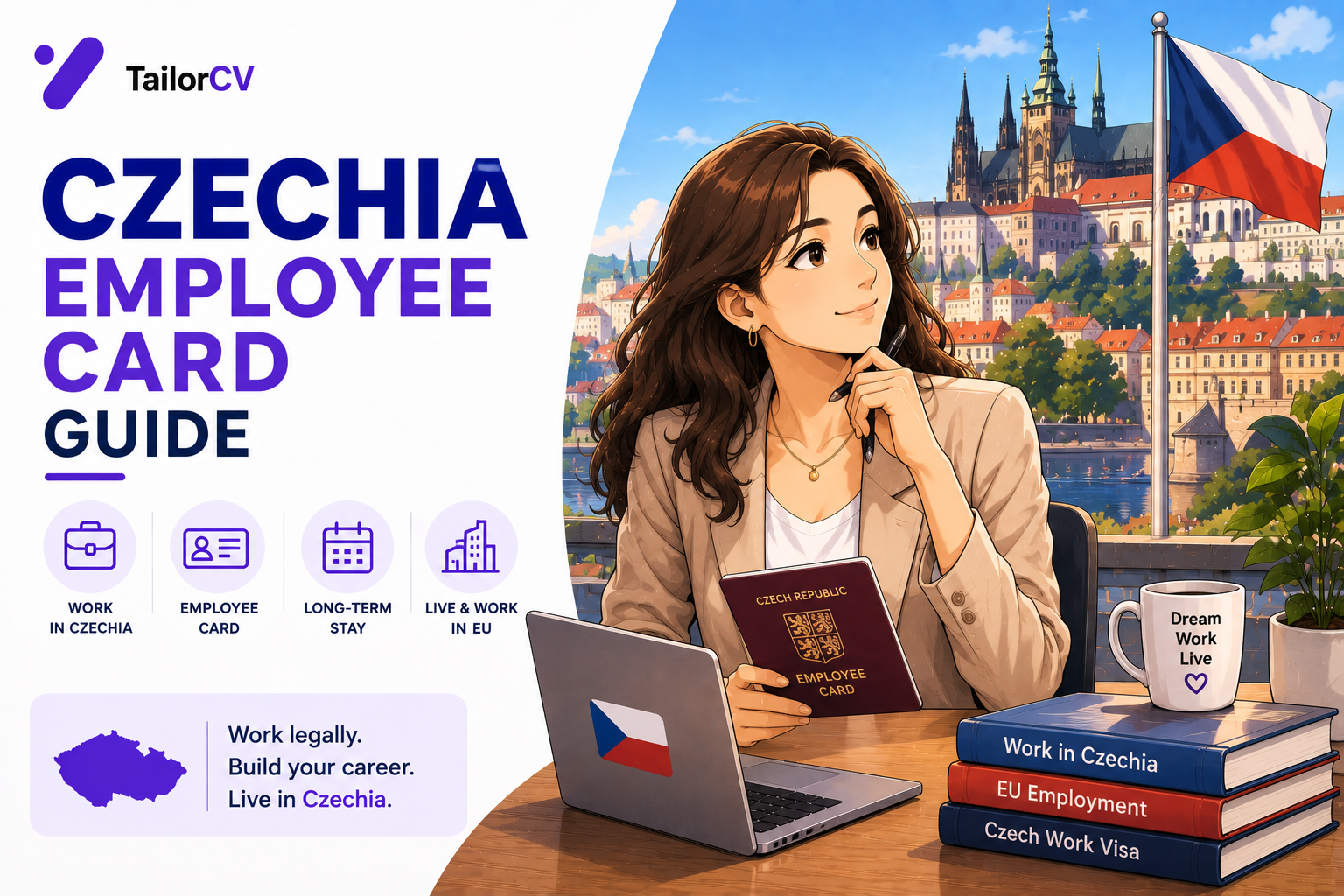
- The Employee Card is the main dual work-and-residence permit for non-EU nationals in Czechia.
- It is tied to a specific job and employer initially, with changes requiring notification or approval.
- The EU Blue Card is available for higher-qualified roles above a salary threshold and carries advantages.
- A fast-track programme exists for qualifying employers, substantially shortening processing.
- The position must generally be advertised in the central register first, which affects the timeline.
The Employee Card
Czechia's standard route and the one most people use.
It is a dual permit. One document authorising both residence and employment, which is simpler than systems requiring two separate processes.
It is job-specific. The card relates to a particular position with a particular employer, and it is issued on the basis of that vacancy.
The vacancy must generally be in the central register of job vacancies available to Employee Card holders, and it must typically have been advertised for a period first so that domestic and EU candidates have the opportunity to apply. This labour market test adds time to the front of the process.
Qualification requirements apply, with the education or vocational training needing to match the role.
Applications are made at a Czech embassy or consulate abroad, and consular appointment availability is a genuine bottleneck in some countries — this catches people out more than any other part of the process.
Validity is tied to the employment contract, up to a maximum period, and it is renewable.
Changing employer requires notification to the Ministry of the Interior and, depending on circumstances, approval — it is not free movement between jobs.
The EU Blue Card
The better option where you qualify.
For higher-qualified employment requiring university education or equivalent, with a salary above a defined multiple of the average gross salary.
Advantages over the Employee Card: easier family reunification, better provisions for mobility within the EU, and a stronger position for long-term residence.
The same central register and advertising requirements generally apply.
Check the current salary threshold, which is revised as average wages change.
If your offer clears the threshold and the role requires a degree, aim for the Blue Card rather than the Employee Card — and note that some employers default to the Employee Card out of habit.
The fast-track programmes
Genuinely useful and widely unknown.
Czechia operates government programmes aimed at speeding up the recruitment of qualified foreign workers for approved employers, with names and scopes that have changed over time.
Qualifying employers — typically those meeting criteria on size, tax compliance and business standing — can have their applicants processed considerably faster, including guaranteed consular appointment slots, which is the part that matters most.
Separate programmes have existed for highly qualified workers, key personnel, and specific sectors experiencing shortages.
Ask your employer directly whether they participate. It can be the difference between a start date in two months and one in six, and many candidates never think to ask.
The employer must be registered in the programme in advance, so this is not something that can be arranged mid-application.
After arrival
The sequence once you are in the country.
Biometrics appointment within a defined period of arriving, at the Ministry of the Interior office, to have your residence card issued.
Address registration, which is required and needs proof of accommodation.
Health insurance. Public health insurance applies once you are employed; before that, commercial insurance is required and you should not have a gap.
Birth number (rodné číslo), which functions as your identifier for administration.
Bank account and the usual practical setup.
Tax registration, mostly handled through payroll for employees.
And a warning about deadlines. Czech administration operates on specific statutory periods for registration and reporting, and missing them creates avoidable problems. Note the dates you are given.
Family and long-term status
Family reunification is available, with the Blue Card offering more favourable conditions than the Employee Card.
A spouse's right to work depends on their permit and the route you came in on.
Schooling is free and public, taught in Czech, with support for newcomers; international schools exist in Prague and Brno at a cost.
Permanent residence follows a qualifying period of continuous residence, with a Czech language requirement at a basic level.
EU long-term residence is an alternative with its own conditions and mobility advantages.
Citizenship requires longer residence plus language and civics requirements.
Continuity matters for all of these, so track your absences if long-term status is the goal.
Costs and preparation
What to budget and what takes longest.
Application fees at the consulate and for the residence card.
Document apostilles and certified translations into Czech — the slowest element, involving your home country's authorities and a court-appointed translator.
Qualification recognition (nostrifikace) where required, particularly for regulated professions.
Proof of accommodation, which usually means a lease or a landlord's declaration, and finding one before you have residence is the familiar chicken-and-egg problem.
Commercial health insurance for the period before public insurance applies.
Proof of funds in some cases.
Timeline realistically: advertising period, consular appointment wait, application processing, travel, biometrics. Several months is normal without a fast-track route and considerably less with one.
Do not resign until the card is approved.
Comparing Czechia to its neighbours
Useful if you are weighing Central European options.
Against Poland. Poland's market is larger with a bigger business services sector; Czechia has lower unemployment and higher wages on average. Poland's regional occupation exemption lists are more generous than Czechia's equivalent provisions.
Against Austria. Austria pays considerably more and is more formal, with a transparent points system. Czechia is cheaper, less formal and easier to enter for a technical worker.
Against Germany. Germany is vastly larger with more opportunity and more competition. Czechia is a smaller market with a genuine labour shortage and a lower cost base.
Against Slovakia and Hungary. Similar Central European profile, with Czechia generally ahead on wages and stability.
On process specifically, Czechia's main weakness is consular appointment availability, which the fast-track programmes exist to address. Poland's regional variation is its equivalent problem.
And on language, Czech and Polish are both genuinely difficult Slavic languages, so neither has an advantage there for a Western learner.
Common failure modes
Five things that delay or derail Czech applications.
No consular appointment. The most common obstacle by a wide margin, and the reason fast-track programmes exist.
Documents not apostilled or translated. Certified translation into Czech by a court-appointed translator is required and takes time.
The vacancy not properly registered. If the position was not in the central register with the advertising period observed, the application cannot proceed.
Qualification mismatch. Your education must correspond to the role, and for regulated professions formal recognition is required.
Missing the post-arrival deadlines. Biometrics and address registration have statutory periods and missing them creates avoidable problems.
Questions to ask your employer
The ones that determine your timeline.
"Do you participate in a fast-track programme?" The single biggest lever on how long this takes.
"Is the vacancy registered and has the advertising period been observed?" Without this the application cannot proceed.
"Are we applying for an Employee Card or a Blue Card?" If your role is degree-level and above the threshold, the Blue Card is better and employers often default away from it.
"Who handles the paperwork on your side?" An employer who has done this before is a different proposition from one starting fresh.
"What consular appointment availability have your previous hires seen?" They will know, and it tells you more than any published figure.
"What is the realistic start date?" Get a considered answer rather than an optimistic one, and plan your resignation around it.
If the process stalls
What to do when nothing is happening.
Establish where it is stuck. Consular appointment, permit decision, or a missing document — the responses differ entirely.
Check appointment availability yourself rather than relying on being told. Consular booking systems release slots at intervals and persistence helps.
Ask the employer to escalate through the fast-track programme if they participate.
Confirm nothing is missing. Czech administration will not always chase an incomplete file, and a gap can sit unaddressed.
Keep a record of every submission and every reference number.
And plan for the delay rather than around an optimistic estimate. Do not resign, do not sign a lease, and do not book flights until the decision is issued.
Mini checklist
- unchecked: Employee Card versus Blue Card assessed for your offer
- unchecked: Salary checked against the Blue Card threshold
- unchecked: Employer's fast-track programme participation confirmed
- unchecked: Vacancy's presence in the central register confirmed
- unchecked: Consular appointment availability checked early
- unchecked: Qualification recognition arranged if required
- unchecked: Documents apostilled and translated
- unchecked: Accommodation proof prepared
- unchecked: Biometrics and residence card process understood
Scenarios
Scenario 1: You have a degree-level offer above the threshold
Ask for the Blue Card rather than the Employee Card. Better family provisions, better EU mobility, and a stronger long-term residence position — and employers frequently default to the Employee Card without considering it.
Scenario 2: Your consulate has no appointments
This is the most common practical obstacle in the Czech process. Ask your employer whether they participate in a fast-track programme, since guaranteed appointment slots are one of the main things those programmes provide.
Scenario 3: You want to change jobs after arriving
Understand the notification and approval requirements before resigning. The Employee Card is tied to a specific position and moving is a process rather than a free choice.
Tip: Ask your employer whether they participate in a Czech fast-track programme before anything else. Guaranteed consular appointment slots are the single biggest determinant of your timeline, and consular availability is where most Czech applications actually stall.
Do's and Don'ts
Do
- Aim for the Blue Card if you qualify
- Ask about fast-track programme participation
- Check consular appointment availability early
- Confirm the vacancy is in the central register
- Prepare apostilled and translated documents
- Understand the job-change process before you need it
Don't
- Accept the Employee Card without checking Blue Card eligibility
- Assume consular appointments are readily available
- Resign a job before understanding transfer requirements
- Leave document authentication late
- Assume the labour market test is instant
- Expect free movement between Czech employers
Common Mistakes
- Not asking about fast-track. It is the biggest single lever on your timeline and it is widely unknown.
- Defaulting to the Employee Card. The Blue Card is better where you qualify.
- Underestimating consular bottlenecks. This is where most Czech applications stall.
- Ignoring the advertising requirement. The labour market test adds real time at the front.
- Assuming job mobility. The card is position-specific and changes require process.
- Late document preparation. Apostilles and certified translations take weeks.
Related Guides
Keep building on this with the related guides in this series:
- Working in Czechia as an International Graduate
- Polish Work Permits and the Blue Card
- The EU Blue Card for Graduates
- The Red-White-Red Card Explained
- The Estonian Startup Visa Explained
You can also check your resume's ATS score for free, generate a tailored cover letter, or build a portfolio website in minutes.
Frequently Asked Questions
What is the Czech Employee Card?
A dual permit authorising both residence and employment for non-EU nationals, tied to a specific position with a specific employer.
Should I get an Employee Card or a Blue Card?
The Blue Card where you qualify — degree-level work above the salary threshold. It offers better family reunification, EU mobility and long-term residence provisions.
What is the fast-track programme?
A government scheme letting approved employers have applicants processed considerably faster, including guaranteed consular appointment slots. Ask your employer whether they participate.
Why do Czech applications take so long?
Usually consular appointment availability, plus the requirement that the vacancy be advertised in the central register first so domestic and EU candidates can apply.
Can I change employers on an Employee Card?
Not freely. The card is position-specific and changes require notification and, depending on circumstances, approval from the Ministry of the Interior.
Do EU citizens need an Employee Card?
No. EU, EEA and Swiss citizens have free movement and register their residence rather than applying for a permit.
What do I do after arriving in Czechia?
Attend the biometrics appointment within the required period, register your address, ensure you have continuous health insurance cover, and obtain your birth number for administration.
How do I get permanent residence in Czechia?
After a qualifying period of continuous residence, with a Czech language requirement at a basic level. Track your absences, since continuity affects eligibility.
What takes longest in a Czech Employee Card application?
Consular appointment availability and document apostilles with certified Czech translations. The mandatory advertising period at the front adds time too — several months in total without a fast-track route.
How does Czechia compare to Poland for work permits?
Poland's regional occupation exemption lists are more generous, while Czechia's fast-track employer programmes address its main weakness, which is consular appointment availability.
What should I ask a Czech employer about the permit?
Whether they participate in a fast-track programme, whether the vacancy is registered with the advertising period observed, whether you are applying for an Employee Card or Blue Card, and what consular waits their previous hires experienced.
What is your resume scoring right now?
Scan it against a job description and get your ATS match score in about a minute.
Drop your resume here or choose a file
PDF only. Max 2 MB.
We never share your data or use it to train AI models.

Was this guide useful?
Be the first to rate it.