 TD
TD
Key Takeaways
- Service companies build for clients; product companies build their own software. The daily work differs more than the job titles suggest.
- Services hire in bulk with structured training; product companies hire selectively with a much higher technical bar.
- Pay differs substantially at entry and diverges further with experience.
- Moving from services to product is common and achievable, and it is the single most trodden path in Indian technology.
- Neither is objectively better — they suit different starting positions and different goals.
What each actually does
The distinction people repeat without understanding.
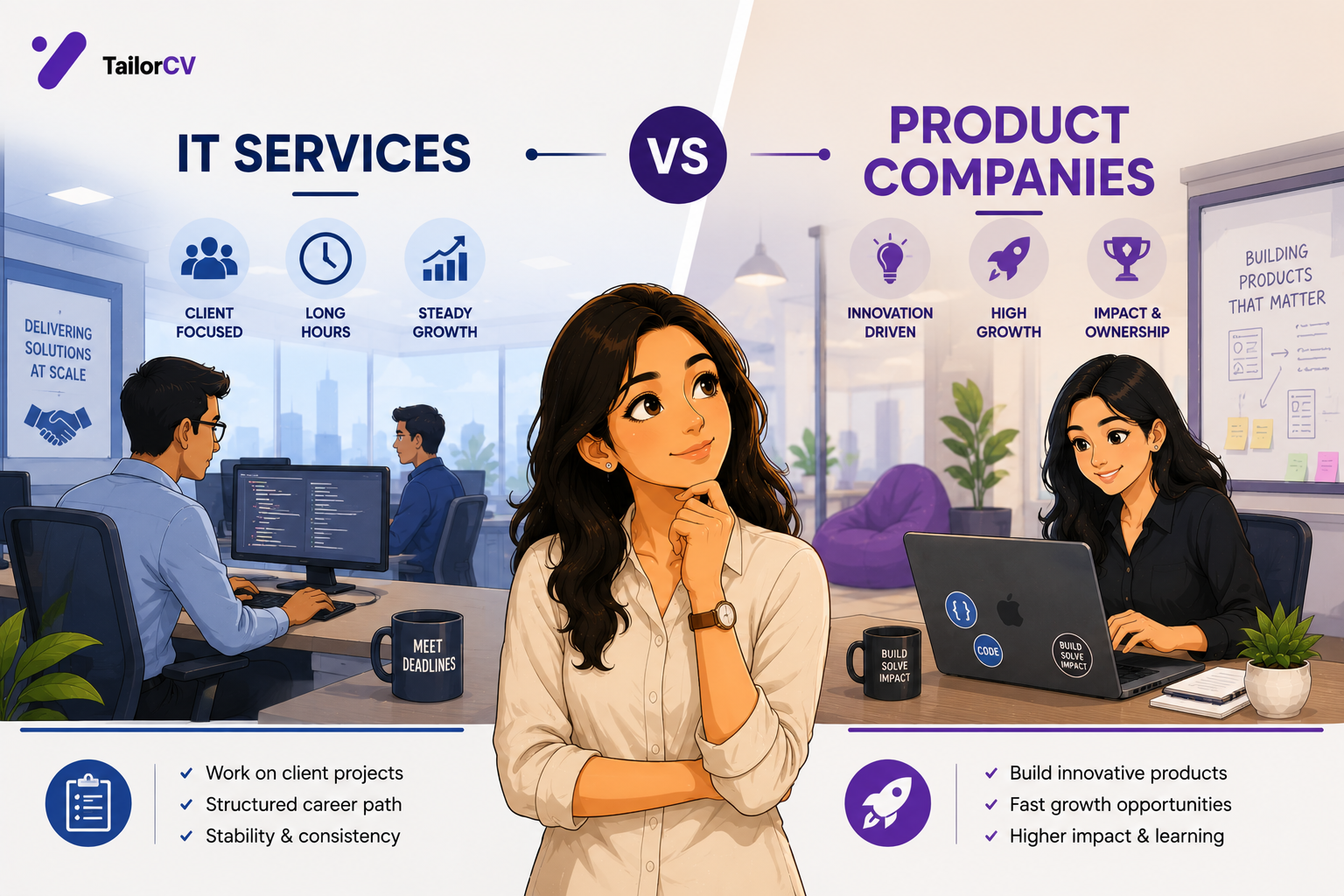
A services company sells its people's time to clients. TCS, Infosys, Wipro, Cognizant, Accenture, Capgemini, HCL and their peers build and maintain software for banks, retailers, insurers and manufacturers who do not want to build it themselves.
A product company builds and owns its own software. Whether that is a consumer app, a SaaS platform or infrastructure, the company decides what to build, ships it, and lives with the consequences.
The daily difference is ownership. In services you work within a client's requirements, timelines and technology choices. In product you participate in deciding those things.
Scale differs too. Services projects are frequently large, long-running and maintenance-heavy. Product work is frequently smaller, faster and more iterative.
Neither is trivial. Large-scale enterprise integration is genuinely hard engineering, and dismissing services work as unskilled is both wrong and a common graduate error.
Side by side
| IT services | Product company | |
|---|---|---|
| Client | External, contracted | Internal, the company itself |
| Hiring volume | Very high | Low |
| Entry bar | Eligibility criteria, aptitude test | DSA, projects, system design |
| Training | Extensive structured bootcamp | Minimal, learn by doing |
| Technology choice | Frequently set by the client | Chosen by the team |
| Pace | Project cycles, sometimes slow | Faster, iterative |
| Entry pay | Standardised, modest | Wide range, generally higher |
| Pay growth | Steady, structured bands | Steeper, performance-linked |
| Job security | Generally high | More variable, particularly at startups |
| Learning curve | Structured but sometimes narrow | Steep and self-directed |
When services is the right choice
Because the internet's dismissiveness about this is unhelpful.
You did not clear product interviews yet. That is an extremely common position and services gives you a paid start while you continue preparing.
You want structured training. The services bootcamps are genuinely substantial and teach fundamentals many graduates lack.
You value stability. Services employment is generally more secure than early-stage product work.
You want a recognisable name on your first resume line, which does help subsequent applications.
You are unsure what you want to specialise in. Exposure to multiple clients and domains is a real advantage for someone still deciding.
And the exit is well established. Moving from services to product after two or three years is one of the most common trajectories in Indian technology, and the people who do it well use those years deliberately.
Making the move from services to product
The practical path, since so many people want it.
Start preparing immediately, not later. DSA practice alongside a full-time job is hard and it is the only way this works. An hour a day for a year is the realistic shape.
Build something outside work. Client work is frequently not shareable, so you need public projects that demonstrate capability.
Get depth somewhere. Cloud certification, a data engineering specialism, security — something specific that distinguishes you from the volume of generalist services engineers.
Use the domain knowledge. Two years in banking projects makes you genuinely more valuable to a fintech than a generalist fresher, and candidates consistently undersell this.
Time it around two to three years. Early enough that you are still hired against potential, late enough to have real experience.
Apply to GCCs as well as product companies. They are frequently a more achievable step and pay well above services.
And be honest in interviews about what you did and did not own. Overstating your role in a large client project is easily unpicked.
What each looks like day to day
Concretely, since the abstract comparison only goes so far.
In services, you are frequently one of many engineers on a large client engagement. Requirements arrive, technology choices are often already made, and the work involves building, integrating and maintaining within those constraints. Client communication is a real part of the role, and process and documentation matter.
In a product company, teams are smaller, ownership is clearer, and you are more likely to be involved in deciding what gets built as well as building it. The pace is faster, the feedback loop is shorter, and the consequences of a decision land on you rather than on a client.
In a GCC, it is somewhere between — the parent's product, the parent's standards, with the India team's scope depending on the centre.
Learning differs. Services teaches breadth, process and client interaction. Product teaches depth, ownership and speed.
And neither is uniformly better. Plenty of people find product-company pace stressful and services structure comfortable; plenty find the reverse. Knowing which you are is worth more than any salary comparison.
Reading an offer properly
Because CTC comparisons mislead constantly.
Break the number down. Fixed base, variable pay, joining bonus, retention bonus, gratuity, employer PF contribution and any notional benefits are all frequently included in an advertised CTC.
Only fixed base is guaranteed monthly income. Variable pay depends on performance and company results.
Joining and retention bonuses are one-time and inflate the first year's figure misleadingly.
Stock, where offered, needs its vesting schedule understood.
And compare take-home, not CTC. Two offers with the same headline can differ meaningfully in what actually reaches your account each month.
Ask for the breakdown in writing. It is an entirely normal request and the answer is the offer.
Common misconceptions
Five beliefs that shape bad decisions.
"Services work is not real engineering." Large-scale enterprise integration, migration and maintenance is genuinely difficult work, and dismissing it is both wrong and a common graduate error.
"Product companies are always better paid." At entry generally yes; at a struggling startup, not necessarily, and equity that never vests is worth nothing.
"I can move whenever I want." The move gets harder the longer you leave it. Two to three years is the window where it is easiest.
"Training at services will make me employable elsewhere." The training teaches fundamentals; what makes you employable elsewhere is what you build and learn on your own time.
"A big brand on my resume is enough." It helps with screening and it does not survive a technical interview on its own.
And a sixth: "GCCs are just services with a different name." They are not — different employer, different economics, different work.
Choosing between two offers
A practical framework when you have one of each.
Ask what you would actually work on. A specific answer beats a vague one, and services offers frequently cannot name your project at offer stage — which is itself information.
Ask about the training. Services bootcamps vary in quality and length, and a good one is genuinely valuable.
Ask about team size and ownership at the product company. A small team means more scope.
Compare fixed base, not CTC.
Consider the location and what the salary buys there.
Assess stability honestly if the product company is early-stage — funding runway matters and it is reasonable to ask about it.
And weigh what you want to learn. Breadth and process, or depth and ownership. That question determines the answer more reliably than the salary difference does.
The startup option
A third category that gets collapsed into "product" and behaves differently.
Early-stage startups hire fast and informally. Referrals, direct outreach and quick processes rather than structured interview loops.
Ownership is immediate. A graduate at a fifteen-person company will own real features within weeks, which is a genuine learning accelerator.
Pay varies enormously. Some funded startups pay competitively with product companies; many do not, and equity is frequently offered in place of cash.
Equity needs scrutiny. Ask about the total shares outstanding, your strike price, the vesting schedule and what happened in previous funding rounds. A large-sounding grant means little without those.
Stability is genuinely lower. Funding runway is a real risk and asking about it directly is reasonable rather than rude.
And the learning is unmatched if the company survives. People who spend two years at a growing startup frequently come out with more scope than peers at larger companies — and people at a startup that fails come out with a gap and a story, which is survivable but worth going in aware of.
Mini checklist
- unchecked: Decided which you are targeting and why
- unchecked: Preparation matched to that target
- unchecked: DSA practice scheduled if aiming at product
- unchecked: Public projects built outside work
- unchecked: A specialism chosen and developed
- unchecked: Domain knowledge from services work articulated
- unchecked: GCCs included as a middle option
- unchecked: Two to three year timeline planned if moving
- unchecked: Honest about ownership in interviews
Scenarios
Scenario 1: You have a services offer and no product offer
Take it, and start preparing the same month. A paid start with structured training while you build toward a move is a considerably better position than waiting unemployed for a product offer.
Scenario 2: You are two years into services and stuck
The move is achievable and it requires deliberate work — daily DSA practice, public projects and a specialism. People who drift for five years find it much harder than people who move at two or three.
Scenario 3: You want product work but keep failing interviews
Consider GCCs as an intermediate step. The bar is real but frequently more forgiving than top product companies, the pay is well above services, and the experience makes the next move easier.
Tip: If you take a services role, start preparing for your next one in the first month rather than the second year. An hour of DSA a day alongside work is the realistic path, and the people who move successfully almost all started early.
Do's and Don'ts
Do
- Take a services offer over unemployment
- Start preparing for the move immediately
- Build public projects outside client work
- Develop a specialism
- Use your domain knowledge in applications
- Consider GCCs as a middle path
Don't
- Dismiss services work as unskilled
- Assume the move happens automatically
- Drift for five years before trying
- Overstate your ownership of client projects
- Ignore GCCs
- Compare CTC figures without breaking them down
Common Mistakes
- Dismissing services entirely. It is a genuine start with real training and a well-worn exit.
- Not preparing from month one. The move requires sustained effort begun early.
- No public projects. Client work is usually not shareable, so you need your own.
- Drifting too long. Moving at two or three years is far easier than at six.
- Ignoring GCCs. Frequently the most achievable step up from services.
- Overstating ownership. Easily unpicked in a technical interview.
Related Guides
Keep building on this with the related guides in this series:
- Graduate Jobs in India - How the Market Works
- Global Capability Centres in India
- Technology Jobs in Bangalore and Hyderabad
- Resume Format for India
- Salary Negotiation for Indian Freshers
- Service-Based vs Product-Based Companies 2026 - Which Should You Target?
You can also check your resume's ATS score for free, generate a tailored cover letter, or build a portfolio website in minutes.
Frequently Asked Questions
Is a product company always better than IT services?
No. Product companies generally pay more and offer more ownership; services offers structured training, stability and a recognisable name. Which is better depends on your starting position and goals.
Can I move from services to a product company?
Yes, and it is one of the most common paths in Indian technology. It requires deliberate preparation — daily DSA practice, public projects and a specialism — begun early rather than late.
When is the best time to move?
Around two to three years. Early enough that you are hired partly on potential, late enough to have genuine experience to discuss.
Should I reject a services offer to keep trying for product?
Generally not. A paid start with training while you prepare is a stronger position than unemployment, and the services-to-product path is well established.
What is the middle option?
Global Capability Centres. The technical bar is real but frequently more forgiving than top product companies, and pay is well above services rates.
Does domain knowledge from services help?
Substantially, and candidates consistently undersell it. Two years on banking projects makes you genuinely more valuable to a fintech than a generalist fresher.
What is day-to-day work like in services versus product?
Services means working within a client's requirements and technology choices on large engagements, with real client communication. Product means smaller teams, clearer ownership, faster pace and involvement in what gets built.
How should I compare two Indian offers?
Break the CTC down. Only fixed base is guaranteed monthly income; variable pay, joining bonuses and notional benefits inflate headline figures. Compare take-home rather than CTC.
Is services work real engineering?
Yes. Large-scale enterprise integration, migration and maintenance is genuinely difficult, and dismissing it is a common graduate error that leads people to reject reasonable first jobs.
How do startups differ from product companies in India?
They hire faster and more informally, give ownership immediately, pay variably with equity frequently substituting for cash, and carry genuinely higher stability risk. Ask about runway and equity terms directly.
What is your resume scoring right now?
Scan it against a job description and get your ATS match score in about a minute.
Drop your resume here or choose a file
PDF only. Max 2 MB.
We never share your data or use it to train AI models.

Was this guide useful?
Be the first to rate it.