TD
TD
Key Takeaways
- Agencies read your resume for range, speed, client management and craft. In-house teams read it for depth in one brand, ownership, and business results.
- Agency to in-house: group client work by category, pick the brands closest to the target company, and show outcomes beyond the campaign - revenue, retention, long-term brand metrics.
- In-house to agency: show breadth (channels, audiences, formats), pace, and your ability to work with stakeholders as if they were clients.
- The same campaign can be framed both ways. Agency framing emphasises the brief, the client and the creative; in-house framing emphasises the business goal, the budget and what happened afterwards.
- Client names are usually fine for agencies to list, but check confidentiality and never claim a whole campaign as yours alone.
- Your portfolio should follow the same logic as your resume - many clients for an agency, depth and results for in-house.
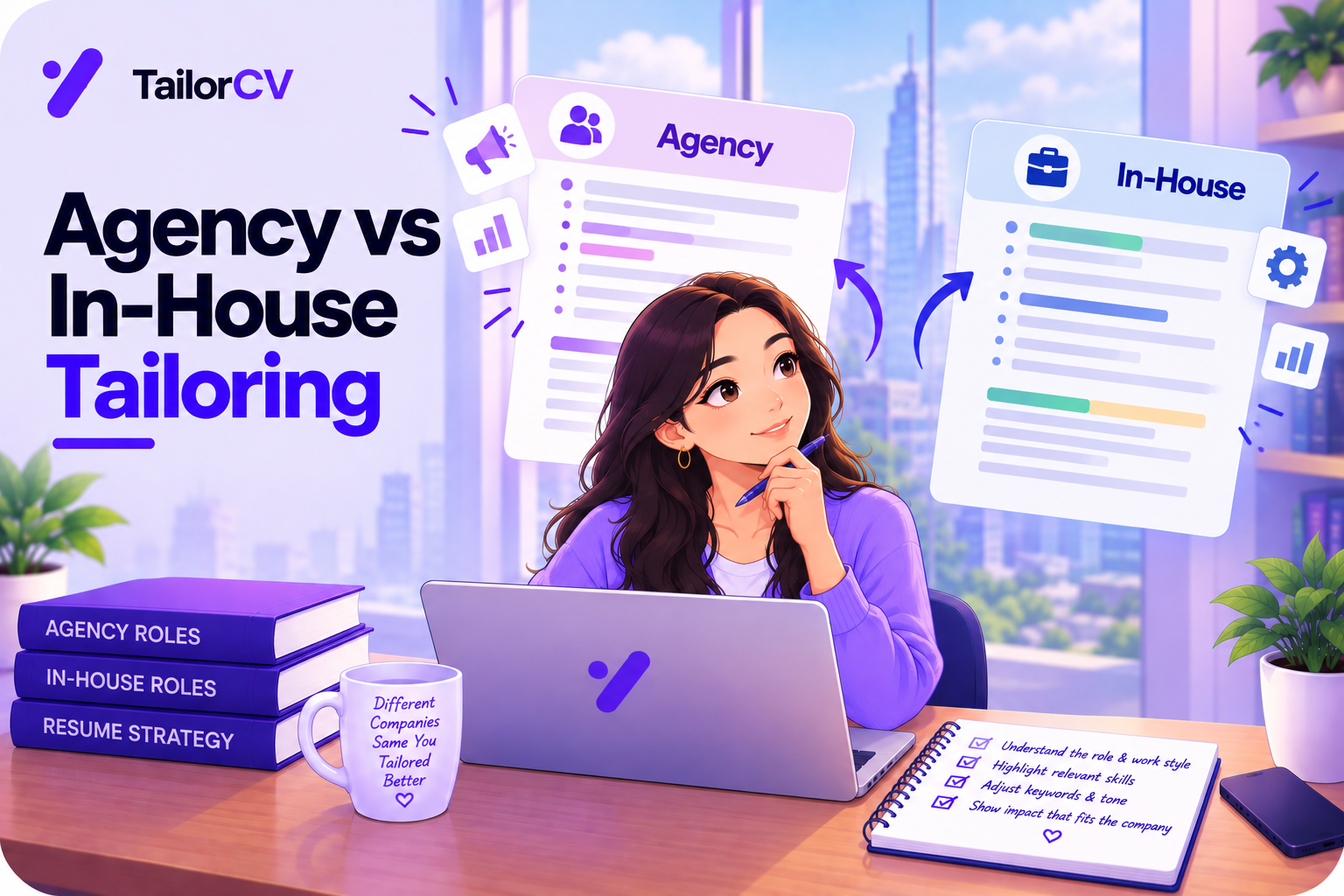
You work in marketing, design, PR, content or advertising, and you are crossing between an agency and an in-house team. The two read resumes differently. Agencies want range, speed and proof you can keep clients happy. In-house teams want depth in one brand, ownership of results over time, and business impact beyond the launch. Tailoring means presenting the same work through the lens the reader cares about.
This guide covers both directions, with the same examples framed for each.
What Each Reader Is Looking For
| Signal | Agency hiring manager | In-house hiring manager |
|---|---|---|
| Core question | Can this person deliver great work for many clients, fast? | Can this person own our brand and move our numbers? |
| Breadth vs depth | Breadth - categories, channels, formats | Depth - one brand, one audience, long-term |
| Evidence they trust | Client roster, awards, campaign results | Business metrics: revenue, CAC, retention, share |
| Pace | High volume, tight deadlines, many briefs | Longer cycles, iteration, sustained programmes |
| Relationships | Client management, pitching | Internal stakeholders: sales, product, finance, leadership |
| Portfolio | Many clients, strongest creative | Fewer projects, deeper case studies with results |
| Red flag | Only one brand, slow pace | Only campaigns, no business outcomes |
Direction 1: Agency to In-House
The main challenge is showing you care about the business after the campaign ships.
Group clients by category
An agency resume often lists every client. In-house readers want to see experience relevant to their category.
Before: "Account Manager - worked on campaigns for 15 clients including FMCG, fintech, auto, travel and healthcare brands."
After: Account Manager - Digital Agency, 2022-2026 Fintech and financial services (4 clients) - Led the always-on performance programme for a UPI payments app; new-user CAC fell 32% over 12 months while monthly acquisitions doubled. Consumer brands (6 clients) - Ran a festive campaign for a D2C skincare brand that delivered 3.1x ROAS on ₹1.5 crore spend.
If the target is a fintech, lead with the fintech group and condense the rest.
Show outcomes past the campaign
Agency results often stop at campaign metrics - impressions, CTR, engagement. In-house readers want what happened to the business.
| Agency-style metric | In-house-style framing |
|---|---|
| "Delivered 12M impressions" | "Lifted branded search 40% during the campaign period" |
| "Achieved 4% CTR" | "Drove 18,000 signups at ₹210 CAC, 30% below target" |
| "Won a regional creative award" | Keep it - and add the business result the campaign achieved |
| "Managed 8 launches a year" | "Owned the launch playbook the client still uses" |
Use only outcomes you actually know. If the client never shared business results, keep the campaign metrics and describe what the campaign was designed to achieve. Estimating impact honestly covers what you can defend.
Reframe client management as stakeholder management
In-house marketers spend much of their time aligning sales, product, finance and leadership. Your client work is strong evidence of that, if you frame it that way.
"Managed the relationship with a fintech client's CMO, product and compliance teams, getting campaigns through legal review in 5 days instead of 3 weeks."
Direction 2: In-House to Agency
The main challenge is showing range and pace.
Show breadth within your in-house role
Even one brand gives you variety: multiple channels, audiences, product lines, markets and formats. Make that variety visible.
Before: "Brand Manager - managed marketing for our flagship product."
After: "Brand Manager - ran marketing across 4 product lines, 3 regional markets and 6 channels (TV, digital video, search, social, influencer, retail), with a ₹12 crore annual budget."
Show pace and volume
Agencies run many briefs at once. Count yours.
"Briefed and delivered 40+ campaigns a year across digital and retail, working with 3 external agencies and an in-house design team."
Show you can handle stakeholders like clients
Internal stakeholders are your "clients". Pitching an idea to leadership, winning budget, or managing a demanding sales team all translate.
"Pitched and won budget for a new influencer programme from the leadership team; programme now accounts for 18% of new customers."
Bring your category expertise
Agencies pitch for clients in categories. Deep in-house experience in one category makes you valuable for pitches and accounts in that space. Name it clearly in your summary.
The Same Campaign, Framed Both Ways
This is the core tailoring move. Here is one project described for each reader.
The work: a festive-season campaign for a skincare brand - you managed the brief, coordinated creative, ran paid media and reported results.
Agency framing: "Led a festive campaign for a D2C skincare client from brief to delivery - coordinated creative, influencer and paid teams across 4 channels; 3.1x ROAS on ₹1.5 crore spend, client renewed for the following year."
In-house framing: "Owned the festive-season campaign for our skincare line - set the ₹1.5 crore budget split, briefed the agency and influencers, and tracked results through to repeat purchase; 3.1x ROAS, with 22% of new buyers purchasing again within 60 days."
The agency version emphasises delivery and the client relationship. The in-house version emphasises budget ownership and a longer-term business outcome.
Headline, Summary and Skills: What Changes
The top of the page does most of the translating. Here is how each element shifts.
Headline
Agency titles ("Account Manager", "Client Servicing Lead") and in-house titles ("Brand Manager", "Growth Marketing Manager") describe overlapping work. Use the title the posting uses, as long as it truthfully describes what you did. Use the posting's job title covers how far you can go.
| Your current title | For an in-house posting | For an agency posting |
|---|---|---|
| Account Manager (agency) | "Marketing Manager - Performance & Brand" | Keep "Account Manager" |
| Brand Manager (in-house) | Keep "Brand Manager" | "Brand Manager - Client-side, D2C Consumer" |
| Senior Designer (agency) | "Brand & Product Designer" | Keep "Senior Designer" |
| Content Lead (in-house) | Keep "Content Lead" | "Content Lead - Multi-channel, 40+ pieces/month" |
Summary
Lead with the lens the reader wants. For in-house: the category, the business outcome, and your wish to go deep. For agency: range, volume, and the categories you can help win. The three-sentence structure in summary in three sentences works well for both.
Skills line
Agency readers scan for channel and tool range; in-house readers scan for the tools their team already uses plus analytics. Reorder, do not invent, and put the posting's named platforms first - resume skills section order explains the grouping, and where to place keywords covers getting them into bullets too.
Role-specific examples of full resumes are in the marketing manager resume guide and the graphic designer resume guide.
How the Move Changes by Level
| Level | Agency to in-house: lead with | In-house to agency: lead with |
|---|---|---|
| Executive / junior (0-3 yrs) | Channels and tools you ran hands-on | Variety of tasks and campaigns delivered |
| Manager (3-7 yrs) | Accounts owned end to end, business results | Breadth of channels, volume, agency management |
| Senior / head of (7+ yrs) | Strategy, team leadership, category expertise | Category depth, leadership, pitch and client value |
At senior levels, agencies often hire in-house leaders to win and run accounts in their category; in-house teams often hire agency leaders to build capability. Name that value in your summary.
Worked Example 1: An Agency Designer Moving In-House
Situation: Neel is a senior designer at a branding agency applying for a design lead role at a fintech startup.
Before: a list of 20 clients with one-line descriptions of logos, packaging and campaigns.
After:
- Summary: "Brand and digital designer with five years at a branding agency - including three fintech brand identities - looking to own one brand's design system long term."
- Experience grouped: "Fintech and financial services (3 identities)", "Consumer and retail (8 projects)".
- Top bullet: "Designed the identity and design system for a fintech lending app, including 120 UI components; the client's product team still builds on it two years later."
His portfolio link now opens on fintech case studies with process and outcomes. For portfolio matching, see matching your portfolio to the job description.
Worked Example 2: An In-House Marketer Moving to an Agency
Situation: Ritika has four years as a marketing manager at a D2C food brand and is applying for an account director role at a performance marketing agency.
Before: "Marketing Manager. Responsible for growth marketing and brand campaigns."
After: "Marketing Manager, D2C food brand. Ran performance marketing across Meta, Google and marketplaces with a ₹6 crore annual budget; managed 2 external agencies and delivered 30+ campaigns a year, growing revenue from ₹18 crore to ₹41 crore in three years."
Her summary highlights category expertise ("D2C food and consumer"), agency management experience and volume. The agency now sees someone who has been the client and understands what clients need.
Worked Example 3: A PR Executive Choosing Between Both
Situation: Sara, two years at a PR agency, is applying to agencies and in-house communications roles.
She builds two versions. The agency version leads with her client roster, coverage volume and media relationships. The in-house version leads with her deepest account - a healthcare client she worked with for 18 months - and the reputation outcomes she tracked, such as share of positive coverage and crisis response times. For maintaining the two, see splitting resume versions.
Worked Example 4: A Copywriter Moving From a Big Agency to a Startup
Situation: Farzana spent five years as a copywriter at a large advertising agency, working on TV scripts, print ads and festive campaigns for FMCG brands. She is applying for a content lead role at a 60-person fintech startup, where she would own the blog, app copy, emails and social - mostly alone.
The gap the startup worries about: she has only worked in big teams with art directors, account managers and long approval chains. Can she ship on her own, across formats, and measure what works?
Agency-style bullet: "Wrote TV and digital scripts for a leading detergent brand's festive campaign, part of a team that won a regional creative award."
Startup-ready bullet: "Wrote and shipped the full copy set for a festive campaign - 3 TV scripts, 40 social posts, 12 email variants - on a 4-week timeline; email variants tested at up to 2x open rate over the brand's baseline."
She adds a small side project that shows ownership: a personal finance newsletter she writes and publishes alone, with about 1,800 subscribers. Her summary names both sides: "Copywriter with five years across TV, digital and email at a national agency - now writing and running a 1,800-subscriber finance newsletter on my own." The award stays, but volume, formats and measured results now lead.
Client Names, Awards and Confidentiality
Listing clients
Agencies generally expect client names, and many agency employees list them. Check your employment contract and any client NDAs; where in doubt, describe the client ("a top-3 Indian telecom brand").
Awards
Awards matter more to agencies than in-house teams, but both value them. Name the award and the category, and pair it with a business result where possible.
Credit for shared work
Creative and campaign work is collaborative. Say what you did - account lead, art director, copywriter, strategist - rather than implying you made the whole campaign. See tailoring when your work was a team effort, and for sensitive details, confidential work on your resume.
Interview Questions to Expect
Agency to in-house: "Won't you get bored with one brand?"
"At the agency I loved variety, but I kept handing campaigns over just as we learned what worked. I want to stay with one brand long enough to build on the results - which is why this role's focus on long-term brand growth appeals to me."
In-house to agency: "Can you handle the pace?"
Point to volume: number of campaigns, launches, briefs and agencies managed per year. Numbers answer this better than enthusiasm.
Prepare both sets of stories using the interview story bank method, and rehearse with the mock interview tool.
Edge Cases and Exceptions
Holding company or network agencies
Very large agency networks can feel more like in-house teams - one big client, long tenure. If you worked on one account for years, emphasise depth, not range, even when moving between agencies.
In-house creative studios
Some large companies run internal agencies that serve many brands. Present that work like agency experience: many briefs, many stakeholders, fast turnaround.
Freelancers moving to either side
Freelancers have agency-like range and in-house-like ownership. Pick the frame that matches the target: client range for agencies, end-to-end ownership for in-house roles.
Moving from client-side to a specialist agency
Specialist agencies - performance, SEO, influencer - value depth in their channel. Lead with channel results rather than general brand marketing.
Common Mistakes
Agency to in-house: listing every client
A full client list reads as breadth without depth. Group, select the relevant category and condense the rest.
Agency to in-house: only campaign metrics
Impressions and CTR alone do not show business thinking. Add downstream results where you know them.
In-house to agency: describing responsibilities instead of output
"Responsible for brand marketing" does not show pace or range. Count campaigns, channels and briefs.
Both: claiming whole campaigns
"Created the award-winning campaign" when you were one of eight people will come up in interviews. State your role precisely.
Both: a portfolio that contradicts the resume
If your resume says in-house depth but your portfolio shows 30 thumbnails with no case studies, the reader gets mixed signals. Align them.
How This Fits With Tailoring
Agency and in-house moves need a direction-specific base, then per-posting tailoring.
- Decide which reader you are writing for.
- Rewrite your summary around range (agency) or depth and outcomes (in-house).
- Group or expand your experience accordingly.
- Reframe key campaigns with the right metrics.
- Align your portfolio.
- Tailor each application from the base.
The per-posting edits are covered in what to change when tailoring, and the equivalent shift in strategy work is in consulting vs industry tailoring.
Check each version against its target posting with the free ATS scan - agency and in-house postings use different vocabulary for similar work. The AI resume optimizer can reframe your bullets toward either reader using only what is already on your resume, and the portfolio builder lets you publish a case-study page that matches the version you send.
Quick Checklist
- Which reader are you writing for - agency or in-house?
- Does your summary lead with range (agency) or depth and outcomes (in-house)?
- Agency to in-house: are clients grouped by category, with the relevant category first?
- In-house to agency: are channels, formats and campaign volume counted?
- Are campaign results matched to the reader's preferred metrics?
- Is your portfolio aligned with the version you are sending?
- Is your role on shared campaigns stated precisely?
Frequently Asked Questions
How do I tailor my resume from agency to in-house?
Group clients by category and lead with the ones closest to the target company, add business outcomes beyond campaign metrics, and reframe client management as stakeholder management. Your summary should say you want to own one brand long term.
How do I move from in-house to an agency?
Show breadth across channels, audiences and products, quantify your pace and volume, frame internal stakeholders as clients, and highlight your category expertise as a pitch and account asset.
Should I list all my agency clients on my resume?
Usually not all of them. Group them by category and focus on the most relevant, with two or three strong results. Check contracts and NDAs before naming clients.
Do in-house teams care about agency awards?
Somewhat, but they care more about business results. Keep notable awards and pair them with the outcomes the campaign achieved.
What metrics do in-house marketing teams want to see?
Business metrics such as revenue, customer acquisition cost, conversion, retention, market share and brand lift. Campaign metrics help, but downstream results carry more weight.
How do I show pace on an in-house resume?
Count your output: campaigns per year, launches, briefs, channels, agencies managed. Specific volume answers "can you handle agency pace?" better than any claim.
Should my portfolio be different for agency and in-house roles?
Yes. For agencies, show range and your strongest creative across clients. For in-house roles, show fewer, deeper case studies with the business problem, your process and the results.
Can I apply to both agency and in-house roles at once?
Yes, but build two versions. The two readers want different lead evidence, and one resume usually serves neither well.
Is agency experience valued by in-house teams?
Yes - especially for pace, range and client-management skills. It is most valued when you also show business outcomes and interest in going deep on one brand.
Should I mention which agency network I worked for?
Yes. Well-known agencies and networks help readers gauge the scale and standard of your work.
Do agencies care about in-house candidates' brand experience?
Yes. Agencies value people who understand the client side - budgets, approvals, internal politics - because it helps them serve clients better, especially in the same category.
How do I list many short agency projects on one resume?
Group them under the agency with category subheadings, and show two or three of the most relevant results per group rather than listing every project.
What to Do Now
Decide which reader you are facing, then pick your three strongest projects and rewrite them using that reader's framing - range and delivery for agencies, ownership and business outcomes for in-house. Rewrite your summary to match and align your portfolio.
Next, read consulting vs industry tailoring for the parallel move in strategy work, and tailoring across industries if the new role is also in a different category.
See what tailoring is worth on your resume
Score your current resume against a real job description before you change a word.
Drop your resume here or choose a file
PDF only. Max 2 MB.
We never share your data or use it to train AI models.

Start from a template that tailors well
Clean structure means swapping keywords per job takes minutes, not a re-layout every time.
Was this guide useful?
Be the first to rate it.