SS
SS

Key Takeaways
- Federal hiring runs through defined pathways for students and recent graduates rather than through ordinary campus recruiting.
- Most federal positions require US citizenship, which closes the route for many international graduates — but not all agencies and not all roles.
- The federal resume is a different document from a private-sector one: longer, more detailed, and explicitly matched to the announcement.
- Timelines are long. Months from application to offer is normal, and security clearance can add substantially more.
- The trade-off is stability, scale of work, structured progression and strong benefits against slower pace and lower headline pay.
The pathways that exist
Federal hiring for early-career candidates is more structured than most students realise, and the structure is worth knowing because applying outside it is harder.
Internship programmes for current students. Paid positions for people enrolled in a qualifying programme, running during the academic year or over the summer. These are the main pipeline, and many convert to permanent positions on completion of the programme and the degree.
Recent graduate programmes. Entry-level developmental positions for people who completed a qualifying degree within a defined recent window — generally two years, with a longer window for those who served in the military. These carry structured training and mentoring, and successful participants can be converted to permanent roles.
Programmes for advanced degree holders. A separate, more competitive leadership development track for people finishing graduate degrees, with rotations and accelerated progression.
Direct competitive hiring. Ordinary vacancy announcements open to the public, which recent graduates can and do apply to. Less structured, and often less contested than the named programmes.
Agency-specific schemes. Individual departments and agencies run their own fellowships and entry schemes with their own names, criteria and calendars. These are frequently the least known and the least contested.
The central portal for federal vacancies is where nearly all of this is advertised, and learning to search it properly is most of the battle.
The citizenship question, plainly
This determines whether the sector is open to you at all, so it belongs early rather than buried.
Most federal positions require US citizenship. This is the general rule and it is why the sector does not appear in most international students' plans.
There are exceptions. Some agencies can hire non-citizens for specific positions where no qualified citizen is available, and certain roles — often specialised technical or language positions — are open more broadly. These are a minority and they do exist.
Federal contractors are a different question. Companies contracting to the government are private employers, and their citizenship requirements depend on the contract. Many contracts require citizenship or clearance; many do not. This is a substantially larger employment market than direct federal hiring and it is worth investigating separately.
National laboratories and federally funded research centres operate under their own arrangements, and some are cap-exempt for immigration purposes — a genuinely useful route covered in the national labs guide.
The practical instruction: read each announcement's eligibility section before investing time. It states the requirement explicitly, and it is the first thing to check rather than the last.
The federal resume is a different document
The single most common reason capable candidates are screened out, and it is entirely fixable.
It is long. Where a private-sector resume for a graduate is one page, a federal resume commonly runs to four or five. Brevity is not a virtue here; completeness is.
It must address the announcement explicitly. Announcements list specialised experience requirements and evaluation criteria. A human resources specialist assesses whether your document demonstrates each one. If a requirement is not evidenced in your resume, you do not receive credit for it, even if it is obvious from context.
Detail that a private resume would cut is required. Employment dates including months, hours worked per week, supervisor names and contact details, salary, and a full description of duties. Omitting hours per week is a common and costly error, because experience is credited proportionally.
Use the language of the announcement. Not keyword stuffing — the announcement defines what it is looking for and your document should demonstrably speak to it. The same principle as tailoring any application, applied more literally than anywhere else.
Answer the questionnaire honestly and completely. Most announcements include a self-assessment questionnaire that determines your rating. Overstating is checked against your resume and can result in disqualification; understating removes you before a human reads anything.
Follow the format instructions exactly. Some announcements specify required documents — transcripts, proof of eligibility. A missing document is a mechanical rejection.
Timelines, and planning around them
The most common reason candidates drop out is not rejection. It is that they took another offer while waiting.
Announcements are open for a defined and often short window. Some close within days, some when a cap on applications is reached. Checking regularly matters more than in most markets.
Referral takes weeks. Your application is rated, and qualified candidates are referred to the hiring manager in a list.
Interviews may be months after applying. Panel interviews are standard, frequently with structured scored questions — the panel format is similar to public sector hiring elsewhere.
Offers are tentative until conditions are met. A tentative offer precedes background investigation, and a final offer follows it.
Security clearance, where required, can take many months. Sometimes more than a year for higher levels. Positions requiring clearance may allow you to start in a limited capacity or may not.
What to do about it: apply early and to several announcements, keep applying elsewhere while you wait, and never decline other options on the strength of a tentative offer. Treat the federal process as a long parallel track rather than as something to organise your autumn around.
What the work is actually like
Scale. Federal programmes operate at national scale, and a graduate can find themselves working on something affecting millions of people in their first year. This is genuinely unusual and it is the main non-financial draw.
Pace. Slower. More process, more review, more stakeholders. Some people find this intolerable and others find it a reasonable price for the scale and the stability. Knowing which you are matters more than any other factor here.
Structure. Defined grades with published pay scales and predictable progression. Less negotiation than the private sector and much more transparency.
Benefits. Generally strong — health coverage, a defined retirement contribution, substantial leave. When comparing offers, these are a real part of the package and graduates routinely undercount them.
Job security. High relative to the private sector, subject to the political and budgetary environment.
Pay. Below private-sector equivalents in technical and analytical fields, particularly at senior levels. Competitive at entry, especially once benefits are counted.
Mobility. Movement between agencies is common, and federal experience is well regarded by contractors and by regulated industries afterwards, which makes it a less confining first job than it appears.
Applying well
Search by series, not just by title. Federal jobs are classified into occupational series, and searching by the series relevant to your field surfaces roles whose titles you would never have guessed.
Set up saved searches with alerts on the central portal. Announcements open and close quickly and there is no equivalent of a recruiting season to organise around.
Apply to several announcements. Rating and referral introduce variance, and strong candidates are frequently not referred on a particular announcement for reasons unrelated to quality.
Include everything relevant, including unpaid work. Volunteer work, campus roles and academic projects count as experience and can be credited if described properly with hours.
Prepare for a structured panel. Scored questions against defined criteria, several interviewers marking independently. Structure your answers visibly and keep them to about two minutes — the competency approach transfers directly.
Be honest about clearance. If a position requires it, the investigation examines your history in detail. Undisclosed issues are far more damaging than disclosed ones.
Reading a vacancy announcement
Federal announcements are long and structured, and candidates lose out by skimming them. Each section does a specific job.
Eligibility. Who may apply — citizenship, and whether the announcement is open to the public or restricted to current employees or a specific pathway. Read this first; it decides whether the rest is relevant.
Duties. What the job involves. Useful, and not what you are assessed against.
Qualifications. This is the important one. It defines the specialised experience required, usually in a paragraph of specific language. Your resume must demonstrate each element of it, in comparable terms. This paragraph is effectively the marking scheme.
Education. Whether a degree substitutes for experience, and at what level. For graduates this frequently matters more than the experience clause.
How you will be evaluated. The competencies you are rated against, and whether a questionnaire is used.
Required documents. Transcripts, proof of eligibility, and anything else. Missing one is a mechanical rejection with no appeal.
Closing date and application limits. Some close early once a cap is reached.
The practical method: copy the qualifications paragraph into a document, break it into its individual requirements, and check that your resume evidences each one explicitly. Where it does not, add the experience that does — from coursework, projects, volunteering or campus work, described with dates and hours. That single exercise is the difference between being rated qualified and being screened out.
Searching the system properly
Most candidates search by job title, find little, and conclude there is nothing for them. The system does not work that way.
Search by occupational series. Federal roles are classified into numbered series by function. Find the series that matches your field and search on it — this surfaces roles whose titles are bureaucratic and would never occur to you.
Search by grade. Entry-level graduate roles cluster in a predictable band. Filtering by grade removes the senior positions that dominate keyword results.
Filter by hiring path. The system lets you filter to announcements open to students, recent graduates, or the general public. Applying to an announcement you are not eligible for is wasted effort, and the filter prevents it.
Save searches and enable alerts. Announcements open and close on no fixed calendar, sometimes within days, and there is no recruiting season to organise around. Alerts are the only realistic way to keep up.
Search agency sites directly too. Some fellowships and agency-specific schemes are advertised on the agency's own pages and not only centrally.
Look at location filters honestly. A large share of federal work is outside the capital, in regional offices, laboratories and field stations, and those postings are consistently less contested.
The questionnaire, handled properly
The self-assessment questionnaire attached to most announcements decides your rating, and it is where qualified people most often eliminate themselves in both directions.
How it works. A series of statements about your experience, each rated on a scale from no experience to expert. Your answers generate a score, and only applicants above a threshold are referred to the hiring manager.
Overstating is checked. Your resume must substantiate what you claimed. A human resources specialist compares them, and an inflated questionnaire that the resume does not support can result in a lowered rating or disqualification outright.
Understating is fatal in a quieter way. Candidates modestly rate themselves in the middle for tasks they have genuinely performed, score below the threshold, and are never referred. Nobody reads their carefully written resume, because it never reaches a human.
The correct approach is accurate and confident. If you have performed the task, say so at the level you actually performed it, and make sure the resume describes that experience explicitly with dates and hours. The two documents are read together and they must agree.
Read each statement carefully. The distinctions between levels are usually spelled out — performing a task under supervision, performing it independently, and being the person others consult are different ratings and the definitions are given.
And where a narrative response is requested, give a specific example. Some announcements ask you to describe your experience in free text. This is read, and generic answers are scored down.
Who this sector actually suits
Worth being honest about, because federal work is a poor fit for some people and an excellent one for others, and the difference is temperament rather than ability.
It suits you if: you want to work on something at national scale early; you value stability and predictable progression; you can tolerate process as the price of consequence; you want strong benefits and defined hours; or you are drawn to a mission that is not commercial.
It suits you poorly if: you need to see the results of your work within weeks; you find review and documentation demoralising rather than tedious; you want compensation to track performance closely; or you want to move quickly between roles and employers.
The honest test. Ask yourself how you would feel about spending three months getting a change approved that you knew was right on day one — and then having it affect a few million people. Some people find that trade obviously worthwhile and others find it unbearable, and both answers are legitimate.
And note the exit is open. Federal experience is well regarded by contractors, regulated industries, policy organisations and consultancies. A first job here does not commit you to a career here, which lowers the stakes of trying it considerably.
Tip: Address every listed qualification explicitly in your USAJOBS application, using the posting's own words. Federal resumes are scored against those criteria literally, which is why they run far longer than private-sector ones.
Common Mistakes
- Sending a one-page private-sector resume. It will not evidence the specialised experience the announcement requires, and you will not be rated qualified.
- Omitting hours per week. Experience is credited proportionally, so leaving it out costs you credit you earned.
- Overstating on the questionnaire. It is checked against your resume, and inconsistency can disqualify you outright.
- Applying to one announcement and waiting. Referral introduces variance and timelines are long; apply widely and keep other options live.
- Ignoring eligibility requirements. Citizenship and programme-specific criteria are stated explicitly and are not negotiable.
- Declining other offers on a tentative offer. Tentative means conditional, and the conditions take months.
Federal contractors, the larger market
Worth a section of its own, because for many candidates — including most international graduates — this is the realistic version of working on government work.
What they are. Private companies delivering services to federal agencies: technology, engineering, research, logistics, professional services. Collectively they employ far more people on federal work than the agencies employ directly.
Why they are more accessible. They are private employers with private hiring processes — faster, less formal, and following ordinary application conventions rather than the federal resume format.
Citizenship and clearance vary by contract. Some roles require citizenship or an active clearance; many do not. Read the posting, and ask the recruiter directly rather than assuming the whole sector is closed.
Sponsorship varies too. Larger contractors frequently do sponsor, and the enrolment and eligibility questions apply exactly as they do anywhere else.
What the work is like. Often the same work as the agency staff, alongside them, on the same programmes. Pace is somewhere between federal and commercial. Pay is generally better than direct federal employment and below top-tier commercial technology.
How to find them. Search by the agency you are interested in plus the word contractor, look at who holds contracts in public award data, and search job boards for roles referencing specific agencies or clearance levels. Most graduates never think to look, which makes the postings less contested than their quality warrants.
What the first years look like
Useful for deciding whether the trade is one you want.
Structured progression. Entry-level developmental positions carry defined promotion steps, frequently with automatic advancement through the first grades subject to satisfactory performance. That predictability is unusual and it is genuinely valuable early in a career.
Training is a real budget line. Formal training, conference attendance and further study support are more available than at most private employers, and tuition assistance is common.
The work is broad early. Graduates are often given responsibility for a defined piece of a large programme quickly, because the programmes are large and the teams are stretched.
You will spend real time on process. Documentation, review, clearance of decisions, coordination between offices. This is the price of the scale, and it is the thing people either accept or leave over.
Mobility is a feature. Moving between agencies is routine, and federal experience is well regarded afterwards by contractors, regulated industries and policy organisations. A first federal job is not a closed door.
Benefits compound. Retirement contributions, health coverage and leave are strong, and they are worth more relative to a private offer than the headline salary comparison suggests. When comparing, build the total package rather than the base — the same discipline that applies to any offer comparison.
The interview, and what follows
Panel interviews are the norm. Three to five people, structured questions asked in the same order to every candidate, scored independently against defined criteria. Interviewers frequently cannot deviate from the script, which means rapport matters less and structure matters more.
Answer in a visible shape. Situation, what you did, the outcome, what you would change — around two minutes. Rambling costs you with every scorer simultaneously, and the competency structure transfers directly.
Expect questions about process and constraint. How you would handle a policy you disagreed with, or a decision made above you. These are fit questions and the answer that works describes making the case properly, documenting the concern, then implementing the decision.
Reference and background checks are thorough. Everything you claimed is verified — dates, degrees, employment. Discrepancies surface here, which is why accuracy on the resume matters more in this sector than almost anywhere.
A tentative offer is conditional. It precedes the background investigation and, where required, clearance. Do not decline other offers on the strength of it, and do not resign anything.
Ask for the timeline in writing. Federal HR will tell you what stage you are at and roughly how long the next one takes. That information is what lets you keep the rest of your search running sensibly in parallel.
Related Guides
Keep building on this with the related guides in this series:
- 401(k) and Benefits Explained for New Graduates
- US Background Checks - What Employers Actually See
- Cap-Exempt H-1B Employers - The Route Around the Lottery
- Community College Transfer Students - Building a Career Strategy That Works
- US Data Science New Grad Hiring - The Roles, the Loop and the Preparation
- Day-One CPT - What It Is and Why It Carries Real Risk
- Conferences and Professional Events for US Students
You can also check your resume's ATS score for free, generate a tailored cover letter, or build a portfolio website in minutes.
Frequently Asked Questions
Can international students apply?
Most federal positions require US citizenship. Some agencies can hire non-citizens for specific roles, and federal contractors are a separate and much larger market with varying requirements. Read each announcement's eligibility section first.
How long is a federal resume?
Four to five pages is normal for a graduate applicant, and longer is not unusual. Completeness matters more than brevity, which reverses the private-sector convention entirely.
Do internships convert to permanent jobs?
Frequently, yes — conversion after completing the programme and the degree is a designed feature of the student pathways, and it is the main pipeline into federal employment.
How long does the process take?
Months from application to offer is normal. Security clearance, where required, can add many months more. Plan for it as a parallel track rather than a primary one.
Is the pay competitive?
Competitive at entry once benefits are counted, and below private-sector equivalents at senior levels in technical fields. The published pay scales make it unusually easy to know exactly what you would earn.
What if I miss the programme deadlines?
Ordinary competitive announcements are open to recent graduates year-round and are frequently less contested than the named programmes. Set up alerts and apply to those.
Find out where a fresher resume stands
Score yours against a real posting - no account, no cost.
Drop your resume here or choose a file
PDF only. Max 2 MB.
We never share your data or use it to train AI models.

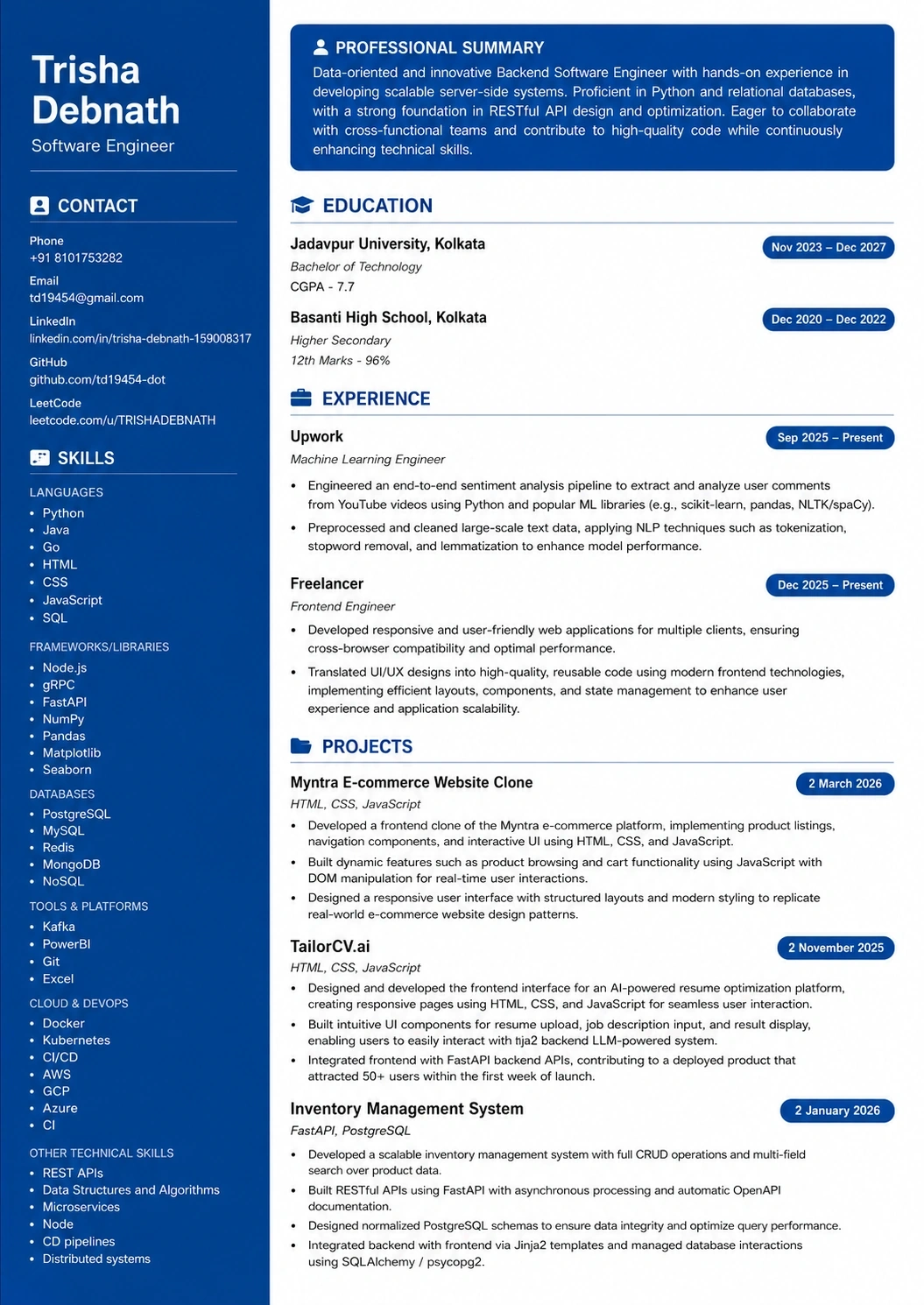
A layout that works with a short history
Leads with skills and projects instead of years of experience you do not have yet.
Was this guide useful?
Be the first to rate it.