 SS
SS
Key Takeaways
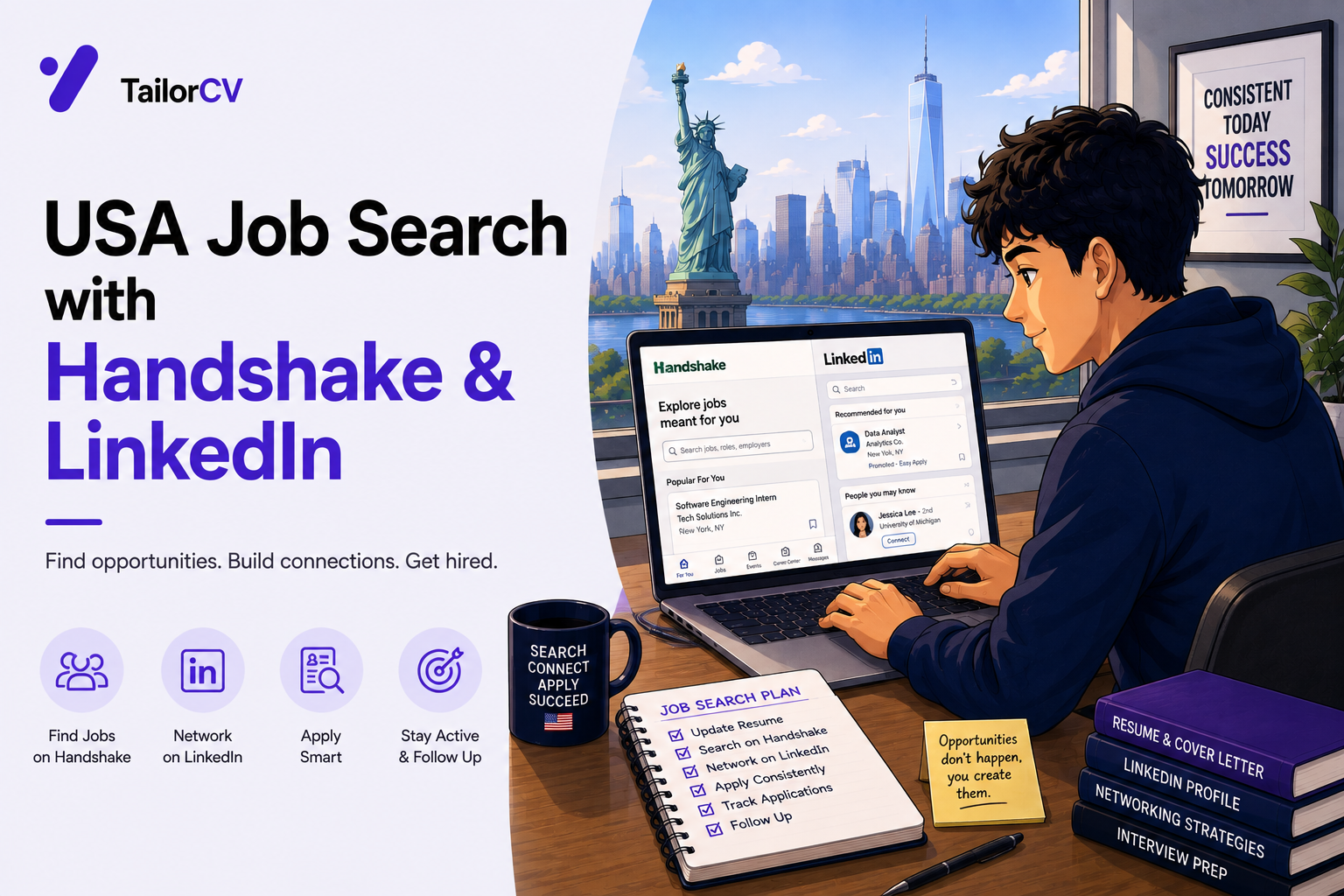
- Handshake surfaces roles filtered to your school and is where employers post when they specifically want your university's students.
- Company career pages carry the most roles and open earliest; aggregators lag and sometimes list expired postings.
- LinkedIn is most valuable for finding people, not roles — its main use in a student search is research and outreach.
- Easy Apply produces volume and very low conversion. Applying through the employer's own system converts better.
- Track what you applied to. By November you will not remember, and recruiters call about roles you forgot.
Handshake
Handshake is the university-linked platform most US institutions use. Employers post roles targeted at specific schools, and your profile is visible to recruiters who filter by university, major and graduation year.
Strengths. Roles here are frequently school-targeted, which means less competition than a public posting. Employers who recruit at your campus post here first. On-campus interview scheduling often runs through it.
Weaknesses. Coverage is incomplete — many employers do not use it, particularly smaller companies and startups. And some roles are cross-posted from elsewhere, so it is not exclusive.
Use it for: on-campus recruiting, school-targeted roles, career fair logistics, and being found by recruiters filtering for your programme.
Complete the profile properly. Recruiters search it, and an empty profile is invisible to that channel.
Company career pages
The most reliable source, and the one students under-use.
They open earliest. Employers post to their own site before it propagates anywhere else. In autumn recruiting, applying the day a posting opens is a genuine advantage — some new grad roles hit an application cap within days.
They are authoritative. No expired listings, no duplicated postings, no wrong details.
They are the actual application system. Applying elsewhere often just redirects you here anyway, with a worse experience.
The practical habit: build a list of 20-30 target employers and check their career pages weekly during the recruiting window. That is fifteen minutes and it is the highest-return routine in a student search.
LinkedIn is where students waste the most effort, because they use it as a job board when its value is as a people directory.
What it is good for:
- Finding alumni at target companies. The school filter is the single most useful feature for a student.
- Researching interviewers. Knowing someone's background before you meet them is genuinely useful.
- Understanding teams. Who works on what, how people move between groups.
- Being contactable. Recruiters do search it.
What it is weaker for: applying. Easy Apply generates enormous volume for employers, which means each application gets less attention. Conversion is poor.
The better use of LinkedIn in a student search is finding people to contact and then applying through the company's own system. A referral obtained via LinkedIn is worth many times an Easy Apply submission.
Aggregators and job boards
General boards aggregate listings from many sources. They are broad and shallow.
Problems: postings lag behind the source, expired roles persist, duplicates are common, and some listings are not genuine openings.
Where they help: discovering employers you did not know existed, particularly smaller companies without campus presence. Use them to find a company, then apply on the company's site.
Choosing by situation
| Situation | Best channel |
|---|---|
| Employer recruits at your school | Handshake, then the career page |
| Large employer, autumn cycle | Career page, the day it opens |
| You want a referral | LinkedIn to find the person, career page to apply |
| Smaller companies you have not heard of | Aggregators to discover, career page to apply |
| Non-target school | Career pages and referrals — Handshake coverage is thinner |
Avoiding duplicate applications
A real problem once you are applying at volume. Applying twice to the same role through different channels looks careless, and some systems flag it.
Keep a simple tracker: company, role, requisition number if there is one, date, channel, status. A spreadsheet is fine.
This also matters when a recruiter calls in November about a role you applied for in September. Being unable to remember which role is a bad start to a conversation.
What actually decides the outcome
The channel affects whether your application is seen. What happens next is the same everywhere.
Your resume is parsed and matched before a human reads it. A document that does not survive parsing fails in every channel equally, and a generic document matches nothing specifically. Tailoring per posting does more for your interview rate than choosing between platforms.
If you are applying at volume — which autumn recruiting requires — the practical difficulty is keeping tailoring up while raising volume. A browser extension that tailors against the posting you are viewing removes most of that friction.
A weekly routine that actually works
Search advice usually describes channels. What decides outcomes is having a schedule you keep during a semester that is already full. This one takes about three hours a week.
Monday, forty minutes — career pages. Work through your list of twenty to thirty target employers. Most weeks nothing has changed and it takes fifteen minutes. During peak autumn, several will have opened postings in the last seven days, and applying within days of a posting opening is a genuine and measurable advantage.
Tuesday, sixty minutes — applications. Apply to everything found on Monday. Batch it. Tailoring each resume is the part people skip when tired, and it is the part that decides the outcome, so do it while the energy is there rather than at midnight on Thursday.
Wednesday, thirty minutes — outreach. Three messages. Not thirty — three, each to a specific person with a specific reason. The cold outreach guide covers what to write; the point of scheduling it is that outreach is the activity that gets dropped first and compounds the most.
Thursday, thirty minutes — follow-ups and admin. Reply to anything outstanding, update the tracker, confirm interview times.
Friday, twenty minutes — review. Look at the tracker. How many applications went out, how many responses came back, what changed. Twenty minutes of looking at your own numbers is what turns a search from a mood into a process.
The reason to fix days is that job searching expands to fill whatever anxiety is available. Bounded slots mean you do the work and then stop, which is the only version of this that survives a full semester.
The tracker, specifically
A spreadsheet with these columns, and no more:
| Column | Why it earns its place |
|---|---|
| Company | Obvious |
| Role title and requisition number | Two roles at one company are otherwise indistinguishable in November |
| Date applied | Tells you when following up is reasonable |
| Channel | So you can see which channels actually convert |
| Resume version used | When something works, you need to know what you sent |
| Referral, and who | Determines who to thank, and who to update |
| Status | Applied / screen / interview / offer / rejected / silent |
| Next action and date | The only column that makes it an operating tool rather than a record |
Two habits make it work. Update it when you apply, not weekly — reconstruction is where accuracy dies. And read the "next action" column at the start of every session, because it is the thing that stops applications from silently expiring.
The immediate payoff is a recruiter calling about a September application in November and you being able to say what role, what team, and why you applied. The larger payoff is that after forty applications the sheet tells you where you are actually losing.
What recruiters filter on in Handshake
Recruiters search this platform with filters, which means your profile is either in the result set or invisible. The fields that matter:
Graduation date and degree. The primary filter on nearly every search. If these are blank or wrong, you do not appear at all — this is the single most common self-inflicted wound on the platform.
Major and school. Also filtered, also frequently incomplete.
Work authorisation. Some recruiters filter on it. Answering it accurately puts you in the right pool rather than the wrong one; leaving it blank sometimes excludes you from both.
Skills. Keyword-matched. List the ones you would defend in an interview, spelled the way the industry spells them.
Job type and location preferences. Filtered heavily. Setting these too narrowly makes you invisible to roles you would have taken; leaving them empty is also a filter failure.
An uploaded resume. Profiles without one are frequently skipped, because the recruiter's next step requires one.
Complete profile, correct graduation date, resume attached. That is a thirty-minute job that turns a passive channel on.
The six LinkedIn fields that matter for a student
Everything else on the profile is decoration.
Headline. Not "Student at X". Say what you do and what you are looking for: "CS senior at X — backend and data engineering, seeking Summer 2027 internships". This is the line that appears everywhere and it is the only one most people read.
Education with dates. Powers the alumni search that other people use to find you, and the recruiter filters that surface you.
About, three sentences. What you build, one piece of evidence, what you are looking for and when. Long About sections are not read.
Experience, including the unglamorous jobs. Campus work, retail, tutoring. It makes the profile look like a person rather than a placeholder.
Projects or featured links. Where a recruiter can see something that exists. This is the highest-value section on a student profile and the most commonly empty.
Open to work, configured. Roles, locations, start date. Recruiters filter on it.
Using the alumni search properly
This is the most useful feature available to a student and almost nobody uses it beyond a single search.
Go to your university's page and open the alumni view. Filter by where they work, then by what they do. You now have a list of people who share your institution — which is the single strongest basis for a cold message that gets answered.
Three refinements that raise the response rate:
Filter to people one to four years out. They remember the process, they are not too senior to reply, and their information is current. A director who graduated fifteen years ago cannot tell you what the online assessment looks like now.
Filter by your specific programme, not just the university. "I'm in the same master's programme you did" is a much stronger opening than "we went to the same school".
Look at who has moved recently. Someone who joined a company in the last six months is still enthusiastic about it and is often inside the referral bonus window, which makes referring you actively worth their time.
When nothing is working: diagnosing the funnel
After thirty or forty applications with no traction, the useful move is not more applications. It is working out which stage is failing, because the fix is completely different at each one.
Applications out, zero responses. The problem is the document or the targeting. Either the resume is not surviving the parse and match — testable directly with an ATS scan — or you are applying to roles that ask for something you plainly do not have. Fix the document first, because it is faster and it affects every channel equally.
Responses, but rejected after the recruiter screen. Usually the basics: availability, location, authorisation, or an answer that raised a concern. Frequently fixable by preparing three sentences.
Screens, but rejected after technical rounds. A preparation problem, and the most honest diagnosis of all of them. More applications will not help; more practice will.
Final rounds, no offers. The most frustrating stage and usually the closest. At this point it is often not you — final round decisions frequently come down to headcount. Ask for feedback, keep the relationship, keep applying.
Knowing which of these four you are in is the entire value of the tracker, and it is why the review slot on Friday is on the schedule.
Common Mistakes
- Relying only on Handshake. Coverage is partial; many employers never post there.
- Using LinkedIn as the primary application channel. High volume, low conversion.
- Applying to aggregator listings without checking the source. Expired and duplicate postings are common.
- Not checking career pages weekly during the window. Some roles cap applications within days.
- No tracking. Duplicate applications and forgotten conversations both follow.
- Optimising channel choice while sending an untailored resume. The screen is the same in every channel.
Asking for a referral, exactly
Referrals are the highest-converting channel available to a student and the one most people execute badly, usually by asking too early or too vaguely.
Do not ask in the first message. A stranger cannot refer you, because a referral attaches their name to your application and most employers pay them if you are hired. Asking immediately reads as transactional and gets ignored.
The first message asks for information. Short, specific, easy to answer:
"Hi Priya — I'm a senior at [university], same programme you did. I'm applying for new grad backend roles and [company] is at the top of my list. Would you be open to a fifteen-minute call about what the team actually works on? Happy to work around your schedule."
The referral request comes after the conversation, and it is easier because you now have a reason:
"Thanks again for the call — the point about the platform team owning the migration was genuinely useful. I've applied to req 4471. If you'd be comfortable referring me I'd really appreciate it, and if not that's completely fine — the conversation was worth it either way."
Three details that matter. Name the requisition number, because the referral system asks for it and making them hunt is how referrals get forgotten. Give them an out explicitly, which removes the social pressure and, counter-intuitively, raises the yes rate. Attach your resume, because they will be asked to upload one.
If you cannot get a call, a direct but well-formed ask still works with people who share a specific connection with you:
"Hi — I'm in the same master's programme you did at [university]. I've applied to the new grad data role, req 8823. Would you be willing to refer me? I've attached my resume in case it's useful, and no problem at all if you'd rather not."
The response rate on these is not high. It does not need to be — ten sent, two answered, one referral is a good week, and one referral is worth roughly thirty cold applications.
When a recruiter contacts you
This happens more than students expect, particularly on Handshake with a complete profile, and it is frequently mishandled.
Reply within a day, even if the answer is no. Recruiters work from lists and move on quickly. A same-day reply to a message that does not interest you costs nothing and keeps you in a pipeline that may have a better role in six weeks.
Answer the logistics in the first reply. Graduation date, location preference, work authorisation, availability. Most recruiter messages exist to establish these four things, and answering them upfront saves a round trip and marks you as organised.
Ask what the role actually is before agreeing to a call, politely. Recruiters sometimes contact broadly, and a fifteen-minute call about a role you would never take is a real cost during a busy semester.
Log it in the tracker. Recruiter conversations are the ones that resurface months later, and they are the ones people most often fail to record because they did not feel like an application.
What to do in the off-season
Autumn recruiting ends and most students stop entirely until the following autumn. That gap is where the next year's advantage is built, at a cost of maybe an hour a week.
Keep the target list current. Companies change, teams move, new employers appear. A list built in September and never touched is stale by March.
Build the project. The single highest-return use of a quiet spring, because it is the thing that changes what your applications say rather than how many you send.
Maintain the contacts you made. A short message to someone who spoke to you in October — what you have been working on, a genuine question — costs five minutes and keeps a relationship that otherwise evaporates.
Watch for the second wave. Many employers, particularly smaller ones and those with unpredictable headcount, hire in spring for the same start date. Students who have stopped checking miss these entirely, and they are less contested precisely because most people have stopped looking.
Frequently Asked Questions
Is Handshake worth using if my school is small?
Yes. Employers filtering for your school are specifically looking for students like you, which is less competitive than a public posting. Coverage may be thinner, so pair it with career pages.
Does Easy Apply actually work?
Occasionally, but conversion is low because volume is enormous. Use it as a supplement, not a strategy, and prefer the employer's own system where it exists.
Should I apply through Handshake or the company site if both list it?
If the Handshake listing is school-targeted, use Handshake — that targeting is the advantage. Otherwise the company site.
How do I find alumni on LinkedIn?
Use the school filter on your university's page, then narrow by company or role. It is the most useful student feature on the platform.
How many roles should I be tracking?
However many you have applied to — all of them. The tracker exists so you can answer a recruiter's call competently, not to hit a number.
Do recruiters really search these profiles?
Yes, particularly on Handshake for campus roles and LinkedIn for everything else. A complete profile is a passive channel that costs one evening to set up.
Should I connect with recruiters on LinkedIn?
Yes, with a short note saying who you are and what you are looking for. A connection request with no message from an unknown student is usually ignored; one with two specific sentences is frequently accepted.
How long should I wait before following up on an application?
Roughly two weeks for a direct application, and one week if a person referred you. One follow-up, short, then let it go. Repeated follow-ups do not help and are remembered.
Is it worth setting up job alerts?
Yes, but narrowly. Broad alerts produce noise you stop reading within a week. Alerts scoped to a specific title plus a location, or to a single company, stay useful.
Does applying on a weekend or at night matter?
Not meaningfully. What matters is how soon after the posting opened, not the hour. Applying within the first few days is the effect people mistake for a time-of-day effect.
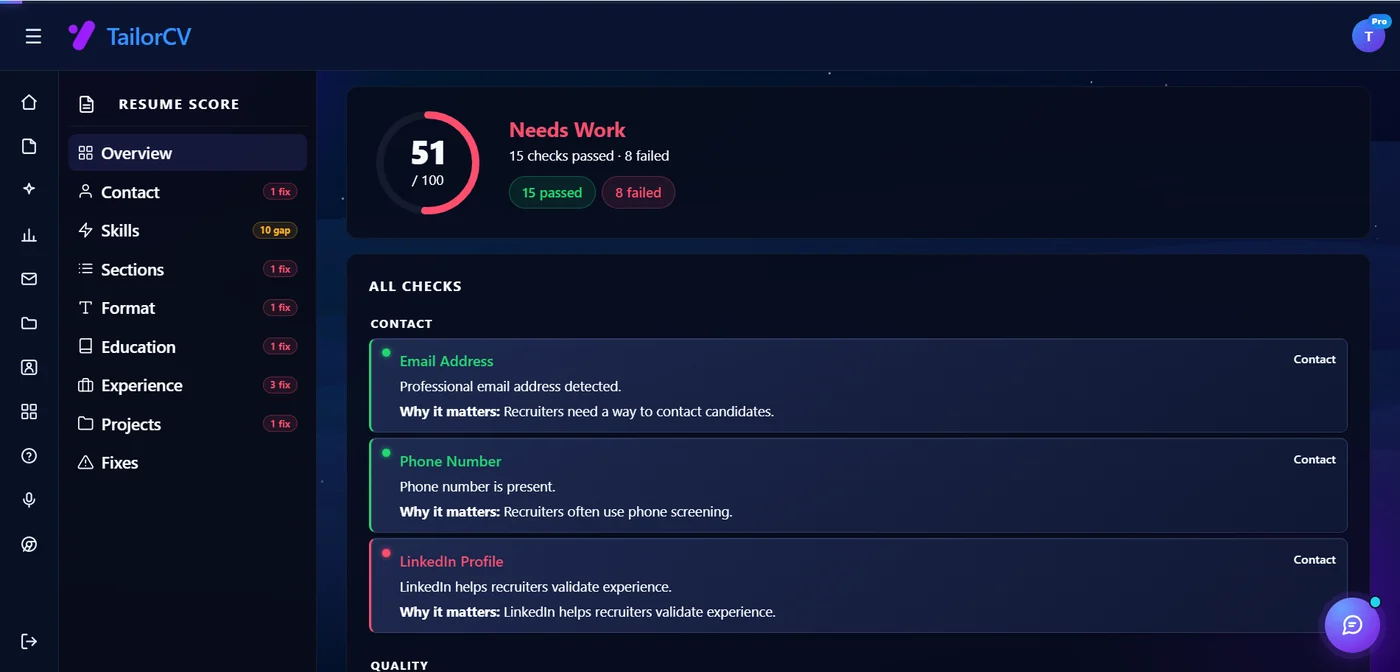
Find out where a fresher resume stands
Score yours against a real posting - no account, no cost.
Drop your resume here or choose a file
PDF only. Max 2 MB.
We never share your data or use it to train AI models.
Was this guide useful?
Be the first to rate it.