 SS
SS
Key Takeaways
- Most background checks verify facts you supplied — employment dates, education, identity — rather than searching for undisclosed information.
- A discrepancy between your resume and the record is the most common cause of a withdrawn offer, and rounding a GPA or stretching dates is enough to trigger one.
- Offers are frequently "contingent", meaning conditional on the check clearing, and you should not decline other options until it does.
- You generally have rights: to be told a check is happening, to consent, and to dispute an inaccurate result before a final decision.
- Anything genuinely complicated in your history is better disclosed on your terms than discovered on theirs.
What is actually checked
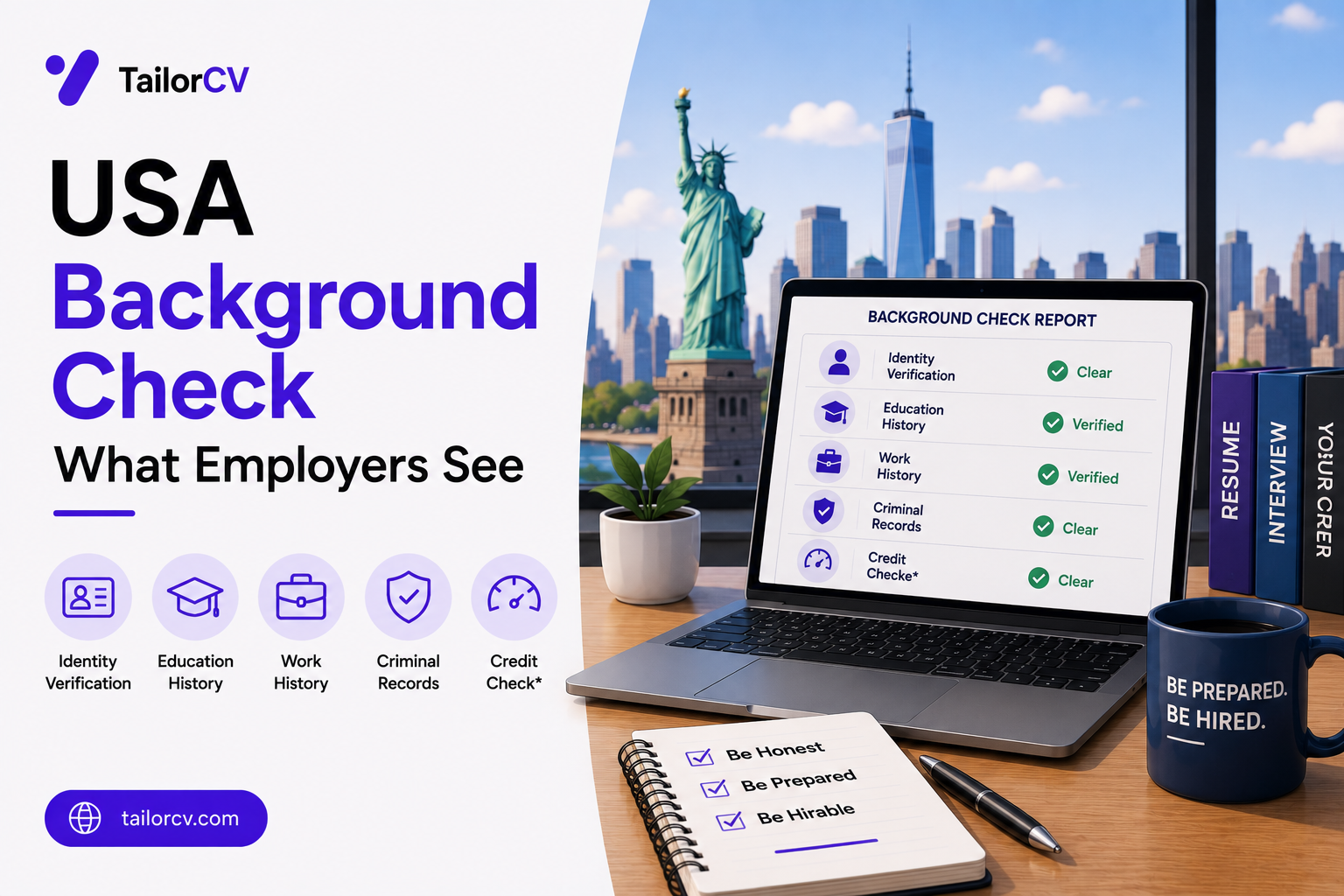
Identity. That you are who you say you are, usually via identification documents and a social security number trace.
Employment history. Employer names, job titles and dates. Frequently confirmed through the previous employer's HR or a third-party verification service — HireRight, Sterling, and Checkr are among the largest and most commonly used by employers, and their reports are what you're entitled to receive a copy of under the FCRA if an adverse decision is being considered. Note what is generally not included: most former employers confirm dates and title only, as a matter of policy, rather than discussing performance.
Education. Institution, degree, dates, and sometimes GPA. Verified directly with the institution or through a clearinghouse service.
Criminal records, where legally permitted. Rules vary considerably by state and by role. Many states and cities have adopted "Ban the Box" laws, which restrict employers from asking about criminal history on an initial application and require the question to wait until later in the process (often after a conditional offer) — worth knowing this term exists, since it's the actual legal framework behind why some applications simply don't ask the question at all.
Credit history, only for a narrow set of roles — typically those involving financial responsibility, like handling money directly or having signing authority. Several states, including California, Colorado, and Illinois, restrict or largely prohibit employment credit checks outright except for a defined list of qualifying roles, so a request for credit history on a role that doesn't obviously involve financial responsibility is worth asking about directly rather than assuming it's standard practice everywhere.
Professional licences, for regulated roles, confirmed directly with the issuing state board or licensing body rather than taken on your word.
References, where the employer chooses to contact them, which is a separate exercise from the formal check and generally not something a screening vendor handles on the employer's behalf.
What is generally not part of a standard check: your social media, your personal life, your reasons for leaving a previous job, or anything the employer would need separate consent and a specific reason to examine.
Why discrepancies matter more than problems
This is the part new graduates misunderstand, and it is the single most consequential point on the page.
A verification service compares what you said against what the record says. It does not evaluate whether you are a good person. Its output is a list of matches and mismatches.
A mismatch triggers a review. Not automatically a rejection, and it moves your file from routine to examined, and it invites a question you would rather not have been asked.
The common mismatches are all avoidable. A GPA rounded upward. Employment dates stretched by a couple of months to close a gap. A degree described as completed when a final requirement is outstanding. A job title elevated slightly beyond what HR has on record.
Each of these feels harmless and none of them are. The GPA point is the classic example — 3.48 stated as 3.5 is a discrepancy on a report, and offers have been withdrawn over exactly that.
The rule is simple: everything on your resume should survive someone else describing the same facts independently. State dates as your records state them, degrees as your transcript states them, and titles as your employer's HR system states them.
Contingent offers, and what they mean for you
Most offers are conditional until the check clears. The letter usually says so explicitly, in language about the offer being contingent on satisfactory completion of background screening.
Do not decline other offers on a contingent one. This is the practical consequence and the one people ignore. A contingent offer is not yet a job, and withdrawing from other processes before it clears leaves you with nothing if a problem surfaces.
Do not resign a current role either, if you have one, until the offer is confirmed unconditional.
Timelines vary from days to several weeks, depending on how many institutions have to be contacted and how responsive they are. International education verification in particular can take considerably longer.
Ask what stage it is at if you have heard nothing for a while. A polite check-in with the recruiter is entirely normal.
If something in your history is complicated
Disclose proactively where it is relevant. A gap, a course you did not complete, a job you left in unusual circumstances, or a criminal record where the role and jurisdiction make it relevant. Explaining it yourself, briefly and factually, is always better than it surfacing without context.
Keep the explanation short. One or two sentences, no defensiveness, no elaborate narrative. Long explanations invite scrutiny that a brief factual one closes.
Know your rights — they come from a specific federal law. The Fair Credit Reporting Act (FCRA) is what actually grants the protections described here: you must be told a background check is being conducted and give written consent before it happens, and if the employer is considering an adverse decision based on the report, they must give you a copy of it and a real opportunity to dispute inaccurate information before making a final decision — not after. Knowing the law's name matters practically: if an employer skips these steps, that's a real, specifically named legal violation you can point to, not just an unfair-feeling process.
Errors do happen. Records are mismatched, names are confused, dates are recorded wrong. If a report contains something you know to be incorrect, say so promptly and provide documentation.
Get advice for anything genuinely serious. A criminal record with employment implications is a situation where specific advice about your jurisdiction and your circumstances is worth far more than any general article.
Preparing before it happens
- Check your own records first. Confirm your exact employment dates with previous employers, your degree conferral date with your institution, and your GPA to the precision on your transcript. Fix your resume to match before you apply anywhere.
- Keep documentation. Offer letters, transcripts, certificates, and anything establishing dates. The same record-keeping habit that pays off throughout a career pays off here specifically.
- Tell your references they may be contacted. A surprised reference is a poor reference, and giving them your resume and the role description costs nothing.
- For international candidates, expect education verification to take longer, and note that this process runs alongside — and separately from — the employment eligibility paperwork your employer must complete.
Do's and Don'ts
Do
- Confirm your exact dates and GPA against your own records
- State your degree exactly as your transcript states it
- Warn your references before they are contacted
- Disclose anything complicated yourself, briefly
- Keep your offer letters and transcripts filed
Don't
- Round a GPA upward
- Stretch employment dates to close a gap
- Let a reference be surprised by the call
- Wait for a check to surface something you could have explained
- Decline other offers while yours is still contingent
Tip: Confirm your exact employment dates and GPA against your own records before you apply anywhere. Discrepancies, not discoveries, are what cost people offers at this stage.
Common Mistakes
- Rounding a GPA upward. Rounding a GPA upward the most common discrepancy and it is entirely self-inflicted.
- Stretching employment dates to close a gap. Gaps are unremarkable; inaccurate dates are not.
- Declining other offers on a contingent one. Declining other offers on a contingent one a contingent offer is not yet a job.
- Inflating your job title. Elevating a job title beyond what HR recorded. Verification services check against the official record, not your description.
- Not warning references. Not warning references a surprised referee reads as a lukewarm one.
- Assuming a check searches for secrets. It mostly verifies what you supplied, which is why accuracy matters more than history.
Related Guides
Keep building on this with the related guides in this series:
- Cap-Exempt H-1B Employers - The Route Around the Lottery
- 401(k) and Benefits Explained for New Graduates
- Community College Transfer Students - Building a Career Strategy That Works
- US Data Science New Grad Hiring - The Roles, the Loop and the Preparation
- Day-One CPT - What It Is and Why It Carries Real Risk
- The I-9 and Employment Verification - What New Graduates Need to Know
You can also check your resume's ATS score for free, generate a tailored cover letter, or build a portfolio website in minutes.
Frequently Asked Questions
Will a previous employer say why I left?
Usually not. Most companies have a policy of confirming dates and title only, precisely to avoid liability. What is verified is generally factual rather than evaluative.
Does a gap in my employment history cause a problem?
Not by itself. Gaps are extremely common and unremarkable. What causes problems is misrepresenting dates to conceal one.
How long does a background check take?
Commonly a few days to a couple of weeks, longer where international institutions are involved or where an institution is slow to respond.
Can an offer be withdrawn over a background check?
Yes, and the usual reason is a discrepancy rather than a discovery. This is why accuracy on the resume matters at exactly this stage.
Do employers check social media?
Not as part of a standard formal background check. Some hiring managers look informally, which is a separate matter and worth bearing in mind for anything public.
What if the report contains an error?
You generally have the right to receive a copy and dispute inaccurate information before a final adverse decision. Raise it promptly with documentation.
What law actually gives me these rights?
The Fair Credit Reporting Act (FCRA) — it's the federal law requiring consent before a check, disclosure of the report, and a real chance to dispute errors before an adverse decision is finalized. Worth knowing the name if you ever need to point to it directly.
What is your resume scoring right now?
Scan it against a job description and get your ATS match score in about a minute.
Drop your resume here or choose a file
PDF only. Max 2 MB.
We never share your data or use it to train AI models.

Was this guide useful?
Be the first to rate it.