 TD
TD
Key Takeaways
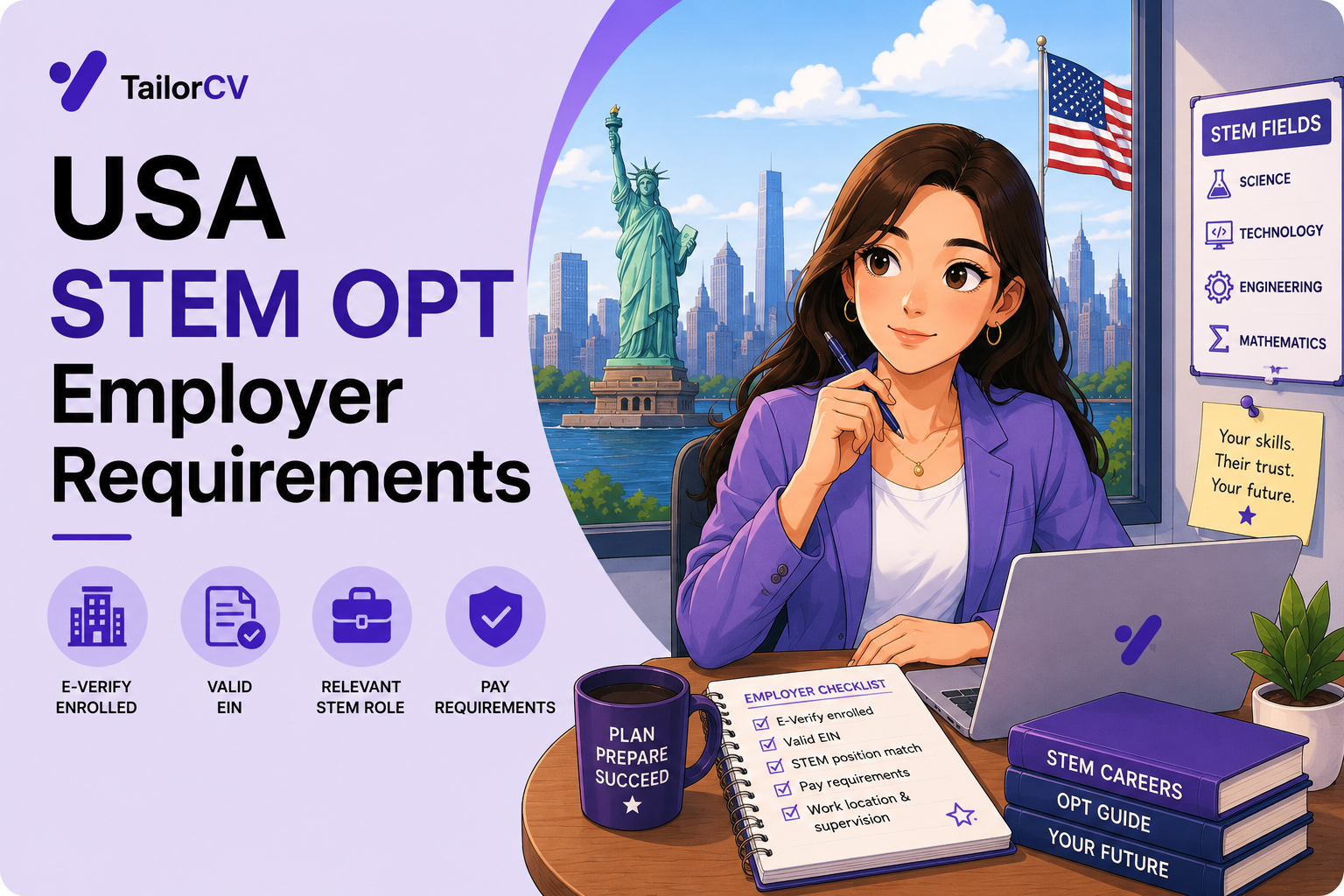
- The STEM extension requires the employer to be enrolled in E-Verify, which many small companies are not.
- A formal training plan (Form I-983) must be completed and signed by the employer, and some decline the paperwork.
- These are requirements on the employer, not on you, so a strong candidate can still be ineligible at a given company.
- Check E-Verify enrolment before you invest in an application, not after an offer.
- Because the extension is what gives you multiple H-1B attempts, employer eligibility shapes your whole search.
Why this matters so much
Standard OPT gives 12 months. The STEM extension adds a further 24, taking you to 36.
That difference is not incremental. Because H-1B registration happens once a year, your runway determines how many attempts you get. Twelve months usually means one; thirty-six usually means three.
So the extension is often the difference between staying and leaving. And the extension depends on your employer meeting conditions that have nothing to do with your ability.
The two employer requirements
E-Verify enrolment. The employer must be enrolled in the federal E-Verify system. This is voluntary for most private employers, so many are not — particularly small companies and startups. Some states require it for certain employers, which is why enrolment is more common in some places than others.
The I-983 training plan. A formal document describing your training objectives, how they relate to your degree, how you will be supervised and evaluated. You and the employer complete it together, the employer signs, and it goes to your school. There are periodic evaluations afterwards.
Neither is difficult for a company that has done it before. Both are friction for a company that has not.
What this rules out in practice
Small companies and early-stage startups. Frequently not E-Verify enrolled, and often unwilling to take on a formal training plan with reporting obligations. This is the single largest category of employers effectively closed to you if you are relying on the extension.
Employers without an HR function. The I-983 requires someone to own the paperwork and the ongoing evaluations. At a company of fifteen people, that is a real ask.
Some contract and staffing arrangements. Requirements around the employer-employee relationship and supervision make certain third-party placements difficult or non-compliant.
The uncomfortable implication: a startup offer you would otherwise take may be unusable if you need the extension to remain in the country. That is a genuine trade-off, and it is better understood before you apply than after you have declined other offers.
How to check before applying
Search the E-Verify employer list. The government publishes participating employers. Checking takes a minute and saves weeks.
Read the careers page. Employers who routinely hire international graduates often say so. Some state E-Verify participation explicitly.
Ask the recruiter early. A direct question in a first screen is entirely normal:
"One quick thing — is the company enrolled in E-Verify? I'm on OPT and would be looking at the STEM extension later, which requires it."
That is a fifteen-second question that saves both sides a month. Recruiters who work with international candidates hear it regularly.
Ask whether they have done an I-983 before. "Have you supported a STEM OPT extension previously?" tells you whether you would be the first case, which matters more than company size.
Raising it without losing the offer
The instinct is to hide it until an offer is signed. That backfires — the requirement surfaces regardless, and discovering it late costs goodwill and sometimes the offer.
Better approach:
Raise it once, early, framed as logistics. Not as a request for a favour. It is a form and an enrolment, not sponsorship, and it costs the employer no money.
Explain what it is not. Many employers confuse STEM OPT with H-1B sponsorship, which is more expensive and more involved. Saying clearly that this requires no petition, no fee and no lottery removes an objection that was never real.
Have the specifics ready. Knowing your own OPT dates and STEM eligibility turns a vague conversation into a short factual one. The same principle applies as with the sponsorship question generally — precision reads as competence.
Strategy implications
If you need the extension, your employer pool is narrower than your classmates'. That changes tactics:
Apply earlier and more widely. A smaller viable pool means more applications in flight, and the autumn window matters more to you.
Prioritise larger employers. More likely enrolled, more likely to have done the paperwork, more likely to have a process.
Do not write off startups entirely — some are enrolled, particularly in states where it is required. Check rather than assume.
Keep documentation from day one. The I-983 requires evaluations during the extension period. Keeping your own records of responsibilities and reviews makes those straightforward instead of a scramble.
Volume with targeting is the balance. A narrower pool does not mean lowering the quality of applications — a tailored resume that parses cleanly is what gets you read at the employers who are viable.
Checking an employer before you apply
The whole point of understanding these requirements is that they let you filter early. Fifteen minutes of checking beats a rejection at offer stage.
Search the public enrolment list. The programme publishes a list of participating employers, updated regularly and searchable by name and state. This is the most reliable single check available and it takes two minutes. Note two traps: large companies appear under legal entity names that differ from their brand, and enrolment can exist at one subsidiary and not another.
Look for the notice on the careers page. Participating employers are required to display posters at hiring sites, and many carry the notice on their careers page or in the footer of job postings. Its presence is a strong positive signal; its absence proves nothing.
Read the job posting language. Postings that say "we are unable to sponsor now or in the future" are telling you the answer. Postings that distinguish between "sponsorship now" and "sponsorship in future" are written by someone who understands the categories, which itself indicates a process exists.
Ask the recruiter, plainly, in the first conversation. "Is the company enrolled in E-Verify?" is a factual question with a one-word answer, and it is not an odd thing for a candidate to ask. Recruiters at employers who hire international graduates hear it regularly.
Ask the second question too. Enrolment is necessary and not sufficient — the employer also has to complete and sign the training plan. "Have you completed an I-983 for a student before?" separates employers with a process from employers who are enrolled for unrelated reasons and have never done the paperwork.
Build this into your target list before you start applying, not after. A spreadsheet column for enrolment status, filled in during your planning week, changes where forty applications go.
Raising it without damaging the process
Two failure modes, and they are opposite. Some candidates never ask and discover the problem after an offer. Others raise it so early and so anxiously that they create a concern.
Timing. The enrolment question belongs in the recruiter screen, where logistics live. The training plan conversation belongs after an offer is close, because it is genuinely a post-offer administrative step.
Framing. This is a fact about the employer, not a request you are making. "I wanted to check whether the company is enrolled in E-Verify, because that determines whether the extension applies" is a candidate managing their own process competently. "I hope this isn't a problem, but I might need..." is a candidate apologising for existing.
Explain what it is not, briefly, if there is confusion. Small employers sometimes conflate this with visa sponsorship and react to the word rather than the substance. One sentence clears it: "This isn't a visa petition — there's no filing fee and no lottery. It's a form describing the training I'd receive, which you'd sign, plus enrolment in a federal verification system that's free to join."
Have the specifics ready. If an employer is willing but unfamiliar, being able to say what the form asks for and roughly how long enrolment takes turns their vague reluctance into a manageable task. Your international office can give you a one-page summary; carrying it is worth doing.
Ask once, then let them decide. Pressing an employer who has said no does not change the answer and does change how you are remembered.
What this does to your search strategy
Because employer eligibility is binary and knowable in advance, it should shape the shape of your search rather than being a filter you apply at the end.
Front-load the list building. Before the autumn cycle opens, spend an afternoon producing a list of thirty to forty target employers with enrolment status checked. This is dull and it is the single most valuable planning task available to an international student.
Weight toward larger employers, without excluding smaller ones.
Enrolment correlates strongly with size, because larger organisations are more likely to be required to participate or to have adopted it as policy. But some small companies are enrolled — federal contractors of any size frequently are, as are employers in states that mandate it — so a blanket rule costs you real opportunities.
Treat state as a factor. Several states require participation for some or all employers, which means the enrolled proportion of employers varies geographically. If you are flexible on location, this is a genuine input into where to concentrate.
Apply earlier and more widely than a domestic classmate would.
The eligible pool is smaller, so the same interview volume requires more applications. This is arithmetic, not pessimism, and planning for it in September is much better than discovering it in January.
Keep startups on the list selectively. Early-stage companies are the least likely to be enrolled, and some will enrol for a candidate they want. Whether that is worth pursuing depends on how much they want you, which you will know by the time it comes up.
Understand what this connects to. The extension is what gives you multiple attempts at the H-1B lottery rather than one, and the mechanics of the underlying authorisation determine your timeline. Employer eligibility is therefore not a detail at the end of the process — it is one of the first things that should shape where you apply at all.
Keeping your own records
The extension involves periodic evaluations and a reporting obligation, and the burden of proving compliance falls partly on you. Keeping records is dull and it prevents an entire category of problem.
Keep every signed version of the training plan, including the interim evaluations, with dates. Do not rely on the employer's HR system to retain them — people leave, systems get replaced, and companies get acquired.
Record your reporting dates in a calendar with reminders, well ahead. Missed reporting deadlines cause real problems and they are entirely avoidable.
Keep your supervisor's details current, including a personal contact where you have one. Supervisors change during an extension period more often than you would think, and a new supervisor has to be brought into a process they did not start.
Note any change in role, title, salary or worksite. Material changes generally have to be reported, and reconstructing when something changed, months later, is unpleasant.
Keep it all in one folder that is not on a work laptop. The device you lose access to on your last day should not be the only place your immigration records live.
Ten minutes a quarter. The alternative is discovering a gap in your record at the moment it matters most.
Why this shapes the whole search, not just one application
Worth stating plainly, because students treat it as a detail and it is closer to a constraint on the entire plan.
A domestic classmate applying to two hundred employers has two hundred realistic options. An international student applying to the same two hundred has however many are enrolled — and the proportion varies enormously by sector, company size and state.
That has three consequences. Your application volume needs to be higher to reach the same number of interviews, which is arithmetic rather than pessimism. Your list needs building earlier, because filtering takes an afternoon you will not have in December. And your sector choices are narrower than you think — some industries are almost entirely enrolled, others barely at all, and knowing which is which before you commit a semester to one is worth the hour it takes to find out.
None of this is a reason to lower your sights. It is a reason to do the filtering work in September, when it costs an afternoon, rather than in February, when it costs the season.
Common Mistakes
- Assuming any employer can support it. Enrolment is voluntary and many are not enrolled.
- Confusing STEM OPT with H-1B sponsorship. They are different, and conflating them makes employers refuse something cheap.
- Checking after the offer. The most expensive point to discover an incompatibility.
- Not knowing your own STEM eligibility. It depends on programme code, not on how technical the subject sounds.
- Assuming a large company automatically qualifies. Most do, but confirming takes a minute.
- Hiding it until late. It surfaces anyway, and lateness converts a formality into a trust problem.
The two requirements, in plain terms
Worth restating carefully, because candidates frequently confuse these with visa sponsorship and negotiate against the wrong objection.
Enrolment in the federal employment verification system. A voluntary programme for most private employers, mandatory for federal contractors and for all or some employers in a number of states. Enrolment is free, done online, and takes a modest amount of administrative time. There is no fee, no petition, no government adjudication of your individual case.
A signed training plan. A form describing what you will learn in the role, how you will be supervised, and how your progress will be evaluated. The employer completes their sections and signs it. There are periodic evaluation points during the extension where the employer signs again.
Neither of these is a visa petition. There is no lottery, no filing fee, no immigration attorney required, and no cap. The employer is not sponsoring you in the sense they are thinking of when they say "we don't sponsor".
This distinction is worth having ready as a sentence, because a meaningful number of employers who say no are saying no to something that is not being asked. That does not mean pushing — it means making sure the answer they gave is to the question you asked.
What it means for your first job choice
Because the extension is what converts one shot at the H-1B lottery into several, employer eligibility is not a technicality. It is one of the largest inputs into the long-run outcome of your first job, and it is knowable before you apply.
The practical consequence is a hierarchy that differs from a domestic classmate's:
An eligible employer with an average role beats an ineligible employer with a great role, if you intend to stay long term. This is unromantic advice and the arithmetic supports it — the extension roughly triples your attempts at the next step.
Among eligible employers, prefer those with a filing history.
Enrolment says the mechanism exists. A record of actually filing petitions says the organisation has done the whole sequence before, which is a substantially stronger signal.
Ask about the next step at offer stage, not later. "Does the company sponsor H-1B petitions, and typically at what point in someone's tenure?" is a normal offer-stage question. The answer varies more than candidates expect — some employers file in the first eligible cycle, others wait a year or more, and the difference is material given the timeline.
Do not let this be the only criterion. A job you cannot stand at an eligible employer produces a person who leaves in eight months, which helps nobody. The point is to have the constraint in view early enough that you can optimise within it rather than discovering it at the end.
A checklist for the autumn
One page, done in a single sitting before applications open, and it removes most of the guesswork from the season.
- unchecked: Confirm your degree's designation and get the code in writing from your international office. Do not rely on assuming a technical-sounding degree qualifies.
- unchecked: Write down your exact authorisation dates, current and projected.
- unchecked: Build the target list — thirty to forty employers, with a column for enrolment status.
- unchecked: Check enrolment for each against the public list. An afternoon.
- unchecked: Mark which have a filing history, since that is the stronger signal.
- unchecked: Draft your one-sentence answer for the recruiter screen and say it aloud until it is boring.
- unchecked: Save a one-page summary of the training plan requirements to send to a willing but unfamiliar employer.
- unchecked: Set calendar reminders for reporting dates once you are employed.
None of it is difficult. All of it is much harder to do in January, in parallel with interviews, than in September with nothing else happening.
Frequently Asked Questions
Does STEM OPT cost the employer money?
No fee comparable to H-1B sponsorship. The costs are E-Verify enrolment, which is free to join, and staff time for the training plan and periodic evaluations.
Can I do STEM OPT with a startup?
Only if the startup is E-Verify enrolled and will complete the I-983. Some are; many are not. Check specifically rather than assuming based on size.
What if my employer refuses the paperwork?
Then the extension is not available at that employer. Since the permit is not employer-tied, you can move to one that will support it — but do that before your standard OPT runs down.
Is my degree STEM-designated?
It depends on the CIP code of your programme, not on the subject name. Ask your DSO for the code and check it against the current list.
Does the extension change my H-1B odds?
Not within a single lottery. It changes how many lotteries you can enter before your authorisation expires, which is a different and larger effect.
Can I switch employers during the extension?
Yes, but the new employer must also meet the requirements, and a new training plan is needed. Confirm eligibility before resigning.
Can an employer enrol specifically for me?
Yes. Enrolment is free and the process is not lengthy. Whether an employer will do it depends on how much they want the hire and whether anyone internally has the time — it is a much smaller ask than a visa petition, and framing it that way helps.
Does the training plan create ongoing obligations for the employer?
There are periodic reporting and evaluation requirements during the extension period, which is why some employers hesitate — the objection is usually administrative rather than financial. Being able to describe what is actually required, briefly, sometimes resolves it.
Should I mention this in my resume or cover letter?
No. It is not a credential and it takes space from evidence. It belongs in the recruiter conversation, as logistics rather than a disclosure.
What if I find out after accepting an offer that they are not enrolled?
Raise it immediately and factually, with what would be required. Some employers will enrol. Where they will not, you still have your initial authorisation period, and knowing early means you can plan the next step rather than discovering it near the end.
What is your resume scoring right now?
Scan it against a job description and get your ATS match score in about a minute.
Drop your resume here or choose a file
PDF only. Max 2 MB.
We never share your data or use it to train AI models.

Was this guide useful?
Be the first to rate it.