 TD
TD
Key Takeaways
- State-owned enterprises are among the largest graduate employers in China, spanning banking, energy, telecommunications, infrastructure and more.
- The application and selection process is generally formal and structured, with published criteria and multiple assessment stages.
- Stability, benefits and structured progression are the sector's main draw, generally with lower pace and lower headline pay than top-tier technology or finance employers.
- Some positions carry residency, political status or citizenship requirements, worth checking specifically before applying.
- The sector is consistently overlooked by students focused on the most visible private employers, despite offering some of the largest and most stable graduate opportunities available.
The scale of the sector
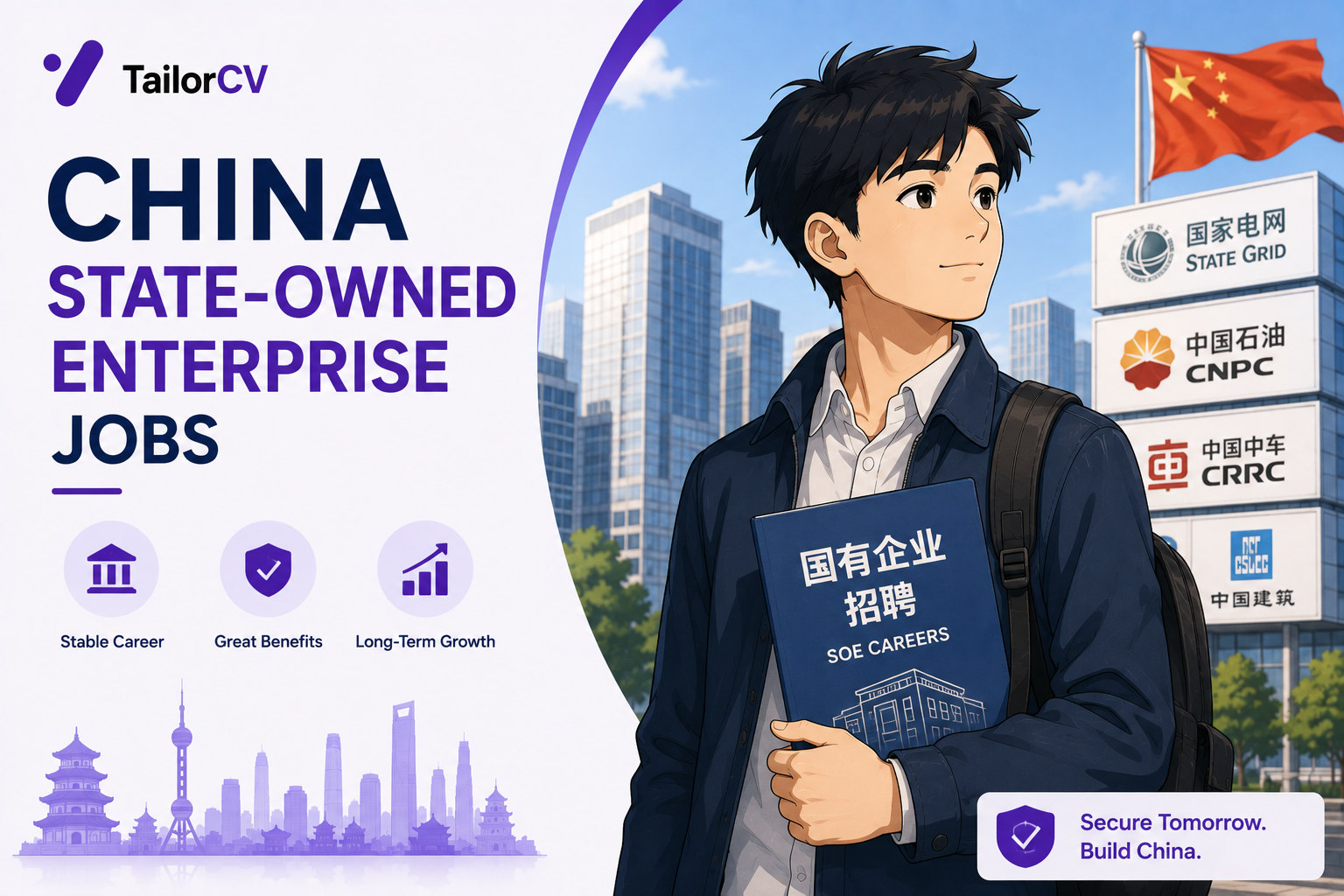
State-owned enterprises operate across nearly every major industry, banking and finance, energy and utilities, telecommunications, transportation and infrastructure, and heavy industry, among many others, collectively representing an enormous share of formal employment and graduate hiring nationally. In banking, the "Big Four" state banks — Industrial and Commercial Bank of China (ICBC), China Construction Bank, Agricultural Bank of China, and Bank of China — run some of the largest graduate intakes in the country. In energy, State Grid, Sinopec, PetroChina, and CNOOC (China National Offshore Oil Corporation) anchor the sector; in telecommunications, China Mobile, China Unicom, and China Telecom are the three dominant carriers, each running substantial graduate programmes. Researching these organisations by name, rather than treating "state-owned enterprise" as one undifferentiated category, is where a real, targeted search actually starts.
Several of these organisations are among the largest employers of any kind in the country, with graduate intakes running into the tens of thousands annually across their combined operations, the scale here is genuinely different from equivalent sectors in many Western markets, and worth keeping in mind before assuming this sector is a niche or secondary option.
Recruiting runs through the standard national two-season cycle, alongside private employers, though timing and process specifics vary by organisation and sector.
What the work is actually like
Structure and process are generally more formal than at many private employers, defined grades, published progression paths, and standardised evaluation processes are common, similar in spirit to structured public sector employment elsewhere, though the specific mechanics differ considerably.
Pace is generally slower than at top-tier private technology or finance employers, more process, more layers of review, this genuinely suits some graduates and frustrates others, worth being honest with yourself about which before committing.
Stability is a real and significant draw, job security and predictable career paths are more pronounced here than in much of the private sector, a meaningful factor for many graduates weighing their options.
Compensation is generally competitive at entry level and below top-tier private finance or technology at senior levels, though total package, including housing benefits, pension contributions and other provisions at many of these organisations, is often stronger than a base salary comparison alone suggests.
The selection process
- Applications open through the standard recruiting seasons, often with published eligibility criteria stated clearly, including sometimes specific degree requirements, examination results, or other stated thresholds.
- Written examinations are common, testing general knowledge, logical reasoning, sometimes specific professional or technical content depending on the role, this is a distinctive feature relative to many private-sector processes and worth preparing for specifically. These exams often follow a recognisable format across organisations — general aptitude sections resembling the civil-service style examinations used elsewhere in the public sector, plus role-specific content for technical or professional positions — so practice materials aimed broadly at "SOE recruitment exams" rather than one specific employer are often genuinely transferable preparation.
- Interviews follow, often panel-based, assessing both competency and fit against the organisation's stated values and requirements.
- The overall process is generally formal and criteria-driven, worth reading published requirements carefully and preparing specifically against them, rather than assuming a generic graduate application approach transfers directly.
Eligibility considerations
Some positions, particularly in specific sectors or at certain organisations, may carry citizenship, residency or other eligibility requirements, worth checking the specific posting's stated criteria directly and early rather than assuming broad eligibility.
Requirements vary considerably by organisation, sector and specific role, a blanket assumption in either direction, that the sector is entirely open or entirely closed to a specific category of applicant, is unreliable, checking the specific employer and role is the only dependable approach.
Why the sector is overlooked
Students concentrate heavily on the most visible and internationally recognised private employers, particularly in technology, exactly the pattern that repeats across graduate markets everywhere, the sector with the strongest brand recognition among peers attracts a disproportionate share of applications relative to its actual size or quality.
Which means the applicant-to-seat ratio at many state-owned enterprises is considerably more favourable than at the handful of employers dominating student attention, despite comparable or in some cases superior stability and total compensation once benefits are counted.
The trade-off is genuinely real, not illusory. Pace, working style and the nature of the work itself differ from private-sector technology or finance, and the sector suits some graduates considerably better than others, this is a decision worth making deliberately rather than by default.
Preparing for the written examination stage specifically
Practice materials for these standard examinations are widely available and cover the general knowledge, logical reasoning and, where relevant, professional content typically tested, worth dedicating genuine, sustained preparation time here specifically, since this stage functions as a real, mechanical filter rather than a formality many candidates mistakenly assume it to be.
Timed practice under realistic conditions matters more than untimed review, exactly the same principle that improves outcomes on any structured aptitude assessment used at scale, speed under genuine time pressure is frequently the binding constraint rather than the underlying difficulty of the material itself.
Understanding organisational culture across this diverse sector
Culture and pace genuinely vary considerably across different organisations within this broad category, a large national banking institution operates quite differently from a regional infrastructure authority or a specific energy company, worth researching the specific organisation's actual reputation and working environment directly, rather than assuming a single uniform culture applies across this entire, genuinely diverse sector.
Speak with current or recent employees of your specific target organisation where possible, a genuine first-hand account of daily working life, pace and progression reveals considerably more than general assumptions about this broad employer category.
Tip: Prepare for the written examination as a distinct stage, not an afterthought. Practice materials aimed broadly at SOE recruitment exams transfer well across organisations, and this stage filters more candidates than the interview does.
Common Mistakes
- Overlooking the sector entirely. A major and often less contested source of quality graduate employment.
- Assuming a generic application approach transfers directly. Assuming a generic application approach transfers directly the process is often more formal and criteria-driven than at many private employers.
- Not preparing for written examinations specifically. Not preparing for written examinations specifically a distinctive and common feature of this sector's selection process.
- Assuming you are eligible. Assuming eligibility without checking a specific posting's stated requirements. Criteria vary genuinely by organisation and role.
- Comparing compensation on base salary alone. Total package, including benefits, is often stronger than a bare salary figure suggests.
- Ignoring the pace trade-off. Choosing the sector without honestly weighing the pace and working style trade-off. A genuine difference from much of the private sector, worth considering deliberately.
Related Guides
Keep building on this with the related guides in this series:
- China Campus Interview Questions - What Is Actually Asked
- China Campus Recruiting - How the Autumn and Spring Cycles Work
- Teaching English in China - A Realistic Guide for Graduates
- The Points System for Foreign Graduate Work Permits in China
- Graduate Salary Expectations in China - A Realistic Guide
- HSK Levels and What They Actually Mean for Employment in China
- UK Charity Sector Jobs 2026 - Careers Beyond Fundraising
You can also check your resume's ATS score for free, generate a tailored cover letter, or build a portfolio website in minutes.
Frequently Asked Questions
Are state-owned enterprises a good option for graduates?
For many graduates, genuinely yes, offering stability, structured progression and often strong total benefits, with a trade-off of generally slower pace than top-tier private technology or finance employers.
How competitive is this sector compared to well-known private companies?
Often less contested relative to the scale and quality of the opportunity, since student attention concentrates heavily on a small number of highly visible private employers.
Do I need any special qualifications or connections?
Generally no beyond meeting the published criteria for a specific role, though some positions do carry specific eligibility requirements worth checking directly.
How is the pay compared to private technology companies?
Generally competitive at entry and below top-tier private technology or finance at senior levels, though total compensation including benefits is often stronger than a base salary comparison suggests.
Is the application process different from private companies?
Generally more formal, with published criteria and often written examinations as a standard stage, worth preparing for specifically rather than assuming a generic approach transfers.
Can international students apply?
Varies by organisation and role, with some positions carrying specific citizenship or residency requirements, check the specific posting's stated criteria directly.
Which specific organisations should I research first?
The "Big Four" state banks (ICBC, China Construction Bank, Agricultural Bank of China, Bank of China) in finance, State Grid, Sinopec, PetroChina, and CNOOC in energy, and China Mobile, China Unicom, and China Telecom in telecommunications are the names with the largest, most established graduate programmes worth starting your research with by name.
What is your resume scoring right now?
Scan it against a job description and get your ATS match score in about a minute.
Drop your resume here or choose a file
PDF only. Max 2 MB.
We never share your data or use it to train AI models.

Was this guide useful?
Be the first to rate it.