 SS
SS
Key Takeaways
- A referral usually enters a different queue from the public application and reaches a human directly, which is why it outperforms volume applying.
- Asking for a conversation converts far better than asking for a referral or a job in a first message.
- Alumni are the highest-yield group by a wide margin, and university email addresses get opened.
- Expect most messages to go unanswered. A 10-20% reply rate on well-targeted outreach is normal and sufficient.
- The follow-up after a good conversation is where the referral actually happens, and most students never send it.
Why referrals work mechanically
At a large employer, public applications go into a queue that is screened by software and then by a recruiter working through hundreds of profiles. A referred application typically enters through an internal system, is flagged, and is often reviewed by a human directly.
That is the entire advantage, and it is a big one. It does not mean you skip the interviews. It means you are not eliminated by a keyword mismatch before anyone reads your work.
This matters most for candidates who are screened out on a technicality — a GPA below a stated cutoff, a non-target school, an unusual background, or a resume that parses badly. A referral routes around the filter.
Who to contact
In rough order of reply rate:
Alumni from your university. By a wide margin the best. Shared institution is a genuine reason to reply, and many people feel some obligation to help students from their school. Use your university's alumni tool or LinkedIn's school filter.
People who did your degree or came from your background. A second-generation immigrant engineer who studied the same subject will often reply to someone with the same story.
People in the specific team you want. More useful than a generic recruiter, because they know whether headcount exists.
Recruiters. Worth contacting, but they receive enormous volume and reply selectively.
Who not to contact: the VP or the CEO, unless you have a genuine connection. Senior people receive the most outreach and reply least. A mid-level engineer three years out of your university is far more likely to help you and far more likely to still remember what job hunting felt like.
What to write
The single most effective change most students can make: ask for a conversation, not a job.
"Would you refer me?" asks a stranger to stake their reputation on you. "Could I ask you two questions about your team?" asks for ten minutes. The second gets replies; the first usually does not.
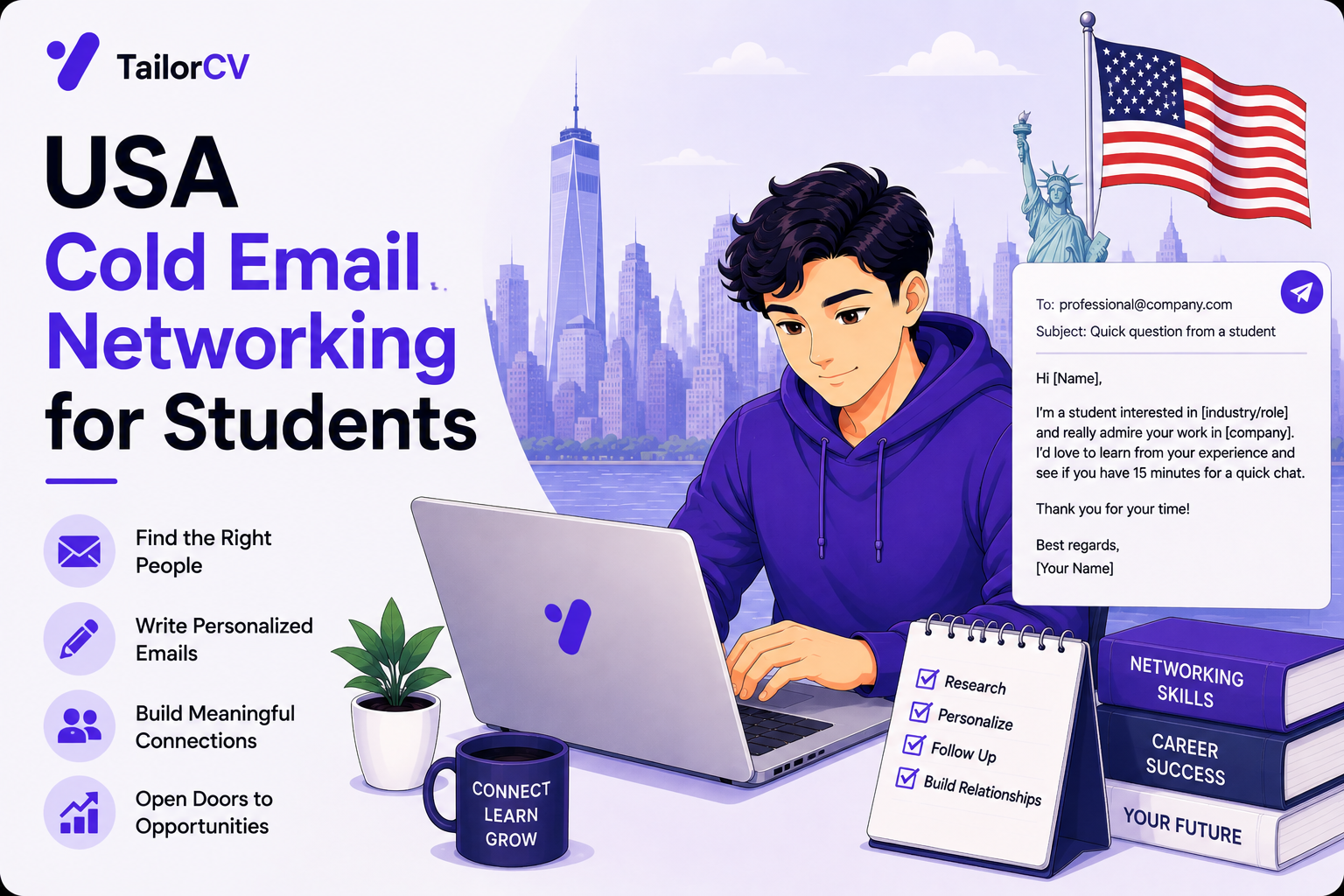
A workable structure, four to six sentences:
Subject: Georgia Tech student — quick question about your team at Stripe
Hi Marcus,
I'm a junior at Georgia Tech studying CS, and I saw you moved from the payments team to risk engineering last year. I'm applying for the summer data engineering internship and I'm trying to understand how those teams differ in practice.
Would you have ten minutes in the next couple of weeks for a quick call? Happy to work around your schedule, and I'm glad to send questions in advance if that's easier.
Thanks either way, Priya
Why it works: it identifies the shared connection immediately, shows five minutes of research, asks for something small and bounded, and gives them an easy exit.
Keep it short. Under 150 words. Long emails from strangers do not get read.
Use your university email address where you can. It is a credibility signal and gets past spam filters that treat unfamiliar personal domains harshly.
Write a specific subject line. "Quick question from a Georgia Tech student" beats "Networking" or "Opportunity".
What not to write
Each of these is common and each one lowers your reply rate.
"I'd love to pick your brain." Signals an open-ended demand on someone's time with no defined end.
"Any advice you could offer would be greatly appreciated." There is no question here, so there is nothing to reply to. The recipient would have to invent the conversation themselves, which is work.
A referral request in the first message to a stranger. A referral attaches their name to you and at most companies pays them if you are hired. Asking before they know anything about you reads as transactional.
A long message. Anything over about 150 words gets skimmed. Anything over 300 gets closed.
Your life story. Where you grew up, why you chose your major, what you are passionate about. None of it is why they would reply.
An attached resume in a cold first message. It looks like a job application, which is not what you said you were sending.
"Dear Sir/Madam" or no name at all. If you cannot find the name, you have not done enough to justify the message.
Flattery about the company. They work there. They know.
A message with the previous recipient's name still in it. Happens constantly with templates, and it ends the conversation instantly.
Running the conversation
Getting the call is most of the work. Not wasting it is the rest.
Have three specific questions ready and send nothing else. Good ones: what does a normal week actually look like, what surprised you most in your first six months, what would you want to know if you were applying now. Bad ones: anything answerable from the careers page.
Fifteen minutes means fifteen minutes. At thirteen, say "I'm conscious of your time — one last question if that's alright." People notice, and it is a large part of why they agree to a second conversation.
Ask about the process, not just the job. "How did you get in?" and "what does the loop look like now?" produce genuinely useful information you cannot get elsewhere.
Take notes and use them. The follow-up email is only strong if it references something specific.
Do not ask for the referral in the first two minutes. Ask at the end, or in the follow-up. By then you have given them a reason.
Say what you will do next, then do it. If they suggest reading something or talking to someone, do it and tell them you did. That single behaviour is what turns one contact into three.
Realistic expectations
The most common reason students abandon outreach is that they misjudge what success looks like.
Most messages get no reply. A ten to twenty percent response rate on well-targeted outreach is normal and entirely sufficient. Sending forty messages and getting six conversations is a good outcome, not a failing one.
Silence is not rejection. People are busy, inboxes are full, and a message sent during a launch week disappears. It is generally fine to follow up once after ten days or so, briefly.
Volume without targeting collapses the rate. Two hundred generic messages will do worse in absolute terms than forty specific ones, because generic messages get deleted and also occasionally get you flagged.
Three a day is a sustainable pace. Fifteen a week, forty-five a month, which is more than enough. Doing sixty in one evening and then none for a month is the pattern that fails.
Start before you need it. Outreach done in September produces conversations in October and referrals in November. Outreach begun in January, when you are anxious and the deadlines have passed, has a visible urgency to it that lowers the response rate further.
The compounding effect is the real point. One good conversation produces an introduction to two more. That is why the students who start early end up with a network that generates opportunities, and the ones who start late end up sending cold messages into silence.
The messages, written out
Templates are less useful than annotated real examples, because the failure is almost always in what the message asks for rather than how it is phrased.
The first message to an alum — asking for a conversation, not a referral:
Subject: [University] senior — question about data engineering at [Company]
Hi Daniel,
I'm a senior at [University] doing the same CS programme you did. I'm applying for new grad data roles this autumn and [Company] is at the top of my list.
I built a pipeline last spring that dedupes job postings across fifteen boards, and the part I found hardest was reconciling conflicting records from different sources. I saw your team works on ingestion — would you be open to fifteen minutes to talk about what that work is actually like day to day? Happy to work around whatever time suits.
Either way, thanks for reading.
Priya
Why it works: the subject line says who and what in eight words. The shared programme is named in the first sentence. There is one concrete piece of evidence. The ask is small, specific and time-bounded. And it does not ask for a referral, a job, or "any advice you might have".
The follow-up after the conversation — where the referral actually happens:
Hi Daniel,
Thanks again for the call. The point about preferring the most recently updated record was genuinely useful — it's the opposite of what I did, and I think you're right about why.
I've applied to the new grad data engineering role, requisition 4471. If you'd be comfortable referring me I'd really appreciate it — resume attached in case it's useful. And if not, no problem at all; the conversation was worth it either way.
Priya
Why it works: it proves you listened, it names the requisition so the referral form is easy to complete, it attaches the resume they will be asked to upload, and it gives an explicit out — which, counter-intuitively, raises the yes rate rather than lowering it.
When you cannot get a call, a direct ask still works where the connection is specific:
Hi — I'm in the same master's programme you did at [University]. I've applied to the new grad analytics role, req 8823. Would you be willing to refer me? Resume attached, and completely fine if you'd rather not.
Three sentences. Low response rate, near-zero cost, and it occasionally works.
Why referrals work, mechanically
Worth understanding, because it tells you what to ask for and what not to expect.
A referral enters a different queue. At most large employers the referral portal routes an application to a recruiter directly, rather than into the general pool that is filtered by software first. That is the entire mechanism, and at a company receiving tens of thousands of graduate applications it is an enormous advantage.
The employee is usually paid if you are hired. Referral bonuses are standard, which is why asking is less of an imposition than it feels — you are offering them a small financial upside, not asking for charity. It is also why people three to six months into a job refer more readily than long-tenured staff.
It does not change the bar. The loop is the same, the interviewers are the same, and at employers with hiring committees the decision is made from written feedback that does not mention who referred you. Students who believe a referral carries them through the interview underprepare and are surprised.
Seniority barely matters. A first-year engineer's referral routes your application identically to a director's at most large employers. Do not hold out for a senior contact.
A weak referral is still a referral. Someone who met you once and refers you has done the mechanical thing that matters. It does not need to be a strong personal endorsement to work.
What follows from all this: ask more people than feels comfortable, ask people close to your own level, make the ask easy to action, and then prepare as though you had no referral at all.
Timing your outreach
When you send matters more than most people assume, and a few patterns hold reliably.
Send on Tuesday, Wednesday or Thursday morning. Monday mornings are triage and Friday afternoons are gone. Mid-week, early, lands when someone is working through their inbox rather than clearing it.
Start before the season, not during it. September outreach reaches people who are not yet fielding requests from every student on your course. November outreach arrives in a queue.
Give it ten days before following up. Once, two sentences, no reproach: "Hi Daniel — just floating this in case it got buried. Completely understand if now isn't a good time." That single follow-up converts a meaningful share of non-replies and a second one converts almost none.
Do not send after a company's bad news. A layoff round or a bad quarter is not the week to ask someone for fifteen minutes.
Ask for a call at least a week out. "Would some time next week work?" is easier to say yes to than "are you free tomorrow?"
And confirm the day before. A one-line message the evening before halves the no-show rate, and no-shows are the main way a hard-won conversation evaporates.
Common Mistakes
- Asking for a referral in the first message. Too big an ask from a stranger.
- Sending the same text to everyone. Recognisable, and it kills your reply rate.
- Contacting only senior people. Highest volume of inbound, lowest reply rate.
- No follow-up after a good conversation. The most common way a promising contact goes nowhere.
- Treating a no as personal. Most non-replies are about inbox load, not about you.
- Ignoring alumni tools. The highest-yield channel, and it sits unused in most university career portals.
Who to contact, in order of yield
Not all outreach is equally likely to work, and targeting matters far more than volume.
Alumni from your university, one to four years out. The highest-yield group by a wide margin. The shared institution gives you a legitimate reason to write, they remember the process clearly, they are not senior enough to be inundated, and they are frequently inside a referral bonus window that makes helping you actively worthwhile. Find them through your university's alumni search, filtered by employer.
Alumni from your specific programme. Stronger still. "I'm on the same master's programme you did" outperforms "we went to the same university" noticeably.
People who recently joined the company. Someone three to six months in is enthusiastic, remembers applying, and is usually eligible to refer. They are also less likely to have twelve other students in their inbox.
People on the specific team you want. Lower response rate, much higher value when it lands, because they can speak to the actual work and their referral carries context.
People with something else in common. A previous employer, a hometown, a language, a sport. Any genuine specific connection raises the reply rate substantially.
Recruiters. Worth contacting for process questions and timelines. They will not advocate for you the way an employee can, but they can tell you when a requisition opens.
Cold contacts with no connection at all. The lowest yield, and not worthless — just do these last, after the higher-yield groups are exhausted.
One practical note: use your university email address. It gets opened more reliably than a personal one, it verifies your claim to be a student, and it is less likely to be filtered.
Keeping the network after you get the job
Outreach is treated as a job-search activity and abandoned the moment an offer lands, which wastes most of what it produced.
Tell everyone who helped. A one-line message — "I took the offer at X, thank you for the call in October, it genuinely helped" — to every person who spoke to you. It takes twenty minutes, people appreciate it enormously, and it converts a transaction into a relationship.
Stay in touch twice a year with the ones you liked. Not a broadcast; a short note when something reminds you of them. This is what makes the contact reachable in three years when you want to move.
Be the person you were asking for. Within a year students will message you the way you messaged people. Answering them is cheap, and it is the mechanism by which the whole system keeps working.
Keep the list. Names, company, how you met, what you talked about. In five years you will not remember, and a contact you cannot place is not a contact.
The students who end up with genuinely useful networks are not the ones who sent the most messages. They are the ones who kept the twenty relationships that started from a fifteen-minute call.
Tracking your outreach
Volume without a record collapses within a month, because you lose track of who you wrote to and when following up is due.
Keep it in the same sheet as your applications. Name, company, how you found them, date sent, replied yes or no, date of the call, follow-up sent, referral asked, outcome.
The column that earns its place is the follow-up date. Ten days after sending, one short nudge. Without a date in a column, that nudge does not happen, and it converts a meaningful share of non-replies.
Record what you talked about. In six weeks, when they reply or you want to update them, you need the specific detail that makes the message worth reading.
Review it weekly with your applications. Three messages a day is forty-five a month, and after two months the sheet tells you which groups actually reply — usually your own programme's alumni by a wide margin — so you can point the next month's effort at what works.
What to do when someone says no
Handled well, a no is not a dead end.
Thank them anyway, in one line. It costs nothing and it keeps the door open — people who declined in October sometimes reach out in February when a role opens on their team.
Do not ask why, and do not ask again. A referral is a personal risk for them and pressing converts a polite no into a memorable one.
Ask for something smaller instead. "Completely understand — would you be open to a quick question about the interview process instead?" often gets a yes, and the information is genuinely useful.
Ask whether someone else would be better placed. "Is there anyone on the team you'd suggest I speak to?" This is the highest-value follow-up to a no, and it works surprisingly often.
Move on quickly. Most no's are about their bandwidth or their company's referral rules, not about you — and the next three messages are worth more than the energy spent on the one that declined.
Frequently Asked Questions
Does a referral guarantee an interview?
No. It usually guarantees a human read of your application, which is the hard part. You still have to clear the interviews.
Is LinkedIn or email better?
Email if you can find the address, because it is less crowded. LinkedIn works, particularly with a short note attached to the connection request. Do not send a blank connection request and then a wall of text.
What if I have no alumni at the company?
Look for shared background of any kind — same degree, same home country, same previous employer, same student organisation. Failing that, a specific and well-researched message to someone on the team still works, just at a lower rate.
How many people should I contact at one company?
Two or three, spaced out, with genuinely different messages. Eight at once is visible and counterproductive.
Should I follow up if there is no reply?
One follow-up after about a week is acceptable and often works. Two is pushing it. Three is a problem.
Do referrals help if my GPA is below the cutoff?
This is exactly the case where they help most. An automated filter cannot be argued with; a human reading a referred application can weigh evidence against a number.
Find out where a fresher resume stands
Score yours against a real posting - no account, no cost.
Drop your resume here or choose a file
PDF only. Max 2 MB.
We never share your data or use it to train AI models.

Was this guide useful?
Be the first to rate it.