TD
TD
Key Takeaways
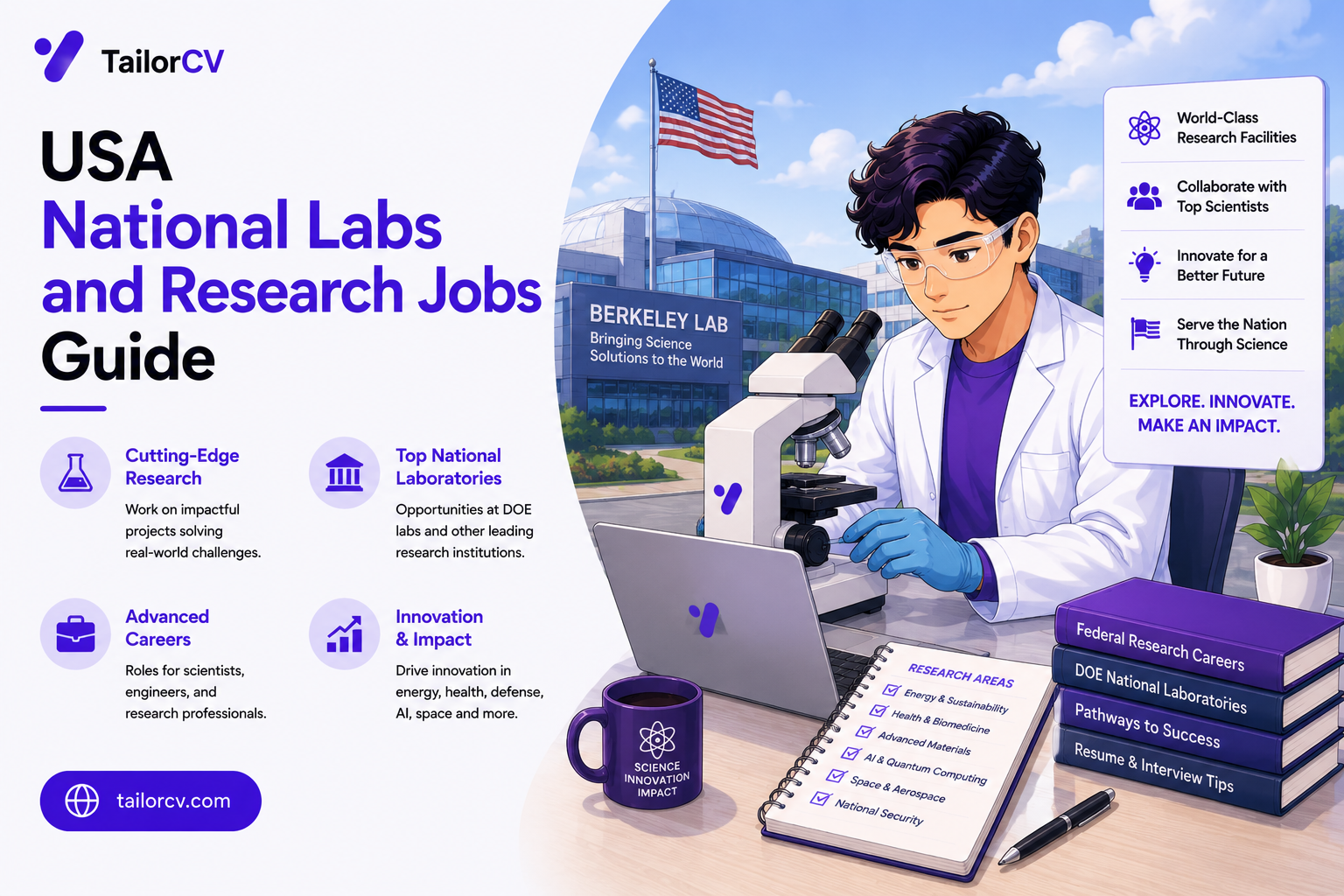
- National laboratories employ thousands of scientists, engineers and technical staff and run structured graduate and internship programmes.
- Many are operated by contractors — universities or companies — rather than by the government directly, which changes both hiring and eligibility.
- Some positions require citizenship and clearance; many do not, and the ones that do not are frequently open to international candidates.
- Some labs qualify as cap-exempt employers for immigration purposes, which removes the H-1B lottery entirely.
- The work is genuinely large-scale and long-horizon, with pay below top-tier industry and considerably better stability.
What they are
The United States funds a network of national laboratories and federally funded research and development centres covering energy, defence, computing, materials, biology, climate, aerospace and fundamental physics.
Their scale is not widely appreciated by students. Individually these are organisations of thousands of people. Collectively they operate some of the largest scientific instruments in the world — supercomputers, particle accelerators, light sources, fusion experiments, telescope arrays — and they employ the engineers, software developers, data scientists, technicians and administrators required to run them, not only physicists.
The operating structure matters for hiring. Many labs are government-owned and contractor-operated: the facility belongs to a federal agency and a university, a consortium or a company manages it under contract. That means your employer is frequently not the federal government, which changes the citizenship rules, the hiring process and sometimes your immigration options in your favour.
Who they hire
The stereotype is a physics PhD. The reality is much broader.
Software engineers and computational scientists. Scientific computing, simulation, data pipelines, visualisation, high-performance computing. These are real software jobs on unusually interesting problems, and the labs struggle to compete with industry for candidates, which works in your favour.
Data scientists and statisticians. Enormous experimental datasets and genuine analytical difficulty.
Engineers of every discipline. Mechanical, electrical, civil, nuclear, materials, systems. Instrument design, facility operation, capital projects.
Technicians and operators. Skilled roles supporting experimental facilities, frequently open at associate and bachelor's level.
Postdoctoral researchers, which is the traditional route and only one of several.
Cybersecurity, IT and networking. Significant functions given what the labs hold.
Project management, procurement, finance, communications and safety. Large organisations need all of it.
The point for a job-seeking graduate: search the careers page by function rather than by discipline. A computer science graduate scanning for "physicist" concludes there is nothing there, when the same lab has thirty open software roles.
The entry routes
Undergraduate internships. Structured summer programmes, frequently with a stipend and housing, and often run centrally by the sponsoring agency rather than by the individual lab. Applications typically open in the autumn or early winter for the following summer, which is earlier than students expect.
Graduate student programmes. Longer-term appointments allowing graduate students to conduct thesis research at a lab, using facilities their university does not have. These are unusually good and unusually under-applied-to.
Postbaccalaureate appointments. One or two year research positions for people between a bachelor's degree and graduate school. A genuine alternative to going straight into a PhD or straight into industry, and a common route into a permanent role.
Postdoctoral fellowships. Named fellowships at most labs, some highly competitive, generally two to three years.
Direct staff hiring. Ordinary vacancies for permanent scientific, engineering and technical staff. Open to graduates at bachelor's and master's level more often than people assume.
The application pattern. Most labs post on their own careers site, and the central agency programmes have their own portals. There is no single place that aggregates them all, which is precisely why they stay under-contested — finding them takes a little work and most students never do it.
Citizenship, clearance and immigration
The question that decides whether this is viable for you, and the answer is more encouraging than for direct federal employment.
Some positions require citizenship. Particularly at defence-oriented labs, in nuclear work, and anywhere involving classified material. These are stated explicitly on the posting.
Many positions do not. Open scientific research — energy, climate, biology, basic physics, much of computing — frequently has no citizenship requirement, and the labs employ substantial numbers of foreign nationals.
Clearance takes time where required. Months, sometimes much longer, and the posting will say.
Foreign national access has its own process. Even for unclassified work, labs have procedures for approving access by non-citizens, which can add lead time. Ask about it early rather than discovering it after an offer.
Some labs are cap-exempt. This is the genuinely valuable part. Labs operated by universities, and organisations qualifying as non-profit or governmental research organisations, may be able to sponsor H-1B outside the annual cap — no lottery, no filing season. The cap-exempt guide explains the mechanism, and it makes the labs one of the most useful segments an international graduate can look at.
Ask two questions in the first conversation: does this position require citizenship, and is this employer cap-exempt for H-1B purposes. Both have short factual answers and both determine whether the application is worth making.
What the work is like
The problems are large and the horizon is long. Projects run for years, sometimes decades. A graduate can join something that will still be running when they are senior. For people who find quarterly cycles unsatisfying, this is the appeal.
The instruments are unique. Working on a machine that exists in only two or three places in the world is a specific kind of privilege and it shapes what you learn.
Pace is deliberate. Safety culture, review processes, documentation. In some parts of the labs this is very slow indeed, and it is not a good fit for everyone.
Publication is normal. Much of the work is published, which matters if you are building an academic record — or, incidentally, an O-1 case.
Pay sits below top-tier industry for comparable technical skill, particularly in software, and comes with strong benefits, genuine job stability and predictable hours.
Location is a real factor. Many labs are in small towns or semi-rural areas rather than in major metropolitan centres. This is either a large advantage or a dealbreaker, and it is worth being honest with yourself about which before you apply.
Applying well
Apply to the internship programmes early. Autumn and early winter for the following summer, which catches students who expect a spring deadline.
Write for a scientific reader. These applications frequently want a statement of research interest, and it should describe what you have actually done and what you want to work on, specifically. A generic enthusiasm statement performs badly with reviewers who are working scientists.
Name the group or facility. Labs are collections of divisions with distinct programmes. An application naming a specific group and explaining why reads completely differently from one addressed to the lab in general.
Contact researchers directly. This works better here than in almost any other sector. Scientists respond to specific, informed questions about their work, they are rarely contacted by students seeking staff roles, and an internal advocate matters. Your own professors are frequently one connection away — ask them.
Have references ready early. Academic-style applications ask for them sooner than corporate ones.
Expect a longer process. Weeks to months, plus any clearance or foreign national access processing. Keep other applications running in parallel.
Contacting researchers directly
This works better at national labs than in almost any other sector, and it is the single highest-return activity available to you here.
Why it works. Staff scientists are not besieged by student outreach the way corporate recruiters are. They care about their work and respond to specific questions about it. And hiring at labs is frequently driven by individual groups with funded positions rather than by a central campaign, which means a scientist who wants you can often make it happen.
How to find people. Read recent papers from the lab in your area and note the authors. Look at group pages, which labs maintain publicly. Check who presented at conferences in your field.
What to write. Short, specific, and about their work rather than about your need.
Dear Dr Alvarez — I'm finishing an MS in mechanical engineering at [university] and I read your group's paper on the thermal management approach for the beamline optics. The part I found interesting was the trade-off you describe between cooling capacity and vibration, because I ran into a smaller version of that in my thesis work on [x]. I'm looking for research positions from June and wondered whether your group takes people at master's level. I've attached my CV in case it's useful.
Why that works: it demonstrates you read the paper, it connects their work to yours specifically, and the ask is clear and easy to answer.
Ask your own professors first. Academic networks reach into the labs densely, and an introduction from someone your target knows converts far better than a cold message. Most students never ask.
Follow up once after ten days, briefly, then leave it.
The postbaccalaureate route
Under-known, and one of the most useful options available to a bachelor's graduate who is unsure about a PhD.
What it is. A one or two year paid research appointment at a lab for someone who has recently completed a bachelor's degree, working in a research group on real projects.
Why it is valuable. It answers a question that is otherwise expensive to answer. A PhD is five or six years and people commit to it on very little information about whether they enjoy research. A postbac gives you a year inside a real group, doing real work, before making that decision.
What it leads to. Three common outcomes, all reasonable: into a PhD with a much stronger application and a clear research direction; into a permanent technical staff position at the lab; or into industry with a year of genuine research experience and a publication or two.
Who it suits. Anyone finishing a science or engineering bachelor's who is interested in research and not certain, and anyone whose undergraduate institution had limited research opportunities.
How to apply. These are advertised both centrally through agency programmes and directly by labs, and direct contact with a group is frequently how they get filled. The outreach approach applies, adapted to a scientific audience as above.
One caution. It is a term appointment, not a permanent job, so plan the next step from the start rather than in the final months.
What the labs pay attention to
Applications here are read by working scientists and engineers rather than by generalist recruiters, which changes what a strong application looks like.
Technical specificity. What you actually did, with the methods named. "Performed data analysis" is empty; "wrote the reduction pipeline for the detector calibration data, in Python, handling about 200GB per run" tells a reader everything.
Evidence you can work independently. Research work is less supervised than a graduate job in industry. A project you drove, a problem you solved without being told how, or a piece of work you took further than the assignment required all speak to this.
A real reason for this group. The most common weakness in these applications. Naming the division, the facility or a paper, and connecting it to your own work, separates you from applicants who sent the same document to twelve labs.
Publications and presentations, where you have them, listed properly in academic format.
Honesty about what you have not done. Scientific readers respond well to a candidate who says which techniques they know and which they would be learning. Overclaiming is transparent to a specialist and it is the fastest way to lose credibility.
Software practice, for computational roles. Labs increasingly care about whether you can write maintainable code, use version control properly and test your work — because a great deal of scientific software is written by people who never learned to.
And a CV rather than a one-page resume. Academic-style applications expect a fuller document, closer to the conventions used outside the US than to a corporate one-pager. Include publications, presentations, technical skills and relevant coursework.
Where the labs are, and why it matters
Location is the factor that decides most people's answer here, and it deserves a clear look rather than a quick dismissal.
Many labs are deliberately remote. Large facilities need space, isolation, or specific geography. Some sit in small towns hours from a major city.
Some are in or near large metropolitan areas, attached to universities or in established research corridors.
What remote actually means in practice. Housing is dramatically cheaper, commutes are short, and the lab is frequently the centre of a genuine scientific community with colleagues who are also your neighbours. It also means a smaller job market for a partner, fewer options if you leave the lab, and a social life built largely around the same institution.
Why it is worth taking seriously either way. Some of the best-resourced technical work in the country happens in places graduates rule out without looking. Equally, taking a role in a location you will be unhappy in is a bad trade regardless of the work — and people do it, then leave within eighteen months.
A reasonable approach: visit before accepting if you can, ask current staff what people do outside work, and ask specifically what happens to partners looking for employment. Labs are used to that question and the good ones have answers.
Tip: Email a specific researcher whose work you have actually read, rather than applying only through the portal. Lab hiring runs on individual principal investigators far more than on central recruiting.
Common Mistakes
- Assuming they only hire physicists. Software, data, engineering and technical operations roles vastly outnumber the stereotype.
- Assuming citizenship is always required. Many open-science positions have no such requirement and labs employ many foreign nationals.
- Not asking about cap-exempt status. Not asking about cap-exempt status for an international graduate this can be the single most valuable fact about the employer.
- Applying in spring for a summer internship. Applying in spring for a summer internship the programmes generally open in autumn or early winter.
- Sending a generic application. Naming the division, the facility or the researcher changes the outcome materially.
- Ignoring location too quickly. Some of the best-resourced technical work in the country happens in places graduates dismiss without looking.
Choosing a lab
They differ more than their common description suggests, and the differences should shape where you apply.
By mission. Energy, defence, basic science, biological and environmental research, computing. The mission determines both the work and the citizenship rules — defence-oriented labs have far more restricted positions than open-science ones.
By operator. University-operated labs frequently feel more academic, publish more freely, and are more likely to be cap-exempt for immigration purposes. Company-operated labs are frequently more programme-driven and process-heavy.
By facility. If a specific instrument is central to your field, the lab that operates it is not interchangeable with any other.
By location. This is the practical one. Some labs sit inside major metropolitan areas; many are deliberately remote. Housing costs, partner employment, transport and what you want your life to look like are all legitimate inputs, and they are the factor people most often ignore and most often leave over.
By size of group. A large division and a ten-person group are different jobs. Ask how many people are in the group and what proportion are early-career, because a group with no junior staff may not have thought about how to develop one.
A reasonable approach: identify the four or five labs whose work genuinely overlaps your field, learn their group structure, and apply deliberately to those rather than scattering applications across the whole network. The channel rewards specificity, and specificity is only possible at small numbers.
How this compares to industry and academia
Useful framing, because the labs sit between the two and people evaluate them against the wrong benchmark.
Against an industry technical role. Lower pay, particularly in software and data. Much longer project horizons. Better job security and more predictable hours. Far more freedom to publish. Less product pressure and less commercial urgency, which is either relief or frustration depending on your temperament.
Against an academic postdoc. Generally better paid and considerably more stable, with real budgets and equipment. Less freedom to set your own research direction, since lab work is programme-driven and funded against goals. Fewer teaching obligations. Staff positions are permanent in a way academic soft-money posts are not, which matters a great deal to anyone who has watched a postdoc chain.
Against a PhD, for a bachelor's graduate. A postbaccalaureate appointment is a much cheaper way to find out whether you want a research career, and it strengthens a PhD application substantially if you decide you do.
On career optionality. Lab experience travels well into industry, particularly in specialised technical areas, and into academia. What it does not do is put you on a fast commercial track — someone who wants to be a senior engineer at a major technology company in five years is choosing the slower path.
And on the thing people underweight: for an international graduate, the possibility of cap-exempt sponsorship can outweigh every other line in this comparison, because it converts an uncertain future into a plannable one.
A short application checklist
Before you apply
- unchecked: Identify four or five labs whose work genuinely overlaps your field
- unchecked: Read two recent papers from the group you are targeting
- unchecked: Check the posting for citizenship and clearance requirements
- unchecked: Ask whether the employer is cap-exempt, if that matters to you
- unchecked: Prepare a CV rather than a one-page resume, with publications and technical skills
In the application
- unchecked: Name the division, facility or paper, and connect it to your own work
- unchecked: Describe methods and scale specifically, not in general terms
- unchecked: Be honest about what you have not done
- unchecked: List references early — academic-style processes ask sooner than corporate ones
In parallel
- unchecked: Email one researcher in the group with a specific question about their work
- unchecked: Ask your own professors whether they know anyone there
- unchecked: Keep other applications running, because the timeline is long
After an offer
- unchecked: Confirm what any foreign national access process involves and how long it takes
- unchecked: Ask about relocation, since many labs are outside major cities
- unchecked: Compare the total package rather than the base, since benefits and stability are a real part of the value
Related Guides
Keep building on this with the related guides in this series:
- 401(k) and Benefits Explained for New Graduates
- US Background Checks - What Employers Actually See
- Cap-Exempt H-1B Employers - The Route Around the Lottery
- Community College Transfer Students - Building a Career Strategy That Works
- US Data Science New Grad Hiring - The Roles, the Loop and the Preparation
- Day-One CPT - What It Is and Why It Carries Real Risk
You can also check your resume's ATS score for free, generate a tailored cover letter, or build a portfolio website in minutes.
Frequently Asked Questions
Do I need a PhD?
No. Labs hire at bachelor's and master's level across engineering, software, data and technical operations, and run postbaccalaureate programmes designed specifically for people with a bachelor's degree.
Can international students work at national labs?
Frequently yes, for unclassified open research. Positions requiring citizenship or clearance say so explicitly, and there is usually an additional access process for foreign nationals that adds lead time.
Are national labs cap-exempt for H-1B?
Some are, depending on how they are operated and classified. It is a question with a factual answer — ask the recruiter or HR directly, because it can remove the lottery entirely.
How does the pay compare to industry?
Below top-tier technology and finance for comparable skills, competitive with mid-market employers, and paired with strong benefits and unusual stability.
When do internship applications open?
Generally autumn to early winter for the following summer. Check the sponsoring agency's central programme portal as well as individual lab pages, since the two are separate.
Is a postdoc the only research route?
No, and treating it as the only option is a common error. Postbaccalaureate appointments, graduate student research programmes and permanent technical staff roles are all genuine routes, and the staff roles in particular are frequently more stable than an academic track.
What is your resume scoring right now?
Scan it against a job description and get your ATS match score in about a minute.
Drop your resume here or choose a file
PDF only. Max 2 MB.
We never share your data or use it to train AI models.

See what your portfolio could look like
This theme is built straight from your resume — pick one and your portfolio is live in minutes.
Was this guide useful?
Be the first to rate it.