 SS
SS
Key Takeaways
- UK employers score against a published competency framework, so preparation means mapping evidence to their named competencies.
- The follow-up questions are the assessment, not the initial answer. Prepared stories that collapse on probing are the common failure.
- Use "we" for context and "I" for your contribution — British modesty norms make candidates disappear from their own stories.
- Results need to be concrete. "It went well" is not a result.
- The same stories are reused across the application form, video interview and assessment centre, so build them once and properly.
What a competency framework is
Most UK graduate employers define the behaviours they hire for. Typically five to eight, with names like commercial awareness, working with others, resilience, analytical thinking, communication, leadership, adaptability.
Every stage of the process scores against that list. The application form questions map to it, the recorded video interview maps to it, and the assessment centre exercises each target specific ones.
Many employers publish theirs. Finding it and preparing one strong example per competency is the single highest-return preparation available, and most candidates never look.
Why the probe matters more than the answer
A US behavioural interview often accepts a well-told story and moves on. A UK competency interview does not.
Expect three or four follow-ups on the same example:
- What was your specific role in that?
- Why did you take that approach rather than the alternative?
- How did you know it had worked?
- What would you do differently now?
- How did the others react?
This is deliberate. Interviewers are testing whether the story is real and whether you have reflected on it. A memorised ninety-second answer that falls apart on the second question is worse than a rougher answer you can genuinely discuss.
Practical implication: choose stories you actually lived and can talk about for five minutes, not the most impressive-sounding one. If you cannot remember what someone else said or why you chose one approach over another, the probe will expose it.
Structure
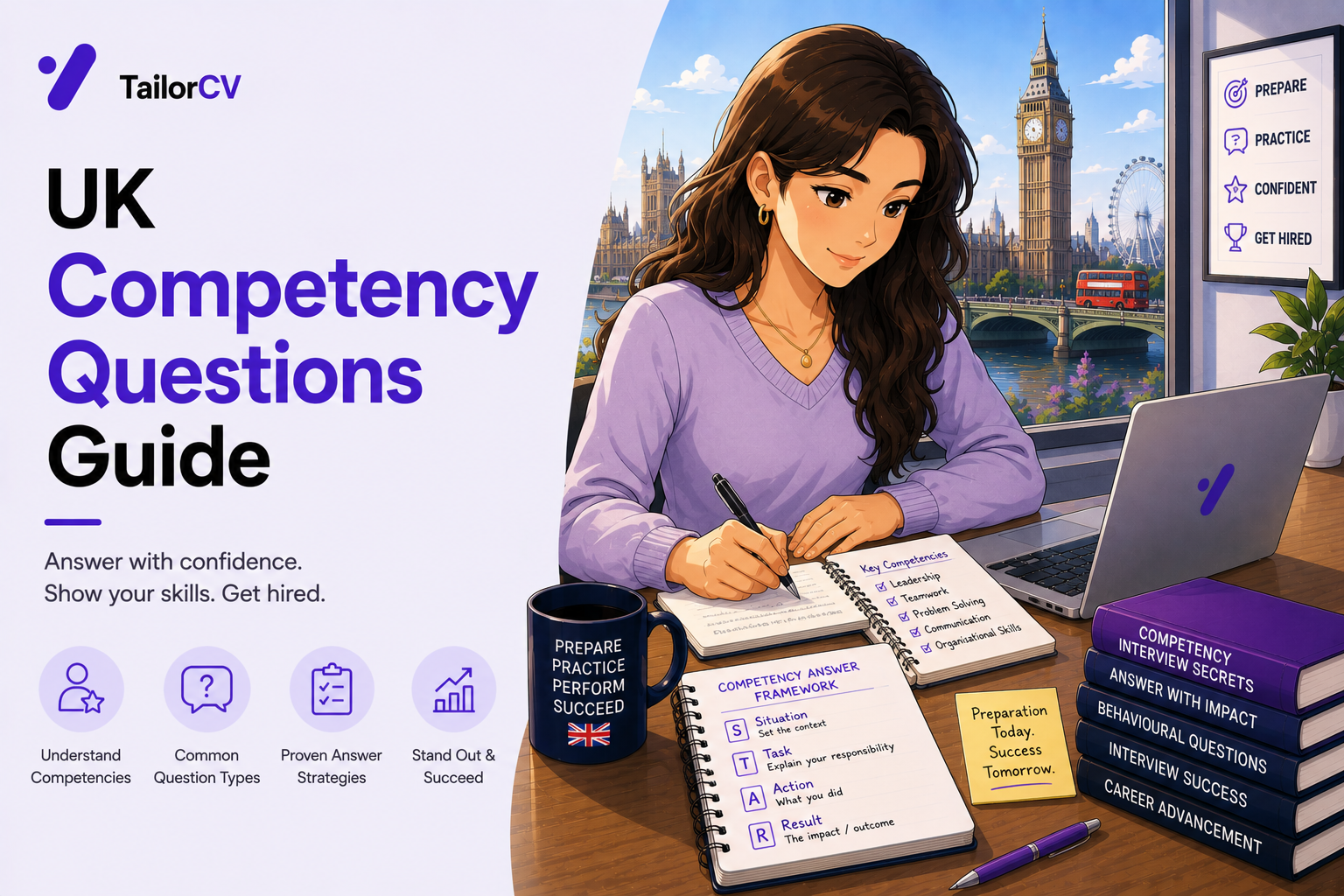
STAR works: Situation, Task, Action, Result. Two refinements matter in the UK context.
Keep Situation short. Two sentences. Candidates routinely spend half the answer on background.
Make Result concrete. The most common weakness is ending with an absence of failure — "and we submitted on time", "and it went well". That tells the interviewer nothing.
Weak: "We worked together and delivered the project successfully."
Better: "We delivered two days early. The validation step I added caught three duplicated records, which would have overstated the totals by roughly 8%, and the department reused our template for the following year."
Numbers help where they exist. Where they do not, a specific consequence works — something changed, someone adopted it, something stopped breaking.
The "we" problem
British workplace norms discourage self-promotion, and candidates over-correct into invisibility. An answer that says "we decided, we built, we fixed" throughout leaves the interviewer unable to score you, because they are assessing you rather than your team.
The balance: "we" for context, "I" for contribution.
"We had three days and the integration was failing. I took the parser, isolated the encoding bug and rewrote the import step, then walked the others through it so they could handle the same problem later."
That describes the team accurately and is clear about what you did. It is not boasting; it is answering the question.
Building the story bank
Six to eight stories, each usable for several competencies with different emphasis.
Cover:
- Working with someone difficult
- A genuine failure of yours, and what changed after
- Leading without authority
- A hard analytical or technical problem
- Competing deadlines and how you prioritised
- Something you started that nobody asked for
- Difficult feedback you received
- Adapting when circumstances changed
Student material is entirely legitimate — group projects, part-time work, societies, sport, volunteering, tutoring, family responsibility. Interviewers hiring graduates expect graduate-scale examples and are assessing your thinking, not the size of the setting.
The same stories carry through the whole process, which is why building them properly once is efficient. The US approach to story banks is the same discipline with a slightly different delivery register.
The failure question
"Tell me about a time you failed" is asked to test self-awareness. The disguised-strength answer — "I'm too much of a perfectionist" — is transparent and lands badly.
What works: a real failure, a real consequence, and a specific change you made afterwards. The change is the part being scored.
"I under-communicated on a group project and a teammate duplicated two days of work. Since then I post a short summary at the end of every working session, which I carried into my placement year and still do."
Short, honest, and it demonstrates the reflection the question exists to find.
Commercial awareness
A distinctively British emphasis, particularly in finance, law and consulting. It means: do you understand the business, the sector and what affects it.
Preparation is reading, with a view. Being able to name something happening in the sector and say why it matters to this employer is what separates candidates. Generic "the industry is changing rapidly" answers are heard constantly.
Pair this with proper company research — the two questions employers use to separate similar candidates are "why us" and "what's happening in our market".
The probe, demonstrated
Nothing explains why the follow-up matters more than seeing an answer survive one and then fail one. Same opening answer, two candidates.
The question: "Tell us about a time you worked in a team where there was disagreement."
The opening answer, from both candidates:
"On my final-year group project we had to choose between two approaches for the data pipeline. Two of us wanted a simpler approach and two wanted something more sophisticated. I suggested we timebox a prototype of each for a week and decide on evidence. We did, the simpler one was adequate, and we went with it and finished on schedule."
Perfectly good. Now the probe.
Candidate A:
"What specifically did the other pair want to do?" "They wanted a more advanced solution." "In what way more advanced?" "It was more complex, using more sophisticated techniques." "Who ran the prototype for their approach?" "We all worked on it together."
The story is dissolving. Every answer is vaguer than the question. The assessor now suspects — correctly or not — that this either did not happen or that the candidate was not close to it.
Candidate B:
"What specifically did the other pair want to do?" "They wanted to build it as a streaming pipeline rather than a batch job that ran nightly. Their argument was that the dataset would grow and batch would stop being viable." "Was that a reasonable argument?" "It was, and it is probably right eventually. It was not right for a twelve-week project with four people who had never built either." "Who ran their prototype?" "Priya did, and I helped with the ingest part. Which mattered, actually — if I had only worked on my own version I do not think they would have accepted the result." "What would you do differently?" "I would have raised it in week two instead of week four. We lost a fortnight to a disagreement nobody was naming."
Same story, and it holds. The details are specific, the candidate credits the opposing view, and the answer to "what would you do differently" is a real criticism of themselves rather than a disguised strength.
The lesson is not that candidate B is a better storyteller. It is that candidate B is describing something that happened. Use true stories. Invented ones are indistinguishable from real ones for about ninety seconds, and every UK competency interview goes past ninety seconds.
Building the story bank properly
Six stories, built once, carry you through the application form, the video interview and the assessment centre. This is the highest-return preparation available in UK graduate recruitment, and it takes an afternoon.
Cover these six situations:
| Story | Competencies it usually serves |
|---|---|
| A team disagreement you helped resolve | Teamwork, influencing, communication |
| Something that failed, and what you did | Resilience, self-awareness, learning |
| A time you led without authority | Leadership, initiative |
| A deadline or resource problem | Planning, prioritisation, working under pressure |
| Something you had to learn fast | Adaptability, learning agility |
| Something you are genuinely proud of | Drive, motivation, values |
For each, write down: what the situation was in two sentences, what you specifically did, what happened, what you would change, and three details you could produce under probing — a name, a number, a date.
That last row is the part people skip and it is the part that decides whether the story survives. Write down the actual numbers now, because you will not recall them under pressure eight weeks later.
The "we" problem, fixed mechanically
British professional norms discourage self-promotion, so candidates describe their team's work and vanish from their own story. Assessors cannot score what you did not claim.
The fix is mechanical rather than a matter of confidence. Go through each written story and mark every sentence as context or contribution. Context takes "we". Contribution takes "I". Then check that at least half your sentences are contribution sentences.
Two rewrites, before and after:
"We identified that the reporting process was taking too long, so we automated the parts that were repetitive, and we managed to cut it down significantly."
"We were spending about three hours a week on the reconciliation. I worked out that most of it was two copy-paste steps, wrote a script for those, and got it to about twenty minutes. The other two kept running the checks manually, which was the right call — that part actually needed judgement."
The second version still credits the team, still uses "we" for context, and leaves no doubt about what the speaker did. That is the target, and it is not immodesty — it is answering the question, which was about you.
The failure question, and why candidates get it wrong
"Tell us about a time you failed" is asked in nearly every UK competency process and answered badly by most candidates, because they choose a failure that is secretly a success.
The disguised-strength answer — "I took on too much because I care too deeply" — is transparent to anyone who has run interviews, and it costs you the competency being assessed, which is self-awareness.
What a strong answer contains: a real failure with real consequences, your genuine contribution to it, what you understood afterwards that you did not understand before, and — the part most often missing — evidence that the understanding changed your behaviour subsequently.
"I ran the society's main event in second year and we came in about four hundred pounds over budget. The reason was that I approved things individually and never looked at the running total, so every decision looked small. What I actually got wrong was not the spending — it was that I had no view of the whole thing at any point. When I ran the smaller event that spring, the first thing I built was a single sheet with the total on it, and I looked at it before approving anything. We came in under."
Real, consequential, specific about the mechanism, and it demonstrates a changed behaviour. That answer scores well on a competency framework, and the reason is that it contains information rather than positioning.
Commercial awareness, made concrete
Named as a competency in most UK frameworks and consistently the thinnest area for candidates, because it is the only one that cannot be answered from your own life.
It does not mean predicting markets. It means understanding how the employer makes money, what pressures it faces, and what is happening in its sector — at the level of an interested outsider who reads.
Four weeks of twenty minutes daily is enough. Read one business news source, follow three ongoing stories relevant to the sector, write three sentences on each about what you think happens next, and read the employer's most recent annual results summary. That last step is public, takes an hour, and almost no graduate candidate does it.
The question that tests it is usually "tell me something happening in our industry", and the difference between a weak and a strong answer is whether you have a view or a summary. A summary repeats what you read. A view says what you think follows from it, and invites the interviewer to disagree — which is a much better conversation than the one where you recite a headline.
Where the same stories get used
The reason to build the story bank properly is that UK graduate processes reuse the same evidence at four separate stages, and candidates who rebuild from scratch each time produce weaker material every round.
The application form. Written competency questions with tight word limits — often 250 words or fewer. The constraint is real: your story must compress to situation in one sentence, contribution in three or four, result in one. Written answers are read, and at the biggest employers they are the primary sift alongside the psychometric tests.
The recorded video interview. Same competencies, spoken, with a preparation window of thirty seconds and an answer window of two minutes. No follow-ups, which means the initial answer has to be self-contained — the video interview guide covers the format, and the relevant discipline here is finishing early rather than filling the time.
The assessment centre interview. The full version with probing, which is what the story bank is really built for. The assessment centre guide covers the other exercises, and the interview within it is where these stories get tested hardest.
The final interview with a senior person. Less structured, often more conversational, and frequently returning to something from earlier in the process. Consistency matters — a story that has quietly grown between round one and round four is noticed.
The practical consequence: write each story at two lengths. A 200-word written version and a spoken version you can deliver in ninety seconds, with the details underneath ready for probing. Doing this once serves all four stages, and it is why the afternoon spent building the bank is the best-value preparation in the entire UK process.
Answer length, by stage
The same story has to work at three lengths, and candidates who prepare only one struggle at the other two.
250 words, written. Application form. One sentence of situation, three or four of your contribution, one of result. Ruthless. Anything that is not you doing something gets cut, including most of the background you feel is necessary.
90 seconds, spoken, no follow-up. Video interview. Self-contained, because nobody will ask a clarifying question. Say the result explicitly rather than leaving it implied — this is the stage where candidates most often finish without ever stating what happened.
Two minutes, spoken, expecting probing. Assessment centre and final interview. Deliberately leave threads for the interviewer to pull — a decision you made, a person who disagreed. Answers that close every loop pre-emptively run long and give the assessor nothing to explore, which produces a shallower conversation and a lower score.
Write the 250-word version first. The other two are compressions and expansions of it, and having the written one forces the discipline that the spoken ones need.
Common Mistakes
- Preparing the answer but not the follow-ups. The probe is the assessment.
- Long situations. Half the answer spent on background.
- No concrete result. "It went well" is not an outcome.
- Disappearing behind "we". Leaves nothing to score.
- A fake failure. Transparent, and it wastes a question you could have won.
- Ignoring the published competency framework. It is the marking scheme, and it is usually public.
Finding the competency framework
Most UK employers publish the competencies they score against, and most candidates never look. This is unusual — it is the marking scheme, handed out in advance — and it takes ten minutes to find.
The graduate careers pages. Larger employers set out "what we look for" or "our values" as a named list. That list is usually the framework, or close enough to it.
The job posting itself. The bullets under "what we are looking for" are frequently the competencies in plain language.
The application form's own questions. If the form asks four written questions, those four are almost certainly the competencies weighted most heavily.
Alumni who went through it. The most reliable source, and the alumni search works the same way here as anywhere.
Once you have the list, map your six stories against it and check for gaps. Where a competency has no story, that is your afternoon's work — not rewriting the ones you have.
One caution: match your evidence to their language without parroting it. An answer that repeats the competency name back — "this demonstrates my commercial awareness and my collaborative approach" — reads as coached. Describe what you did; let the assessor do the mapping, which is their job and which they will do accurately if the evidence is there.
Frequently Asked Questions
How long should an answer be?
Ninety seconds to two minutes for the initial answer, leaving room for follow-ups. Four-minute answers get interrupted.
Can I use the same example twice?
Once more, with clearly different emphasis, is acceptable. Repeatedly returning to one story suggests a thin bank.
What if I have no work experience?
Group projects, societies, part-time work and volunteering are all valid. Graduate interviewers expect graduate-scale examples.
Should I write my answers out?
Write bullet points. Full scripts produce recited delivery and collapse when the question is phrased differently.
What is commercial awareness really?
Understanding what the business does, how it makes money, and what is currently affecting its sector — with an actual opinion rather than a summary.
How do I find the competency framework?
Check the employer's graduate careers pages, which frequently publish values or competencies. Where they do not, the job description's requirements are the next best proxy.
How many stories do I actually need?
Six well-built ones, each usable for two or three competencies. Candidates who prepare twelve shallow stories perform worse than those with six that survive probing.
What if the interviewer asks about a competency I have no story for?
Say what you have. "I have not led a formal team, but the closest thing is..." is a legitimate answer and scores better than forcing an unrelated story into the frame. Assessors have heard both.
Should I write out full answers or bullet points?
Bullets. Written-out answers get memorised, and memorised answers sound memorised — which reads as rehearsed rather than real, and collapses on the first follow-up because you cannot navigate outside the script.
Is it acceptable to pause before answering?
Yes, and it reads better than an instant answer. "Let me think about which example fits best" buys you five seconds and signals that you are choosing rather than reciting.
Was this guide useful?
Be the first to rate it.