 TD
TD

Key Takeaways
- Mid-level readers look for ownership: work you ran end to end, decisions you made, and results you are accountable for - not tasks you helped with.
- Restructure: experience goes first, education moves to the bottom, and college projects shrink or disappear unless they are exceptional.
- Rewrite "assisted", "supported" and "worked on" bullets into what you actually owned. Most two-year professionals own more than their resume admits.
- Add scope: how many users, how much budget, how many stakeholders, how often. Scope is what separates a junior bullet from a mid-level one.
- A posting asking for "3+ years" is often reachable at two years with strong evidence. Apply, and let the resume make the case.
- Your summary should now describe what you do, not what you hope to do. Drop the objective.
You have about two years of experience and you are applying for roles one level up - "Analyst II", "Mid-level Engineer", "Marketing Manager" - but your resume still reads like a fresher's. Projects are near the top, education leads, and bullets describe what you helped with. Mid-level hiring managers are looking for one thing: evidence you own work. Restructure the page around your experience and rewrite each bullet around what you ran, decided and delivered.
This guide covers the structural changes, the bullet rewrites, and how to handle postings that ask for more years than you have.
What Changes Between Junior and Mid-Level
The jump from junior to mid-level is less about new skills and more about how you work.
| Dimension | Junior | Mid-level |
|---|---|---|
| Work | Tasks assigned and reviewed | Projects owned end to end |
| Decisions | Follows the approach | Chooses the approach, explains why |
| Supervision | Frequent check-ins | Works independently, flags risks |
| Stakeholders | Mostly own team | Other teams, sometimes clients or leadership |
| Results | "Contributed to" | Accountable for a measurable outcome |
| Others | Learns from seniors | Starts helping newer joiners |
Your resume needs to show the right column. Most people at two years have already started doing mid-level work; they just have not rewritten their resume to show it.
Restructure the Page
The fastest signal that you are no longer a fresher is page structure.
Move education to the bottom
At two years, your experience is more relevant than your degree. Put experience directly after your summary and move education below it. Keep CGPA only if it is strong and the industry values it; drop school marks.
Shrink college projects
College projects were your main evidence as a fresher. Now they compete for space with real work. Keep one only if it is exceptional or shows a skill your job does not - and consider moving it into a short "Selected Projects" section below experience. See projects in a resume.
Drop the objective
"Seeking a challenging role to grow my skills" is a fresher convention. Replace it with a summary that describes what you do and what you have achieved. Resume objective vs summary explains the difference.
Before and after structure
| Section order - fresher resume | Section order - mid-level resume |
|---|---|
| Objective | Summary |
| Education | Experience |
| Projects | Skills |
| Skills | Selected projects (optional) |
| Internships | Education |
| Experience | Certifications (if relevant) |
| Achievements / extracurriculars | - |
Rewrite Bullets Around Ownership
This is the biggest change, and it is mostly about describing your real work more accurately.
Find what you actually own
Ask yourself:
- What does my manager rely on me to handle without checking?
- Which reports, systems, campaigns or processes would break if I left?
- What have I built or changed, not just maintained?
- Who from other teams comes to me directly?
- Have I trained or helped anyone newer?
The answers are your mid-level evidence. The post on what counts as relevant experience covers how readers judge it.
Replace helper verbs
| Junior phrasing | Mid-level phrasing |
|---|---|
| "Assisted in preparing monthly reports" | "Own the monthly performance report for 3 regional teams" |
| "Supported the marketing team with campaigns" | "Run paid social campaigns with a ₹8 lakh monthly budget" |
| "Worked on bug fixes for the payments module" | "Maintain the payments reconciliation service; cut failed reconciliations from 3% to 0.5%" |
| "Helped onboard new clients" | "Onboard about 6 new clients a month, from kickoff to go-live" |
| "Involved in the migration project" | "Led the data validation workstream for a CRM migration covering 40,000 records" |
Only claim ownership you actually have. If you genuinely assisted, say what your part was - but most people at two years undersell. Best action verbs for your resume has more options.
Add scope to every major bullet
Scope turns a task into evidence of level: users, volume, budget, team size, frequency, stakeholders.
Before: "Created dashboards for the sales team."
After: "Built and maintain the weekly sales dashboard used by 35 account managers and the regional head for forecasting."
For numbers you do not have exactly, see estimating impact honestly.
Rewrite the Summary for Your New Level
Your summary should describe your current capability and a specific result.
Fresher-style: "Motivated engineer with a B.Tech in CSE seeking an opportunity to grow as a backend developer."
Mid-level: "Backend engineer with two years building payment services in Java and Spring Boot - own the reconciliation service processing about 50,000 transactions a day, and mentor one new joiner."
The first talks about hopes and education. The second talks about responsibility, scale and a hint of leadership. Summary in three sentences gives the full structure.
Handling "3+ Years" When You Have Two
Mid-level postings often ask for three or more years. At two years, many of these are reachable.
When to apply
| Your situation | Apply? |
|---|---|
| 2 years, strong ownership evidence, match on core skills | Yes |
| 2 years including a substantial internship in the same field | Yes |
| 1.5 years, strong evidence | Often yes, as a stretch |
| 2 years, mostly assisted work, few owned results | Build evidence first, or apply more selectively |
| Posting says "minimum 5 years" and lists senior responsibilities | Usually no |
Experience thresholds are often guidelines rather than filters. JD asks for years you don't have covers how to decide and how to present it.
Let evidence make the case
Do not stretch your dates or count college projects as years. Instead, make your two years look like strong two years: owned projects, measurable results, scope. A hiring manager comparing you with a three-year candidate who describes tasks will often prefer you.
Worked Example 1: A Data Analyst Moving to Analyst II
Situation: Sanya has two years as a junior data analyst. Her resume leads with her MSc, then a dissertation project, then her job with bullets starting "Assisted" and "Supported".
Owned work she discovered in the audit: she runs the weekly churn report alone, built the team's customer segmentation, and answers ad-hoc questions directly from the product team.
Before: "Assisted senior analysts with customer churn analysis and reporting."
After: - "Own the weekly churn report for the leadership team, covering 120,000 subscribers; flagged a billing-related churn spike that led to a pricing-page fix." - "Built the customer segmentation model (SQL, Python) the product and marketing teams use for targeting." - "Field about 10 ad-hoc data requests a week directly from product managers."
Education moves to the bottom; the dissertation becomes one line under education. Her summary now leads with owning churn reporting. For analyst-specific phrasing, see which bullets to rewrite.
Worked Example 2: A Marketing Executive Applying for Manager Roles
Situation: Varun has two years as a marketing executive at a D2C brand and wants marketing manager roles.
Before: "Supported performance marketing activities across Meta and Google."
After: "Run Meta and Google campaigns end to end with a ₹10 lakh monthly budget - plan, launch, optimise and report weekly to the founders; cut CAC 22% over six months."
He adds one bullet that shows early leadership: "Trained and now review the work of one marketing intern." That single line signals readiness for managing others, which marketing manager roles often need.
Worked Example 3: A Software Engineer With a Strong Internship
Situation: Nisha has 20 months full-time plus a 6-month internship at the same company. She is applying for mid-level roles asking for 2-3 years.
Approach: She lists the internship and full-time role under one employer heading, showing progression:
Acme Fintech - Bengaluru Software Engineer, 2025-present Software Engineering Intern, 2024
Her bullets focus on the services she owns now. She does not claim 2.5 years of full-time experience - the dates show the truth - but the progression at one company reads as a strong 26 months. For promotions within one company, see resume for promotion within a company.
Worked Example 4: A Customer Success Associate Going for Manager
Situation: Pallavi has two years as a customer success associate at a SaaS company and wants customer success manager roles. Her resume says she "managed client queries" and "supported renewals".
Ownership audit:
- She owns a book of 35 mid-market accounts outright.
- She runs quarterly business reviews for her top 10 accounts herself.
- She flagged a pattern of churn among accounts that never completed onboarding and proposed a 30-day check-in, which the team adopted.
Before: "Managed client queries and supported account renewals."
After: - "Own a book of 35 mid-market accounts (about ₹2.4 crore ARR) - onboarding, adoption and renewals; 94% gross retention last year." - "Run quarterly business reviews for my top 10 accounts, presenting usage data and next-quarter plans to client leadership." - "Spotted that most churned accounts never finished onboarding; proposed a 30-day check-in the team adopted for all new customers."
Her new summary: "Customer success professional who owns a ₹2.4 crore book of 35 accounts with 94% retention, and designed our team's onboarding check-in." Two years of experience now reads like someone already doing the manager job at a smaller scale.
If You Have Already Changed Jobs Once
Many people at two years have two short roles - a first job of eight months and a current one of sixteen, say. That can make a resume look junior and restless at the same time.
Show a direction, not two starts
Make the two roles read as one progression. The first role's bullets should set up the skills the second role builds on. A one-line summary can connect them: "Two years in B2B analytics - first building reports at a logistics startup, now owning churn analysis at a SaaS company."
Keep both roles visible
Removing the first job to look more settled creates a gap, which is worse. Condense it instead, keeping the bullet that leads into your current work. Cutting irrelevant experience without creating a gap covers how.
Have a short, forward-looking reason ready
"The startup wound down its analytics team, and I wanted to go deeper on customer analytics" is enough. Keep it factual and point toward the role you are applying for. Tailoring a resume after job hopping covers longer patterns.
When Your Title Doesn't Match Your Level
Titles vary wildly. At some companies "Associate" is entry level; at others it is mid-level. "Executive" can mean anything from trainee to manager.
| Your situation | What to do |
|---|---|
| Title undersells you ("Trainee" doing full analyst work) | Keep the title, add a clarifier: "Trainee Analyst (owns weekly revenue reporting)" |
| Title oversells you ("Manager" with no reports at a small startup) | Keep it, but let bullets show real scope so interviews don't surprise anyone |
| Title is company-specific ("Growth Ninja") | Add a standard equivalent: "Growth Ninja (Performance Marketing Executive)" |
| You were promoted recently | Show both titles under one employer heading |
Never change the title itself - it is verifiable. The clarifier approach is covered in fixing a non-standard job title.
What Mid-Level Interviewers Will Probe
Once your resume shows ownership, interviews will test it.
| Resume claim | Likely question |
|---|---|
| "Own the weekly churn report" | "Walk me through how you build it and what you do when numbers look wrong." |
| "Run campaigns end to end" | "Tell me about a campaign that didn't work and what you changed." |
| "Maintain the reconciliation service" | "What was the hardest production issue you handled?" |
| "Mentor one new joiner" | "How do you help someone who is stuck?" |
Prepare a story for each ownership bullet using the interview story bank method. The mock interview tool can generate these questions from your own resume.
Edge Cases and Exceptions
Your first two years were at a very small startup
At small companies, juniors often do mid-level work because there is nobody else. Your resume can show that - but pair it with scope indicators, since readers may discount titles from very small companies.
You worked through a long notice period or bench time
Service companies sometimes leave new joiners on the bench for months. Describe the productive parts - training, internal projects - honestly rather than hiding the period.
Your two years included a career switch
If your first year was in a different function, condense it and lead with the second year's relevant work. The ownership rewrite matters even more here.
The mid-level posting asks for a specific certification
Some mid-level roles expect certifications (cloud, project management, finance). If you are close to completing one, state the expected date honestly.
Common Mistakes
Keeping the fresher structure
Education at the top and projects before experience instantly signal "junior". Restructure first.
Underselling with helper verbs
"Assisted", "supported" and "helped" hide real ownership. Rewrite with accurate verbs.
Inflating ownership
Claiming you "led" a project you contributed to will surface in interviews. See tailoring without lying and team vs individual credit.
Listing every college achievement
Hackathon participation and fest roles rarely help a mid-level application. Keep only exceptional ones.
A skills list that still looks like coursework
Replace "C, C++, Java, Python, HTML, DBMS, OS" with the tools you use at work, in the order the posting names them. Resume skills section order covers the grouping.
How This Fits With Tailoring
The restructure and ownership rewrite is a one-time change to your base resume. After that, tailor each mid-level application normally:
- Match the posting's title where accurate.
- Lead your summary with the ownership most relevant to the posting.
- Put the matching owned project first in your current role.
- Reorder skills to match.
The free ATS scan shows how your rewritten resume matches a mid-level posting in about a minute. The AI resume optimizer can reword bullets toward the posting - review the output to be sure it describes ownership you actually have. For the stretch applications, see tailoring for a stretch role.
Quick Checklist
- Is experience directly after the summary, with education at the bottom?
- Has the objective been replaced with a specific summary?
- Are college projects cut or shrunk to one line?
- Do bullets describe what you own, not what you helped with?
- Does each major bullet show scope - users, volume, budget, stakeholders?
- Is there at least one sign of early leadership, if true?
- Is your skills line made of tools you use at work, not coursework?
Frequently Asked Questions
How do I make my resume look mid-level with 2 years of experience?
Put experience first and education last, remove the objective, shrink college projects, and rewrite bullets around work you own, with scope and results. Most people at two years already do mid-level work but describe it as junior.
Should I remove college projects after 2 years of experience?
Usually shrink them to one line or remove them, unless a project is exceptional or shows a skill your job does not. Your work experience should carry the resume now.
Can I apply for a job asking for 3 years if I have 2?
Often yes, if you match the core skills and can show ownership and results. Experience requirements are frequently guidelines. Do not stretch your dates; let your evidence make the case.
Where should education go on a resume after 2 years?
At the bottom, after experience and skills. Keep your degree and institution; drop school marks and include CGPA only if strong and valued in your field.
What is the difference between a junior and mid-level resume?
A junior resume shows tasks and potential; a mid-level resume shows ownership, decisions, scope and measurable results. The same work can often be rewritten to show the difference.
Does an internship count toward years of experience?
It can support your case, especially if it was in the same field or company. Show it with its real dates, ideally under the same employer if you converted to full-time, rather than adding it to your full-time years.
How do I show leadership with only 2 years of experience?
Mentoring a new joiner, training interns, running a recurring process, coordinating with other teams, or leading a small workstream all count. One honest line can signal readiness.
Should my summary mention I have 2 years of experience?
It can, but lead with what you do and a specific result rather than the number of years. "Backend engineer who owns the reconciliation service" says more than "2 years of experience".
Is two years enough experience for a mid-level job?
Often, yes - especially if you can show ownership, independent work and measurable results. Many employers weigh evidence above the exact year count.
How do I show I work independently on my resume?
Use bullets that describe work you run end to end, recurring responsibilities you own, and decisions you make without sign-off, with the scale of each.
Should I list my college CGPA after two years of experience?
Only if it is strong and your industry values it, such as consulting or some finance roles. Otherwise, your degree and institution are enough at this stage.
How many bullets should each role have at two years?
Four to six for your current role and two to four for any earlier role, each showing ownership and scope rather than routine duties.
What to Do Now
Restructure your resume first: summary, experience, skills, then education. Then answer the five ownership questions and rewrite each bullet in your current role around what you own, with scope.
Rewrite your summary around your strongest owned result and apply to mid-level roles you match on core skills. Next, read first management role resume if you are already mentoring, and how far back your experience should go for what to keep from college.
What is your resume scoring right now?
Scan it against a job description and get your ATS match score in about a minute.
Drop your resume here or choose a file
PDF only. Max 2 MB.
We never share your data or use it to train AI models.

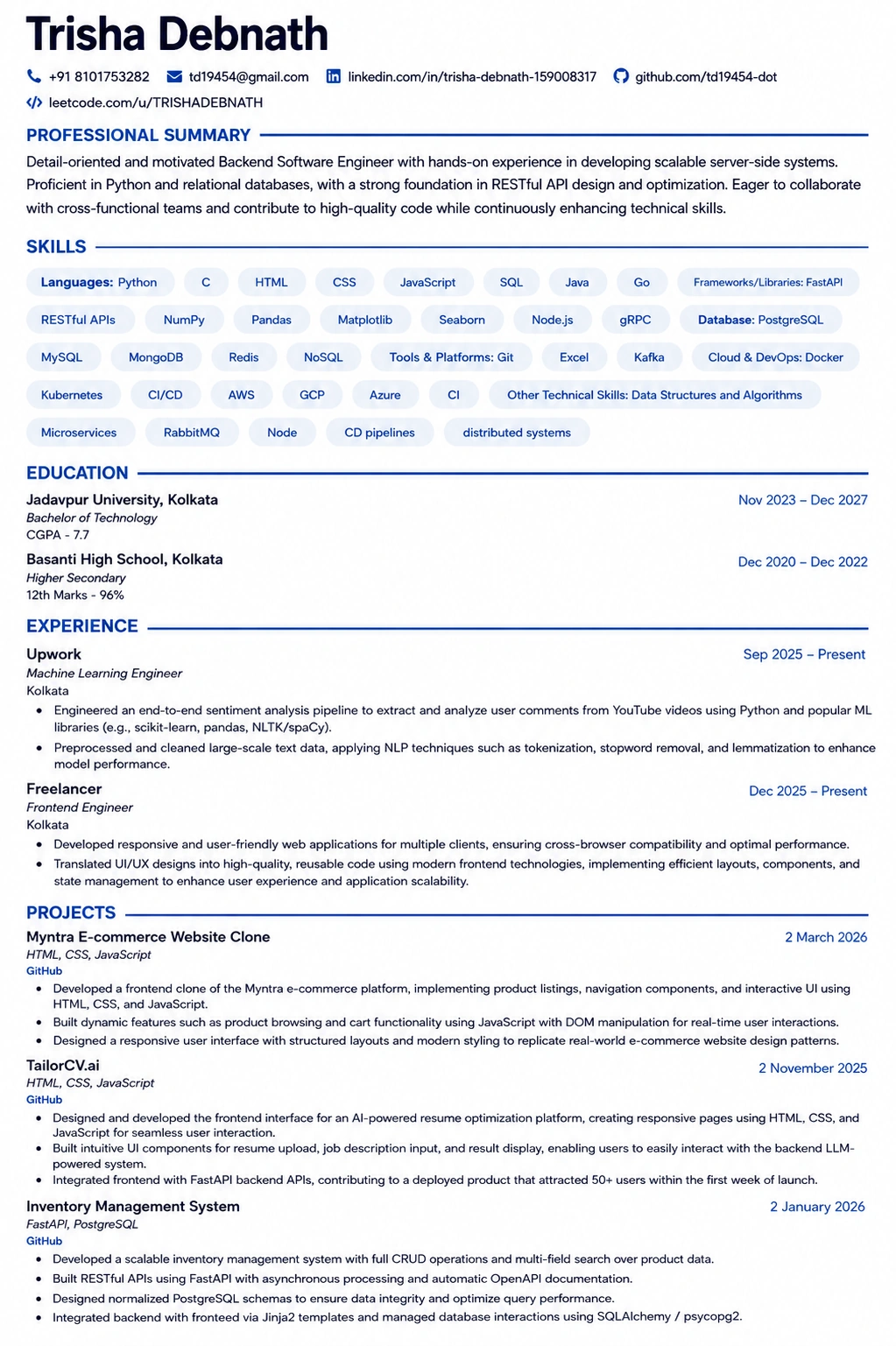
Templates that keep this structure intact
This template is ATS-tested — start from it and the formatting rules in this guide are already handled.
Was this guide useful?
Be the first to rate it.