 SS
SS
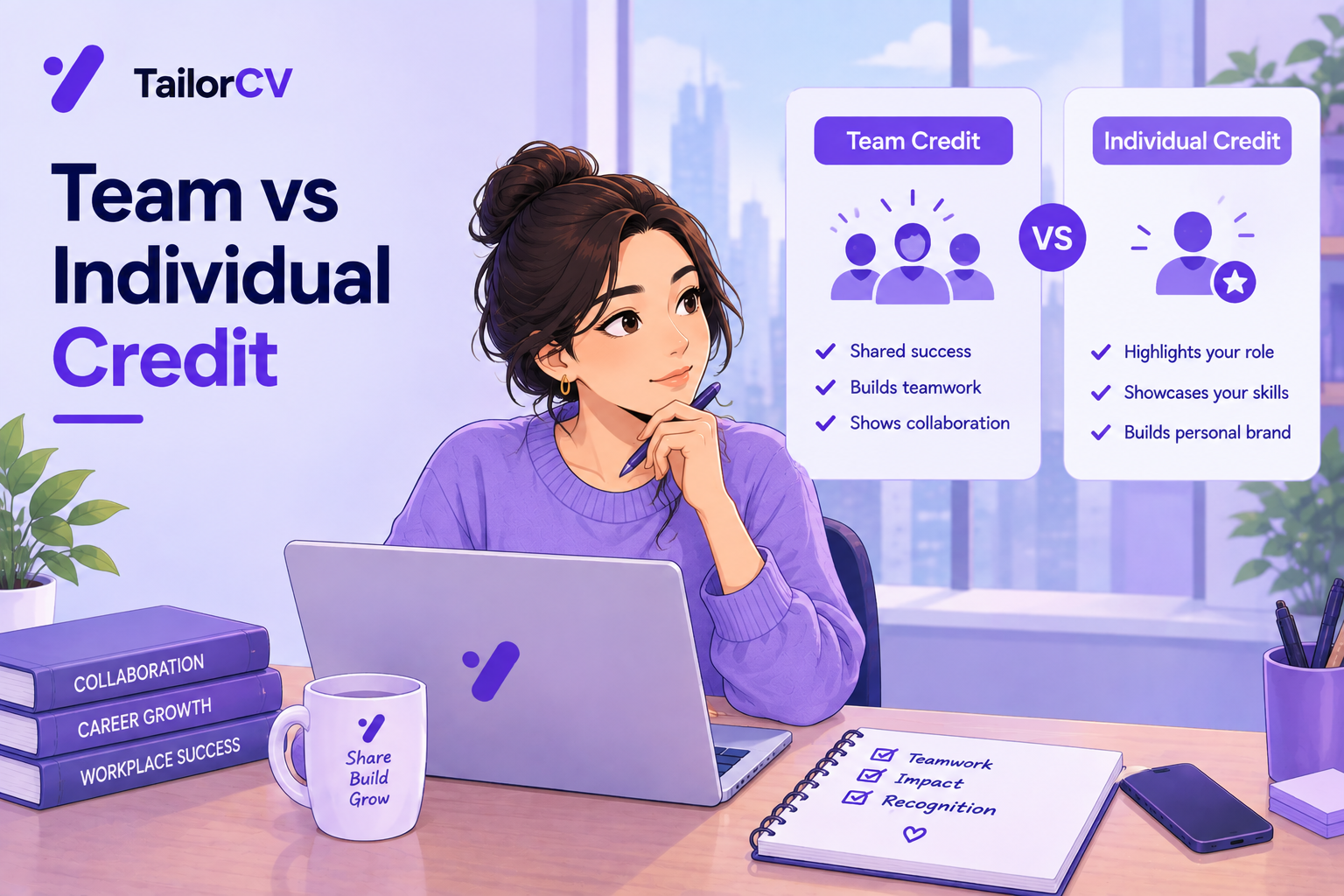
Key Takeaways
- Lead with your specific action, then connect it to the team outcome: "Built X, which helped the team achieve Y."
- Name your role in the team - owner, lead, one of four, the person who handled a specific part. Scope makes the claim believable.
- Tailor by choosing which of your contributions to foreground. The same team project can support very different postings.
- Never claim sole credit for a shared result. Interviewers dig into team outcomes, and colleagues are often the reference.
- Underselling is as common as overclaiming. "Helped with", "assisted in" and "was part of" hide real work - replace them with the verb for what you did.
- Collaboration itself is a skill postings ask for. Coordinating a team is a legitimate achievement, not a lesser one.
You were one of five people on the project that shipped, grew or saved something - and you are not sure how to put it on your resume. The honest, effective pattern is: your specific action first, then the team result it fed into, with your role made clear. "Built the pricing API that let the checkout team launch in three weeks" works; "Launched new checkout" alone overclaims, and "Assisted with checkout launch" undersells.
This guide shows how to separate your contribution from the team's, how to tailor the same shared project for different roles, and how to hold up under interview questions.
Why Team Results Are Tricky on a Resume
Almost everything meaningful at work is done by groups. But a resume is about one person.
Recruiters are trying to find you in the result
When a recruiter reads "Increased revenue 30%", their question is: what did this person do? If the bullet does not say, they either discount it or assume you are overclaiming. The post on resume red flags recruiters notice lists vague ownership among the common ones.
Interviewers test team claims directly
Behavioural interviews often ask "what was your specific role?" and "what would have happened without you?" A bullet that blurs "I" and "we" sets you up for an awkward answer. The STAR method guide explains why interviewers push for your individual actions.
References may be your teammates
At many companies, reference checks involve former colleagues or managers who know exactly who did what. A shared result claimed as yours alone can surface there.
The Contribution Formula
Most strong team bullets follow one structure.
[Your action verb] + [what you specifically did] + [team outcome it enabled or fed into] + [your scope, if useful]
Overclaim: "Launched a new mobile app with 50,000 downloads."
Undersell: "Assisted in the development of the company's mobile app."
Balanced: "Built the offline-sync module for the company's new mobile app - one of four engineers on the launch, which reached 50,000 downloads in three months."
The balanced version tells the reader your part, your team size, and the outcome - all true, all defensible.
Useful connecting phrases
| Phrase | Use when |
|---|---|
| "...which enabled the team to..." | Your work unlocked the team outcome |
| "...contributing to..." | Your work was one of several inputs |
| "...as part of a 5-person team that..." | Team size matters for scale |
| "Led the X workstream of..." | You owned one part of a larger project |
| "Coordinated X people across Y teams to..." | Your contribution was the coordination |
| "Owned X end to end within..." | You had full responsibility for a component |
Identifying What You Actually Did
Before writing the bullet, separate your work from the team's. Most people underestimate their own share because they only remember the whole.
Questions to find your contribution
- Which parts would not exist if you had not been there?
- Which decisions did you make or strongly influence?
- What did you build, write, analyse, design or negotiate yourself?
- Who did you coordinate, and what did coordinating involve?
- What problem did you notice that others had missed?
- What did people come to you for during the project?
Sorting your answers
| Your answer | Bullet type | Example |
|---|---|---|
| "I built/wrote/designed the X" | Ownership bullet | "Designed the onboarding flow..." |
| "I led the X part" | Workstream bullet | "Led data migration for..." |
| "I got people to agree / kept it on track" | Coordination bullet | "Coordinated legal, finance and product to..." |
| "I found the problem" | Diagnosis bullet | "Identified the root cause of..." |
| "I did a smaller support part" | Contribution bullet | "Tested 40+ edge cases for..." |
Every type is legitimate. Coordination and diagnosis are often undervalued, and postings for senior or cross-functional roles specifically look for them.
Tailoring One Team Project for Different Roles
The same shared project usually contains several contributions. Tailoring means choosing which to lead with for each posting.
Example project
A five-person team rebuilt a food-delivery company's restaurant onboarding. Your contributions: you analysed where restaurants dropped off in the signup funnel, redesigned two form screens, wrote the requirements document, and ran weekly check-ins with the sales team.
| Target role | Lead contribution | Bullet |
|---|---|---|
| Data / product analyst | Funnel analysis | "Analysed the restaurant signup funnel and found 60% of drop-off at the documents step - which shaped the team's redesign that doubled completed signups." |
| UX designer | Form redesign | "Redesigned the two signup screens with the highest drop-off, part of a team rebuild that doubled completed restaurant signups." |
| Business analyst | Requirements | "Wrote the requirements document for the restaurant onboarding rebuild and ran weekly check-ins with sales, keeping a five-person team aligned through launch." |
| Project / programme manager | Coordination | "Coordinated a five-person product team and the sales org through the onboarding rebuild; delivered on schedule, doubling completed signups." |
The outcome - signups doubled - stays the same and stays attributed to the team. What changes is which true part of your work leads. The general approach to choosing the lead is in what to change when tailoring.
Worked Example 1: A Student Group Project
Situation: Ananya's final-year project was a four-person team building a crop-price prediction app. She built the data pipeline that scraped and cleaned mandi price data. Others handled the model, app and presentation.
Before: "Worked in a team of 4 to build a crop price prediction app using machine learning."
After (for a data engineering internship): "Built the data pipeline for a 4-person crop-price prediction project - scraped and cleaned 3 years of daily mandi prices for 25 crops in Python, feeding the team's forecasting model."
After (for a data analyst role): "Cleaned and analysed 3 years of daily mandi price data for 25 crops, identifying seasonal patterns the team's model used for forecasting."
She does not claim the model or the app. Her part is still clearly substantial. For more on presenting academic projects, see final-year project for placement and projects in a resume.
Worked Example 2: A Mid-Level Engineer on a Big Launch
Situation: Rohit was one of 12 engineers on a payments platform migration that cut transaction failures by 40%. He owned the retry and reconciliation service.
Overclaim: "Reduced payment failures 40% by migrating the payments platform."
Balanced: "Designed and built the retry and reconciliation service for a 12-engineer payments migration; the new platform cut transaction failures 40%."
If he wants to show more of his specific impact, he can add a number only he owns:
"Designed and built the retry and reconciliation service for a 12-engineer payments migration - recovering about 3,000 failed transactions a day; the platform overall cut failures 40%."
The 3,000 a day is his service's result; the 40% is the team's. Both are honest. For estimating the part you own, see estimating impact honestly.
Worked Example 3: A Manager Crediting Their Team
Situation: Deepa leads a six-person customer success team that improved renewal rates. As a manager, the team's result is partly hers - but she wants to show leadership, not take the credit.
Weak: "Improved renewal rates from 82% to 91%."
Strong: "Led a 6-person customer success team that raised renewals from 82% to 91% - introduced a 90-day risk review and coached the team on renewal conversations."
The leadership actions are hers; the result is the team's; the bullet makes both clear. Managers are judged on team results, so claiming them as "led a team that..." is expected. For first-time managers presenting this, see moving from senior IC to first management role.
Worked Example 4: A Researcher on a Multi-Author Paper
Situation: Arnav is one of seven authors on a published paper about a new crop-disease detection model. He is applying for machine learning engineer roles. He built the data augmentation pipeline and ran the ablation studies; others designed the model and wrote most of the paper.
Overclaim: "Developed a crop-disease detection model published in [journal]."
Undersell: "Co-authored a paper on crop-disease detection."
Balanced: "Built the data augmentation pipeline and ran ablation studies for a 7-author paper on crop-disease detection (published 2025); augmentation improved model accuracy on rare diseases by about 6 points."
The balanced version names his specific contributions, the team size, the publication and a result tied to his part. In an interview, he can speak in depth about augmentation and ablations - the parts he owns - and describe the model design at a level appropriate to someone who worked alongside it. For research work more generally, see what counts as relevant experience.
Underselling: The More Common Mistake
Overclaiming gets the warnings, but many candidates - especially early-career and those from cultures that discourage self-promotion - consistently undersell.
Words that hide your work
| Underselling phrase | What it hides | Replace with |
|---|---|---|
| "Helped with" | Whatever you actually did | The real verb: built, wrote, analysed |
| "Assisted in" | Your part | "Handled", "prepared", "ran" |
| "Was part of" | Your role | "One of 4 engineers who..." + your piece |
| "Involved in" | Everything | Your specific contribution |
| "Supported the team" | Any detail | What support: testing, research, reporting |
| "Exposure to" | Actual use | "Used X to..." if you did |
Before: "Helped with the annual budget process."
After: "Built the department's budget model in Excel, consolidating inputs from 8 cost centres for the annual plan."
The fix is almost always to replace the vague verb with the real one. See best action verbs for your resume for alternatives.
"I" vs "We" and Other Style Questions
Resumes drop the pronoun
Resume bullets normally start with a verb and omit "I". That means "we" also disappears, which is why you need the team-size or scope phrase to show the work was shared.
When "we" is still useful
In a summary or cover letter, "we" can be natural: "At Acme, we rebuilt onboarding and doubled signups - I led the funnel analysis." Keep the "I" part explicit.
A cover letter has room the bullet does not: one or two sentences on how the team worked and what you personally changed. That makes it a good place to tell a team story that would be too long for a bullet. The cover letter guide shows how to structure that paragraph so it supports the resume rather than repeating it.
Collaboration keywords
Postings often ask for "cross-functional collaboration" or "stakeholder management". Team bullets are exactly where those skills show. Rather than listing the phrase in your skills section, let a coordination bullet demonstrate it; soft skills nobody can verify explains why showing beats listing.
Edge Cases and Exceptions
You were the only person who worked on it, but it sounds like a team effort
Solo work at a company often gets described as "we". If you did it alone, say so plainly - "Built alone over 6 weeks" is a strong detail.
Your contribution was cancelled or reversed
Work that was later scrapped still shows skill. Describe what you did and, if relevant, what you learned: "Prototyped a recommendation feature for 3 months; the company shifted strategy before launch."
The team was external - an agency, a vendor or a client
Say who was on the team and your role in it: "Managed a 4-person agency team to redesign the website."
Credit is disputed
If a former colleague might describe the work differently, stay conservative. Claim only what nobody would dispute.
Common Mistakes
Claiming the team's headline number as your own
The biggest risk. If you did not produce the whole result, connect your action to it with "contributing to" or "as part of".
Listing only team outcomes with no personal action
"Team won the regional sales award" says nothing about you. Add what you did to help win it.
Inflating your role title within the project
"Project lead" when you were one of several contributors is a verifiable misstatement. Describe what you led, not a title you did not hold. Tailoring without lying covers why role claims are high-risk.
Using the same team bullet in every version
The same project can support different roles - pick the contribution that matches each posting. Using one generic team bullet everywhere wastes the flexibility.
Forgetting coordination counts
If your main contribution was getting people aligned, that is an achievement. Do not leave it out because it feels less concrete than building something.
Preparing for the Interview Questions
Team bullets reliably trigger follow-up questions. Prepare answers to these three:
- "What was your specific role?" - One sentence naming your part and the team size.
- "What would have happened without you?" - The concrete difference your contribution made.
- "What was the hardest part of working with the team?" - A real challenge and how you handled it.
Keep these with your other stories using the interview story bank method. The mock interview tool generates questions from your own resume lines, which is a good way to test whether your team bullets hold up.
How This Fits Into Tailoring
When a posting emphasises a skill that your team projects demonstrate, rewrite the team bullet to lead with that contribution. The sequence:
- Pick the posting's top requirement.
- Find the team project where you did something related.
- Identify which of your contributions matches best.
- Rewrite with the formula: your action + team outcome + scope.
- Check it passes the "would my teammates agree?" test.
For choosing which bullets to rewrite, see which bullets to rewrite. TailorCV's AI resume optimizer rewords existing bullets toward the posting without upgrading your role or inventing outcomes - review the team bullets it produces for the "I vs we" balance. Then run the free ATS scan to see how the tailored version reads against the posting.
Quick Checklist
- Does each team bullet lead with your own action verb?
- Is team size or your role stated where the work was shared?
- Is the team outcome connected with "contributing to" or "as part of" where needed?
- Have you replaced "helped with", "assisted" and "involved in" with real verbs?
- Does each version lead with the contribution that matches the posting?
- Would your teammates agree with every claim?
- Do you have a two-minute answer for "what was your specific role?"
Frequently Asked Questions
How do I put team achievements on my resume?
Lead with your specific action, then connect it to the team outcome and show the team size: "Built the reporting pipeline for a 5-person analytics team that cut monthly close by two days." That shows your part without claiming the whole result.
Can I take credit for team work on my resume?
You can take credit for your contribution and describe the team's result it fed into. You should not present a shared result as yours alone. Interviewers and references often reveal who did what.
Should I use "we" or "I" on my resume?
Resume bullets usually start with a verb and omit pronouns. Use phrases like "as part of a 4-person team" to show shared work. In summaries and cover letters, "we" is fine if you make your own part clear.
How do I describe a group project on a fresher resume?
Name the project, the team size, and your specific part, with a concrete result: "Built the data pipeline for a 4-person prediction project, cleaning 3 years of price data." Avoid "worked in a team of 4" with no detail.
Is "helped with" bad on a resume?
It usually undersells you because it hides what you actually did. Replace it with the real verb - built, wrote, analysed, tested, coordinated - and a specific detail.
How do managers show team results?
Managers are expected to claim team results with "Led a team that..." or "Managed X people who...", plus the specific leadership actions they took: processes introduced, coaching, hiring decisions.
What if I only did a small part of a big project?
Describe your part accurately and connect it to the bigger outcome with "contributing to". A small, clear, true contribution to a large result is more credible than a vague claim of the whole.
How do I show collaboration skills on a resume?
Through coordination bullets rather than a skills-list word: "Coordinated engineering, legal and sales to launch X in six weeks." That demonstrates collaboration and stakeholder management with evidence.
How do I describe a hackathon team project?
Name the team size, your role and what you built, plus the result: "Built the backend API for a 4-person hackathon team; the app placed 2nd of 60 teams."
Should I list team awards on my resume?
Yes, if they are meaningful, but pair them with your contribution: "Part of the 6-person team that won the regional sales award - closed the largest deal of the year."
How do I show individual impact on a team KPI?
Tie your specific action to the metric and describe your share honestly: "Built the churn-risk report behind a 3-point retention improvement the team achieved." If you know your part's own number, add it.
What if my manager took credit for my work?
Describe what you did accurately on your resume regardless. Your own contribution is yours to claim, as long as you can explain it in detail and would not be contradicted by a colleague who saw the work.
What to Do Now
Find the two or three team projects on your resume that relate most to the posting. For each, answer the six contribution questions above, then rewrite the bullet with your action first, the team outcome second, and your scope made clear.
Read each one and ask: would my teammates agree with this? If yes, keep it. Next, read estimating impact honestly for adding numbers to your own part, and confidential work on your resume if the project details are sensitive.
See what tailoring is worth on your resume
Score your current resume against a real job description before you change a word.
Drop your resume here or choose a file
PDF only. Max 2 MB.
We never share your data or use it to train AI models.

Start from a template that tailors well
Clean structure means swapping keywords per job takes minutes, not a re-layout every time.
Was this guide useful?
Be the first to rate it.