SS
SS

Key Takeaways
- An unrecognisable title costs you matches in recruiter searches, which are built on standard title keywords.
- The bracket format shows both your real title and the market equivalent, which is accurate and widely accepted.
- Find your market title from postings that describe your actual work, not from what sounds most senior.
- Keep the same treatment on LinkedIn, where title-based search matters even more.
- Level words are not translations - matching scope is fine, inflating seniority is not.
Your badge says Customer Happiness Advocate. The market calls it Customer Success Manager. Every recruiter searching for the second will never see the first.
This is a translation problem, not an honesty problem, and it has a clean solution.
Why It Costs You
Recruiters search by title. They type "customer success manager," get a list, and work through it. Systems ranking applications weight the title line heavily for the same reason - it is the fastest signal for "has done this job before."
An accurate but unrecognisable title means:
- You do not appear in searches for the work you actually do
- Your application ranks lower than equivalent candidates with conventional titles
- A human skimming your resume has to read three bullets to work out what you are
The last one matters most. On a posting with two hundred applicants, few readers do that work.
The Bracket Format
The standard solution, and the one recruiters are used to seeing:
Customer Happiness Advocate (Customer Success Manager) Acme Corp | March 2022 – Present
Or with the market term leading, if your internal title is genuinely opaque:
Customer Success Manager (internal title: Customer Happiness Advocate) Acme Corp | March 2022 – Present
Both are honest. Your real title is present and verifiable; the market equivalent is there so you can be found. Nobody is misled, because both facts are stated.
Use the first form when your title is merely unusual. Use the second when it is meaningless outside the company - numbered grades, invented names, internal jargon.
Finding Your Market Title
The right method is to work from the job, not from ambition.
1. Find five postings that describe what you actually do. Ignore the titles at first - read the responsibilities and match on those.
2. Look at what those postings are called. If four of five say "Analytics Engineer," that is your market title.
3. Sanity-check the level. Compare scope, reports, budget and years. If those postings all expect eight years and you have three, you have found the right function at the wrong level - use the function, adjust the level word to match your actual scope.
4. Check it against LinkedIn. Search the title and look at the profiles. If their work resembles yours, it fits.
This produces an accurate translation rather than an aspirational one, which is the difference between being findable and being caught out.
The Common Cases
Numbered grades. "Engineer III," "Analyst II," "Grade 7." Meaningless externally. Translate the function and let the seniority show through your scope line.
Invented titles. "Growth Ninja," "Brand Storyteller," "Data Wizard." Common in startups. Almost never searched.
Titles that mean different things elsewhere. "Consultant" inside a corporate team is not consulting-firm Consultant. "Associate" spans junior to senior by industry. Clarify with scope.
Translated titles. A literal translation from another language often lands on a phrase nobody uses. Find the term used in the target market rather than translating word for word.
Titles narrower than the job. "Reporting Analyst" for work that was genuinely analytics engineering. Here the bracket lets you show both without overreaching.
Adding Scope When the Title Still Undersells
Sometimes the honest market title still understates what you did, because your role was broader than the label. Add a scope line rather than inflating the title:
Operations Coordinator (Operations Manager scope) — 3 workflows, £180k budget, 2 direct reports
Or more simply, put the scope in the first bullet:
- Owned three operational workflows end to end, a £180k annual budget and two direct reports.
The title stays verifiable. The scope does the persuading. This is more convincing than an inflated title anyway, because it is specific.
Keep It Consistent
Whatever format you choose, use it everywhere - resume, LinkedIn, application forms. A discrepancy between your LinkedIn title and your resume title is noticed, and it raises exactly the question you do not want raised.
On LinkedIn the bracket format works well in the headline, which is heavily weighted in recruiter search:
Customer Success Manager (Customer Happiness Advocate at Acme) | SaaS | Enterprise accounts
Frequently Asked Questions
Is changing my title on my resume lying? Replacing it is. Showing both your real title and the market equivalent is not - all the information is there and verifiable.
What will a reference check confirm? Your official title as held on record. That is why the real title must appear, and why bracket clarification is safe where substitution is not.
Can I drop my internal title entirely and use only the market one? Risky. If HR confirms a different title, the discrepancy looks like concealment. Showing both costs a few words and removes the problem.
What if my company genuinely had no titles? Use the market-standard title for the work you did and be ready to explain the structure. Describing an untitled role accurately is not inflation.
Does this apply to a title that is standard but old-fashioned? Yes, the same way. If the market has moved from "Webmaster" to "Web Developer," show the current term alongside the historical one.
Check Whether Your Title Registers
Because the title line carries the most weight, it is worth testing whether yours connects to the roles you want.
Scan your resume against a posting for your target role and see whether the posting's title comes back as matched - if not, the bracket fix is a one-line change with disproportionate effect.
Related: should you use the posting's exact job title and when your title undersells your work.
Find out where a fresher resume stands
Score yours against a real posting - no account, no cost.
Drop your resume here or choose a file
PDF only. Max 2 MB.
We never share your data or use it to train AI models.

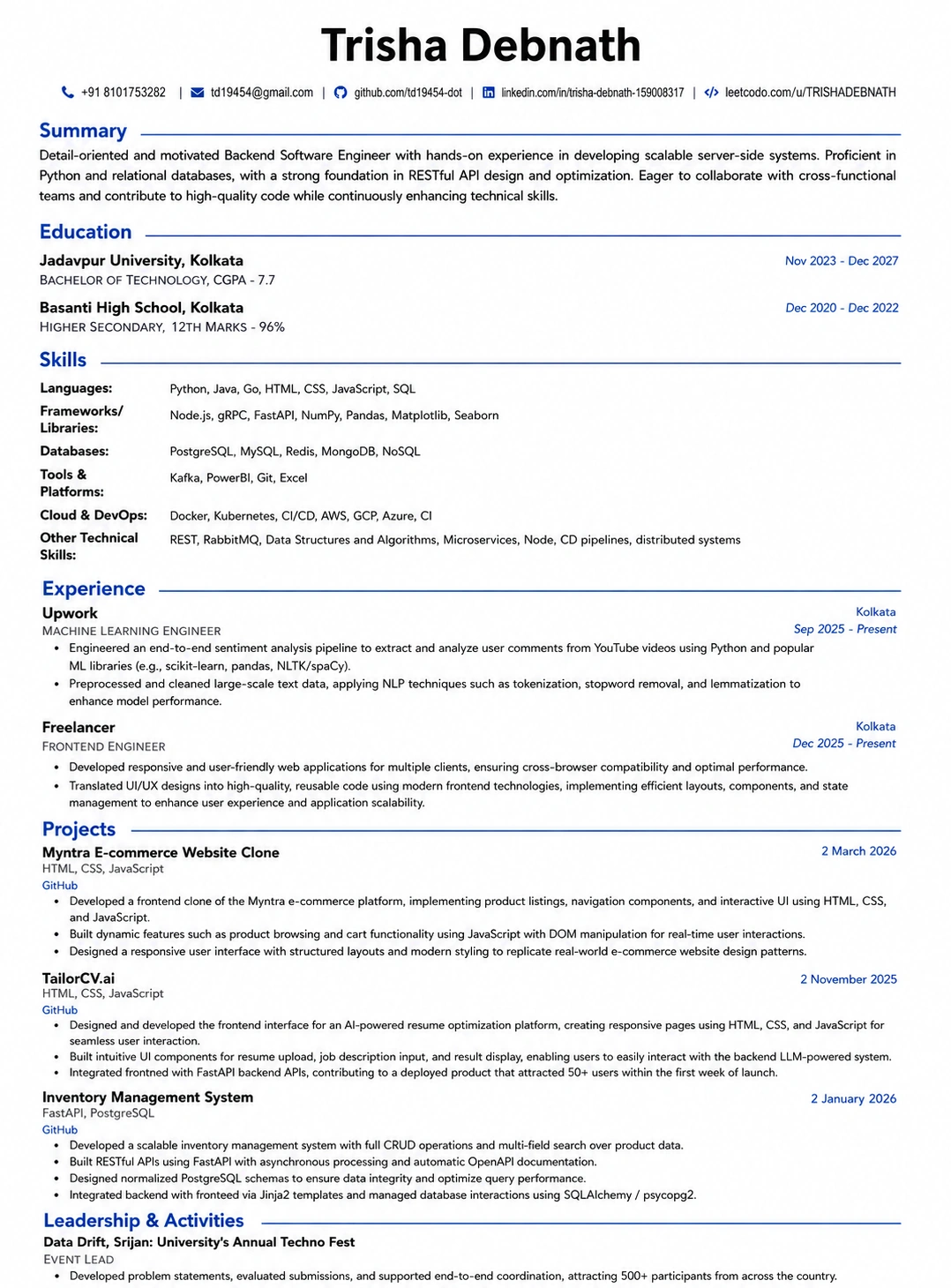
A layout that works with a short history
Leads with skills and projects instead of years of experience you do not have yet.
Was this guide useful?
Be the first to rate it.