SS
SS
Key Takeaways
- Most eliminations happen before any human reads your resume - eligibility filters on CGPA, backlogs, and branch remove the majority automatically.
- Where a resume is screened by a person, it gets seconds, not minutes, so the top third of page one carries almost all the weight.
- Companies increasingly run resumes through parsers, which means a designed template can lose your content entirely.
- Projects with outcomes beat projects with technology lists, because outcomes give a screener a reason to pick you over an identical classmate.
- You cannot change your CGPA during placement season, but you can change which companies you target and what your resume emphasises.
The frustrating thing about shortlisting is its invisibility. You submit through the placement portal, and either your name appears on a list or it does not. There is no feedback and no explanation, so students conclude the process is arbitrary.
It is not. Shortlisting runs on a fairly mechanical sequence: eligibility filters, then keyword or parser screening, then a brief human scan. Each stage removes people for specific, knowable reasons.
This guide covers each stage and what you can actually control at each one.
Start by seeing what a parser extracts from your current resume - the free ATS score checker shows you.
Stage 1: Eligibility Filters
This is the largest cut and it is entirely automatic. Before anyone looks at anything, the placement portal filters on stated criteria.
CGPA or percentage. Commonly 6.0, 6.5, 7.0, or 7.5, sometimes stated as 60% or 70% aggregate. This filter is absolute - there is no appeal and no discretion.
Backlogs. Many companies require no current backlogs. Some require no backlog history at all, which catches students who cleared a paper in a later attempt.
Branch. Some roles are open to CSE and IT only; others to all branches; core roles to specific disciplines.
Year gaps. Some companies restrict gaps in education, and this catches students who took a drop year.
Tenth and twelfth marks. Frequently overlooked - a number of companies screen on these too, and students are surprised to be filtered out on school results.
What you can do about it
Before third year: protect your CGPA and clear backlogs immediately. This is the actionable version, and it only works if you read it early. The full sequencing is in the campus placement preparation timeline.
During placement season: you cannot change these numbers, so change your targeting. Get the criteria list from your TPO early, identify which companies you are eligible for, and prepare specifically for those rather than for a general idea of "placements". Students waste weeks preparing for companies they were never eligible to sit for.
If your CGPA locks you out of most on-campus drives, shift weight to off-campus applications where skill and projects carry more relative weight - see campus placement vs off-campus.
Stage 2: Automated Resume Screening
Larger companies, and increasingly mid-size ones, run submitted resumes through parsing software before human review. Your resume becomes structured data, and if it does not parse, your content effectively does not exist.
This is where beautifully designed resumes quietly fail.
What breaks parsing:
- Multi-column layouts. Text gets read across columns and scrambles into nonsense.
- Text inside images or graphics. Extracted as nothing at all.
- Tables for layout. Frequently mangled.
- Headers and footers carrying your contact details. Commonly dropped entirely - so your phone number disappears.
- Unusual section headings. "My Journey" instead of "Experience" means the parser cannot categorise the block.
- Scanned or image-based PDFs. No extractable text whatsoever.
- Decorative fonts and icons replacing labels - an icon where the word "Email" should be leaves the field unlabelled.
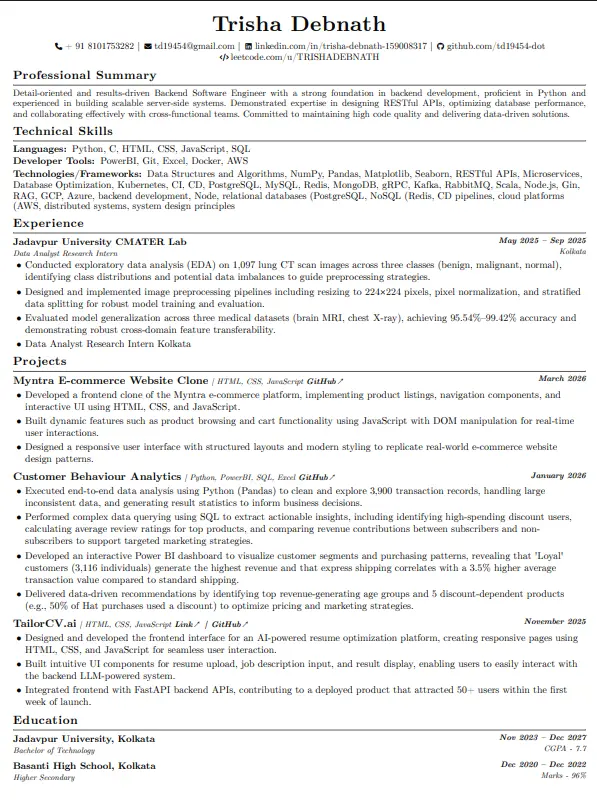
What works: a single-column layout, standard headings (Education, Experience, Projects, Skills), a normal font, real text, and a proper PDF export rather than an image.
The full catalogue of failure modes is in ATS resume formatting mistakes, and the checklist in the ATS resume checklist.
Keyword matching. Where companies filter on skills, they search for specific terms. Name technologies explicitly - "Python", "MySQL", "React" - rather than writing "various programming languages". Use the terms from the job description itself where they are genuinely true of you. The method is in best resume keywords to beat ATS.
Stage 3: The Human Scan
If you survive to here, a recruiter looks at your resume for a few seconds. Not minutes - seconds, across hundreds of near-identical documents from the same college, the same branch, and the same year.
That has a specific consequence: the top third of page one decides your outcome.
What belongs in that space
Contact details - name, phone, email, GitHub, LinkedIn. In the body, not a header.
Education with CGPA if it is above the cutoff, because it is the first thing checked.
A short summary only if it says something specific. Three lines naming your focus area and your strongest evidence. If it says "seeking a challenging position in a reputed organisation", delete it - it is the most-skipped line on every fresher resume.
Your strongest project or internship, immediately. Not on page two.
What distinguishes you
Here is the core problem: three hundred resumes from your batch list the same coursework, similar CGPAs, and comparable technology stacks. The screener needs a reason to pick one.
Outcomes are that reason.
Weak:
Library Management System - Java, MySQL, HTML, CSS Developed a library management system using Java and MySQL.
Strong:
Library Management System - Java, MySQL Built a system now used by the department library to track 2,000+ titles; reduced manual issue-return logging from a register to a two-second lookup, and handled concurrent issue requests with row-level locking after discovering a double-issue bug in testing.
The second version tells a screener you built something real, hit an actual problem, and solved it. That is the entire difference, and it takes twenty minutes to write.
The technique is in how to write resume bullet points and how to quantify achievements on your resume.
What Actually Differentiates a Fresher Resume
In rough order of impact:
An internship. The strongest single differentiator, because it is external validation. Even a short or unpaid one. This is why the summer after third year matters so much - see converting an internship into a PPO.
A deployed or used project. Something with a live link that a screener can open. Enormously more credible than a repository nobody has run.
Quantified outcomes. Numbers on anything - users, records, time saved, accuracy, downloads.
A real GitHub profile. With commits over time and README files. Reviewers do open it - see how to optimise your GitHub profile.
Competitive achievements. Hackathon placings, coding contest ratings, technical fest wins.
Leadership with scale. "Organised a technical fest" is fine; "coordinated a 400-participant technical fest across six colleges, managing a team of 12" is evidence.
Certifications - modestly. They are weak evidence on their own but fine as supporting detail. A certificate without a project behind it convinces nobody.
Which projects to build for maximum effect is covered in choosing a final year project for placements and fresher resume projects that get interviews.
Practical Rules for the Document
One page. For a fresher, two pages signals padding. Everything relevant fits on one.
Reverse chronological within each section.
No photo, no date of birth, no marital status, no father's name unless your placement cell explicitly requires them. Many Indian resume templates include these by default; they add nothing and consume prime space.
No "Declaration" block with a signature at the bottom. It is a legacy convention that wastes lines.
No objective statement unless it is specific.
PDF, named properly - Ananya_Sharma_Resume.pdf, not resume final final2.pdf.
Consistent formatting. Same date format, same tense, same bullet style. Inconsistency reads as carelessness in a document that is partly testing attention to detail.
Proofread. A typo on a one-page document that you had months to write is a genuine negative signal.
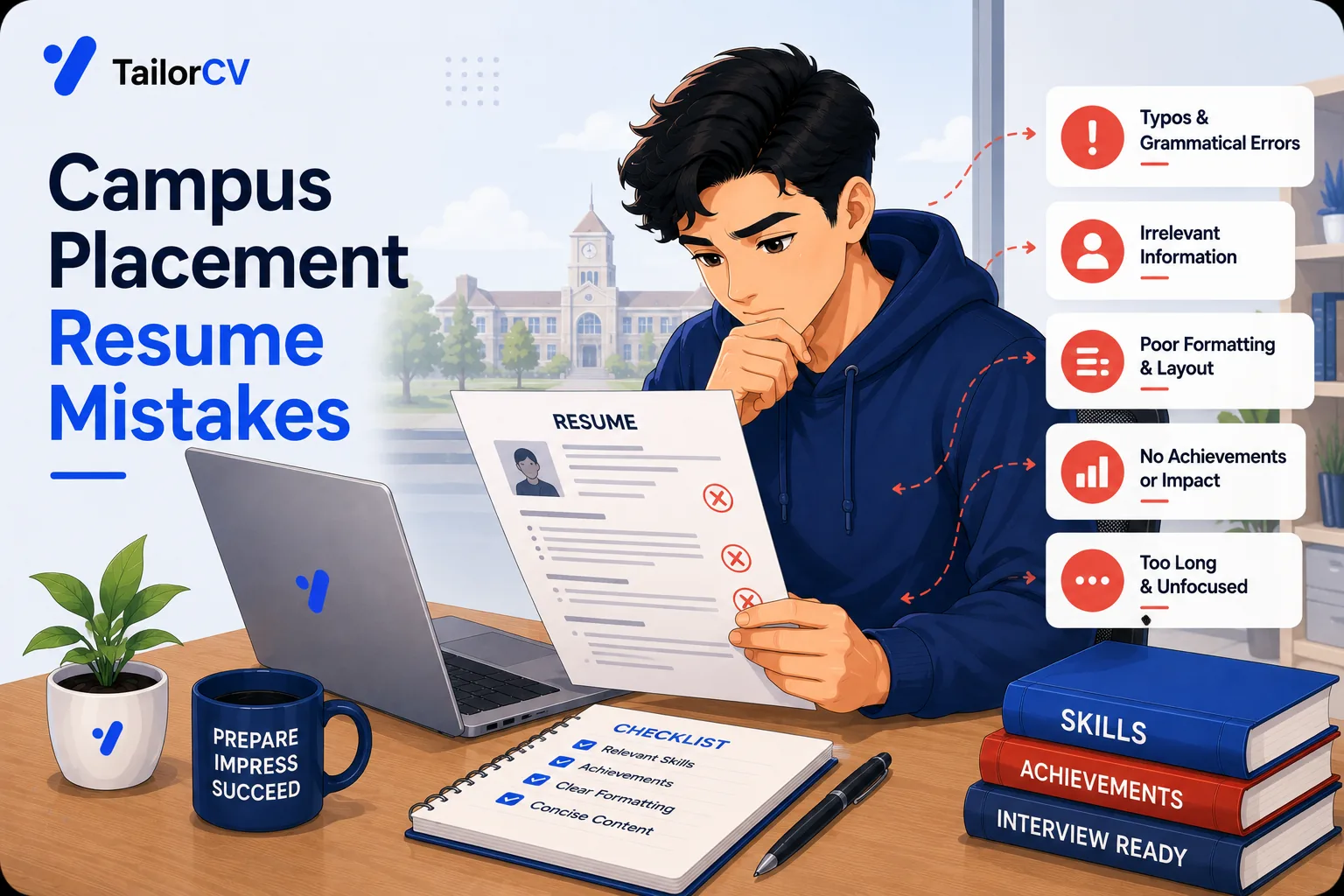
The full list of what to avoid is in campus placement resume mistakes, and for core branches, resume for campus placement for non-CSE branches.
Tailoring When You Have Twenty Companies
You cannot write twenty unique resumes during placement season, and you do not need to.
Make two or three base versions, one per company type - one for service-based IT, one for product-based roles, one for core or analytics if relevant. The distinction is explained in service-based vs product-based companies.
Then adjust the top third per company - reorder projects so the most relevant is first, and adjust the skills line to lead with what the posting names. That is a five-minute edit that meaningfully changes how the resume reads.
The general method is in how to tailor your resume for every job.
Common Mistakes
Not knowing the eligibility criteria. Students prepare for companies they cannot sit for.
A designed template that does not parse. Beautiful and invisible.
Contact details in the header. Frequently dropped by parsers.
A generic objective line. Universally skipped.
Listing technologies instead of outcomes. Makes you identical to everyone else.
Everything important on page two. Screeners may not reach it.
Listing eight shallow projects. Two strong ones are better, and the follow-up questions will find the shallow ones anyway.
Claiming skills you cannot defend. They get tested - see campus placement technical interview questions.
Never getting it reviewed. You cannot see your own resume clearly after the tenth revision.
Frequently Asked Questions
Why was I not shortlisted despite meeting the criteria?
Most commonly either a parsing failure, meaning your content was never extracted properly, or a resume that read as identical to hundreds of others. Both are fixable, unlike the eligibility filters.
Does CGPA matter more than projects for shortlisting?
For the first filter, yes - CGPA is an absolute gate at many companies. Once you clear it, projects and internships do most of the differentiating work.
How long should a fresher resume be?
One page. Two pages for a fresher generally signals padding rather than substance.
Should I include a photo on my placement resume?
Not unless your placement cell requires it. It consumes valuable space and adds no information.
Do certifications help with shortlisting?
Modestly. They are supporting evidence rather than a differentiator on their own. A certification with a project built on top of it is far more convincing than the certificate alone.
How many projects should I list?
Two or three that you can defend in detail. Listing eight shallow projects invites questions you cannot answer.
Should I use a resume template from the internet?
Only if it is single-column, uses standard headings, and contains no text inside images. Many popular templates are visually attractive and parse badly, which is the worst combination.
Find out what a parser actually extracts from your resume. Check your ATS score free.
Make This Practical
Get the eligibility criteria from your TPO first and build your target list from it. Knowing which twenty companies you can actually sit for lets you prepare specifically rather than generally, and it prevents weeks spent preparing for filters you cannot clear.
Then fix the document mechanically before fixing it stylistically. Move to a single-column layout with standard headings, take your contact details out of the header, export a real text PDF, and run it through the free ATS score checker to confirm every field extracts.
Finally, rewrite the top third so a screener has a reason to pick you. Put your strongest project or internship on page one with a real outcome and a number, using how to write resume bullet points - then build two base versions for different company types and reorder the top per application, following how to tailor your resume for every job.
What is your resume scoring right now?
Scan it against a job description and get your ATS match score in about a minute.
Drop your resume here or choose a file
PDF only. Max 2 MB.
We never share your data or use it to train AI models.

Templates that keep this structure intact
This template is ATS-tested — start from it and the formatting rules in this guide are already handled.
Was this guide useful?
Be the first to rate it.