 TD
TD
Key Takeaways
- The HR round is not a formality - students who clear technical rounds lose offers here every season, usually for avoidable reasons.
- Most questions are testing three things: will you accept the offer, will you stay, and can you communicate.
- "Tell me about yourself" is the most important question and the most commonly wasted - it sets the direction of everything that follows.
- Rehearse out loud, not in your head; knowing an answer and delivering it are different skills.
- Honesty with structure beats a polished answer you cannot back up, because follow-up questions expose the gap immediately.
Students prepare for months on aptitude and coding, then treat the HR round as the easy part. Every placement season, technically strong candidates lose offers in a twenty-minute conversation they assumed was a formality.
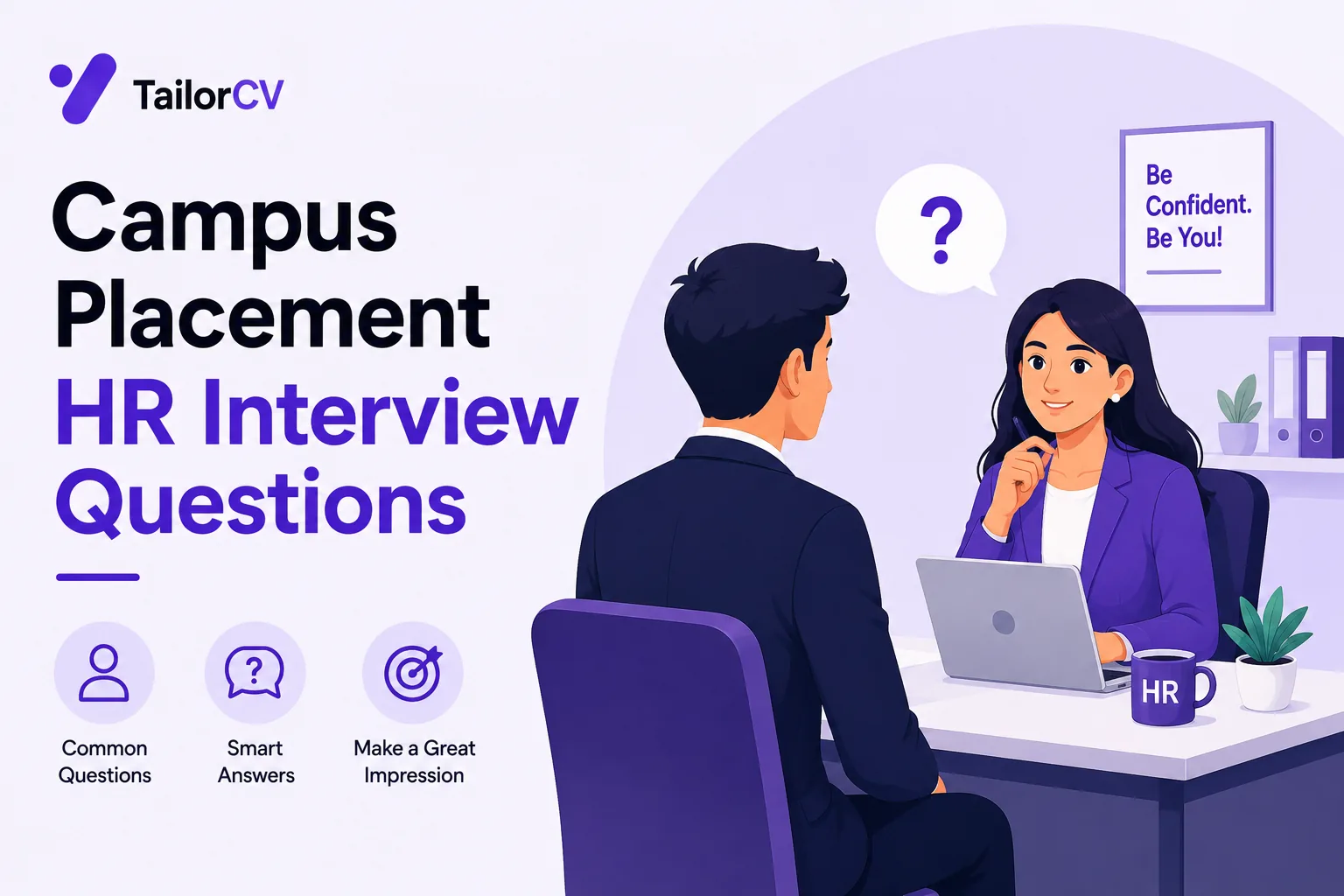
The round is not difficult, but it is a genuine assessment. HR interviewers are checking whether you will accept the offer, whether you will still be there in two years, and whether you can hold a professional conversation. Those three concerns are behind almost every question they ask.
This guide covers the questions, what each is really testing, how to build answers, and what loses offers.
Before you reach this round, make sure your resume is getting you shortlisted - run it through the free ATS score checker.
What the HR Round Is Really Assessing
Understanding the underlying concerns makes the questions much easier to answer.
Will you accept if we make an offer? Companies that visit campuses invest real effort per hire. A candidate who is clearly using them as a backup while waiting for a better offer is a bad investment. This is why they ask about your other offers and your preferences.
Will you stay? Attrition among fresh graduates is a well-known problem, particularly at large service-based employers. Questions about relocation, higher studies, long-term plans, and family expectations are all probing this.
Can you communicate? Whatever the role, you will be in meetings, writing updates, and possibly facing clients. This round is partly a live test of that - see campus placement communication skills.
Are you a reasonable person to work with? Attitude, self-awareness, how you speak about others.
Keep those four in mind and most answers become obvious.
Tell Me About Yourself
The most-asked question, the most-wasted answer, and the one that sets the direction for the rest of the interview.
What not to do: recite your name, your parents' occupations, your hobbies, and your school marks. This is the default answer and it gives the interviewer nothing to work with.
A structure that works - roughly 60 to 90 seconds:
- Who you are academically - name, branch, college, year
- What you have focused on - your area of interest and why
- Your strongest evidence - one project or internship with a concrete outcome
- What you are looking for - connecting to this role
Example:
I'm Ananya, a final year Computer Science student at [College]. Over the last two years I've focused mainly on backend development - I started with a college project and found I preferred the systems side to the interface side.
The project I've spent most time on is an appointment scheduling system for a local clinic. I built it in Django with PostgreSQL, and it's actually in use - about forty bookings a week now. The interesting part was handling double-booking under concurrent requests, which taught me more about databases than my coursework did.
I also interned at [Company] last summer working on their internal reporting tools. I'm looking for a backend role where I can keep building at larger scale, which is why I applied here.
Notice what it does: gives the interviewer three specific things to ask about, contains a real number, and ends pointing at the role. It effectively controls what the next question will be.
Prepare this properly. It is the single highest-return preparation in the whole round.
The Core Questions
Why do you want to join our company?
Testing whether you will accept the offer, and whether you did any research.
Weak: "It's a reputed company with good growth opportunities."
Better: name something specific - the technology they work on, a product, the training programme, the domain. One genuine, specific reason beats three generic ones.
If you are honestly attracted by stability and training, say so - it is a legitimate reason and it sounds more credible than invented enthusiasm.
What are your strengths?
Give two, each with evidence. "I'm a fast learner" means nothing alone. "I picked up React in three weeks for my internship project because the team needed the dashboard done - here's what I built" means something.
What is your weakness?
Give a real one and what you are doing about it. Do not use disguised strengths - "I work too hard", "I'm a perfectionist" - because interviewers hear them constantly and they read as evasive.
I tend to go deep on one part of a problem and lose track of time. During my project I spent two weeks optimising a query that wasn't the bottleneck. Since then I've started timeboxing - I set a limit, and if I'm past it I step back and check whether it's still the right thing to work on.
That answer demonstrates self-awareness, which is what is actually being assessed.
Where do you see yourself in five years?
Testing retention. They want to hear commitment to a technical or professional path, not a plan that obviously leads elsewhere.
Safe and honest: growth within the field, more responsibility, deeper specialisation. Avoid "I want to start my own company" and "I plan to do an MBA" in a campus HR round unless you are prepared for that to affect the outcome.
Are you willing to relocate?
For most campus offers, particularly at large service companies, the honest answer needs to be yes. If it is genuinely no, say so - but understand it may cost the offer, and it is better than accepting and declining later.
Do you have any other offers?
Answer honestly. If you do, do not use it as leverage in a campus HR round - it rarely works and it reads badly. If this company is your preference, saying so plainly is a strong move.
Why should we hire you?
A summary question. Pick two things that match what they need and give evidence for each. Do not list adjectives.
Are you planning higher studies?
Testing retention directly. If you genuinely are, be careful - many companies will not extend an offer to someone who says they are leaving in a year. If you are undecided, saying you are focused on building industry experience now is honest and appropriate.
Questions About Your Resume
Everything on your resume is fair game, and this is where unprepared candidates come apart.
Every project will be questioned. Why did you choose that approach? What was the hardest part? What would you do differently? If you cannot answer these, the interviewer concludes you did not build it - which is often correct. The common errors are covered in campus placement resume mistakes.
Gaps and low marks will come up. A dip in one semester, a backlog, a year gap. Answer briefly and factually, say what changed, and move on. Do not over-explain, and never blame teachers.
Claimed skills will be tested. If your resume says "proficient in Python", expect a Python question. Remove anything you cannot defend.
Situational and Behavioural Questions
Increasingly common even in campus HR rounds:
- "Tell me about a time you worked in a team where someone was not contributing."
- "Describe a situation where you failed."
- "Tell me about a conflict you handled."
- "Give an example of when you took initiative."
Answer using STAR - Situation, Task, Action, Result - keeping the situation short and spending most of the answer on what you did. The structure is covered in behavioral interview questions and answers.
Use real examples from college - group projects, technical fests, club organisation, hackathons. These count. Students often assume only workplace examples are valid and then have nothing to say.
Questions to Ask Them
You will be asked whether you have questions. Saying no reads as disinterest.
Good options:
- "What does the training programme look like for new joiners?"
- "What kind of projects do freshers typically start on?"
- "What skills would help me be effective in the first six months?"
- "How is performance assessed in the first year?"
Avoid opening with salary, leave policy, and working hours in a campus HR round. Those are usually standardised anyway and asking first signals the wrong priority.
Common Mistakes
Treating it as a formality. It eliminates candidates every season.
A memorised "tell me about yourself". It sounds recited, and interviewers can tell instantly.
Fake weaknesses. "I'm a perfectionist" is transparent.
Criticising your college, teachers, or teammates. Reads badly regardless of whether it is justified.
Claiming skills you cannot defend. The follow-up question arrives immediately.
No specific reason for wanting this company. Suggests you applied to everything.
Saying you plan higher studies or a startup soon. Directly conflicts with what the round is assessing.
One-word answers. Leaves the interviewer doing the work.
Rambling. Ninety seconds is a good ceiling for most answers.
Not asking any questions at the end.
Only rehearsing in your head. Speaking is a different skill - practise out loud, ideally with someone else.
Frequently Asked Questions
How long is a campus HR interview?
Typically 15 to 30 minutes, sometimes shorter in high-volume drives. Short does not mean unimportant - decisions get made in that window.
Can I be rejected in HR after clearing technical rounds?
Yes, and it happens regularly. Communication, attitude, retention concerns, and inconsistencies with your resume are all common reasons.
Should I mention other offers?
Answer honestly if asked, but do not use them as leverage in a campus round. If this company is your first preference, saying so directly is a genuinely strong answer.
What should I wear?
Formal - shirt and trousers, or a formal suit or saree. Campus drives are conservative environments and underdressing is noticed more than overdressing.
What if I do not know an answer?
Say so honestly and briefly, then say what you would do to find out. Fabricating is worse, because follow-up questions expose it.
How do I explain a backlog or low CGPA?
Briefly, factually, and without excuses. State what happened, what you changed, and what the result was. Interviewers respond well to accountability and badly to blame.
Should I ask about salary?
Not in a campus HR round. Campus packages are usually standardised and communicated by your placement cell. Asking first signals the wrong priorities.
Make sure your resume gets you to the HR round in the first place. Check your ATS score free.
Make This Practical
Write and rehearse your "tell me about yourself" first, out loud, until it runs 60 to 90 seconds naturally. Build it as academic identity, focus area, one project with a real number, and what you want next - because it controls the direction of everything the interviewer asks afterwards.
Then prepare four STAR stories from college - a team conflict, a failure, an initiative you took, and a deadline you handled - and one honest weakness with the fix you applied. These cover the majority of behavioural questions you will face.
Finally, audit your resume against the round. Remove any skill you cannot be questioned on, prepare a two-minute explanation of every project including what you would do differently, and have three questions ready to ask them. Then confirm the resume itself is clearing the earlier filters using how to get shortlisted for campus placement, campus placement resume mistakes, and the free ATS score checker.
Was this guide useful?
Be the first to rate it.