 SS
SS
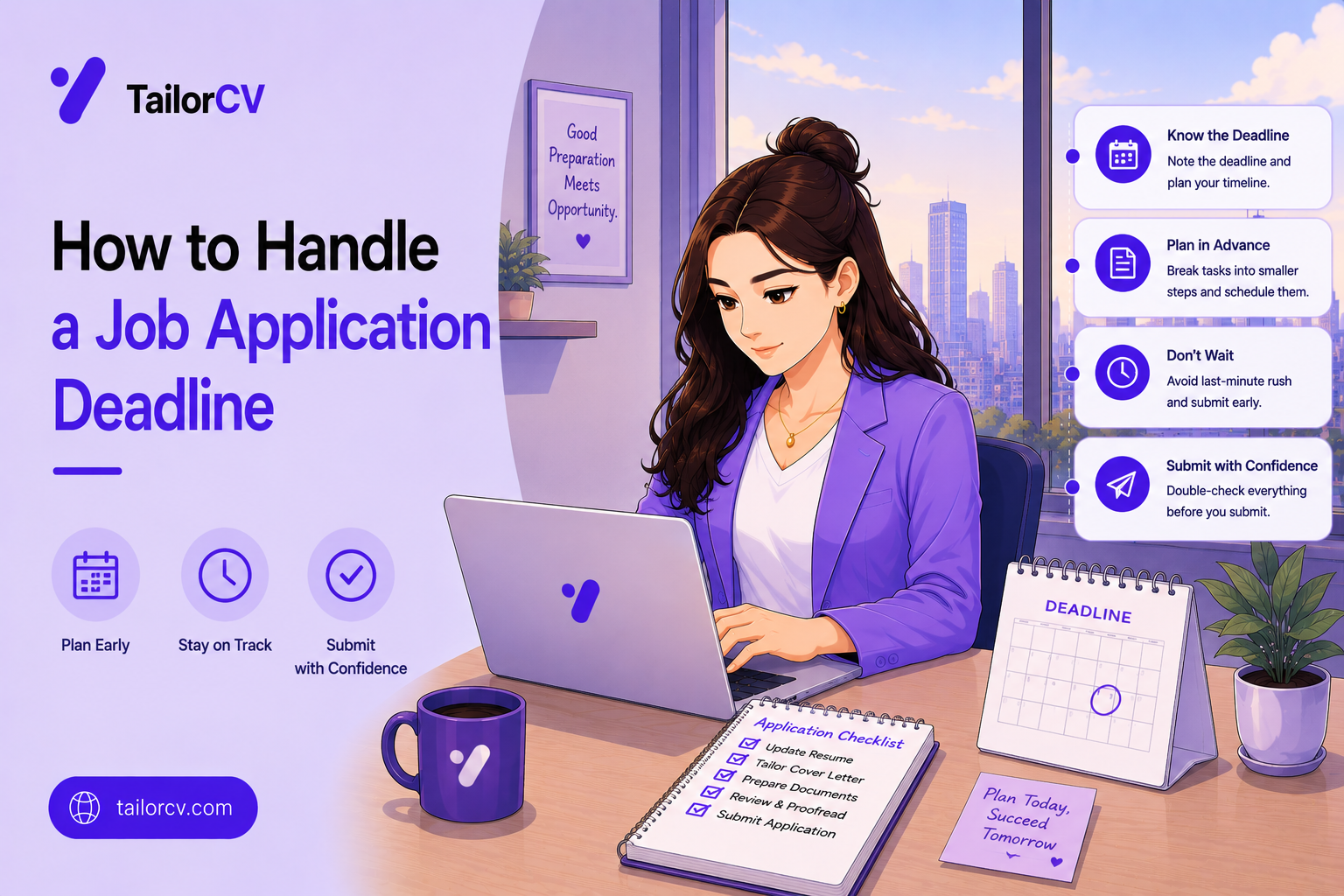
Key Takeaways
- Submitting something good beats submitting nothing perfect. An unsent application has a guaranteed outcome.
- Fix in order of impact — match, then clarity, then polish, and stop when time runs out.
- Deadlines are frequently soft in rolling recruitment and absolutely hard in structured rounds.
- Do not rewrite your resume the night before. Adjust the sections that matter and leave the rest.
- Submit early in the day where you can, since technical failures at deadlines are common.
What to fix first
The triage order when time is short.
Match is first. If your resume does not visibly address the core requirements, nothing else matters, and this is where every remaining minute should go.
The summary is second, because it is read first and it frames everything after it.
The top bullets of your most recent role are third, since they carry more weight than anything further down.
Correctness is fourth — the right company name, working contact details, an accurate title.
Formatting consistency is fifth, and only worth doing if the earlier items are done.
Design polish is last and frequently not worth doing at all under pressure.
Anything below that line gets accepted as-is. A resume with slightly uneven spacing that matches the role well outperforms a beautiful one that does not.
Hard deadlines and soft ones
Knowing which you are facing changes the calculation.
| Situation | Usually | What it means for you |
|---|---|---|
| Graduate scheme or structured round | Hard | Missing it means waiting a full cycle |
| Public sector recruitment | Hard | Late applications are typically not accepted |
| Rolling private sector posting | Soft | The date is administrative |
| Agency-managed role | Soft | The agency wants candidates |
| Posting with a stated close and no cycle | Mixed | Assume hard, apply early |
Structured rounds are genuinely absolute. The system closes, and no amount of enthusiasm reopens it.
Rolling postings are different. The advertised date is frequently a formality, and applications arriving shortly after are often still reviewed, particularly if the role remains unfilled.
But never rely on softness. Treating a soft deadline as hard costs you nothing; treating a hard one as soft costs you the cycle.
And note that the closing time matters, since deadlines are set in the employer's timezone and a late-evening submission from another region can arrive after close.
The night before, realistically
A sequence that fits into an actual evening.
Start by reading the posting properly, even now, because tailoring to a misread posting wastes the whole evening.
Write the summary next while you are freshest, since it is the section that most rewards clear thinking.
Adjust three bullets, not thirty. Pick the three that most directly address the posting's priorities and leave everything else.
Complete the application questions before touching the formatting, because an unfinished form means no application at all while imperfect spacing merely means imperfect spacing.
Export and open the PDF to check it renders as you expect, which catches the errors that only appear after conversion.
Then stop. The temptation at this point is to keep editing, and past a certain hour the edits get worse rather than better.
Sleep and submit in the morning if the deadline allows it, since a final read with a clear head catches more than another hour of tired revision.
After you submit
The part people forget under deadline pressure.
Save the confirmation. Systems occasionally lose applications, and the confirmation is your only evidence you applied at all.
Keep a copy of the exact file you sent, because interview conversations reference the document in front of them rather than the latest version on your machine.
Save the posting text as well, since listings are removed once filled and you will want the original language when preparing.
Note the date in your tracker, which makes follow-up timing obvious later.
Do not follow up immediately. Give it the time the process needs before checking in, and follow up once rather than repeatedly.
And move on to the next application rather than waiting. The single most reliable predictor of a slow search is treating each application as though it will be the one.
Mini checklist
- unchecked: Deadline type identified as hard or soft
- unchecked: Closing time confirmed in the employer's timezone
- unchecked: Core requirements visibly addressed
- unchecked: Summary rewritten for this role
- unchecked: Top bullets adjusted
- unchecked: Company name and contact details verified
- unchecked: Application questions completed in full
- unchecked: Submission made well before the closing hour
- unchecked: Confirmation email received and kept
Scenarios
Scenario 1: You have three hours and a generic resume
Spend two hours on match and summary, thirty minutes on the top bullets, and the rest on checking. Do not attempt a redesign or a restructure.
Scenario 2: The deadline passed yesterday and the posting is still live
Apply anyway if it is a rolling private sector role, with a brief note acknowledging the date. The worst outcome is being ignored, which is also the outcome of not applying.
Scenario 3: You will not finish properly in time
For a rolling posting, submit what you have rather than nothing. For a structured round with a full cycle behind it, consider whether a strong application next cycle beats a weak one now.
Tip: Submit several hours before the stated close rather than in the final hour. Application portals fail under deadline load, uploads time out, and support is unreachable at midnight, so the last hour carries a real risk of losing the application entirely.
Do's and Don'ts
Do
- Fix match before anything else
- Confirm the closing time and timezone
- Submit early in the day
- Complete every application question
- Keep the confirmation email
- Apply late to rolling postings that remain open
Don't
- Rewrite your whole resume overnight
- Leave submission to the final hour
- Skip application questions to save time
- Assume a structured deadline is flexible
- Send nothing because it is not perfect
- Panic-edit sections that were already fine
Common Mistakes
- Submitting in the last hour. Portals fail exactly then.
- Rewriting everything. It rarely finishes and rarely improves the outcome.
- Ignoring the timezone. Deadlines close on the employer's clock.
- Abandoning at the questions stage. An incomplete form is not an application.
- Perfectionism. Unsent applications have a certain outcome.
- Assuming flexibility. Structured rounds genuinely close.
Related Guides
Keep building on this with the related guides in this series:
- When the Job Was Posted Today
- How to Apply to Jobs Faster
- How to Tailor Your Resume in 5 Minutes
- Resume Update Checklist Before Applying
- How to Read a Job Description Properly
You can also check your resume's ATS score for free, generate a tailored cover letter, or build a portfolio website in minutes.
Frequently Asked Questions
Can I apply after the deadline?
Often, for rolling private sector postings that remain live. Structured graduate schemes and public sector rounds genuinely close and late applications are not considered.
What should I fix first with limited time?
Match to the role, then the summary, then the top bullets of your recent role, then correctness. Formatting and design come last and are frequently not worth doing.
Is it better to submit something imperfect or nothing?
Something imperfect, for any rolling posting. An unsent application has a guaranteed outcome, while an imperfect one that matches the role well is genuinely competitive.
When should I submit?
Several hours before the close, not in the final hour. Portals fail under deadline load and support is unavailable overnight, which risks losing the application entirely.
Do deadlines use my timezone?
No, the employer's. A late-evening submission from a different region can arrive after the close even when your own clock says otherwise.
Should I mention that I applied late?
For a rolling posting, a brief acknowledgement is fine and unremarkable. There is no need to draw attention to it at length or to apologise.
What should I do the night before a deadline?
Read the posting properly first, write the summary while fresh, adjust three bullets rather than thirty, complete the application questions before formatting, then check the exported PDF and stop.
What should I do right after submitting?
Save the confirmation email, keep a copy of the exact file you sent, save the posting text before it is removed, note the date for follow-up, and start the next application rather than waiting.
What is your resume scoring right now?
Scan it against a job description and get your ATS match score in about a minute.
Drop your resume here or choose a file
PDF only. Max 2 MB.
We never share your data or use it to train AI models.

Was this guide useful?
Be the first to rate it.