 SS
SS
Key Takeaways
- The most damaging mistakes are structural - a resume that does not parse is invisible regardless of what it says.
- Legacy conventions like declaration blocks, father's name, and photographs consume prime space on a one-page document and add nothing.
- Listing technologies without outcomes makes you indistinguishable from three hundred classmates with the same coursework.
- Every claimed skill becomes an interview question, so anything you cannot defend is a liability rather than an asset.
- Most of these take an afternoon to fix, and they affect every application you make for the rest of the season.
Placement resumes fail in remarkably consistent ways. Sit with a stack of them from any engineering college and the same errors appear again and again - not because students are careless, but because the templates circulating on campus encode conventions that stopped being useful decades ago.
The encouraging part is that these are mechanical problems with mechanical fixes. Unlike CGPA or project depth, which take years, a resume can be substantially improved in one afternoon - and that afternoon affects every application for the rest of the season.
This guide covers the mistakes in order of how much damage they do.
Start by seeing what a parser actually extracts from yours - the free ATS score checker shows you.
Category 1: Structural Mistakes That Make You Invisible
These are the most damaging because they eliminate you before anyone reads a word.
The template that does not parse
Popular resume templates are designed to look impressive, and many of them destroy your content when processed by parsing software.
Multi-column layouts get read across rather than down, scrambling your experience into nonsense. Text inside graphics extracts as nothing. Tables used for layout frequently mangle. Icons replacing labels - a small envelope where the word "Email" should be - leave the field unlabelled and unmatched.
The fix: single column, standard fonts, real text, no text inside images. Plain and readable beats designed and invisible. The full list is in ATS resume formatting mistakes.
Contact details in the header
Word and Google Docs headers are frequently dropped entirely during extraction. Students put their name, phone, and email there because it looks tidy, and the parser returns a resume with no way to contact the candidate.
The fix: put contact details in the body of the document, at the top.
Submitting an image-based PDF
Some students export by taking a screenshot or scanning a printout. The resulting file contains no extractable text at all.
The fix: export directly to PDF from your editor. Open it and try selecting text - if you cannot, neither can the parser.
Everything important on page two
Screeners looking at hundreds of resumes may never reach page two, and for a fresher there should not be one.
The fix: one page, with your strongest project or internship in the top third.
Category 2: Legacy Conventions That Waste Space
These appear on most Indian fresher resumes by default and serve no purpose on a one-page document.
The declaration block
I hereby declare that the above information is true to the best of my knowledge. Place: ___ Date: ___ Signature: ___
Nobody reads this, no company requires it, and it consumes four lines at the bottom of a page where space is scarce. Delete it.
Father's name, date of birth, marital status, and photograph
Standard on older templates and unnecessary unless your placement cell explicitly requires them. They occupy prime space at the top of the document - the exact space that should hold your strongest evidence.
If your college mandates a specific format for internal records, keep that version for the college and use a cleaner one for companies where you are allowed to.
The generic objective statement
To secure a challenging position in a reputed organisation where I can utilise my skills and contribute to organisational growth.
This is the most-skipped line on every fresher resume, and near-identical versions appear on hundreds of them. It says nothing about you.
The fix: either delete it, or replace it with three lines that are specifically true - your focus area, your strongest evidence, and what you are looking for. See how to write a resume summary.
Listing every subject you studied
Your degree already communicates your syllabus. A list of twenty course names tells a recruiter nothing that "B.Tech Computer Science" did not.
The fix: delete it. Name specific coursework only where it is directly relevant and unusual.
Hobbies as a filler section
"Reading, listening to music, playing cricket" appears on an enormous share of resumes and differentiates nobody.
The fix: delete it, unless a hobby is genuinely relevant or unusual enough to be a conversation point.
Category 3: Content Mistakes That Make You Forgettable
You cleared the filters and a human is reading. These are what stop them choosing you.
Technology lists instead of outcomes
Weak:
E-commerce Website - HTML, CSS, JavaScript, PHP, MySQL Developed an e-commerce website using PHP and MySQL.
That is the single most common project entry in campus placements, and it is interchangeable with three hundred others.
Strong:
E-commerce Website - PHP, MySQL, Razorpay Built a working storefront for a family business, now processing about 30 orders a week. Added inventory locking after a race condition let two customers buy the same last item; cut checkout abandonment by moving payment to a single page.
Same project. The second one tells a screener you built something real, encountered an actual problem, and made a decision. That is what earns the interview.
The technique is in how to write resume bullet points and how to quantify achievements on your resume.
No numbers anywhere
Students say they have no metrics, then produce five in conversation. Users, records processed, response time, accuracy, participants, team size, hours saved, downloads.
The fix: go looking. You almost certainly have numbers you have not thought to include. Do not invent them.
Eight shallow projects
Listing everything you have ever built looks like padding, and it invites questions about projects you barely remember.
The fix: two or three you can discuss for twenty minutes each. Curation is itself a signal.
Tutorial projects presented as original work
A to-do app, a weather app, or a course capstone identical to hundreds of others. Interviewers recognise these immediately.
The fix: extend at least one beyond what the tutorial did - add authentication, a different data source, deployment, tests. The moment you make a decision the tutorial did not make for you, it becomes yours. See choosing a final year project for placements.
Skills you cannot defend
A skills section listing twelve languages and eight frameworks is not credible for a final-year student, and every item is a potential question.
The fix: list what you can be examined on. Group by proficiency if it helps - "Proficient: Python, SQL. Familiar: Java, React." Honest calibration reads as maturity. The questions that follow are covered in campus placement technical interview questions.
Vague leadership claims
"Member of technical club" tells a reader nothing.
The fix: state the role and the scale. "Coordinated a 400-participant technical fest across six colleges, managing a team of 12" is evidence.
Category 4: Presentation Mistakes
Small, cheap to fix, and cumulatively damaging.
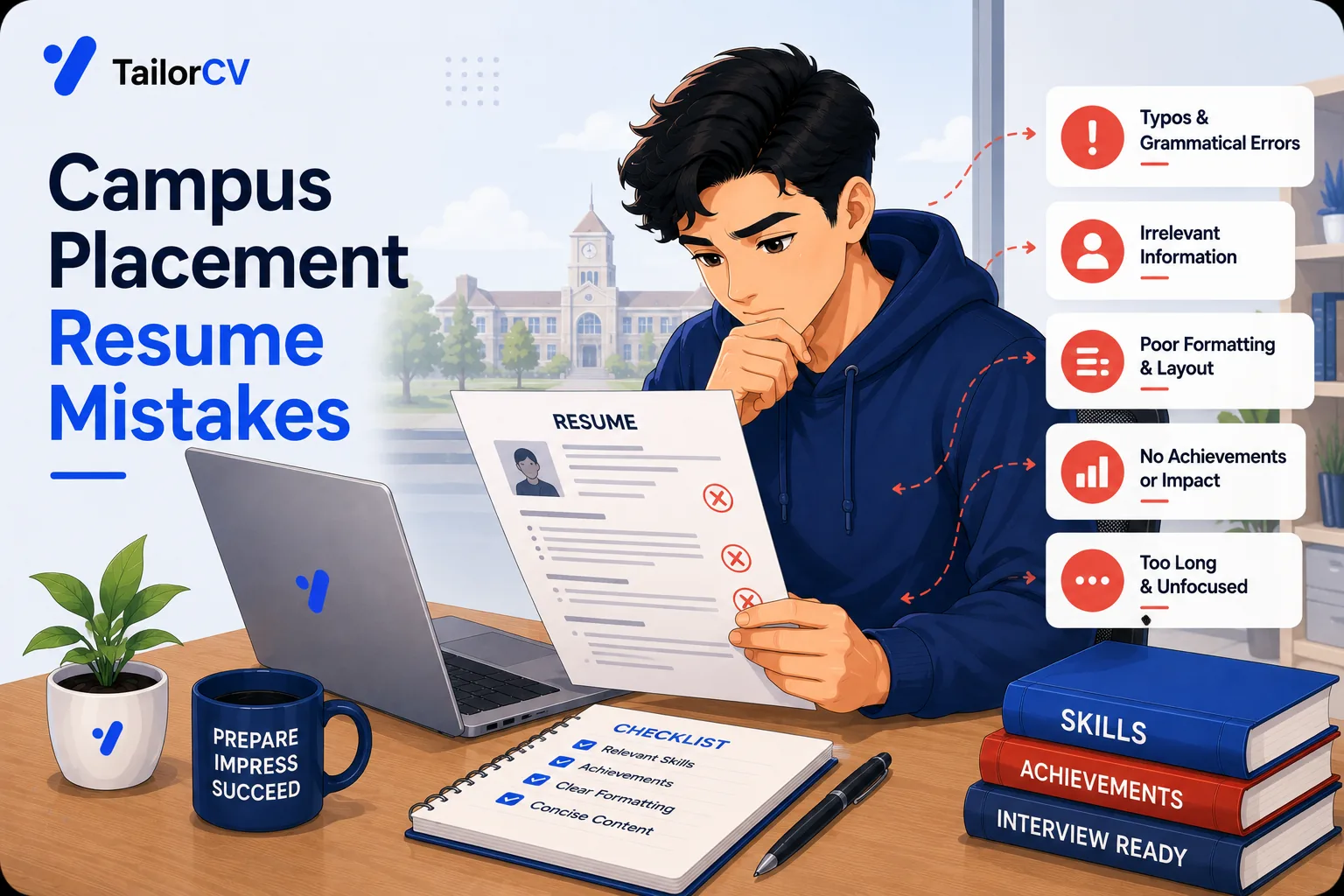
Typos and grammatical errors. On a one-page document you had months to prepare, this reads as carelessness. Proofread, then have someone else proofread.
Inconsistent formatting. Mixed date formats, inconsistent tense, varying bullet styles, different fonts. A document partly assessing attention to detail should not demonstrate a lack of it.
Unprofessional email address. Use firstname.lastname or a close variant.
A dead or broken link. Test every URL in the exported PDF. A GitHub link that 404s is worse than no link.
A GitHub link to an empty profile. If you link it, there must be something there - see how to optimise your GitHub profile.
Careless file naming. Ananya_Sharma_Resume.pdf, not resume final final2 updated.pdf.
Dense walls of text. Screeners scan. White space and short bullets help you.
Category 5: Strategy Mistakes
One resume for every company. Service-based and product-based companies value different things - the differences are in service-based vs product-based companies. Make two base versions and reorder the top third per application.
Never getting it reviewed. After ten revisions you cannot see your own document. Ask a senior who was placed, a faculty member, or your TPO.
Writing it the night before the first drive. It is the one artefact used in every application. Build it in semester 6 - see the campus placement preparation timeline.
Copying a placed senior's resume structure wholesale. What worked for them reflected their evidence, not yours.
Ignoring branch-specific expectations. Core branches have different conventions - see resume for campus placement for non-CSE branches.
Since one resume goes to many companies during placements, campus placement resume: one document, many companies shows how to build versions by company type.
Frequently Asked Questions
Should I include a photo on my placement resume?
Only if your placement cell requires it. It consumes prime space at the top of a one-page document and adds no information a recruiter needs.
Do I need a declaration at the end of my resume?
No. It is a legacy convention that no company requires and it wastes four lines. Remove it.
How many projects should I list?
Two or three that you can discuss in depth. Listing eight shallow ones invites follow-up questions you cannot answer and reads as padding.
Is a one-page resume enough for placements?
Yes - for a fresher it is the standard, and two pages generally signals padding rather than substance.
Should I list all my certifications?
List the relevant ones. A certificate with a project built on top of it is convincing; a list of twelve unrelated course completions is not.
What if I have no internship?
Projects, competitive achievements, and leadership roles carry the weight instead. Make the projects deep and outcome-focused rather than numerous - the approach is in fresher resume projects that get interviews.
Can I use a colourful, designed template?
Only if it is single-column with standard headings and no text inside images. Many attractive templates parse badly, which is the worst possible combination - invisible and expensive.
Find out which of these your resume is currently making. Check your ATS score free.
Make This Practical
Spend the first thirty minutes deleting. Remove the declaration block, the objective statement, the subject list, the hobbies section, and the personal details your placement cell does not require. That alone frees roughly a third of a one-page document for content that actually earns interviews.
Then fix the structure so the content survives. Move to a single column, take contact details out of the header, export a real text PDF, and confirm every field extracts using the free ATS score checker.
Finally, rewrite what remains. Turn each project from a technology list into an outcome with a number, cut down to two or three you can defend for twenty minutes, trim your skills section to what you can be examined on, and get the whole thing reviewed by someone who was placed last year. Then check it against how to get shortlisted for campus placement before the first drive.
Was this guide useful?
Be the first to rate it.