 SS
SS
Key Takeaways
- Service companies hire in large volumes with standardised processes; product companies hire selectively with deeper technical assessment.
- The preparation genuinely differs - aptitude and communication for one, DSA depth and system understanding for the other.
- Product companies generally pay more at entry level, but service companies offer more places, more structure, and a far higher chance of an offer.
- Starting at a service company does not lock you out of product companies later, but the switch requires deliberate effort rather than time served.
- Trying to prepare identically for both usually produces a candidate who is competitive for neither.
This is the decision that shapes a student's entire placement preparation, and most people make it by default rather than deliberately - preparing vaguely for everything, then discovering in semester 7 that the two paths wanted different things.
Neither choice is better in the abstract. They suit different people, different risk appetites, and different levels of preparation. What matters is choosing early enough that your preparation matches your target.
This guide sets out how they differ across work, hiring, money, and career trajectory.
Whichever you target, your resume has to clear the first filter - run it through the free ATS score checker.
What They Actually Are
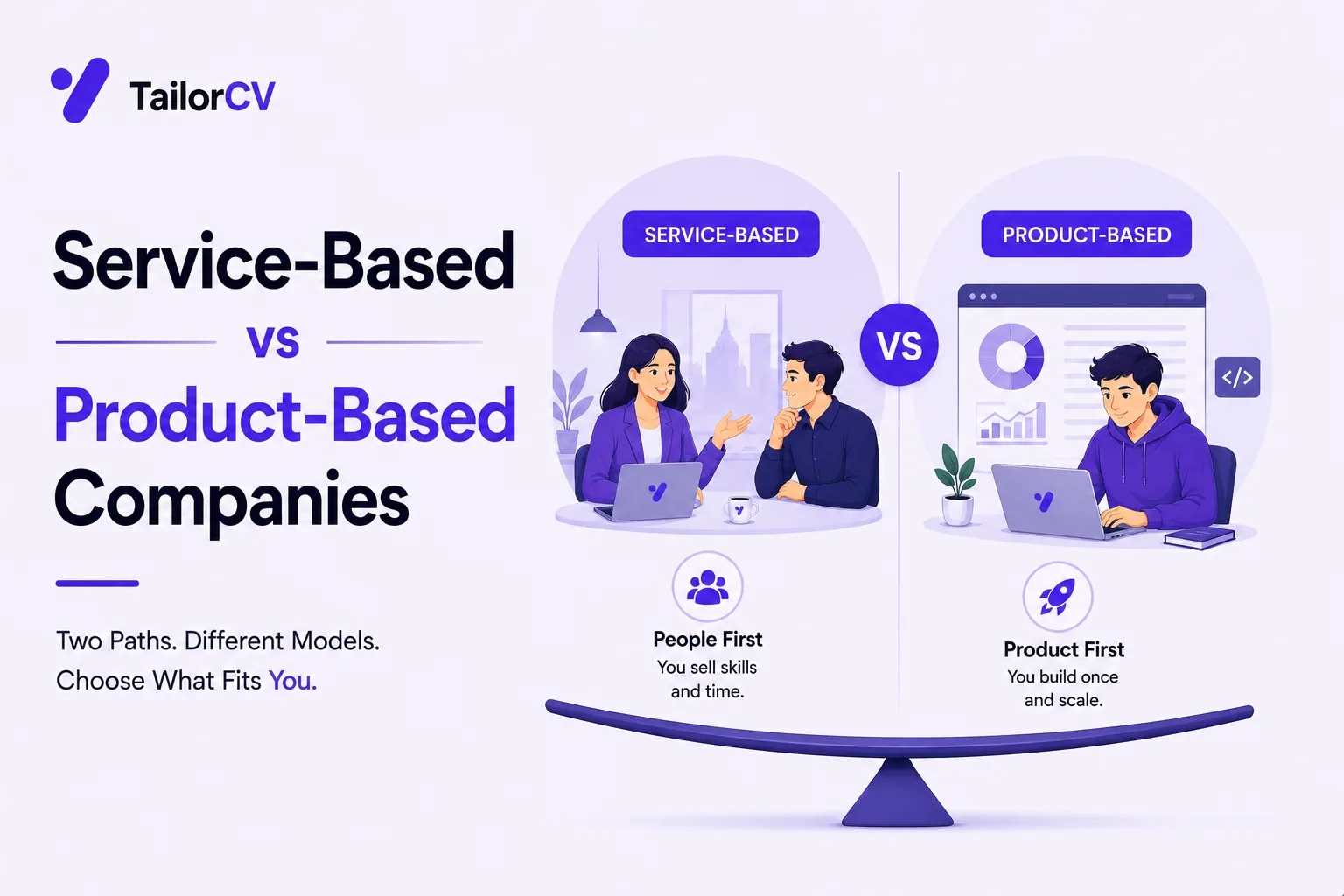
Service-based companies build software for other organisations. A client - a bank, an airline, a retailer - pays them to build, maintain, or run systems. Their business is delivering projects and staffing them, which means they hire in large numbers and place people onto client engagements.
Product-based companies build and own their own software. They sell it, or they monetise it, and their engineers work on that product continuously. Because the product defines the company, hiring is more selective and more technically focused.
The distinction blurs at the edges - service companies run their own products, and product companies have services arms - but the hiring model differs sharply, and that is what matters to you now.
The Work
Service-based
What you do early on: support and maintenance are common first assignments, alongside development on client projects. Many freshers spend an initial period in training before being allocated to a project.
Technology: whatever the client uses. Sometimes modern, frequently legacy - large enterprises run systems that are decades old and someone has to maintain them.
Structure: defined processes, documented workflows, formal training programmes, clear grade progression. This is genuinely valuable if you learn well in structured environments.
Pace: varies enormously by project. Some are demanding, some involve long stretches on the bench between allocations.
Domain exposure: you may work across banking, insurance, healthcare, and telecom over a few years. That breadth is real and underrated - domain knowledge transfers well and is scarce.
Product-based
What you do: work on the company's own product, usually with more ownership of a specific area from earlier on.
Technology: typically more modern, since the company controls its own stack and its competitiveness depends on it.
Structure: less formal training, more learning by doing. Suits people who are comfortable being pointed at a problem rather than handed a curriculum.
Pace: generally faster, with more direct accountability for outcomes.
Depth over breadth: you go deep into one product and one domain rather than across many.
The Hiring Process
This is where the practical difference for a final-year student is sharpest.
Service-based selection
Volume hiring. They may recruit hundreds from a single campus, which means your chance of an offer is far higher.
Standardised process: aptitude test, sometimes a basic coding section, technical interview, HR interview.
Aptitude weighted heavily. This is the main filter and it eliminates the largest share of candidates - see the campus placement aptitude test guide.
Coding at easy to easy-medium difficulty. Arrays, strings, basic logic. Correctness matters more than optimality.
Communication assessed seriously. Many roles are client-facing, and this is a real evaluation criterion rather than a formality - see campus placement communication skills.
Technical questions on fundamentals: OOP concepts, DBMS, operating systems, basic networking - covered in campus placement technical interview questions.
CGPA criteria are usually explicit and strictly applied.
Product-based selection
Selective hiring. They may take a handful from a campus, or none.
Process: online coding round, one to three technical interviews, sometimes a system design discussion, then a hiring manager or HR round.
Aptitude often minimal or absent. Some skip it entirely.
Coding at medium difficulty, with optimal complexity expected and edge cases scrutinised. Graphs and dynamic programming appear more often. See the campus placement coding round guide.
Projects examined properly. Expect real follow-up questions about design decisions, which is why depth beats count - see choosing a final year project for placements.
CGPA sometimes flexible if your technical performance is strong, though many still apply a cutoff.
Compensation
Specific figures date quickly and vary widely, so treat this structurally.
Product companies generally pay more at entry level, sometimes substantially, and typically include performance bonuses and occasionally equity.
Service companies pay less initially with standardised packages across the intake, and early increments tend to be modest. Progression often accelerates after a few years or with a switch.
Two things students underweight:
The probability of an offer. A service company offer that you have is worth more than a product company offer you might get. Given the number of places available, targeting only product companies is a genuinely high-variance strategy.
Cost of living and location. A package in a metro city and one in a smaller city are not comparable. Compare what remains after living costs.
Career Trajectory
The question behind the question is usually: does starting at a service company limit me?
The honest answer: it does not close doors, but moving to a product company later requires deliberate effort rather than time served.
What makes the switch work:
- Keep your DSA current. Product companies test it at every level. Two years of maintenance work without practice makes the switch much harder.
- Choose projects carefully where you have any influence. Development work transfers better than pure support.
- Build outside work. Side projects and open-source contributions demonstrate ability your day job may not - see side projects on your resume.
- Move at the right time. The two-to-four-year window is when switching is most common and most straightforward.
- Use the domain knowledge. If you spent three years on banking systems, fintech product companies value that specifically. It is a genuine advantage that generic candidates lack.
What makes it harder: several years exclusively in support with no development work, no external evidence of ability, and no algorithmic practice. The switch is still possible, but it takes six months of deliberate preparation.
Which Should You Target?
Target product-based if
- Your DSA is genuinely strong and you enjoy that kind of problem
- You have projects with real depth you can discuss for twenty minutes
- You are comfortable with a lower probability of an offer in exchange for a better one
- You learn well without formal structure
- You have started preparing early enough to build the required depth
Target service-based if
- Your aptitude and communication are strong
- Your CGPA meets the criteria comfortably
- You want a high probability of being placed
- You value structured training and a defined progression path
- You started preparing later and need the highest-expected-value option
Target both if
You have time to prepare properly for both, which realistically means starting in semester 5. The overlap is real - fundamentals, communication, resume, projects - but the emphasis differs, and splitting your attention late usually leaves you mediocre at each.
The pragmatic strategy most students should follow: prepare primarily for one, sit for everything you are eligible for, and accept a good offer rather than holding out. Interview experience compounds, and an offer in hand improves your performance in later rounds considerably. The sequencing is in the campus placement preparation timeline.
Common Mistakes
Deciding in semester 7. Too late to build the depth product companies test.
Preparing identically for both. Produces a candidate competitive for neither.
Refusing service company offers while waiting for product companies. High variance, and it costs students placements every year.
Assuming service means no coding. Development roles exist and are common.
Assuming product means no fundamentals. OOP, DBMS, and OS questions still appear.
Believing a service start is permanent. It is not, but the switch requires deliberate work.
Comparing packages without comparing locations. Cost of living changes the picture materially.
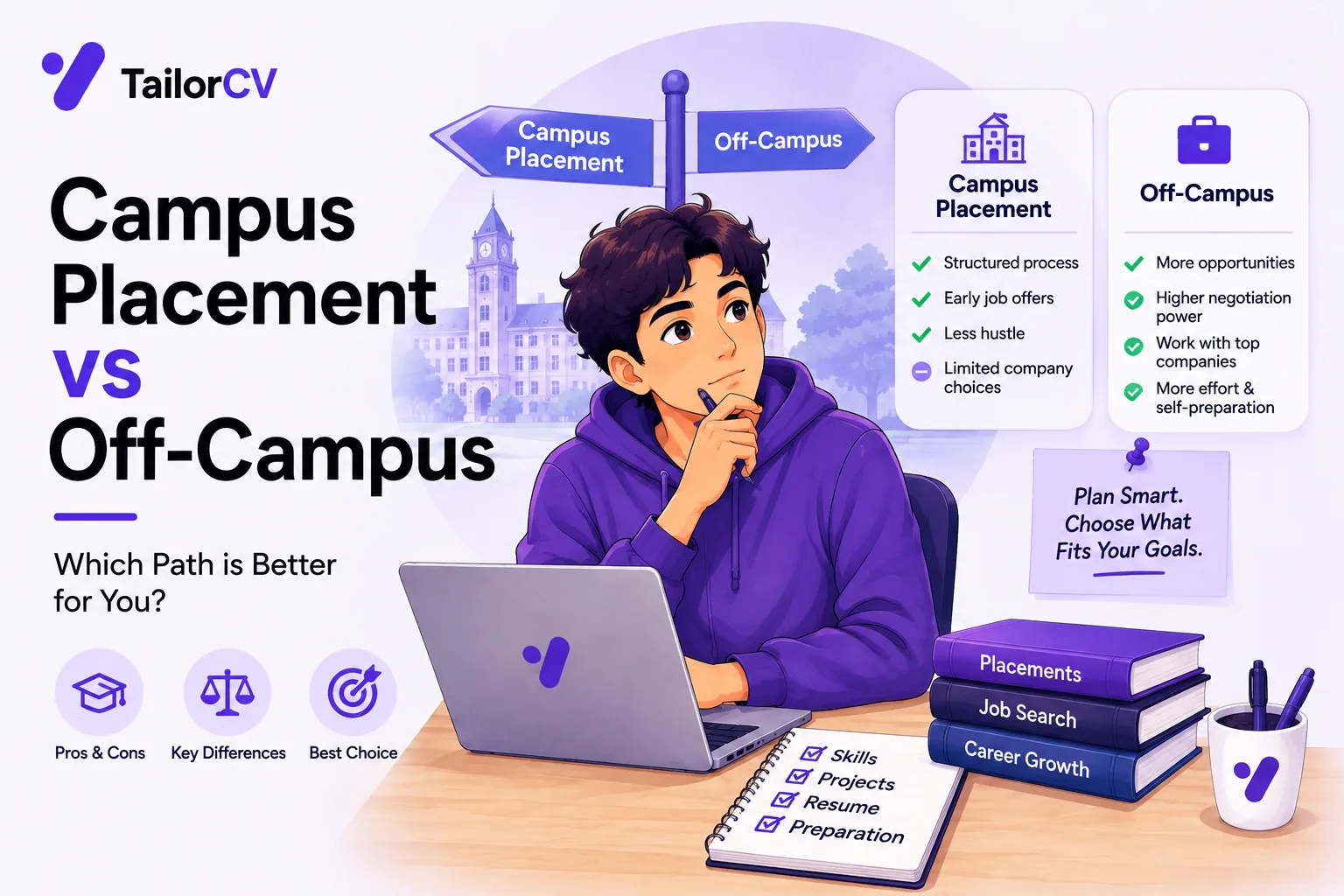
Ignoring off-campus routes. Many product companies hire more through off-campus channels than campus drives - see campus placement vs off-campus.
Frequently Asked Questions
Which is better for freshers, service-based or product-based?
Neither is universally better. Product companies typically pay more and offer deeper technical work; service companies offer more places, structured training, and a much higher probability of an offer. The right answer depends on your preparation, your CGPA, and your risk tolerance.
Can I switch from a service company to a product company?
Yes, and many people do, most commonly in the two-to-four-year window. It requires keeping your DSA current, building demonstrable work outside your job, and preparing deliberately rather than assuming experience alone will carry you.
Do product companies care about CGPA?
Many apply a cutoff, though some weight technical performance more heavily. Service companies almost always apply explicit CGPA criteria strictly.
Should I reject a service company offer to wait for a product company?
Generally not during campus season. The probability of a product offer is lower, and having an offer in hand improves both your options and your performance in later interviews. You can continue interviewing after accepting, within the rules your placement cell sets.
What preparation is common to both?
Programming fundamentals, OOP, DBMS, operating systems, resume quality, project depth, and communication. The differences are in emphasis - aptitude weight for service companies, DSA depth for product companies.
Do service companies only do support work?
No. Development, testing, data, cloud, and consulting roles all exist. Initial allocation varies, and it depends partly on your performance in training and on which client engagements need staffing.
Whichever you target, the resume has to clear the filter first. Check your ATS score free.
Make This Practical
Decide by semester 6, not semester 7. Write down which of the two you are primarily targeting and let that decide where your study hours go - aptitude and communication weight for service companies, DSA depth and project ownership for product companies.
Then prepare the common core properly regardless of choice, since it appears in both: OOP, DBMS, operating systems, one language you know deeply, two projects you can defend, and a resume that parses. The technical ground is in campus placement technical interview questions.
Finally, play the season sensibly. Sit for everything you are eligible for regardless of preference, because interview stamina compounds and an offer in hand changes how you perform. If your primary target does not come through, the alternatives are real - see campus placement vs off-campus and not placed, what next, and confirm your resume clears screening with the free ATS score checker.
What is your resume scoring right now?
Scan it against a job description and get your ATS match score in about a minute.
Drop your resume here or choose a file
PDF only. Max 2 MB.
We never share your data or use it to train AI models.

Was this guide useful?
Be the first to rate it.