 TD
TD
Key Takeaways
- A pre-placement offer means entering placement season with a job already secured, which changes both your options and your performance in other interviews.
- Conversion decisions are made on reliability and communication at least as much as on technical brilliance.
- The first week sets your reputation, and it is disproportionately hard to change afterwards.
- Asking questions early is a strength; going silent for three days while stuck is the most common conversion-killer.
- Finish and document what you were given rather than starting something ambitious you cannot complete.
A pre-placement offer is the best outcome available to a student before placement season begins. It removes the uncertainty entirely, it lets you sit for other companies from a position of strength rather than desperation, and it means the company has assessed you over six or eight weeks rather than a forty-minute interview.
The encouraging part is that conversion is largely predictable. Managers deciding whether to extend an offer are answering a fairly simple question: would I want this person on my team permanently? That question is decided by ordinary professional behaviour far more than by exceptional technical output.
This guide covers what is assessed, how to run your internship, and how to ask.
Before you get the internship, the resume has to work - run it through the free ATS score checker.
What Managers Are Actually Assessing
Interns often assume they are being judged on how much code they write. They are not, primarily.
Reliability. Do you do what you said by when you said? An intern who consistently delivers modest work on time is rated above one who occasionally produces something brilliant and frequently disappears.
Communication. Do you report progress without being chased? Do you say when you are stuck? Managers cannot help someone who goes quiet.
Coachability. Do you take feedback and apply it? An intern who receives a code review and makes the same mistake three more times is signalling something serious.
Ownership. Do you follow a task to completion, including the unglamorous parts - testing, documentation, deployment?
Fit. Are you pleasant to work with? This matters more than students expect, particularly at smaller teams.
Technical ability matters, but it is the expected baseline rather than the differentiator. Every intern is inexperienced; managers know that. What distinguishes candidates is everything above.
The First Week
Your reputation forms fast and is disproportionately hard to change afterwards.
Set up properly on day one. Get your environment, accounts, and access working immediately rather than quietly struggling for three days. Ask for help - nobody thinks less of an intern who cannot configure an unfamiliar internal system.
Understand the product before the code. Spend the first days learning what the company actually does, who uses it, and how your team's work fits. Interns who understand the business ask better questions and are noticed for it.
Learn the workflow. How are tasks assigned and tracked, how do code reviews work, what are the branching conventions, when are the standups. Following the team's process correctly is a real part of the assessment.
Meet people. Learn names and roles beyond your immediate mentor. Conversion conversations often involve more people than you realise.
Ask about expectations explicitly. "What would a successful internship look like from your side?" is an excellent first-week question. It gives you the actual criteria, and asking it signals seriousness.
During the Internship
Communicate more than feels natural
The most common conversion-killer is silence. An intern stuck for three days who says nothing has wasted three days and demonstrated poor judgement. An intern who says "I've been stuck on this for two hours, here's what I've tried" has demonstrated good judgement and lost two hours.
A practical rule: if you have made no progress in about an hour, ask. Show what you tried first - that turns a request for help into evidence of effort.
Send a short update proactively. A two-line message at end of day, or a brief weekly summary, means your manager never has to wonder what you are doing. Very few interns do this, and it is remembered.
Finish things
An intern who completes three small tasks properly is rated above one who starts an ambitious rewrite and leaves it half-done. Completion includes the parts nobody enjoys: tests, documentation, and handover notes.
If your project will not be finished by the end, say so early enough that it can be scoped down rather than abandoned.
Take feedback well
Code review comments are not criticism. Respond to them, make the changes, and do not repeat the same issue. If you disagree, say so once with reasoning and then accept the decision.
Do the unglamorous work willingly
Writing documentation, fixing small bugs, and cleaning up test data are all opportunities to demonstrate reliability. Interns who visibly consider such tasks beneath them are noticed, and not favourably.
Keep a record
Write down what you built, what problems you hit, and what the outcomes were. You need this for three things: the conversion conversation, your resume, and every interview afterwards. Details fade fast, and reconstructing them in October from a June internship is painful.
The technique for turning it into resume material is in how to quantify achievements on your resume.
Asking About Conversion
When to raise it
Not in week one. It reads as being focused on the outcome rather than the work.
Around the midpoint is right. By then you have produced something, and there is still time to act on the answer.
A natural framing: "I've really enjoyed this and I'd be interested in coming back full-time. Is that something that happens here, and what would you be looking for?"
That question does two useful things: it registers your interest, which managers cannot act on if they do not know it, and it gives you the criteria while there is still time to meet them.
Ask for feedback explicitly
"Is there anything I should be doing differently?" at the midpoint is the highest-value question of the internship. Most managers will answer honestly, and it tells you exactly what to fix.
Near the end
Ask directly about the process and timeline. Conversion decisions often involve headcount approvals that take weeks, so a delay is not necessarily a rejection.
If Conversion Does Not Happen
It frequently does not, and often for reasons unrelated to you - headcount freezes, budget, or no open role in that team.
Ask why, politely. "Is there anything I could have done differently?" Some managers give genuinely useful answers.
Ask for a referral or a recommendation. A manager who liked your work but had no headcount will often refer you elsewhere, and that referral is worth a great deal - see networking messages for referrals.
Ask to stay in touch. Roles open later. Interns are contacted months afterwards more often than people expect.
Use the experience regardless. An internship on your resume is the strongest single differentiator for a fresher, converted or not. It is external validation that projects cannot provide, and it gives you real examples for every interview - see how to get shortlisted for campus placement.
Get a written reference before you leave, while the work is fresh in their mind.
Getting the Internship in the First Place
Conversion is moot without the internship. The summer between third and fourth year is the critical window, and applications typically run months before.
Apply early and widely. Internship applications open well ahead of the internship itself.
Use every channel: campus internship drives, company programmes, LinkedIn, referrals from seniors, and direct outreach - see how to write a cold email to a recruiter.
A smaller company is fine. A startup internship where you own real work often produces better material than a large-company internship where you observe. Both count.
Unpaid or low-paid is still worth it if the work is real, particularly if the alternative is nothing.
Lead with projects, since you have no work history yet - see choosing a final year project for placements and the internship resume guide.
The timing sits within the wider plan in the campus placement preparation timeline.
Common Mistakes
Going silent when stuck. The single most damaging behaviour.
Waiting to be told what to do. Asking "what should I pick up next?" reads well.
Starting something ambitious and not finishing. Completion beats ambition.
Treating documentation and testing as beneath you. Visible, and it costs you.
Never asking about conversion. Managers cannot act on interest they do not know about.
Asking about conversion in week one. Reads as the wrong priority.
Not recording what you did. You will need it for the resume and every interview afterwards.
Ignoring the team outside your mentor. Conversion conversations involve more people than you think.
Repeating feedback you have already been given. Signals you are not listening.
Leaving without a reference. Ask before your last day.
For how internships and other non-standard work count toward experience requirements, see what counts as relevant experience.
Frequently Asked Questions
What is a PPO?
A pre-placement offer - a full-time job offer extended to an intern before campus placement season begins, based on their internship performance.
How likely is PPO conversion?
It varies enormously by company, team, and business conditions, so treat any single figure with suspicion. What you can control is your side of it: reliability, communication, and finishing what you were given.
When should I ask about conversion?
Around the midpoint of the internship. Early enough that you can act on the answer, late enough that you have produced something to be judged on.
Does a PPO mean I cannot sit for campus placements?
It depends on your placement cell's rules, which vary by institution. Many allow you to sit for higher-category companies after a PPO; some restrict participation. Confirm with your TPO rather than assuming.
What if my internship is unpaid?
It still counts as experience and still converts in some cases. If the work is real and the alternative is nothing, it is generally worth doing - the resume value alone is substantial.
Can a short internship still lead to an offer?
Yes, though longer internships give more opportunity to demonstrate reliability. Even a short one provides real examples for interviews and external validation on your resume.
What if I made a mistake during my internship?
Own it immediately, fix it, and do not repeat it. Managers expect interns to make mistakes; how you handle one is more informative than whether it happened.
Make sure your resume gets you the internship to begin with. Check your ATS score free.
Make This Practical
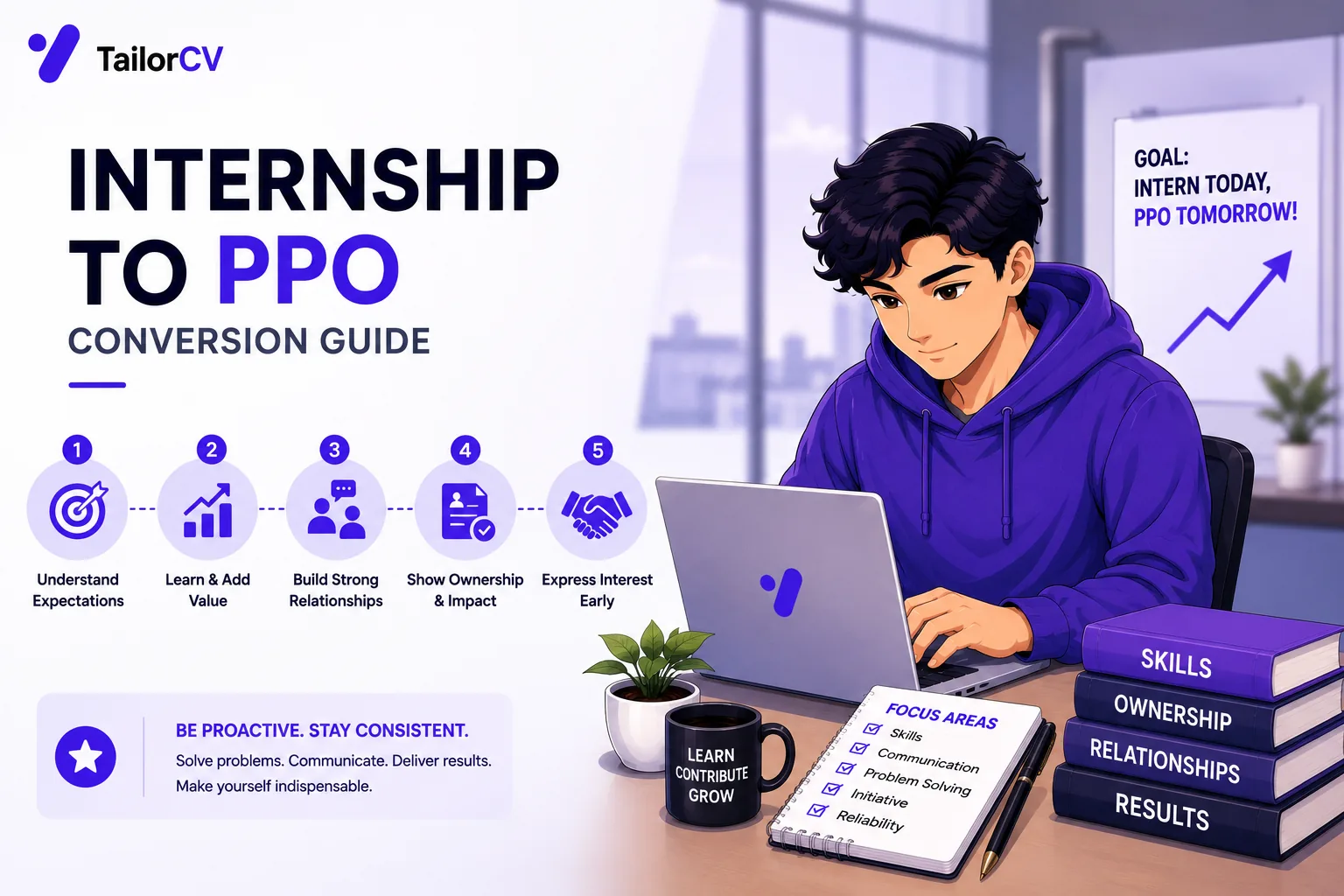
Treat the first week as reputation-setting. Get your environment working on day one, learn what the company actually does before diving into code, and ask your manager directly what a successful internship would look like from their side - that single question gives you the real criteria.
Then over-communicate throughout. If you have made no progress in an hour, ask - showing what you tried first. Send a short end-of-day or weekly update proactively, because almost no intern does and it is remembered. Finish what you were given, including tests and documentation, rather than starting something ambitious you cannot complete.
Finally, register your interest at the midpoint and ask for feedback while there is still time to act on it. Keep a written record of what you built and what it achieved for your resume using how to quantify achievements on your resume, and ask for a written reference before your last day regardless of how conversion goes.
Find out where a fresher resume stands
Score yours against a real posting - no account, no cost.
Drop your resume here or choose a file
PDF only. Max 2 MB.
We never share your data or use it to train AI models.

Was this guide useful?
Be the first to rate it.