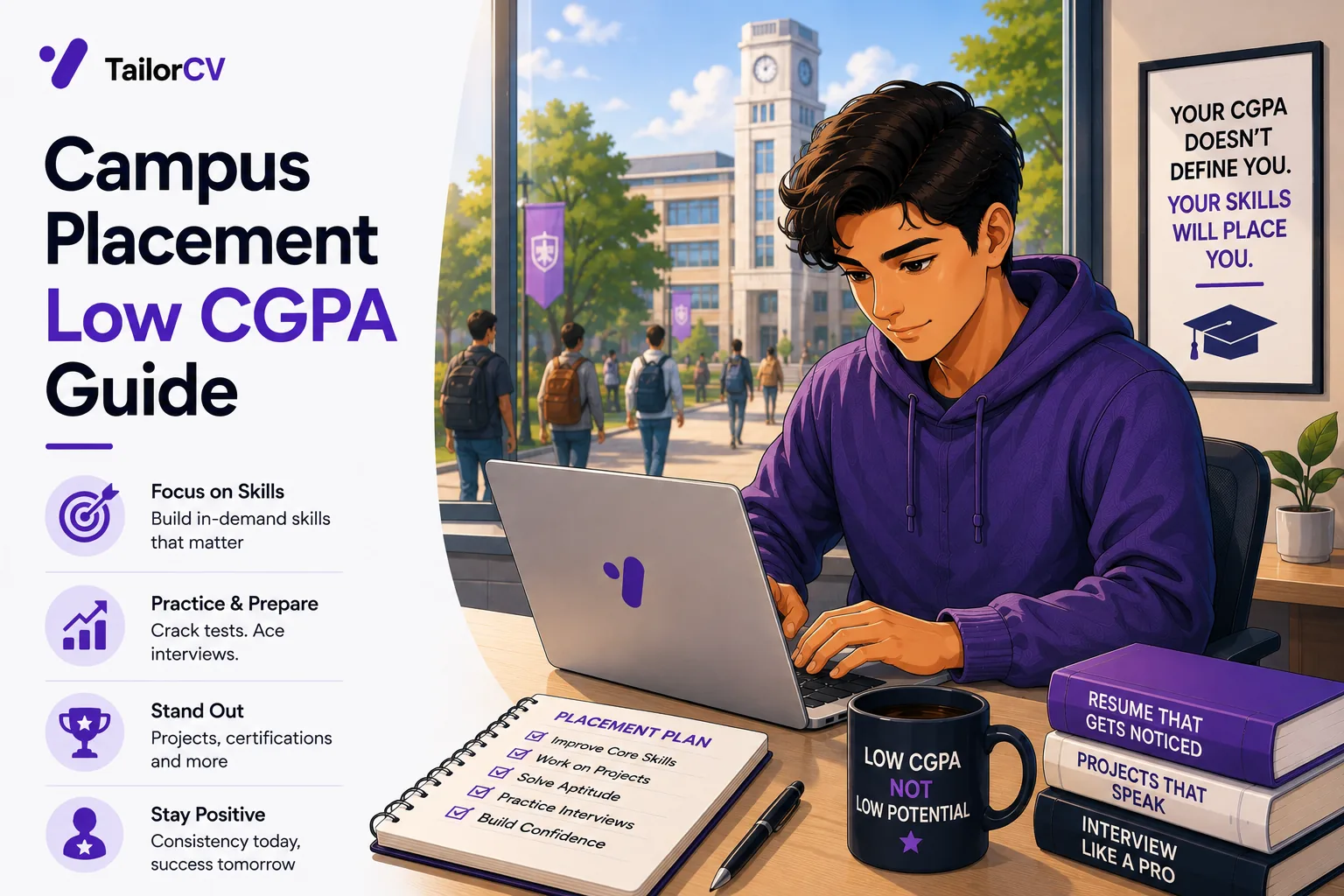
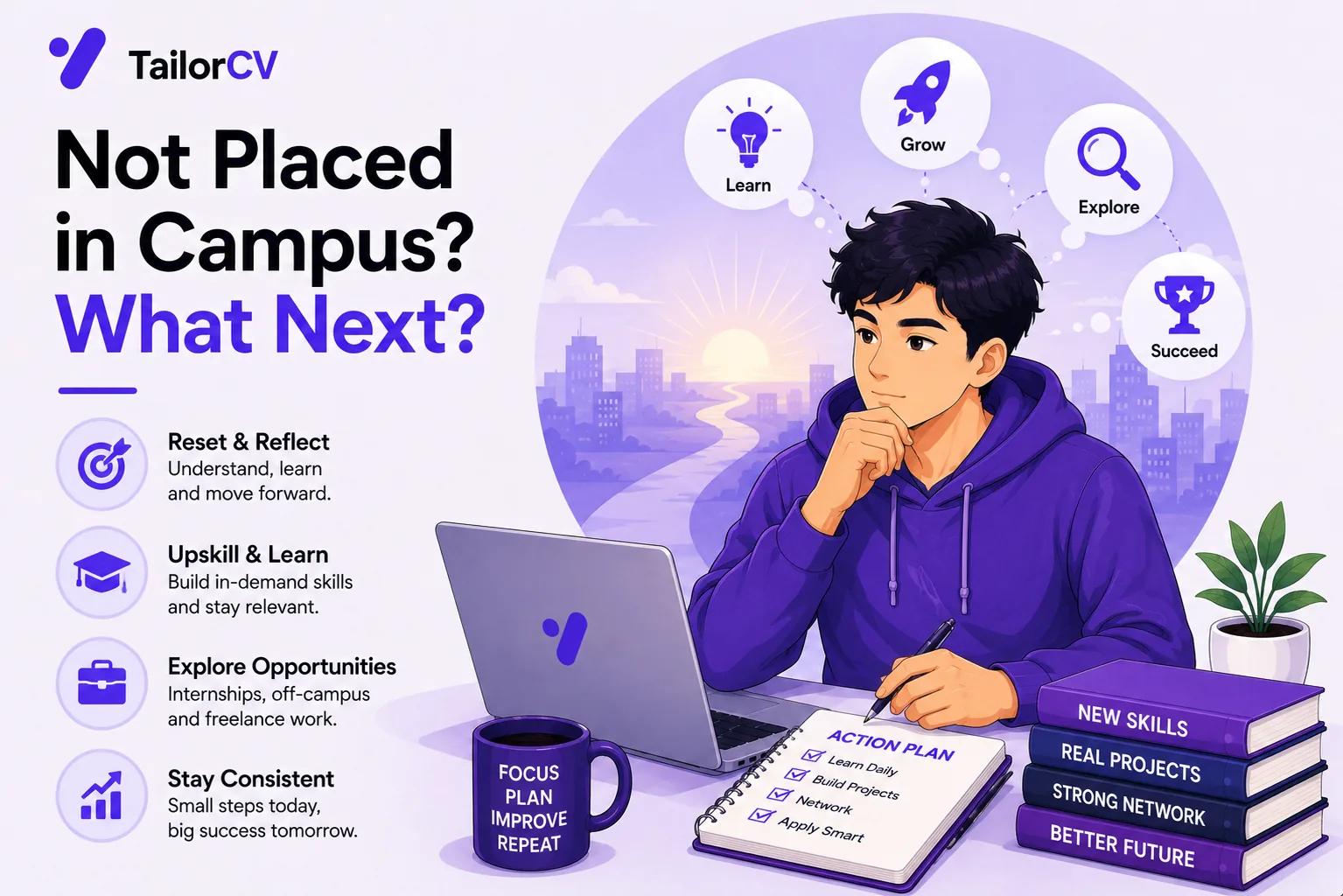
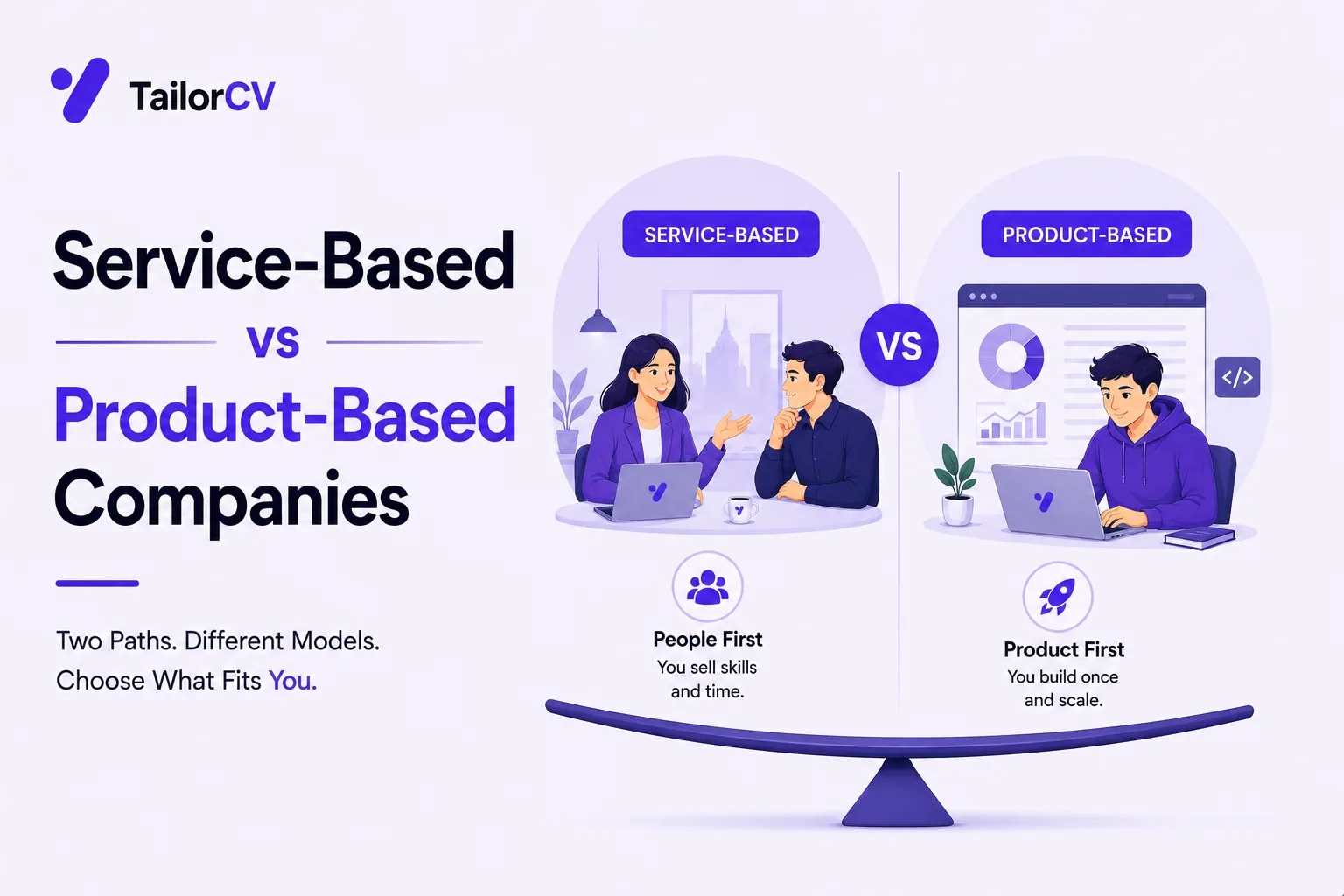
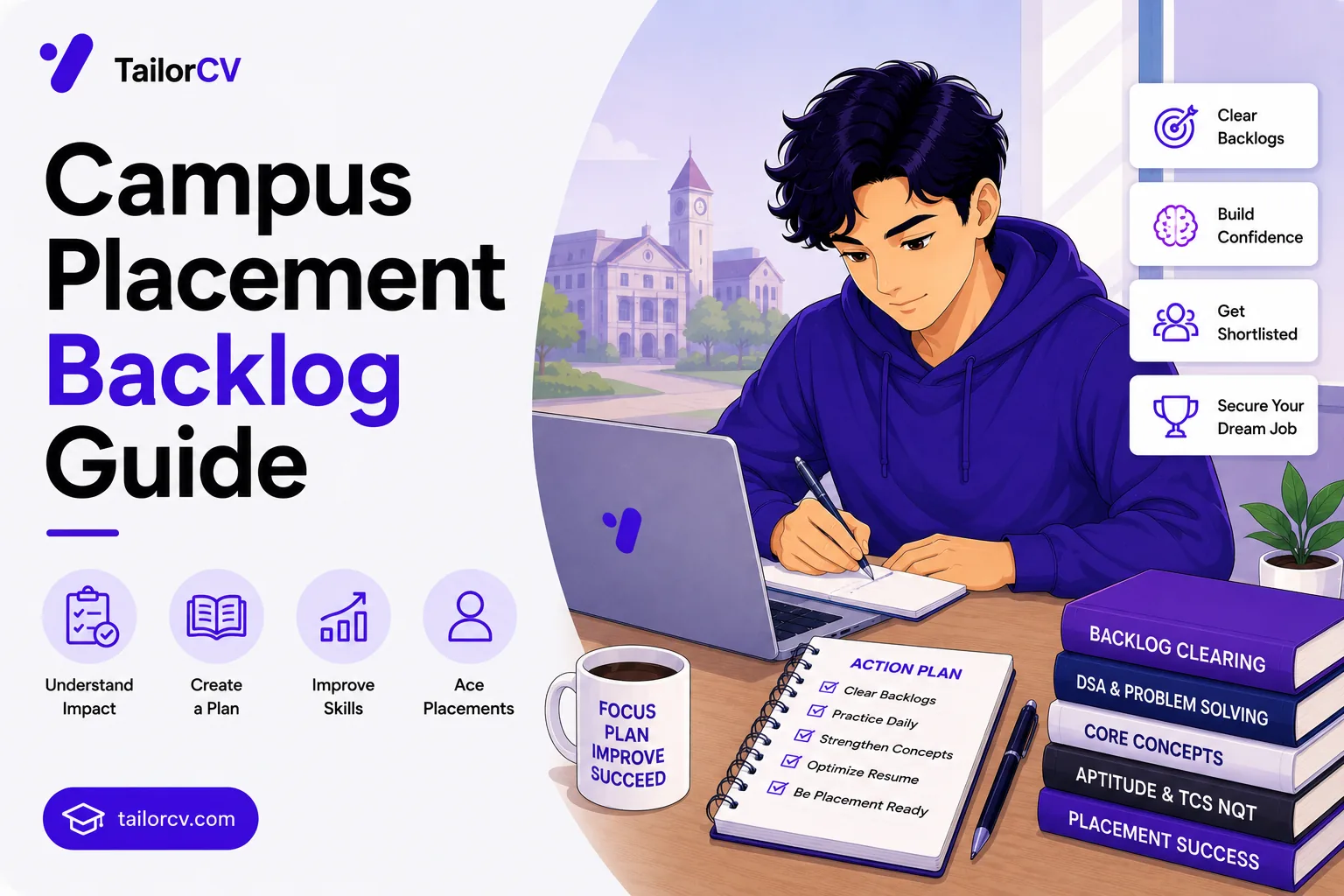
SS
SS
Key Takeaways
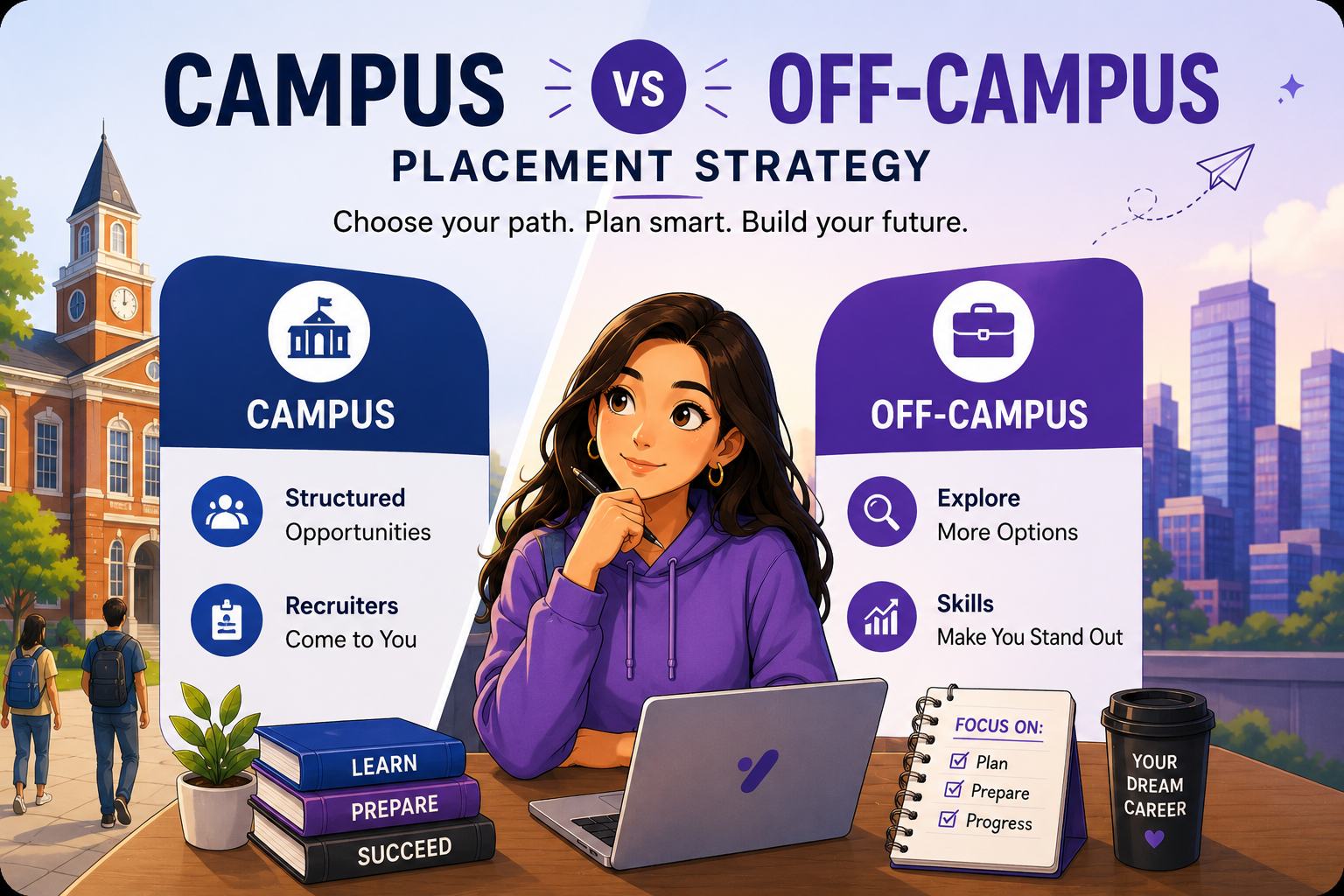
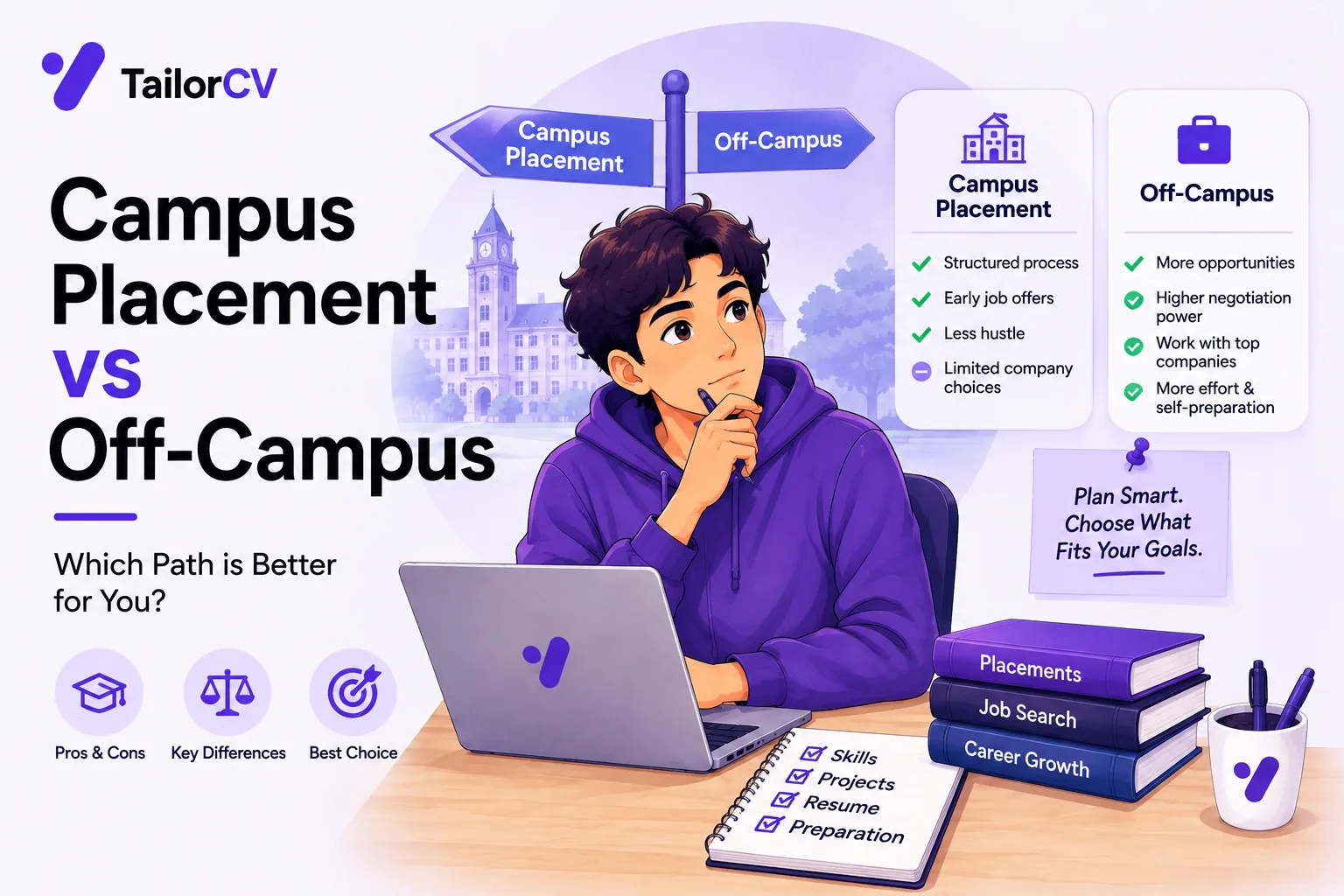
- Campus placement offers convenience and a smaller applicant pool; off-campus offers vastly more openings and no academic gatekeeping.
- CGPA is an absolute filter on campus and often irrelevant off-campus, which reverses who is advantaged.
- Campus hiring is seasonal and compressed; off-campus runs continuously all year.
- Off-campus selection weights projects, portfolio, and referrals far more heavily.
- The two are not alternatives - the right strategy is campus first for the convenience, off-campus in parallel because it never closes.
Students tend to treat these as sequential: try campus placements, and if that fails, go off-campus. That framing costs people opportunities, because it treats the larger market as a fallback rather than a channel.
The honest comparison is that each route advantages different candidates. A student with a strong CGPA and average projects is well served by campus placement. A student with a weak CGPA and strong demonstrable work is systematically disadvantaged on campus and does considerably better off it.
This guide sets out how they actually differ, so you can weight your effort deliberately.
Whichever route you take, the same resume does the work - run it through the free ATS score checker.
The Core Differences
Who can apply
Campus: eligibility filters do most of the elimination before anyone reviews anything. CGPA cutoffs, backlog restrictions, branch requirements, sometimes tenth and twelfth marks, sometimes year-gap limits. These are absolute and unappealable.
Off-campus: many employers have no academic cutoff at all. Where one exists, it is frequently softer and traded off against demonstrated ability.
This is the single most consequential difference. A student who cannot sit for most campus drives because of a 6.2 CGPA is not disadvantaged in the same way off-campus.
Who you compete against
Campus: your batch, and sometimes a few neighbouring colleges. A few hundred candidates, all with similar coursework and similar profiles.
Off-campus: everyone. Graduates from across the country, sometimes candidates with prior experience. The pool is enormous.
Campus is a smaller pond, which is its main advantage.
How many openings exist
Campus: limited to the companies that visit yours, which depends on their recruitment budget, their relationship with your institution, and their headcount that year. Often twenty to fifty companies.
Off-campus: effectively the entire market. Most employers in the country never visit any campus.
Timing
Campus: a compressed season, typically starting in semester 7 and largely concluded within a few months. Miss it and it does not come back.
Off-campus: continuous. Companies hire when they have a vacancy, which is all year.
What gets you selected
Campus: eligibility, then aptitude, then technical rounds, then HR. Standardised and process-driven. Your CGPA does real work.
Off-campus: resume screening, then skill assessment. Projects, portfolio, GitHub, and referrals carry substantially more weight, and academics carry less.
Where Campus Placement Wins
Convenience. The companies come to you. No application hunting, no cold outreach, no chasing recruiters.
A smaller applicant pool. Competing against a few hundred classmates rather than tens of thousands of strangers is a genuine structural advantage, and it is the main reason to take campus seriously even if the companies are not your first choice.
A faster process. Many campus drives run selection to offer within a day or two. Off-campus processes routinely take weeks.
Institutional support. Your placement cell provides criteria, schedules, and preparation resources, and often has records of what companies asked in previous years. That last resource is genuinely valuable and consistently underused.
Volume hiring. Service-based companies recruiting hundreds from one campus offer probability that off-campus rarely matches - the segment is explained in service-based vs product-based companies.
No gap. You start work shortly after graduating, which removes a question you would otherwise have to answer.
Where Off-Campus Wins
Far more openings. The market is orders of magnitude larger than the set of companies visiting your college.
Academics matter less. For students filtered out by CGPA criteria, this reverses their position entirely.
Better company access. Many strong employers - particularly product companies and well-funded startups - do limited campus recruiting or none at all, and hire almost entirely through their own channels.
Role choice. You apply for specific roles rather than accepting whatever allocation follows a general offer.
Referrals work. A referred application is dramatically more likely to be reviewed. Campus placement has no equivalent lever - see networking messages for referrals.
Negotiation is possible. Campus packages are usually standardised and fixed. Off-campus offers are sometimes negotiable.
No deadline. If you are not ready in semester 7, off-campus is still there in semester 8, and after graduation.
Which Route Suits You
Campus placement should be your primary focus if
- Your CGPA comfortably clears typical cutoffs
- You have no backlogs
- Your aptitude and communication are solid
- You want certainty and speed
- You would be satisfied with the companies that visit your college
Off-campus deserves heavier weight if
- Your CGPA locks you out of most campus drives
- You have backlogs or a year gap
- Your projects and portfolio are genuinely strong
- You are targeting specific companies that do not visit your campus
- You want a particular role rather than a general offer
- You are already past placement season - see not placed, what next
The strategy most students should actually follow
Do both, sequenced sensibly.
Semester 5-6: prepare for campus, because it arrives first and has fixed deadlines. Simultaneously build the assets off-campus applications depend on - projects, GitHub, LinkedIn - since these take months and cannot be produced quickly later.
Semester 7: sit for every campus drive you are eligible for, including companies you are lukewarm about. Interview stamina compounds, and an offer in hand improves your performance and your options.
Semester 7-8, in parallel: apply off-campus continuously. There is no reason to wait, and off-campus processes are slow enough that starting early matters.
After accepting an offer: check your placement cell's rules, since many institutions restrict further participation once you accept. Off-campus applications are usually still permitted, but confirm rather than assume.
What Off-Campus Actually Requires
If you are weighting off-campus heavily, the preparation shifts.
A resume that stands alone. On campus, your institution partly vouches for you. Off-campus it does not, so the document carries more weight - see how to get shortlisted for campus placement and campus placement resume mistakes.
Demonstrable work. A deployed project with a live link is worth more off-campus than on, because it is the evidence replacing the campus filter. See choosing a final year project for placements.
A real online presence. GitHub with commit history and README files, LinkedIn complete and accurate. Recruiters check both - see how to optimise your GitHub profile.
Referral outreach. The highest-conversion channel available, and the one students most consistently avoid out of awkwardness. Seniors from your college who were placed are the natural starting point.
Patience with process. Weeks between rounds is normal. Run several applications in parallel rather than sequentially.
Off-campus drives and hiring challenges. Several large employers run regular open assessments for freshers, functioning as campus placements without the eligibility filter. These are worth tracking specifically.
Common Mistakes
Treating off-campus as a fallback. It is the larger market, and starting it late costs months.
Waiting for campus season to end before applying anywhere else. There is no reason to.
Skipping campus drives for companies you are unenthusiastic about. Interview practice compounds and an offer changes your position.
Applying off-campus with a campus-oriented resume. Off-campus screening weights projects and portfolio more heavily, so lead with them.
Ignoring referrals. The single most effective off-campus channel.
Mass-applying identically. Twenty tailored applications beat two hundred generic ones - see how to tailor your resume for every job.
Not checking your placement cell's rules about applying elsewhere after accepting an offer.
Assuming off-campus means lower quality. Many strong employers hire almost exclusively this way.
For the campus side, one placement resume for many companies covers tailoring inside a fixed college template.
Frequently Asked Questions
Is off-campus placement harder than campus placement?
The applicant pool is far larger, which makes any single application harder. But there are vastly more openings and no academic gatekeeping, so the overall odds depend heavily on your profile - particularly whether CGPA filters were working for or against you.
Can I apply off-campus while campus placements are ongoing?
Generally yes, and you should - off-campus processes are slow, so starting early matters. Check your placement cell's specific rules, especially about what happens after you accept a campus offer.
Do off-campus jobs pay less?
Not inherently. Campus packages are standardised across an intake; off-campus offers vary by company and role and are sometimes negotiable. Product companies hiring off-campus frequently pay more than service companies hiring on campus.
Is CGPA important for off-campus jobs?
Considerably less than on campus. Many off-campus employers have no cutoff at all and assess through skill tests and projects instead, which is why students filtered out by campus criteria often do better here.
Should I skip campus drives for companies I do not want?
Generally not. Interview experience compounds, and having an offer improves both your confidence and your negotiating position later. You can decline or continue searching within your placement cell's rules.
How do I find off-campus openings?
Company career pages, job boards, LinkedIn, off-campus hiring challenges run by large employers, and referrals from seniors. Referrals convert best by a wide margin.
What if I get no campus offer at all?
Off-campus is the primary route from that point, and it is a large market. The structured recovery plan is in not placed, what next.
Both routes depend on the same document. Check your ATS score free.
Make This Practical
Run both channels in parallel rather than treating off-campus as a fallback. Prepare for campus first because it has fixed deadlines and a smaller applicant pool, but start off-campus applications during the same semester, since those processes take weeks and there is no reason to wait for the season to end.
Then build the assets off-campus hiring actually screens on, and build them early because they take months: one deployed project with a live link, a GitHub profile with real commit history and README files, and a complete LinkedIn. These substitute for the institutional filter that campus placement provides.
Finally, use referrals deliberately. Ask placed seniors directly and specifically - it is the highest-conversion off-campus channel and the one students most reliably neglect. Sit for every campus drive you are eligible for regardless of preference, tailor each off-campus application using how to tailor your resume for every job, and verify the resume parses with the free ATS score checker.
What is your resume scoring right now?
Scan it against a job description and get your ATS match score in about a minute.
Drop your resume here or choose a file
PDF only. Max 2 MB.
We never share your data or use it to train AI models.

Was this guide useful?
Be the first to rate it.