 SS
SS
Key Takeaways
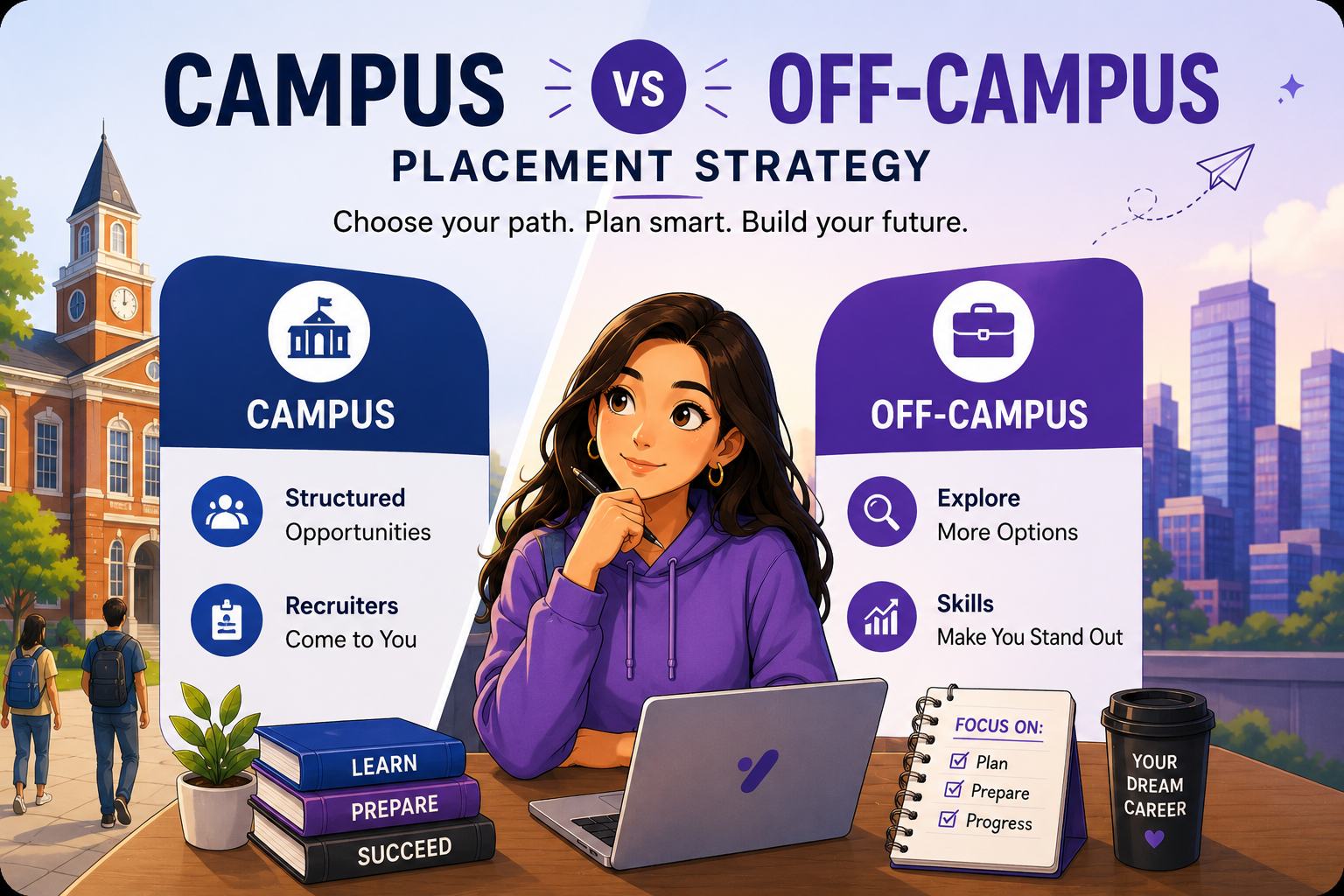
- Campus recruiting is a channel with limited employers and fixed timing; off-campus is the whole market with no schedule.
- Running both at once is normal and sensible — they peak at different times and fail in different ways.
- Off-campus requires you to source postings, build referrals and tailor at volume, which campus placement does for you.
- Not being placed on campus is common and says more about employer quotas than about you.
- The skills that make off-campus work — outreach, tailoring, tracking — are the ones you keep for every later job change.
What each channel actually is
Campus placement is a set of employer relationships your institution maintains. Employers visit, run a process, and hire a fixed number. The convenience is enormous: roles arrive, timing is announced, the process is scheduled, and eligibility is pre-filtered.
The limitation is equally real. The employers who visit are a small subset of the employers who exist. Their intake is capped. And the timing is theirs, not yours.
Off-campus is everything else — company career pages, referrals, job boards, direct outreach. There is no schedule, no cap and no filtering. You do all the work the campus process would otherwise do for you.
Why running both is the right default
They fail differently, which is exactly why you want both.
Campus placement fails when the employers who visit are not the ones you want, when the intake fills before your turn, or when eligibility criteria exclude you. Off-campus fails when you cannot source enough relevant postings or your applications are not landing.
They also peak at different times. Structured campus hiring concentrates in an autumn window in the US, Canada and Singapore, while off-campus hiring runs year-round and picks up precisely when campus season ends.
A reasonable split during the campus window is most of your effort on campus processes with a steady off-campus baseline. Once the campus window closes, that inverts completely.
What off-campus demands that campus does not
Sourcing. Nobody brings you the posting. Building a list of 20-40 target employers and checking their career pages regularly replaces the career fair.
Referrals. Without an institutional relationship, a referral is what gets your application read rather than filtered. This is the highest-return activity in an off-campus search and the one most students skip — asking for a conversation rather than a referral is the approach that actually gets replies.
Tailoring at volume. Campus processes often accept one standard resume. Off-campus, every posting screens by matching language, so a single generic document produces rejections at scale. Tailoring per role is not optional, and it is the main reason off-campus feels harder.
Tracking. Nobody is managing your pipeline. Forty applications across three months is unmanageable from memory.
Handling silence. Campus processes tell you the outcome. Off-campus applications frequently never respond at all, and calibrating to that without losing momentum is its own skill.
If campus placement passes you over
This happens to a lot of people and it is worth being clear about why.
Employers arrive with a fixed number of seats. Eligibility criteria — a grade threshold, a branch restriction, a backlog rule — exclude people for reasons unrelated to capability. The order in which companies visit determines who is still available. None of that is a verdict on you.
What to do:
Move immediately. The worst outcome is spending the weeks after campus season processing the disappointment while off-campus roles fill. Handling rejection quickly matters more than handling it thoroughly.
Change the target list. The employers who visited have filled their seats. Applying to their closed postings is where effort goes to die. Mid-sized firms, regional companies and startups hire on demand and are systematically under-applied to.
Fix the document first. If campus applications did not convert, the resume is the most likely reason and it is now going into a harsher channel. Check it parses correctly before sending it anywhere else.
Build evidence. A project completed in the two months after graduation is a legitimate resume item and often more persuasive than another line of coursework — projects that get interviews is where a gap becomes an advantage.
For international students
The calculation shifts, because your viable employer pool is smaller.
Campus placement is disproportionately valuable when it includes employers who sponsor or who are familiar with hiring international graduates. Off-campus requires you to filter for that yourself, which means more applications to reach the same number of viable ones.
It also means starting earlier. Any work-authorisation question slows a hiring process, so being in a pipeline early is worth more to you than to a domestic classmate — and the graduate visa route you are on determines how much runway you have to work with.
What off-campus teaches you
Worth saying plainly: campus placement is the last time in your career that jobs will be brought to you.
Every subsequent move — changing employers, changing cities, changing fields — is an off-campus search. The habits are the same: source targets, build contacts, tailor applications, track the pipeline, handle silence.
Students who only ever used campus placement often struggle with their second job for exactly this reason. Learning the skills while you still have institutional support is easier than learning them later under pressure.
Running both, without doing either badly
The framing of "campus versus off-campus" implies a choice. In practice the students who do well run both, and the reason they manage it is that the two demand effort at different times.
Campus is front-loaded and calendar-driven. Registration deadlines, eligibility criteria, a fixed sequence of company visits, and a process that mostly happens to you once you are in it. The work is concentrated in a short window and then it is largely waiting.
Off-campus is continuous and self-driven. Applications, outreach, follow-ups, and no external structure telling you when to act. The work is spread thin over months and it is entirely on you to sustain it.
Which means they interleave well. The weeks when campus recruiting is quiet — waiting for shortlists, between company visits — are exactly the weeks to be sending off-campus applications and outreach messages.
A workable split: treat campus as a channel you are registered for and prepared for, and spend three to four hours a week on the off-campus search regardless of what campus is doing. That is the discipline most students lack, because a promising campus process feels like a reason to stop everything else.
The specific failure to avoid: pausing the off-campus search because a campus process is going well. Campus processes end abruptly and often — a shortlist you did not make, a company that filled its quota, a round that went badly — and a student who stopped applying in October discovers in December that they have nothing in the pipeline. Keep both running until something is signed.
And be honest about eligibility. Campus placement usually carries criteria — grades, backlogs, attendance, sometimes a rule that you leave the process once placed. Read them before the season rather than discovering them at registration, because they determine whether campus is your main channel or a supplement.
The rules that govern campus placement
Campus processes carry conditions that off-campus applications do not, and students discover them at the worst moment. Read yours before the season.
Eligibility criteria. Minimum grades, no active backlogs, attendance requirements. These are usually published and usually not read until registration.
The one-offer rule. Many institutions remove you from the campus process once you accept an offer, and some remove you once you receive one. This is the single most consequential rule, because it means an early offer from a company you are lukewarm about can end your access to the companies visiting in March.
Tiering. Some placement cells group employers into tiers and restrict students who have a tier-one offer from sitting further tier-one processes. Know which tier your offer sits in.
Registration deadlines. Frequently months before the first company visits, and missing one excludes you for the year.
Commitment expectations. Declining an offer you accepted, or not turning up to a process you registered for, can carry penalties ranging from a warning to removal from the process. It also affects the institution's relationship with that employer, which is why placement cells take it seriously.
What to do with all this:
Get the rules in writing at the start of the year. Not the summary — the actual document.
Decide in advance what you would accept. If a one-offer rule applies, an offer in October is a decision about your whole season, made under time pressure, and the students who handle it well are the ones who thought about it in August.
Ask which employers came last year and what they hired for. This tells you whether campus is a serious channel for what you want or a channel for something else, and that determines how much of your effort belongs off-campus.
Preparing once for both
The efficiency that makes running two channels affordable: almost all the preparation is shared.
One master resume, from which both campus and off-campus versions are generated. The evidence is identical; only the emphasis moves.
One set of six stories. Campus interviews and off-campus interviews ask the same behavioural questions. Build the story bank once and it serves every process you enter.
One block of aptitude practice. Campus processes and structured off-campus programmes use the same test families. Twenty or thirty timed practice sets covers both.
One block of technical practice, if your field needs it. Coding problems, case practice, whatever applies — none of it is channel-specific.
One tracker. Both channels in the same sheet, so you can see the whole pipeline in one place rather than losing an off-campus process because it lived in your inbox.
What genuinely differs: the campus channel needs you to know its rules and deadlines, and the off-campus channel needs outreach, which has no campus equivalent. That is perhaps two hours of setup and fifteen minutes a day respectively.
Which is the whole argument. Running both is not double the work — it is the same preparation, pointed at twice as many employers, plus a daily habit of three messages. Students who believe they must choose are usually comparing the full cost of one channel against the full cost of another, when most of the cost is shared.
What the screen does in both channels
Whichever channel an application arrives through, a document goes through a filter before a person reads it — and this is where most applications die in both.
The document must survive extraction. Two-column layouts, graphics, tables used for alignment, headers rendered as images. The page looks correct and the extracted text is scrambled or missing. This fails identically in a campus portal and on a company career page, and it is invisible unless you check. Open your PDF, select all, copy, paste into a plain text file, and read what comes out. An ATS scan does it properly.
The language must match the posting. The system compares your text against a specific role. Two candidates who did the same work, one describing it in the industry's vocabulary and one in their own, match very differently. Tailoring per posting moves the interview rate more than any channel decision on this page.
The evidence has to be visible in the first third. Whoever reads it after the filter gives you a few seconds. A resume that opens with education and buries a strong project on page two is losing the only advantage it had.
Why this matters for the campus-versus-off-campus question specifically: students often conclude that one channel "does not work" when the actual problem is a document failing in both. Before deciding a channel is unproductive, confirm that the thing you are sending through it survives the filter — otherwise you are diagnosing the channel for a fault that belongs to the document.
Common Mistakes
- Treating them as alternatives. They are different channels with different timing, and running both is normal.
- Waiting for campus season to end before starting off-campus. By then the autumn market has closed too.
- Applying off-campus with a campus resume. Off-campus screens harder and matches language.
- Chasing only the employers who visited. Their seats are gone.
- Reading a campus rejection as a verdict. Quotas and eligibility rules explain most of it.
- Skipping referrals off-campus. The single highest-return activity in that channel.
What each channel is actually good for
Campus is good for: access to employers who would not otherwise read your application; a compressed timeline where several processes run in weeks rather than months; a structure that does some of the work for you; and volume hiring, where employers take large numbers and the odds per process are better than they look.
Campus is weak for: choice — you get the employers who came, not the ones you wanted; specificity, since roles are frequently generic; and anything outside the sectors that recruit on campus at your institution.
Off-campus is good for: targeting employers you actually want; smaller and mid-sized companies, which never visit campuses and which employ most people; roles that match your specific evidence; and continuing after the campus season ends.
Off-campus is weak for: response rates, which are low and require volume and referrals to overcome; and structure, since nothing external tells you what to do next.
The under-appreciated point: these two channels reach almost entirely different employers. Running only campus means the employers who did not visit are invisible to you. Running only off-campus means you have declined free access to the ones who did. Neither omission is sensible, and the cost of running both is a few hours a week.
Where your evidence goes either way. Both channels put a document through a screen before a person reads it. A resume that does not survive extraction fails in both equally, and matching the language of each posting is what moves the interview rate in both. That work is shared, which is another reason running two channels costs less than twice as much.
If campus does not work out
Most students are not placed through campus recruiting, at most institutions, in most years. That is a base rate rather than a failure, and the response matters.
Do not wait until the campus season formally ends. By the time a placement cell declares the season over, the off-campus market has been running for months and the students who started in September are ahead of you. This is the single strongest argument for running both channels from the beginning.
Off-campus is where most people get hired anyway. Small and mid-sized employers never visit campuses and they employ the majority of graduates. The channel that feels like a fallback is the main market.
Referrals do the heavy lifting. With no institutional channel doing the introducing, one referral is worth roughly thirty cold applications. Alumni from your own institution are the highest-yield contacts, and the fact that they went through the same placement process makes them unusually willing to help.
Build evidence in the quiet months. A project that exists and runs changes what your applications can claim, which is worth more than sending the same document to another fifty employers.
Apply to roles that are eighty percent right. A first job at an adjacent employer, done well for two years, makes you a lateral candidate at organisations that would not have looked at you as a graduate. This is how a great many people reach the employers that filtered them out, and it is invisible from the outside.
And keep the timescale in proportion. A placement season is a few months. The rejection arithmetic means most applicants at most employers are rejected regardless of quality, and a season that produces nothing is a common outcome rather than a verdict. What is not recoverable is stopping — the students who struggle longest are almost always the ones who concluded in December that the year was over.
A week that runs both
Concrete, because "run both channels" is easy to agree with and hard to actually do alongside coursework. About four hours.
Monday, 30 minutes. Check the campus placement portal for new registrations, shortlists and announcements. Check the career pages of your off-campus target list for anything posted in the last week.
Tuesday, 90 minutes. Off-campus applications. Everything found on Monday, tailored. This is the block that gets skipped when tired, and it is the one that matters, so put it where your energy actually is.
Wednesday, 30 minutes. Three outreach messages. Not thirty — three, each specific. This is the activity that compounds and the first to be dropped.
Thursday, 60 minutes. Preparation. Whatever your nearest process needs — aptitude practice, technical problems, rehearsing your stories aloud. When a campus process is imminent, this block belongs to it entirely.
Friday, 20 minutes. Update the tracker. Look at the numbers. Applications out, responses in, what changed. Decide the one thing to fix next week.
When a campus process is running, Thursday and part of Tuesday shift to it. The rest holds. What must not happen is the whole week collapsing into a single campus process, because campus processes end abruptly and a week later you have an empty pipeline.
That is the entire discipline: bounded slots, both channels, and the off-campus work continuing regardless of how the campus season looks in any given fortnight.
Choosing where to put the emphasis
Both channels always, and the weighting between them should depend on your situation rather than on a general rule.
Weight toward campus if: your institution has strong placement relationships in your field; you meet the eligibility criteria comfortably; the employers who visit are ones you actually want; and your field is one that recruits in volume through campus channels.
Weight toward off-campus if: the companies visiting your campus are not in your target sector; you do not meet campus eligibility criteria; you want a specific type of role that volume hiring does not produce; you are targeting smaller or mid-sized employers, which never visit campuses; or you are an international student at an institution whose visiting employers cannot hire you.
Weight heavily toward off-campus if your campus placement season is short, thinly attended, or dominated by employers in one industry. Some institutions have excellent placement cells and some have three companies visiting for four hundred students, and being honest about which one you attend is worth more than any strategy advice.
A useful diagnostic: ask the placement cell how many students were placed last year, and by which companies. Two specific numbers, published or obtainable, and they tell you immediately whether campus is your main channel or a supplement. Students who never ask spend a whole season assuming a channel is more productive than it is.
Frequently Asked Questions
Should I apply off-campus if I am eligible for campus placement?
Yes. Campus intake is capped and the employer list is narrow. A steady off-campus baseline costs little and covers the case where campus does not work out.
Does off-campus hiring pay less?
Not inherently. Campus programmes often have fixed cohort pay; off-campus roles vary in both directions. Smaller employers may pay less but frequently offer more responsibility earlier.
Is it harder to get hired off-campus?
Different rather than harder. You do the sourcing and filtering the campus process would do, but the pool of employers is vastly larger.
When should I start off-campus applications?
Alongside campus season, at low volume, then scale up as the campus window closes. Starting from zero in March is the common and costly mistake.
Do employers view off-campus hires differently?
No. Once you are hired, how you were sourced is invisible. It matters only to you.
What if my institution has weak placement relationships?
Then off-campus is your primary channel from the start, and referrals matter more. That is a harder starting position, not a hopeless one — it is the same position non-target students work from routinely.
What is your resume scoring right now?
Scan it against a job description and get your ATS match score in about a minute.
Drop your resume here or choose a file
PDF only. Max 2 MB.
We never share your data or use it to train AI models.

Was this guide useful?
Be the first to rate it.