 TD
TD
Key Takeaways
- Most resumes are filtered by an Applicant Tracking System (ATS) before reaching a human, making small, fixable issues critical for success.
- Low ATS scores typically result from multiple minor problems rather than a single major flaw.
- The most common issues affecting scores include missing keywords, unparseable formatting, generic resumes, and lack of measurable impact.
- Keyword matching is the primary factor in ATS scoring; resumes must align closely with the specific language used in job descriptions.
- Tailoring your resume to each job description is more important than overall presentation or design.
Most resumes never reach a human. They are scored, ranked, and filtered by an Applicant Tracking System (ATS) first - and the gap between a callback and silence usually comes down to a handful of fixable issues. We looked at the patterns across resumes run through TailorCV's free ATS score checker to see which problems show up most often and which fixes actually move the number.
This is not a controlled lab experiment - it's an observational look at what tends to separate a low-scoring resume from a strong one. Here is what the pattern shows, why it happens, and exactly how to fix each issue on your own resume.
How we looked at this
When someone runs a resume through the ATS score checker, the tool compares it against a specific job description and returns a match score along with the gaps driving that score down: missing keywords, parsing problems, weak relevance, and thin evidence of impact. Looking across a large number of these comparisons - rather than any single resume - makes it possible to see which categories of problems show up again and again, and roughly how much each one tends to matter relative to the others.
That is the scope of what follows: a pattern read across many resume-to-job-description comparisons, not a peer-reviewed study and not a promise about your specific outcome. We are intentionally not attaching invented percentages or sample sizes to these observations - the point of this piece is to explain the why behind the pattern and the what to do about it, not to dress up a blog post with numbers that would not hold up to scrutiny.
Two things stayed consistent across the comparisons, regardless of industry or seniority level:
- Low scores were almost never caused by one catastrophic problem. They were caused by several small, fixable gaps stacking on top of each other.
- The resumes that scored best were not necessarily the most impressive on paper - they were the most precisely mapped to the job description in front of them.
Keep that second point in mind. It matters more than anything else in this article.
The pattern behind low scores
Ranked roughly by how often they showed up and how much they tended to drag the score down, four categories accounted for the overwhelming majority of low-scoring resumes:
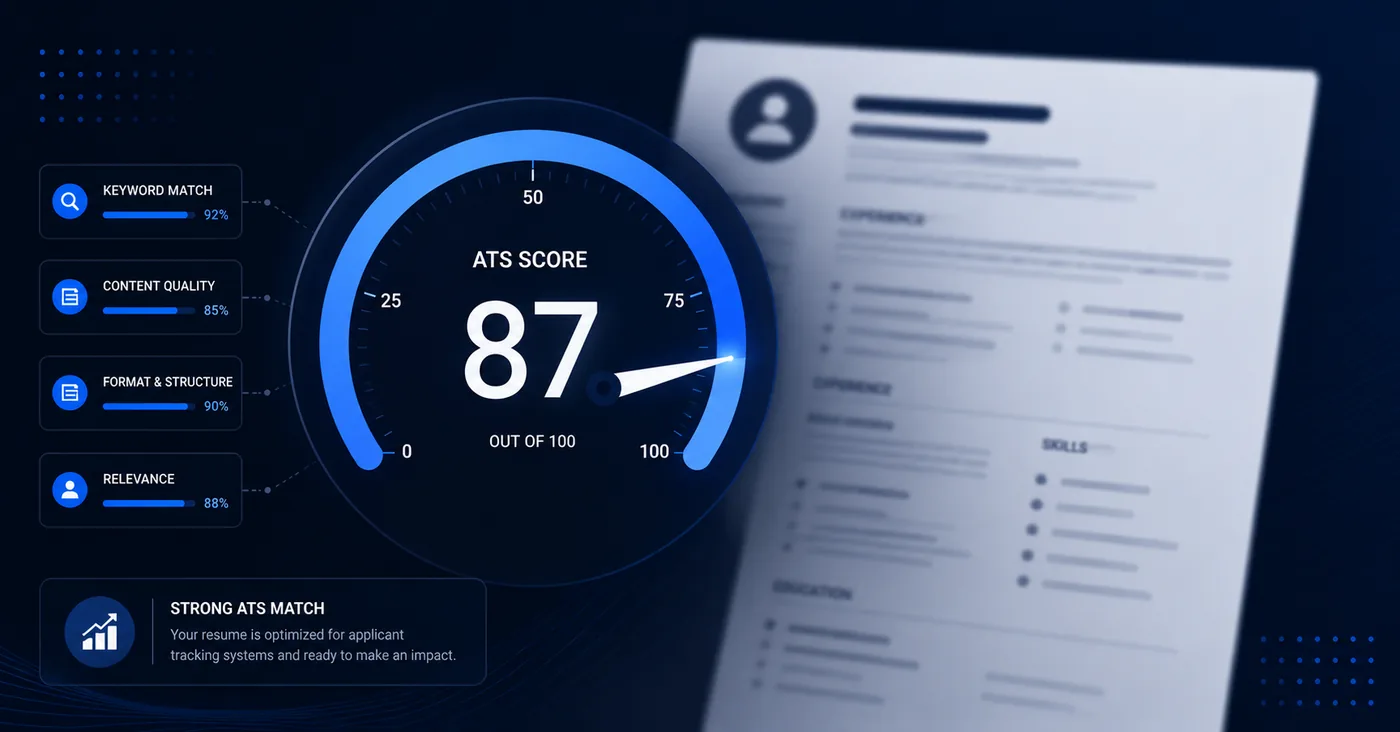
What an ATS score report actually shows you

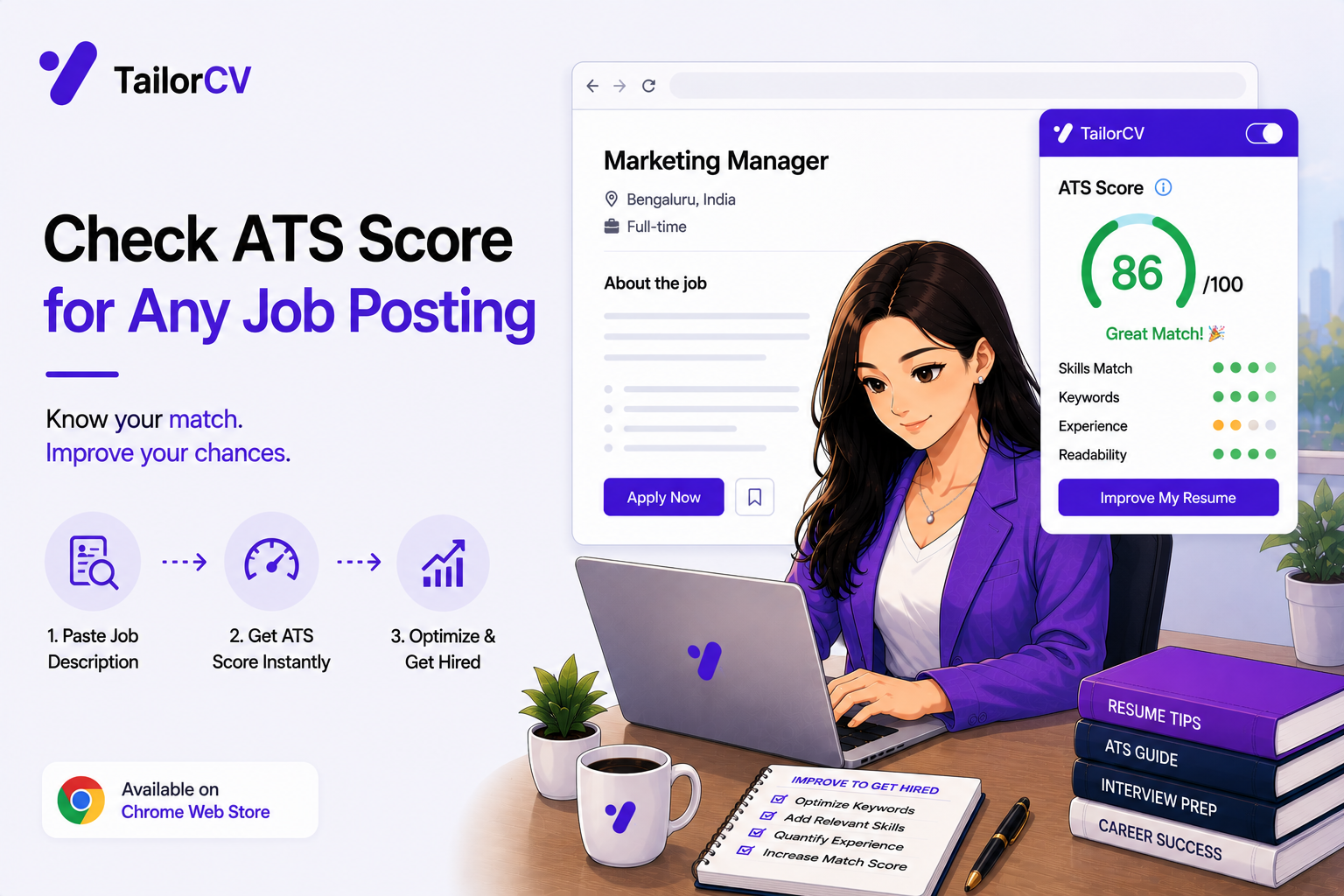
This is what a score actually looks like. The number matters less than the breakdown: each check tells you what failed and why it matters.
- Missing keywords - the resume simply does not contain the language the job description uses.
- Formatting the ATS cannot parse - the content exists, but the system cannot read it correctly.
- Generic, untailored resumes - the resume was clearly written once and sent everywhere.
- No measurable impact - claims exist, but nothing quantifies the outcome.
Keyword match consistently showed up as the largest single driver of the gap between a low score and a high one. That is not surprising once you understand how ATS matching actually works, but it does mean most job seekers are optimizing the wrong thing first - polishing prose and design when the scoring engine is mostly reading for literal term overlap. Let's go through each of the four in order, with the mechanism behind it and the specific fix.
1. Missing keywords: the number one score killer
The most common reason a resume scores low is almost embarrassingly simple: it does not contain the words the job description uses. ATS keyword matching is largely literal. "JS" is not treated as identical to "JavaScript." "Managed a team" does not automatically register as "team leadership" or "people management," even though a human reader would connect the dots instantly.
Why this happens. Most people write their resume once, from memory, describing their work the way they think about it internally. The job description, meanwhile, was written by someone else, for a different audience, using the specific vocabulary of that company's tools, certifications, and role titles. Unless you deliberately go back and reconcile the two, they will not line up - even when the underlying experience is a perfect fit. This is exactly why resumes that are technically well-written for a human reader can still score poorly against a machine: the ATS is not judging quality, it is judging overlap.
In the resumes we looked at, this was consistently the single largest gap between a mediocre score and a strong one - larger than formatting, larger than tailoring, larger than anything else. A resume can be beautifully designed and still fail here, because keyword coverage is scored independently of visual polish.
The fix:
- Read the job description line by line and note every skill, tool, certification, and role-specific phrase.
- Mirror the exact phrasing for anything you genuinely have experience with. If the posting says "stakeholder management," use that phrase - not just "worked with clients."
- Do not stuff keywords that do not reflect real experience; that creates a different problem (see the nuance section below).
- Paste both your resume and the job description into the ATS score checker to see exactly which terms are missing, and browse role-specific keyword lists in the resume examples by job role library.
- For a deeper walkthrough of how to extract the right terms from a posting without overdoing it, see the job description keyword extraction guide and the hidden keywords in job descriptions post.
2. Formatting the ATS can't parse
Tables, multi-column layouts, text embedded in images, headers and footers, icons used as bullet markers, and unusual fonts all cause parsers to drop or scramble content. A resume that looks beautiful to a human eye can read as gibberish - or worse, as blank space - to the system extracting text from it.
Why this happens. ATS platforms extract text from a resume file before they ever score it. That extraction step relies on a predictable, linear structure: text flows top to bottom, left to right, inside standard document elements. The moment a resume uses a design element built for visual appeal - a sidebar, a text box, a table used for layout instead of data - the parser can lose track of where content belongs, misattribute it to the wrong section, or drop it entirely. A skills section trapped inside a text box might not exist at all as far as the scoring engine is concerned, even though it is clearly visible on screen.
This is one of the more frustrating findings because it is entirely invisible to the applicant. You cannot tell, just by looking at your resume, whether it is parsing cleanly - it looks fine to you because you are looking at the rendered PDF, not the raw text the ATS actually extracts.
The fix:
- Use a clean, single-column, standard-heading layout (Experience, Education, Skills, etc.) rather than a designer template with columns or graphics.
- Avoid putting essential content - job titles, dates, skills - inside tables, text boxes, or headers/footers.
- Stick to standard, widely supported fonts rather than decorative ones.
- Use TailorCV's ATS-friendly templates, including the Jake's Resume-style template, which are built specifically to parse correctly.
- For a full checklist of formatting traps, read ATS resume formatting mistakes and ATS resume parser-friendly format.
3. Generic, untailored resumes
A resume sent to every job, unchanged, consistently underperforms one that has been adjusted for the specific role. Relevance - how closely your experience maps to this opening - is itself a scored signal, not just a nice-to-have for the human reader who eventually sees it.
Why this happens. A generic resume is, by definition, optimized for no single job. It hedges. It lists a broad summary that could apply to five different roles, a skills section padded with everything you have ever touched, and bullet points written in general terms so they "still work" no matter where you send them. That hedging is exactly what shows up as a weaker match score - the system is measuring specificity and overlap with one job description, and a resume built to be universally applicable is, almost by design, not tightly matched to anything.
The practical implication is that "one great resume" is the wrong goal. The goal is one strong base resume that gets adjusted - sometimes lightly, sometimes substantially - for each role you apply to.
The fix:
- Rewrite the top third of your resume (summary, skills, most recent role's bullet points) for each application. That section carries a disproportionate amount of the scoring and reading weight.
- Reorder your skills list so the ones mentioned in the job description appear first, not buried at the bottom.
- Swap generic bullet points for versions that reference the specific responsibilities in the posting, using real examples from your background.
- The AI resume optimizer can do a first pass of this tailoring in minutes, which you should then review and adjust for accuracy.
- For the mechanics of matching a resume to a specific posting efficiently, see resume matching with job description: complete guide and how ATS detects a generic resume.
4. No measurable impact
ATS scoring rewards relevant, specific content, and the recruiter who reads the resume next rewards proof. A bullet point like "responsible for sales" carries far less weight - to both the algorithm and the human - than "grew regional sales 28% over two quarters by restructuring the outbound pipeline."
Why this happens. Vague responsibility statements are easy to write because they do not require you to go back and remember specifics. But they also fail to differentiate you from anyone else who held a similar title. Numbers, scope, and outcomes are exactly the kind of specific, concrete language that both keyword-matching systems and human reviewers respond to - they signal that you know precisely what you did and what changed because of it, rather than describing a job description you copied from a template.
This is also where missing keywords and missing metrics compound each other. A bullet point that is both generic ("responsible for sales") and unquantified misses two scoring signals at once, whereas a bullet that is specific, quantified, and uses the job description's own vocabulary hits all three.
The fix:
- Go back through your experience and attach a number wherever one honestly exists: percentage change, dollar amount, team size, time saved, volume handled.
- If you genuinely do not have a hard number, use scope instead ("supported a 12-person team across three markets") rather than leaving the sentence generic.
- See role-specific example bullet points in the resume examples library for a sense of how much detail is appropriate.
Which fix moves the score the most
Based on how consistently each category showed up across the comparisons, this is the order most people should work through when improving a low-scoring resume:
- Add the missing keywords first. This is the single largest lever, and it is the fastest to fix once you know what is missing.
- Fix formatting so the ATS parses cleanly. A resume with great content still loses everything if the parser cannot read it.
- Tailor the summary and skills section to the specific role. This is where relevance is judged most heavily.
- Quantify your achievements with real numbers. This raises both the score and the quality of the resume for the human reader who sees it next.
Notice that this order runs from "fastest and most mechanical" to "requires the most thought." That is intentional - if you only have twenty minutes before an application deadline, spend it on keywords and formatting. If you have an evening, work all the way down the list.
Action checklist: apply this to your resume today
Use this as a working checklist the next time you tailor a resume for a specific opening:
- unchecked: Copy the job description and your resume into a document side by side.
- unchecked: Highlight every skill, tool, and role-specific phrase in the job description.
- unchecked: Check each highlighted term against your resume - is it present, and is it phrased the same way?
- unchecked: Add any genuinely applicable missing terms into your summary, skills, or experience bullets.
- unchecked: Run the resume through the ATS score checker and note the score and the specific gaps it flags.
- unchecked: Open the file as plain text (or copy-paste it into a blank document) to check whether tables, columns, or text boxes are scrambling the content.
- unchecked: Switch to a single-column, standard-heading layout if you spot parsing issues.
- unchecked: Rewrite your summary and top bullet points to reflect this specific role, not a generic version of your career.
- unchecked: Add a number, percentage, or scope detail to at least three bullet points.
- unchecked: Re-run the score after making changes and compare before-and-after gaps.
A worked example (illustrative, not a data point)
To make this concrete, here is a hypothetical - not a real data point, just an illustration of how the four fixes stack.
Imagine a marketing coordinator applying for a "Senior Content Marketing Manager" role. Their original resume summary reads: "Marketing professional with experience creating content and managing campaigns." Their most recent bullet says: "Responsible for blog content and social media." The resume uses a two-column template with a colored sidebar listing skills.
Run through the checker, this resume would likely be flagged on several fronts at once: the summary does not mention "content strategy," "SEO," or "content calendar" - all terms used in the job posting - so keyword match is weak. The sidebar skills list may not parse correctly depending on the template, so even the skills that are relevant might not register. The bullet point is generic and has no number attached.
After applying the fixes in order: the summary is rewritten to "Content marketer with three years of experience building SEO-driven content strategy and managing an editorial calendar across blog and social channels" - now mirroring the job description's own language. The resume is switched to a single-column ATS-friendly template so the skills section parses correctly. The bullet becomes "Grew organic blog traffic 40% over six months by rebuilding the content calendar around SEO-researched topics." Each of those three changes addresses a different one of the four categories above - keyword match, parsing, and quantified impact - and the tailoring pass (matching the summary to this specific job title and skill set) addresses the fourth.
The point of this example is not the specific 40% figure, which is illustrative - it is that each fix targets a distinct, identifiable weakness, and stacking all four typically does more than any single one on its own.
What this data doesn't tell you
It's worth being direct about the limits of this kind of pattern-reading, because overselling it would undercut the advice.
- A high ATS score does not guarantee an interview. It improves the odds that a recruiter sees your resume at all; what happens after that depends on the recruiter, the role, the volume of applicants, and factors no score can capture.
- Correlation is not the same as causation. Resumes that score higher also tend to belong to candidates who took more time and care overall - it is hard to fully separate "this specific fix raised the score" from "a more thorough applicant did several things well at once."
- Keyword matching is not the same as keyword stuffing. Cramming in terms you cannot back up in an interview will not help you - it may raise a score while actively hurting you in the actual hiring process. Only mirror language for skills and experience you genuinely have. For more on where this goes wrong, see ATS keyword mistakes.
- Different ATS platforms weight things differently. Some emphasize keyword density more heavily, others weight formatting or section structure differently. The four categories above are consistently relevant, but the exact proportions will vary by which system a given employer uses.
- A generic resume is not always the wrong strategy. Early in a job search, when you are casting a wide net, some generalization is reasonable. The cost-benefit shifts once you are applying to a smaller number of roles you genuinely want - that is when tailoring effort pays off most.
Limitations of this kind of data
It is worth being upfront about what this kind of pattern-reading can and cannot support, so you can calibrate how much weight to put on it:
- This is observational, not experimental. We are describing patterns across resumes people chose to run through a scoring tool, not a randomized study where identical resumes were varied one factor at a time and outcomes were tracked.
- Outcomes are not fully tracked. A score checker measures match quality against a job description; it does not know whether a given resume ultimately led to an interview or an offer. The link between "higher score" and "better outcome" is a reasonable inference, not a directly measured one here.
- The people who use an ATS score checker are self-selected. They are, by definition, more engaged with optimizing their job search than the average applicant, which can shape which problems show up most often in the pattern.
- Industry and seniority vary. What counts as a "generic" versus "tailored" resume, and how much formatting matters, can shift by field - a designer's portfolio-adjacent resume is a different case than an accountant's.
- Job market conditions shift. Hiring volume, the aggressiveness of ATS filtering, and even which platforms employers use all change over time and by season, which can shift how much weight any single factor carries.
None of this makes the four categories above less useful as a checklist - they line up with how ATS parsing and matching mechanically work, which is well documented independent of any one data set. It just means you should treat this as a strong starting framework, not a guaranteed formula.
Make This Practical
Do not guess whether your resume is ready. Upload it to the free ATS score checker, compare the result against the ATS Score Guide, and fix formatting issues using ATS Resume Formatting Mistakes and ATS Resume Parser Friendly Format.
After the technical cleanup, improve relevance. Use Resume Matching With Job Description, strengthen keyword coverage with the Resume Keywords Guide, and avoid overdoing it by checking ATS Keyword Mistakes. If the layout itself is weak, rebuild with an ATS-friendly resume template. If you want a second data point on how closely score and callback rate track together, read Resume Match Score and Callback Rate: A Data Study.
FAQ
What is a good ATS score?
Aim for 80 or higher against the specific job you are applying to, not a generic "resume score." A score below 60 usually points to missing keywords or a parsing issue rather than weak experience. See what is a good ATS score for target ranges by context.
Does the ATS really reject resumes automatically?
Most ATS platforms rank and filter rather than issue a hard, automatic rejection, but a low-ranked resume rarely gets opened by a busy recruiter working through hundreds of applicants. A higher match score puts you nearer the top of that stack, which is functionally what matters.
Why is my ATS score low even though I'm qualified?
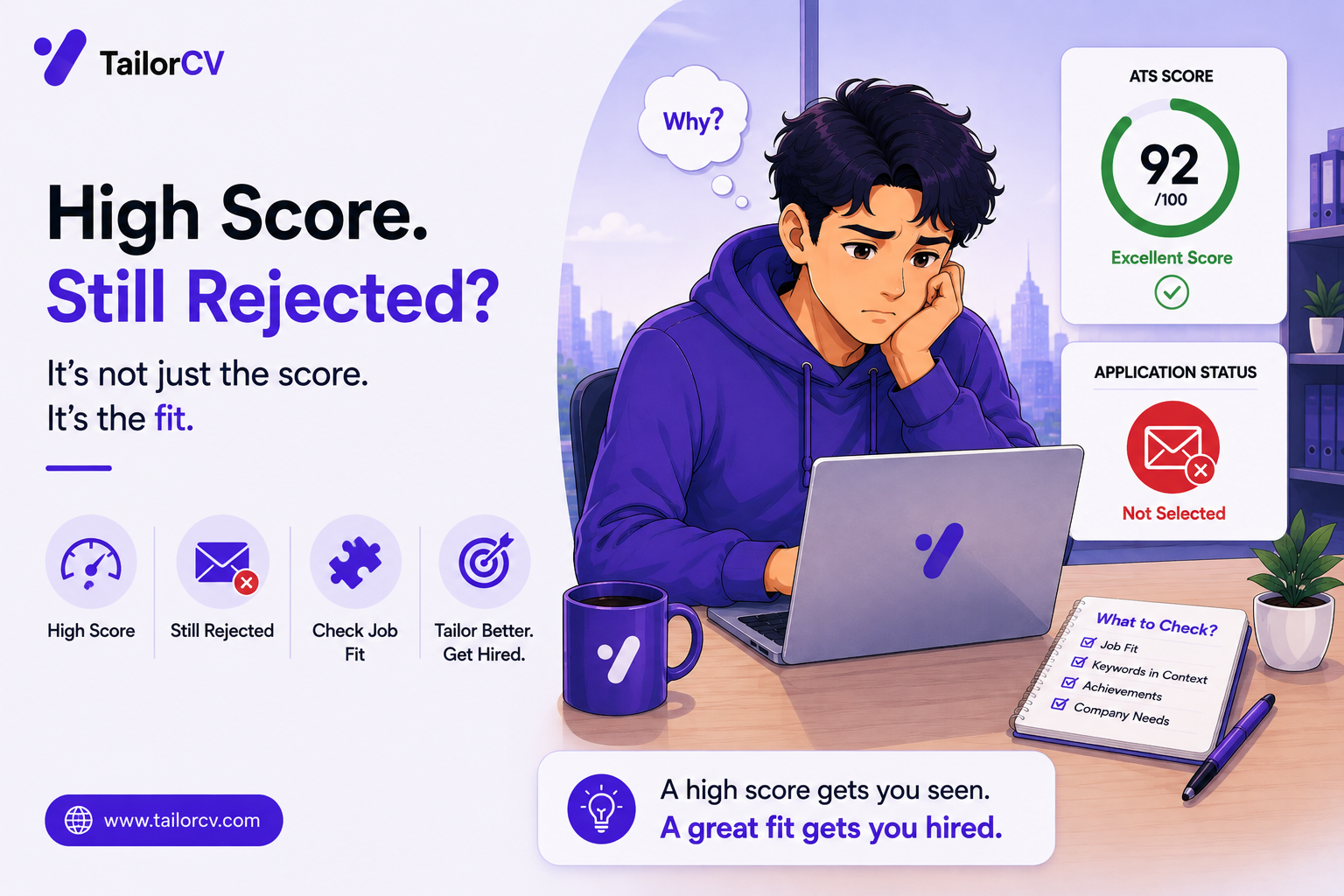
Being qualified and scoring well are two different things - the score measures overlap with a specific job description's language and structure, not your actual competence. See why is my ATS score low for the most common causes beyond a simple keyword gap.
How do I check my ATS score for free?
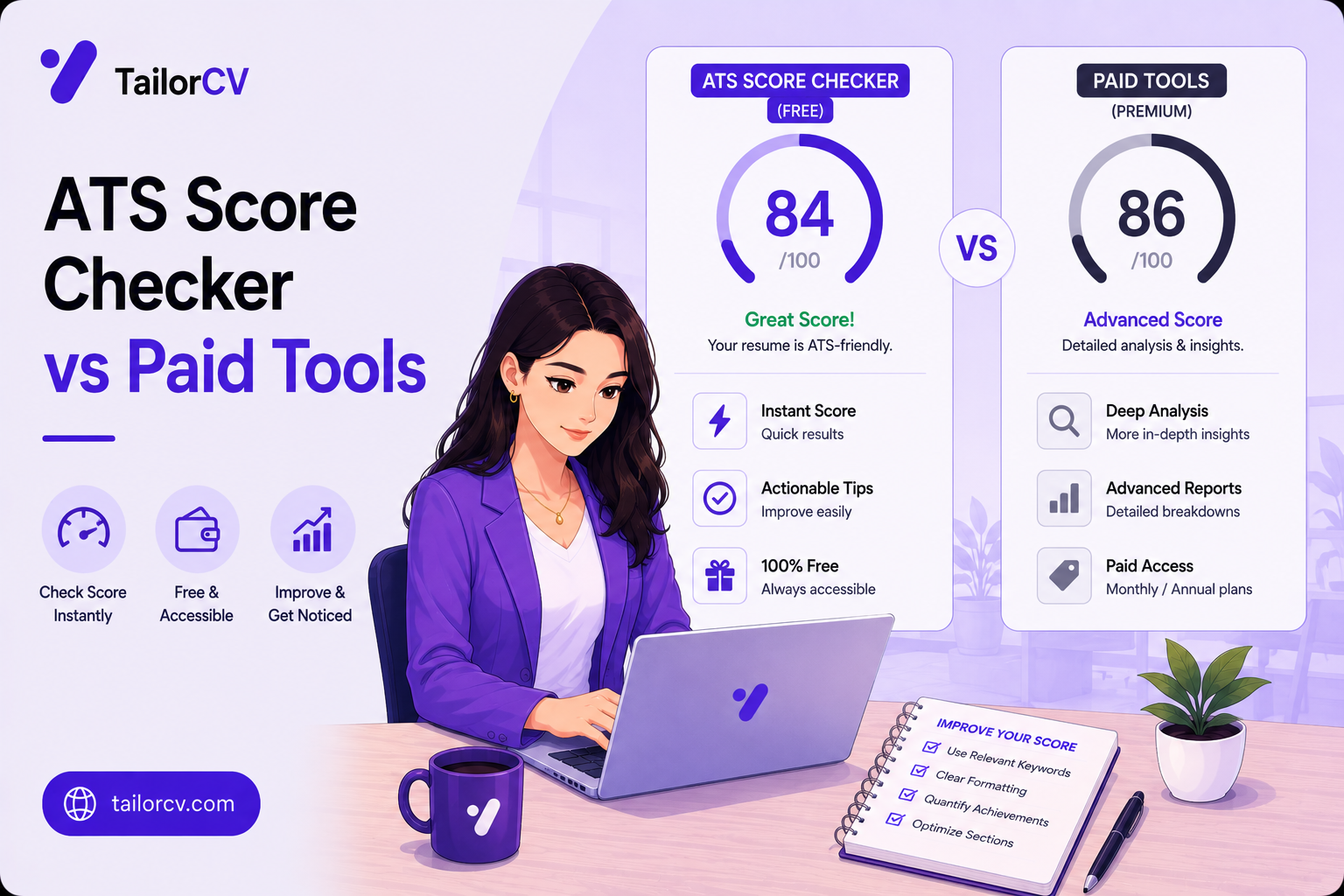
Paste your resume and the job description into TailorCV's free ATS score checker for an instant score, a list of missing keywords, and the specific fixes that would raise it.
Will adding more keywords always raise my score?
Only if the keywords reflect real experience and are worked into your resume naturally. Keyword stuffing can trigger a different penalty and will hurt you once a human reads the resume, so add terms because you have the experience to back them up - see ATS keyword mistakes.
How much should I change my resume for each job?
At minimum, rewrite your summary, reorder your skills, and adjust your most recent role's bullet points to reflect the language of the specific posting. That "top third" tailoring pass carries a disproportionate share of both the ATS score and the recruiter's first impression.
Can a perfectly formatted resume still fail an ATS scan?
Yes. Formatting only controls whether your content gets read correctly - it does not create keyword relevance or quantify your achievements on its own. A clean, parseable resume with no tailoring will still score lower than a clean, parseable, tailored one.
Is a high ATS score the same as a resume that will impress a recruiter?
Not entirely. The score is a proxy for relevance and readability, both of which recruiters also care about, but a recruiter also weighs things a machine cannot see, like career narrative and communication style. Treat the score as a floor to clear, not the entire goal.
Next Step
Run your current resume through the free ATS score checker now, and work through the four fixes above in order before you send out your next application.
What is your resume scoring right now?
Scan it against a job description and get your ATS match score in about a minute.
Drop your resume here or choose a file
PDF only. Max 2 MB.
We never share your data or use it to train AI models.
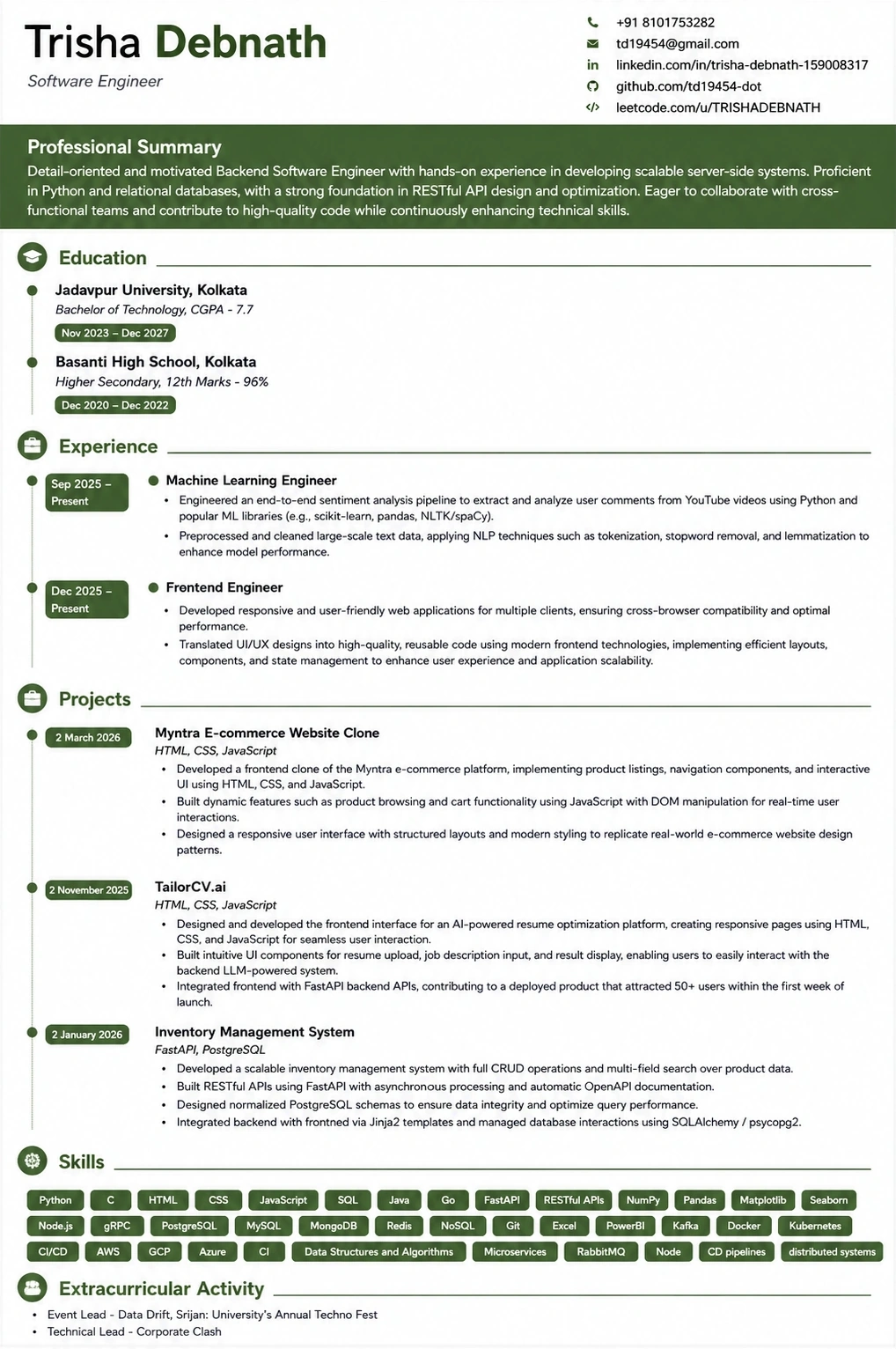
Templates that keep this structure intact
This template is ATS-tested — start from it and the formatting rules in this guide are already handled.
Was this guide useful?
Be the first to rate it.