TD
TD
Key Takeaways
- Teaching is the most accessible professional route into Japan for foreign graduates, generally requiring a bachelor's degree in any subject.
- The main options — government-run placement, private language schools, direct hire and international schools — differ substantially in pay, structure and stability.
- The largest government programme runs on a long annual cycle with applications roughly a year before placement.
- Japanese language ability is usually not required to start, and it matters enormously for daily life and for what comes next.
- Teaching is a good entry point and a limited long-term career unless you move into qualified or international school teaching.
The main routes
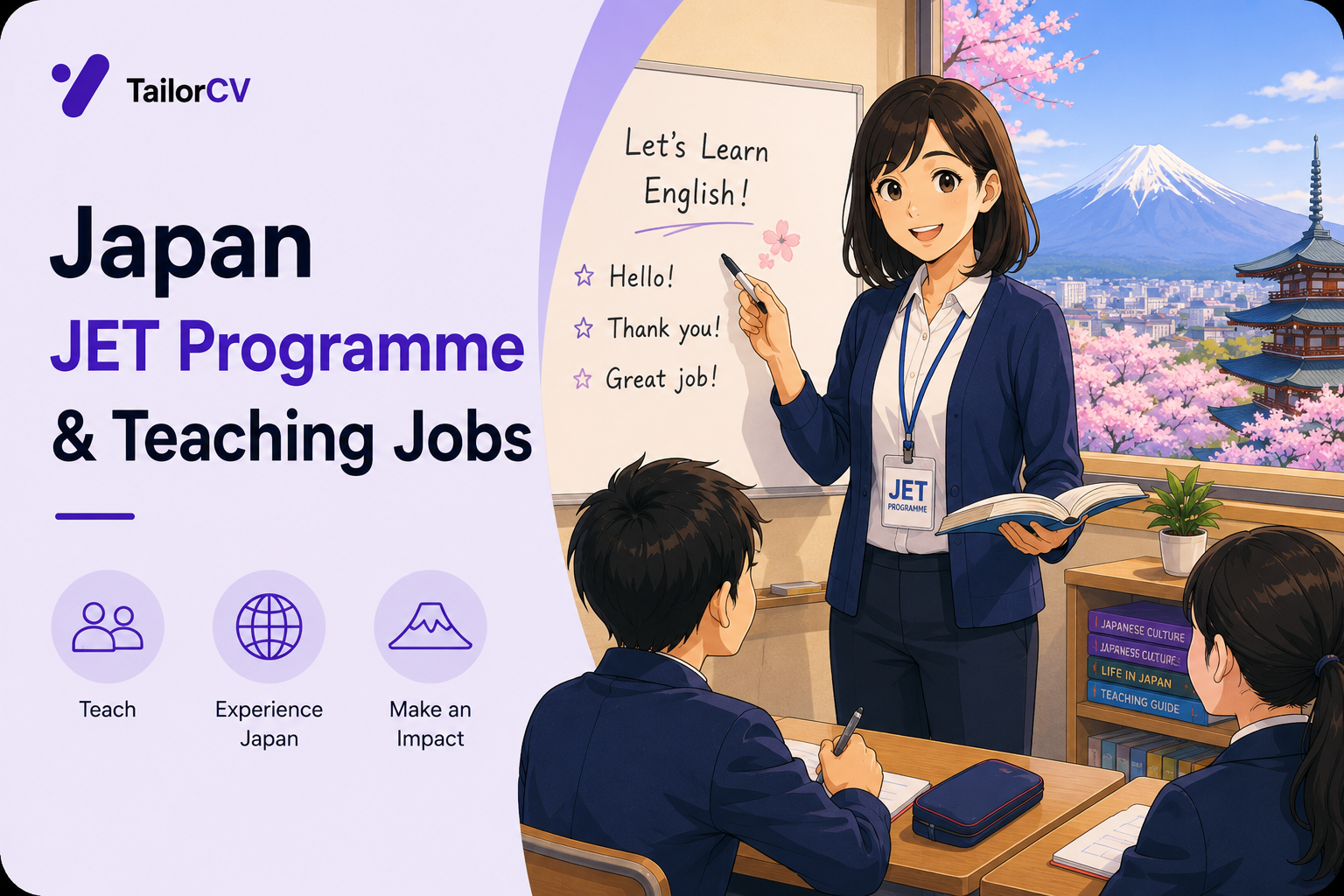
The government-run placement programme — the JET Programme (Japan Exchange and Teaching Programme), jointly run by three Japanese government bodies (MEXT, the Ministry of Foreign Affairs, and CLAIR, the Council of Local Authorities for International Relations). It places foreign graduates as ALTs (Assistant Language Teachers), and in smaller numbers as CIRs (Coordinators for International Relations) and SEAs (Sports Exchange Advisors), in schools and local government offices across Japan, including many rural areas. Structured, with reliable pay, support and a defined contract term (typically one year, renewable up to five). Applications open roughly a year before placement, and the process is long — application, interview, and placement decisions made centrally rather than by you. Placement location is generally not your choice, which is the main trade-off and, for many participants, the most interesting part.
Private language schools — known collectively as eikaiwa (英会話, literally "English conversation") — are commercial conversation schools employing teachers for adult and children's classes. Hiring is year-round, the process is faster, and quality varies enormously between individual eikaiwa chains and branches, so research the specific employer rather than the category. Evening and weekend work is common since students attend outside their own working hours. Pay is generally modest and the work is genuinely teaching-intensive.
Direct hire by schools or boards of education. Working directly rather than through a programme or dispatch company, frequently with better pay and conditions than dispatch arrangements. Harder to find and generally requiring you to already be in Japan with a network.
Dispatch companies. Employing teachers and placing them in schools. Convenient and generally lower paid than direct hire, with the dispatch company taking a margin.
International schools. Teaching a full curriculum to a mostly international student body. Requires a genuine teaching qualification and usually experience, pays substantially more, and is a real career rather than an entry route.
University positions. Language instruction or subject teaching at tertiary level, typically requiring at least a master's degree.
What each is actually like
The government programme offers the most support and the least control. You may be placed anywhere, including a small town with few other foreign residents. Many participants describe this as the most valuable part of the experience; others find the isolation difficult. The support structure, the community of other participants, and the stability are the strongest features.
Language schools offer location choice and less stability. You know where you will live, and the working hours are unsociable and the teaching load can be heavy.
Direct hire and dispatch in schools places you as an assistant alongside a Japanese teacher, which means less autonomy than leading your own classes and a gentler start.
International schools are genuine teaching careers with corresponding requirements, and they are not an entry route for someone without a qualification.
Visa and requirements
A bachelor's degree in any subject is the standard requirement for most teaching routes, which is why this is the most accessible professional route into Japan.
A teaching qualification is generally not required for language teaching, and is required for international schools.
Japanese language ability is usually not required to start. It matters enormously for daily life, particularly in rural placements, and for what you do afterwards — the language requirements guide explains why.
Visa sponsorship is handled by the employer, typically under an instruction-related status or the general working status depending on the role — see the visa guide.
Some programmes have nationality or education-system requirements, particularly the government-run one, so check eligibility before investing in an application.
Where it leads
This is the honest part. Teaching is an excellent way into Japan and a limited long-term career for most people who enter through language instruction.
Common next steps: moving into corporate work using the Japanese acquired during the teaching years, moving into international school teaching with a qualification obtained meanwhile, moving into translation, localisation or content work, or moving into recruitment and business roles serving the foreign community.
Which argues for treating the first year deliberately. People who study Japanese seriously during a teaching placement have substantially more options afterwards than those who do not, and the placement itself provides both time and immersion.
Building a professional network while teaching matters too. The English-conducted market is the most common destination, and it is easier to enter with contacts than cold.
How the JET Programme specifically works
A well-established, government-affiliated programme placing foreign nationals in teaching and, in some positions, international relations roles at schools and local government offices across Japan, this is a structured, genuinely well-organised route with defined application timelines and support structures, distinct from independently arranged teaching positions.
Placements can be in a wide range of locations, including many outside the largest cities, worth being genuinely open to this if you apply, since location assignment is generally not something you can control precisely in advance.
The application process runs on its own annual cycle with defined stages, worth researching current specific timelines and requirements directly, since this is exactly the kind of detail set by the programme's own administration and reviewed periodically.
Independent teaching positions outside this programme
Private language schools, international schools, and other independently arranged teaching positions also exist as a genuine alternative route, requirements and quality vary considerably by specific employer, worth vetting any specific school's legitimacy and sponsorship experience carefully, similar to the same careful vetting that matters in any independent teaching arrangement internationally.
International schools generally offer the most structured working conditions among independent options, often requiring a recognised teaching qualification and sometimes prior classroom experience.
Life beyond the role itself
Placements under structured programmes, particularly in smaller communities, can offer a genuinely rich cultural experience alongside the teaching role itself, worth approaching with genuine openness rather than viewing the specific placement location purely as a limitation.
Build a support network with other participants and local contacts early, particularly valuable if placed somewhere with a smaller international community, this meaningfully smooths the broader adjustment beyond the workplace itself.
Deciding between the structured programme and independent options
Consider your own priorities around structure, support and placement certainty against the flexibility, and generally somewhat less structured support, of independently arranged positions.
The structured programme offers organised application support, defined placement processes and an established community of participants, at the cost of less control over your specific placement location, while independent positions offer more choice over location and specific school, at the cost of needing to vet legitimacy and negotiate terms yourself.
Tip: Apply to JET a full year before you intend to start — the cycle runs roughly 12 months from application to placement. Missing it means waiting an entire year for the next intake.
Common Mistakes
- Applying to the government programme late. Applying to the government programme late the cycle runs roughly a year before placement.
- Assuming you pick your placement. Assuming you choose your location on the government programme. Placement is centrally decided.
- Not researching private employers. Quality varies enormously and reputation is checkable.
- Treating JET as a career. Treating it as a long-term career by default. It is an entry route for most people entering through language instruction.
- Not studying Japanese during the placement. Not studying Japanese during the placement the single biggest determinant of what comes next.
- Confusing international school teaching with language teaching. Different requirements, different careers.
Related Guides
Keep building on this with the related guides in this series:
- English-Speaking Jobs in Japan - Where They Actually Are
- Group Discussions and Aptitude Tests in Japanese Recruiting
- Internships in Japan for International Students
- Japanese Language Requirements for Jobs in Japan
- JLPT N2 and N1 - What They Actually Mean for Employment in Japan
- Shūkatsu - The Japanese Job Hunting Timeline
You can also check your resume's ATS score for free, generate a tailored cover letter, or build a portfolio website in minutes.
Frequently Asked Questions
What is the JET Programme exactly?
A well-established, government-affiliated programme placing foreign nationals in teaching and related roles across Japan, offering structured application timelines and organised support.
Can I choose where I am placed under this programme?
Generally not precisely, placements span a wide range of locations including many outside the largest cities, worth being genuinely open to this when applying.
Are there teaching jobs in Japan outside this programme?
Yes, private language schools and international schools offer independent routes, worth vetting a specific school's legitimacy and sponsorship experience carefully before accepting an offer.
Do I need a teaching qualification?
Requirements vary by programme and employer, international schools generally expect a recognised qualification, other positions vary, worth checking the specific requirement for your target role directly.
Do I need a teaching qualification?
Generally not for language teaching roles, where a bachelor's degree in any subject is the standard requirement. International schools do require a genuine qualification.
Do I need to speak Japanese?
Usually not to be hired for English teaching. It matters considerably for daily life, particularly outside cities, and for your options afterwards.
Can I choose where I live on the government programme?
You can express preferences and placement is centrally decided. Willingness to go anywhere is part of the arrangement.
How does the pay compare?
Government programme pay is reliable and reasonable for a first role. Private language schools are generally modest. International schools pay substantially more and require qualifications.
Can teaching lead to other work in Japan?
Yes, commonly — into corporate roles, translation, recruitment or international school teaching. What determines this most is whether you built language ability and a network during the teaching years.
Is it a good way to decide whether I want to live in Japan?
It is one of the best available, since it is a defined term with support, and it lets you find out before committing to a longer path.
What is your resume scoring right now?
Scan it against a job description and get your ATS match score in about a minute.
Drop your resume here or choose a file
PDF only. Max 2 MB.
We never share your data or use it to train AI models.

Was this guide useful?
Be the first to rate it.