 TD
TD
Key Takeaways
- Being approached does not mean the job is yours. Your resume still goes to a hiring manager who compares you with other candidates, often including applicants who tailored carefully.
- Ask the recruiter for the full job description and what the hiring manager cares about most before you send anything. You have more access than a normal applicant - use it.
- Tailor to the specific role they described, not to your general career. The top third of your resume should answer why they approached you.
- If you are currently employed, keep it discreet: send from personal email, avoid confidential details, and do not update LinkedIn in ways that signal you are looking.
- Include the numbers and scope that justify the approach. Poached candidates are usually being assessed for a step up or a specific capability.
- Your resume shapes the offer too. Clear scope and impact support the level and salary conversation later.
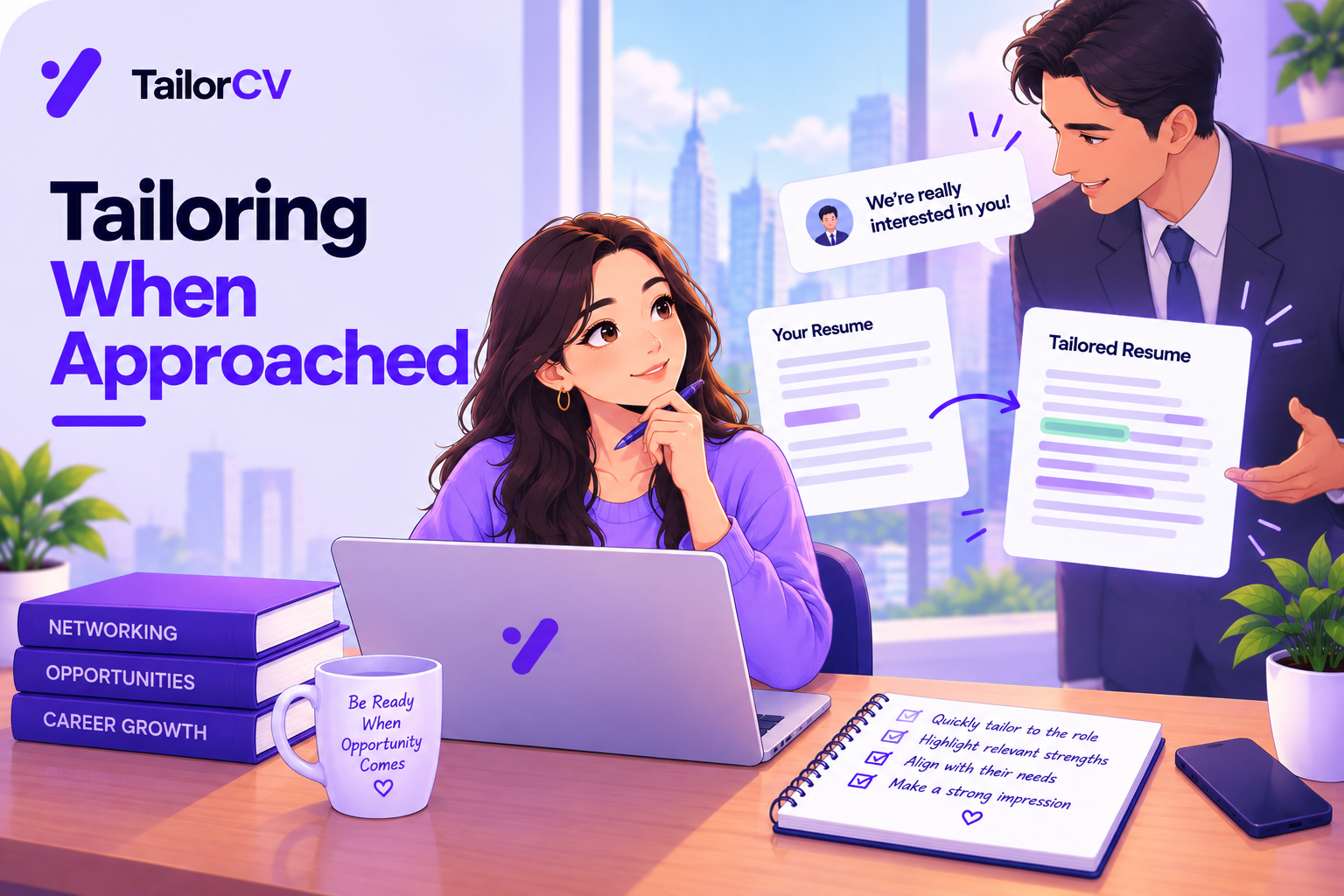
A recruiter messaged you about a role, or someone at another company asked you to "send over your resume". It is tempting to send whatever version you have. Don't. The approach gets you in the door, but your resume still lands on a hiring manager's desk next to other candidates - some of whom applied with carefully tailored documents. Ask for the job description and what matters most, then tailor to that role before you reply.
This guide covers what to ask, what to change, how to stay discreet while employed, and how the resume affects the offer.
Why an Approach Still Needs a Tailored Resume
Being approached feels like being chosen. It is closer to being invited to compete.
Recruiters approach several people
Agency and in-house recruiters typically reach out to a list of potential candidates for each role. Your profile matched a search; so did others. The resume you send is how the hiring manager ranks that list. Resume matching: recruiter vs direct application explains how recruiter submissions are reviewed.
The hiring manager did not see what the recruiter saw
The recruiter may have found you through LinkedIn, a referral or a conference talk. The hiring manager sees only the resume the recruiter forwards, sometimes with a short note. If your resume does not make the match obvious, the recruiter's enthusiasm will not carry it.
Your general resume is tuned for a different job
If your last tailored version was for a role you applied to a year ago, or you are using an old version you never updated, it probably leads with the wrong evidence for this role.
Step 1: Ask Before You Send
An approach gives you something applicants do not have: a person you can ask. Use it.
Questions to ask the recruiter
- "Could you share the full job description?"
- "What does the hiring manager care about most in this role?"
- "What prompted you to reach out to me specifically?"
- "What would make a candidate stand out, and where do most candidates fall short?"
- "What level and team is this, and who does it report to?"
- "What is the compensation range?"
The answer to question 3 tells you what to put in your summary. The answers to 2 and 4 tell you what to lead with. Question 6 tells you whether it is worth pursuing before you invest time.
Reading the recruiter's reason
| What the recruiter says | What to emphasise |
|---|---|
| "Your experience scaling X caught my eye" | Scaling achievements, with numbers |
| "They want someone from [your company/industry]" | Your domain knowledge and context |
| "You've done a similar role at a bigger company" | Scope, process, larger-scale results |
| "They need someone to build the function" | Things you set up from scratch |
| "A referral mentioned you" | Whatever the referrer knows you for |
| "Your profile matched the skills" (generic) | Treat as a normal application; tailor fully |
Step 2: Tailor to the Role They Described
Treat the recruiter's answers as an unusually detailed job description.
Rewrite the summary around why they approached you
General summary: "Product manager with 7 years in B2B SaaS across analytics, billing and platform products."
Tailored after the recruiter's answers: "B2B SaaS product manager who built a usage-based billing system from scratch - now handling ₹60 crore in annual billing - and who led platform migrations across 3 product teams."
The recruiter said the company is moving to usage-based pricing and needs someone who has done it. The first sentence now answers that.
Lead with the evidence the hiring manager cares about
Reorder bullets in your recent roles so the capability behind the approach comes first. Reordering bullets by relevance covers the method.
Show the step up
Poached candidates are often being considered for a role slightly bigger than their current one. Make scope visible: team size, budget, decision authority, cross-team impact. If the approach is for a step up, see tailoring for a stretch role.
Step 3: Keep It Discreet While Employed
If you are currently employed, discretion matters.
Practical discretion checklist
| Do | Avoid |
|---|---|
| Use personal email and phone | Replying from your work email |
| Send a PDF from a personal device | Using work laptops or cloud drives |
| Anonymise sensitive current-employer details | Sharing confidential numbers, clients or roadmaps |
| Ask the recruiter to keep your application confidential | Assuming they will without asking |
| Take calls outside work hours or on breaks | Interviewing from the office |
| Keep LinkedIn stable | Suddenly overhauling your profile or turning on "Open to work" publicly |
What to leave out
Your current employer's unreleased plans, exact financials, customer lists and internal metrics are not yours to share - and a hiring manager who sees them may wonder what you would share about their company. Tailoring when most of your work is confidential shows how to describe work precisely without disclosing protected detail.
A sudden LinkedIn overhaul can signal to your current employer that you are looking. Make updates gradually, or keep your resume more tailored than your profile. Keeping LinkedIn and your tailored resume in sync covers what must match (titles, dates) and what can differ (emphasis).
Step 4: Write for the Offer, Not Just the Interview
Your resume is referenced during levelling and offer discussions, not only screening.
Scope supports level
If your resume clearly shows you managed a team of eight and a ₹5 crore budget, it supports a senior-level offer. If it only lists tasks, the company may level you lower. Make scope explicit in your recent roles.
Impact supports compensation
Strong, specific results strengthen your position when negotiating. A hiring manager arguing for a higher band needs evidence to point at. For the negotiation itself, see the salary negotiation guide.
Worked Example 1: A Senior Engineer Approached by a Scale-Up
Situation: Arvind, a senior backend engineer at a large company, is approached by a recruiter for a staff engineer role at a fast-growing fintech.
What he asks: The recruiter says the company is hitting database scaling limits and needs someone who has sharded a large Postgres setup.
Before (top bullet): "Developed and maintained backend services in Java and Go for the payments platform."
After (top bullets): - "Led the sharding of a 4 TB Postgres cluster across 16 nodes with no downtime, supporting growth from 20M to 60M monthly transactions." - "Defined database scaling standards adopted by 5 teams, including connection pooling and read-replica patterns."
His summary names the scaling work and the step to staff-level scope. He leaves out his current company's internal project names and exact transaction revenue. For more on the step up in scope, see seniority and stretch roles.
Worked Example 2: A Marketer Approached Through a Referral
Situation: Meenakshi's former colleague refers her for a head of brand role, and the hiring manager asks her to send a resume directly.
What she learns: The referrer mentioned her rebrand work; the hiring manager is planning a rebrand next year.
Tailored summary: "Brand leader who led a full rebrand for a 20-year-old consumer brand - new identity, positioning and launch across 1,200 stores - lifting brand preference 8 points in a year."
Because this came through a referral, her resume will be read with more attention - and compared with what the referrer said. Consistency matters. See resume for a referral vs a cold application.
Worked Example 3: A Mid-Level Analyst Approached on LinkedIn
Situation: Karthik gets a generic LinkedIn message from an agency recruiter: "Your profile looks like a great fit for a senior analyst role at a client."
His move: He asks for the job description, the client's industry and the salary range before sending anything. The role turns out to be in insurance analytics - an industry he does not know - with a salary similar to his current one.
He decides it is not worth moving for. Asking first saved him an hour of tailoring and an awkward interview process. When approaches are generic, treat them like any posting and apply your normal filters. Resume for recruiter outreach covers the reverse situation - when you reach out to recruiters.
Worked Example 4: A Fresher Approached After a Hackathon
Situation: Tanmay, a final-year student, won a hackathon sponsored by a startup. A week later, their engineering manager messages him on LinkedIn: "Loved your project - would you be interested in a graduate role? Send over your resume."
His resume is his generic placement version, led by a CGPA line and three course projects. The hackathon is at the bottom under "Achievements".
What he does:
- Asks one question: "Thanks! Could you share what the graduate role focuses on?" The reply: backend work on their payments API.
- Moves the hackathon project to the top of his projects section and describes it technically: "Built a UPI split-payment API in Node.js and PostgreSQL in 36 hours; won first place among 80 teams at the [startup] hackathon."
- Leads his skills line with Node.js, PostgreSQL and REST APIs.
- Adds a GitHub link to the project repository with a short README.
The manager approached him because of the hackathon, so the resume now opens with it. For fresher project framing, see fresher resume projects that get interviews.
Timing and the Note You Send With It
Reply quickly, send carefully
Acknowledge the approach within a day, even if you need longer to tailor: "Thanks - this sounds interesting. Could you share the full JD and a bit about what the hiring manager is looking for? I'll send a tailored resume by Thursday." That buys you time without seeming uninterested. Recruiters working several candidates move on from slow responders, so a quick acknowledgement matters more than an instant resume.
Write a short cover note
The message you send with your resume is often forwarded to the hiring manager along with it. Three or four sentences are enough:
"Thanks for thinking of me. I've attached a resume focused on the billing and platform work you mentioned - the usage-based billing system I built now handles about ₹60 crore a year, which seems close to what the team is planning. I'm happy with my current role, so I'd want to understand the scope and team before going further. I'm free for a call Tuesday or Wednesday evening."
It connects your evidence to their need, signals you are selective, and proposes a next step. The structure is similar to the one in how to write a cold email to a recruiter, just in reverse.
Prepare your own questions
An approach is a two-way evaluation. Have questions ready about the team, the problem and why the role is open - questions to ask in an interview has a good set. If the recruiter goes quiet after your first conversation, what to do when a recruiter goes silent covers the follow-up. And if the approach came through your network, networking messages for referrals covers how to thank and update the person who mentioned you.
Approaches From Headhunters vs Agency Recruiters vs Direct Company Contacts
| Who approached you | Typical situation | What to prioritise |
|---|---|---|
| Executive search / headhunter | Senior roles, retained search, short list | Scope, leadership, strategic results; a polished two-page resume |
| Agency recruiter | Mid-level, contingency, several candidates | Clear match to the JD; quick turnaround |
| In-house recruiter | Company sourcing directly | Their JD's top requirements; company-specific tailoring |
| Hiring manager or peer | Informal, often via network | The capability they already associate with you |
Headhunters often prepare a candidate profile from your resume for the client, so clarity and structure matter even more. They also tend to read the top half first and move on quickly.
At Each Career Stage
| Stage | Typical approach | What to prioritise |
|---|---|---|
| Fresher | Engineering manager after a hackathon, competition or project | The project that caught their eye, with technical detail |
| Early career | Agency or in-house recruiter via LinkedIn | Clear match to the JD; quick turnaround |
| Mid-career | Recruiter or former colleague for a step-up role | Scope, results and the capability behind the approach |
| Senior / executive | Executive search firm on retainer | Leadership, strategic results, a polished two-page resume |
Freshers: approaches are rare, so move fast
An approach at graduate level usually comes from one specific thing you did. Put that thing first and reply quickly.
Senior candidates: the resume becomes a briefing document
At executive levels, search consultants often turn your resume into a client briefing. Clear structure, scope and a crisp summary make their job easier - and present you better.
Edge Cases and Exceptions
The approach is for a role you already applied to
If a recruiter approaches you about a role you applied to directly, tell them. Duplicate submissions can cause ownership disputes between agencies and companies.
Two recruiters approach you for the same role
Only let one submit you. Ask each which company it is before agreeing, and choose the recruiter with the clearest relationship to the hiring manager.
The approach comes from a competitor of your employer
Be extra careful with confidential information and consider any non-compete or non-solicitation terms in your contract before proceeding.
You are not looking but the role is interesting
It is fine to explore. Say so openly - "I'm happy where I am, but I'd like to learn more" - and tailor your resume as seriously as if you were looking.
Common Mistakes
Sending an old, untailored resume
The most common mistake. An approach is not a guarantee, and a generic resume can lose to tailored applicants.
Sending without asking any questions
You lose your biggest advantage - direct access to someone who knows what the hiring manager wants.
Oversharing current-employer information
Confidential details make you look risky. Describe your work precisely without disclosing protected information.
Assuming you do not need to sell yourself
Some candidates treat an approach as "they came to me" and send a flat, modest resume. The hiring manager still needs a reason to choose you.
Inconsistency with what the referrer or recruiter said
If the recruiter pitched you as a scaling expert and your resume does not mention scaling, the hiring manager notices the gap.
How This Comes Up in Interviews
Approached candidates face a slightly different first conversation: the company is partly selling to you, but still assessing you.
| Question | Why they ask | Strong answer |
|---|---|---|
| "What made you open to talking?" | They want to know if you are serious | A specific reason the role interests you |
| "What would make you move?" | Gauging what it would take | Honest priorities: scope, team, problem, compensation |
| "Are you talking to other companies?" | Assessing competition and timing | Honest but brief |
| "What do you know about us?" | Checking genuine interest | Specific details from your research |
Being approached does not excuse weak preparation. Research the company as thoroughly as for any application, and prepare stories that match the capability they approached you for. The interview prep tool can generate questions from the job description the recruiter shared.
How This Fits With Tailoring
Tailoring after an approach is the same process with better inputs:
- Ask for the JD, the hiring manager's priorities and why they approached you.
- Decide whether the role is worth pursuing.
- Rewrite your summary around the reason for the approach.
- Reorder bullets so the relevant capability leads.
- Make scope and results explicit for levelling.
- Remove confidential current-employer detail.
The free ATS scan checks your tailored version against the JD the recruiter shared in about a minute; many agencies and companies still run submissions through an ATS. The AI resume optimizer can rework your bullets toward that JD without adding anything you have not done. Before the first call, the interview prep tool can generate likely questions from the JD and your resume.
Quick Checklist
- Have you asked for the full job description and what matters most?
- Do you know why they approached you specifically?
- Is the role worth pursuing (level, scope, compensation)?
- Does your summary's first sentence answer the reason for the approach?
- Is the matching evidence at the top of your recent role?
- Have you removed confidential current-employer details?
- Are you sending from personal email, with a short cover note?
Frequently Asked Questions
Should I tailor my resume if a recruiter approached me?
Yes. The recruiter may have approached several people, and the hiring manager compares everyone's resumes. Tailoring to the specific role - especially using what the recruiter tells you - improves your chances.
What should I ask a recruiter before sending my resume?
Ask for the full job description, what the hiring manager cares about most, why they reached out to you, the level and reporting line, and the compensation range.
How do I keep my job search confidential while employed?
Use personal email and devices, avoid sharing confidential employer information, ask the recruiter to keep your application confidential, take calls outside work, and avoid sudden public LinkedIn changes.
Can a headhunter share my resume without permission?
Reputable recruiters should ask before submitting you to a specific company. Ask them to confirm each submission with you, so your resume does not reach a company twice or somewhere you would not want it.
Does being headhunted mean I will get the job?
No. It means your profile matched a search or a referral. You still compete with other candidates, so a strong, tailored resume and good interviews still decide the outcome.
Should my resume be different for a headhunter?
Executive search firms value clear scope, leadership and strategic results, presented concisely. The tailoring principles are the same, but the emphasis is usually more senior.
How does my resume affect a job offer?
Your resume is used in levelling and compensation discussions. Clear scope - team size, budget, decision authority - and specific results support a higher level and stronger offer.
What if the recruiter's message is generic?
Treat it like any job posting. Ask for details, decide whether it is worth pursuing, and tailor fully if you proceed.
Should I update my LinkedIn when a recruiter approaches me?
Keep changes small and gradual if you are employed. Your tailored resume can carry the detail; a sudden LinkedIn overhaul can signal to your employer that you are looking.
Is it rude to ask a recruiter about salary before sending my resume?
No. Asking about the compensation range early is normal and saves both sides time if the role is not a fit.
What to Do Now
Before replying to the recruiter, send them the questions above. When you have the job description and the reason they approached you, rewrite your summary's first sentence around that reason and move the matching evidence to the top of your recent role.
Remove confidential details, make scope explicit, and send from a personal account. Next, read confidential work on your resume and what to change when tailoring for the full edit sequence.
See what tailoring is worth on your resume
Score your current resume against a real job description before you change a word.
Drop your resume here or choose a file
PDF only. Max 2 MB.
We never share your data or use it to train AI models.

Start from a template that tailors well
Clean structure means swapping keywords per job takes minutes, not a re-layout every time.
Was this guide useful?
Be the first to rate it.