TD
TD
Key Takeaways
- Moving back to an individual contributor (IC) role is common and increasingly accepted. The resume problem is not the move itself - it is that a management resume leads with the wrong evidence.
- Lead with hands-on work: what you built, analysed, designed or delivered yourself, including during your management years.
- Prove your skills are current. Hiring managers' main worry is that you have been away from the craft - show recent hands-on work, tools and projects.
- Reframe management experience as IC strength: technical direction, mentoring, cross-team influence and business context make senior ICs more effective.
- Keep your management titles accurate. Do not hide them; explain the move briefly and positively in your summary.
- Address level and compensation expectations early. A senior IC role can match or exceed a first-line manager's level, so frame it as a lateral or upward move.
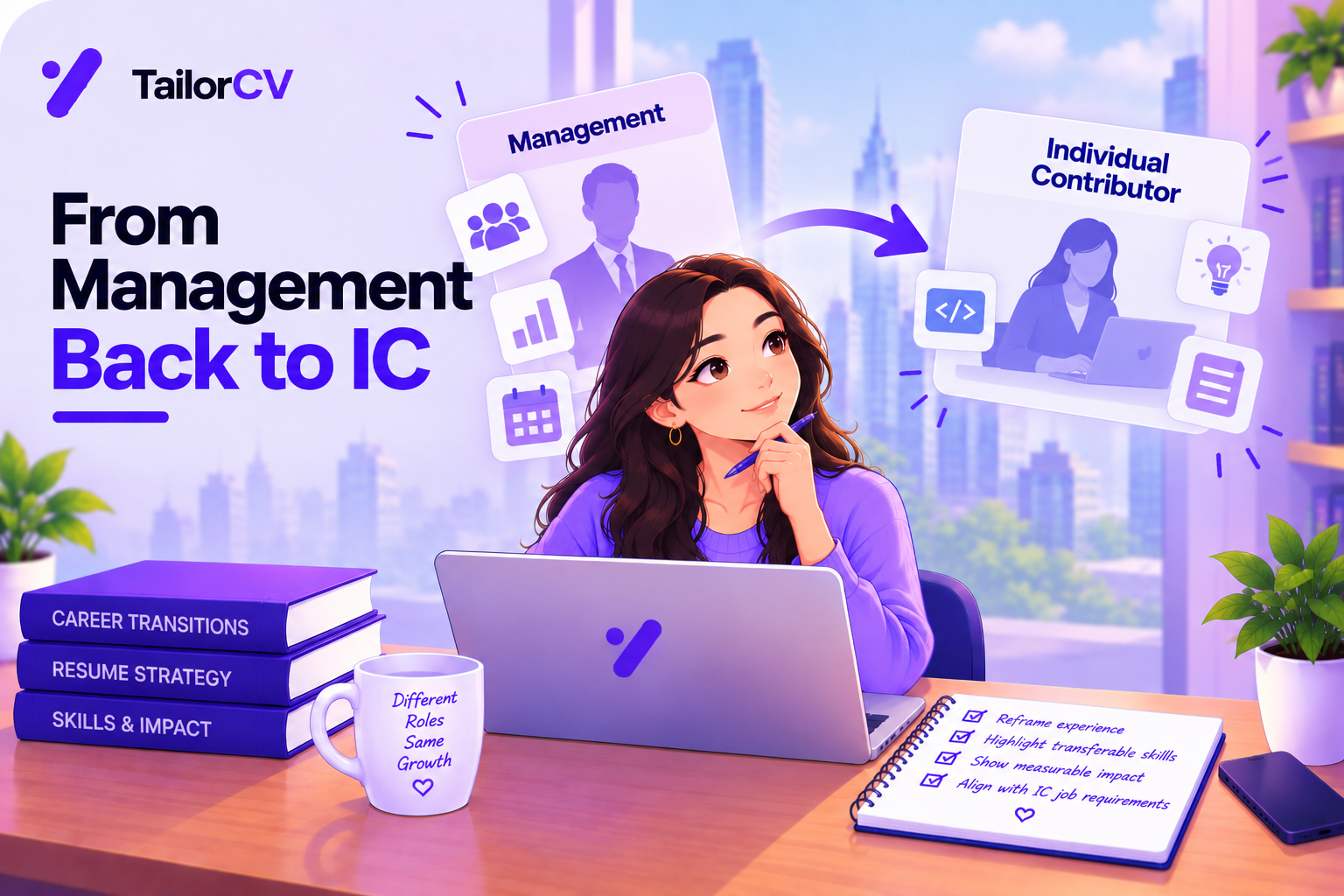
You have been a manager for a few years and want to go back to hands-on work - engineering, design, analysis, writing, research. It is a common and often wise move, but your resume is probably built for the job you are leaving: team size, hiring, planning, stakeholder management. For IC roles, lead with hands-on depth, prove your skills are current, and present your management years as the thing that makes you a stronger senior IC.
This guide covers how to restructure your resume, how to handle the title question, and how to answer "why go back?"
What IC Hiring Managers Worry About
When a hiring manager sees a manager applying for an IC role, three questions come up. Your resume should answer each before it is asked.
| Worry | What they are thinking | How your resume answers it |
|---|---|---|
| Rusty skills | "Have they done the actual work recently?" | Recent hands-on bullets, current tools, recent projects |
| Commitment | "Will they want to manage again in six months?" | A clear, positive reason in the summary |
| Fit with the team | "Will they second-guess the manager or dominate the team?" | Collaboration and mentoring framed as supporting, not directing |
The first worry is by far the most important. Address it with evidence, not assurances.
Step 1: Lead With Hands-On Work
Your most recent role probably has management bullets at the top. Flip the order.
Find the hands-on work in your management years
Most first-line managers kept some hands-on work: code reviews, architecture decisions, analysis for leadership, design critiques, writing key documents, filling in during crunches. List it.
- What did you still build, write, analyse or design yourself?
- Which technical or craft decisions did you make directly?
- What did you review in depth - code, designs, models, drafts?
- What problems did you personally solve when the team was stuck?
Before and after: an engineering manager
Before (management-first): - "Managed a team of 8 engineers across 2 squads; ran hiring, performance reviews and quarterly planning." - "Grew the team from 4 to 8 engineers." - "Partnered with product on the roadmap."
After (IC-first): - "Designed the event-driven architecture for the order platform (Kafka, Go) and wrote the core routing service, handling about 15,000 orders an hour." - "Reviewed all production changes to the payments path and led incident response for the two largest outages, cutting mean time to recovery from 90 to 25 minutes." - "Managed a team of 8 engineers across 2 squads, including hiring 4 and setting technical standards."
The management bullet is still there - accurate and honest - but it no longer leads.
Step 2: Prove Your Skills Are Current
The "rusty skills" worry is strongest if you have managed for more than two or three years.
Evidence that counts
| Evidence | Example |
|---|---|
| Recent hands-on work at your job | "Wrote the migration tooling for our Postgres upgrade (2026)" |
| Side projects | "Built an open-source CLI for log analysis in Rust - 300 GitHub stars" |
| Recent courses with real output | "Completed a distributed systems course; built a Raft implementation as the final project" |
| Contributions and writing | "Published 4 technical articles on event sourcing" |
| Certifications that test skills | Only if they include hands-on assessment |
Put the most recent, most substantial evidence near the top - in your summary or first bullets. For side projects, see side projects on your resume, and for proving a skill without formal credentials, how to prove skills without certificates.
Update your skills section
Your skills list may still reflect what you used before managing. Update it to current tools and versions, and put the ones the posting names first. Resume skills section order covers grouping.
Step 3: Reframe Management as an IC Advantage
Your management years are not a gap - they are experience most ICs do not have. Frame them as making you a better senior contributor.
| Management experience | IC-relevant framing |
|---|---|
| Setting team priorities | "Understands how technical choices connect to business goals" |
| Running hiring | "Raises the bar in interviews; helps grow the team" |
| Mentoring and 1:1s | "Mentors engineers informally; accelerates onboarding" |
| Cross-team planning | "Drives alignment on technical decisions across teams" |
| Handling incidents and escalations | "Stays calm and effective in high-stakes situations" |
Staff, principal and lead IC roles in particular value these skills - influence without authority is central to them. The post on team vs individual credit helps separate what you did personally from what your team delivered.
Step 4: Handle the Title and the Explanation
Keep your titles accurate
Do not change "Engineering Manager" to "Lead Engineer" to hide the management years. Titles are verified, and hiding them looks worse than explaining them. Show the title honestly and let the bullets lead with hands-on work.
Explain the move in one line
Your summary should say what you want and why, positively.
Summary: "Backend engineer with 9 years of experience, including 3 managing an 8-person platform team. I'm returning to hands-on engineering because building systems is the work I enjoy most - and I stayed close to it, designing our order platform's architecture and writing its core routing service."
It states the move, frames it as a choice toward something, and immediately provides evidence of current skills. For summary structure, see summary in three sentences.
Language to avoid
"Stepping down", "demoted", "burned out on management" and "didn't enjoy managing people" all frame the move negatively. Say what you are moving toward, not what you are leaving.
Step 5: Target the Right Level
A move back to IC does not have to be a step down.
| Your management level | Natural IC target | Why |
|---|---|---|
| First-line manager (team of 3-8) | Senior or staff IC | Similar level at many companies |
| Manager of managers | Staff or principal IC | Scope and influence carry over |
| Director | Principal / distinguished IC, or architect roles | Rare, but exists at larger companies |
| Manager at a small startup | Senior IC at a larger company | Titles at small companies often inflate |
Check how the target company levels IC and manager roles; at many tech companies, senior and staff IC roles match or exceed first-line manager levels. If compensation is a concern, research the band before applying rather than tailoring for a role that pays much less. Tailoring for a stretch role covers applying at the upper edge of your evidence.
Worked Example 1: An Engineering Manager Returning to Senior Engineer
Situation: Farhan managed a 6-person backend team for three years and wants a senior backend engineer role.
Hands-on work he found: designed the team's caching layer, wrote the load-testing framework, handled on-call escalations, reviewed all database migrations.
- "Designed and built the Redis caching layer for the catalogue service, cutting p95 latency from 800ms to 120ms."
- "Wrote the team's load-testing framework in Go; used before every major release."
- "Managed a 6-person backend team for 3 years, hiring 3 engineers and mentoring 2 to senior."
His side project - a small open-source rate limiter written in 2026 - goes into a "Selected projects" section. His summary explains the move and cites the caching work.
Worked Example 2: A Design Manager Returning to Senior Product Designer
Situation: Leela managed a four-person design team and wants to go back to hands-on product design.
Before: "Led design team of 4; established design processes and partnered with PMs across 3 product areas."
After: - "Personally designed the onboarding redesign end to end - research with 20 users, prototypes and final UI - lifting activation from 28% to 36%." - "Created and maintain the component library used by 4 designers and 15 engineers." - "Managed a team of 4 designers, introducing weekly critiques and a research repository."
Her portfolio is updated to show hands-on work from her management years, not just team output. For matching the portfolio to postings, see matching your portfolio to the job description.
Worked Example 3: An Analytics Manager Returning to Senior Analyst
Situation: Deepak managed a small analytics team for two years at a startup that downsized. He now wants senior analyst roles.
Challenge: His SQL and Python work in the last year was limited.
Approach: He spends two weekends on a public-data analysis project (city transport ridership, 5 million rows in Python and SQL) and publishes it with a short write-up. His resume leads with his most technical recent work at the startup - building the company's revenue attribution model - then the new project, then his management bullets.
"Built the company's revenue attribution model in SQL and Python, used to allocate a ₹4 crore marketing budget."
The recent project addresses the "rusty" worry directly. His summary: "Senior analyst returning to hands-on work after two years leading a 3-person analytics team - most recently built our revenue attribution model."
Worked Example 4: A Sales Manager Returning to Enterprise Sales
Situation: Vivek managed a team of six account executives for three years. He misses selling directly and wants a senior enterprise account executive role - which pays well through commission.
The worry he must address: a hiring manager may think he could not handle management, or that he has lost his selling edge.
Management-first bullets: - "Managed a team of 6 AEs; team hit 104% of target in FY25." - "Hired 4 AEs and ran weekly pipeline reviews."
IC-first bullets: - "Personally closed the team's 3 largest deals in FY25 (combined ₹4.2 crore) while managing, including a 14-month enterprise cycle with a listed manufacturer." - "Built the discovery-call framework the team used on every enterprise opportunity." - "Managed a team of 6 AEs to 104% of target, hiring 4."
His summary: "Enterprise seller who spent three years leading a 6-person sales team - and kept closing the biggest deals myself. Returning to a senior AE role to focus on complex enterprise sales." The deals he closed personally answer the "lost his edge" worry directly.
Let the Cover Letter Carry the Story
The resume has room for one line of explanation. The cover letter has room for the full reason - and it is where a hiring manager decides whether your move is deliberate or a retreat.
A three-part paragraph that works
- The pull: what you enjoy about hands-on work, in specific terms.
- The evidence: the hands-on work you kept doing while managing, and anything recent.
- The advantage: how your management years will help this team - mentoring, context, calm in incidents.
"Over three years managing the platform team, the work I looked forward to most was the architecture reviews and the incidents I helped debug. I kept my hands in - I designed our order platform's routing service and wrote its core. I'm applying for this senior role because I want that to be my whole job, and I'd bring what managing taught me about planning and mentoring to the team."
The structure is similar to a career-change letter; cover letter for a career change covers it in more depth. The cover letter generator can draft one from the posting that you then edit into your own voice.
Edge Cases and Exceptions
You were moved out of management involuntarily
If a reorganisation removed your management role, you can still frame the move positively and honestly: "After the reorganisation, I chose to stay hands-on, which is where I do my best work."
You managed for a long time (8+ years)
After many years of management, the "rusty skills" worry is strongest. Recent, substantial hands-on evidence - projects, contributions, courses with real output - is essential.
The IC role reports to someone junior to your old level
This is common and usually fine. Show in interviews that you can support a manager's decisions without taking over.
You might want to manage again later
Say so honestly if asked, framed as a long-term possibility after building depth. Most companies value managers who have returned to IC work.
Common Mistakes
Leaving the management-first structure
If your top bullets are about headcount, planning and hiring, IC hiring managers read you as a manager. Flip the order.
Hiding or altering management titles
Titles are verified. Keep them accurate and explain the move instead. Tailoring without lying covers why.
No evidence of recent hands-on work
Assurances like "still very hands-on" carry little weight. Specific recent work, projects or contributions do.
Negative framing
"I didn't like managing" makes interviewers worry about attitude. Describe what you are moving toward.
Overselling management as the main strength
Management experience is a bonus for IC roles, not the headline. Keep it to one or two bullets per role.
What IC Interviews Will Test
Expect a thorough technical or craft assessment - often more thorough than for other candidates, because of the "rusty" worry - plus the question "why go back?"
| Question | Strong answer ingredients |
|---|---|
| "Why move back to an IC role?" | A positive pull toward the craft, with evidence you stayed close to it |
| "Will you want to manage again?" | Honest; if you might someday, say you want to build depth first |
| "How will you work with a manager who may be less experienced than you?" | Supportive framing, examples of backing others' decisions |
| Technical / craft exercise | Recent practice - prepare as seriously as a new candidate |
The technical interview preparation guide and the mock interview tool help you prepare, and the interview story bank method keeps your hands-on stories ready.
How This Fits With Tailoring
Build an IC-focused base resume first, then tailor per posting:
- Flip each recent role to hands-on first.
- Add recent evidence of current skills.
- Update skills to current tools.
- Rewrite the summary to explain the move positively.
- Tailor each application to the posting's technical priorities.
If you are applying to both management and IC roles, keep two bases; see splitting resume versions. The free ATS scan checks that your IC version covers the posting's technical terms, in about a minute, and the AI resume optimizer can reorder and reword your bullets toward an IC posting without inventing hands-on work you did not do. For the reverse move, see first management role resume.
Quick Checklist
- Does each recent role lead with hands-on work?
- Is there recent evidence your skills are current (work, projects, contributions)?
- Is your skills section updated to current tools?
- Are management titles kept accurate, with one or two management bullets below?
- Does your summary explain the move positively in one line?
- Have you checked the target company's IC levels and pay bands?
- Are you preparing for a thorough technical or craft assessment?
Frequently Asked Questions
Is it bad to go from manager back to individual contributor?
No. It is a common and increasingly respected move, especially in technical and creative fields. The key is presenting it as a deliberate choice and showing your hands-on skills are current.
How do I explain going back to IC on my resume?
Use one line in your summary that says what you want and why, positively - for example, that building systems is the work you enjoy most - followed by evidence that you stayed hands-on.
Should I remove my manager title from my resume?
No. Keep titles accurate; they are verified in reference checks. Lead each role with hands-on bullets and keep one or two management bullets below them.
How do I show my skills are still current after managing?
List recent hands-on work at your job, side projects, recent courses with real output, and publications or contributions. Update your skills section to current tools.
Will I have to take a pay cut going back to IC?
Not necessarily. At many companies, senior and staff IC roles match or exceed first-line manager levels. Research the target company's bands and aim for the IC level that matches your experience.
What IC level should a former manager apply for?
Often senior or staff for former first-line managers, and staff or principal for managers of managers, depending on how much hands-on depth you kept and how the company levels roles.
How do I answer "why go back to IC" in an interview?
Describe the pull toward the craft, give evidence you stayed close to it, and be honest about whether you might manage again later. Avoid criticising management or your previous company.
Does management experience help in an IC role?
Yes. Understanding priorities, mentoring, running hiring and influencing across teams make senior ICs more effective. Present these as supporting strengths, not your headline.
Will companies think I failed as a manager?
Some may wonder, which is why a positive, specific reason and evidence of recent hands-on work matter. Many companies actively value former managers in senior IC roles.
Should I mention I was a manager in my summary?
Yes, briefly. Hiding it would look odd once they see your titles. Mention it and immediately connect it to why you are returning to hands-on work.
How long can I manage before going back to IC becomes hard?
It gets harder the longer you are fully hands-off, but there is no fixed limit. What matters is recent hands-on evidence - many people return after five or more years with current projects to show.
Should my portfolio or GitHub show recent work?
Yes. Recent commits, designs or analyses are the most direct proof that your skills are current, and interviewers for former managers often look for them.
What to Do Now
List every piece of hands-on work you did during your management years. Rewrite each recent role so those bullets lead, with one or two accurate management bullets underneath. Add your most recent evidence of current skills and update your skills section.
Then rewrite your summary to explain the move positively, and check the target company's IC levels. Next, read first management role resume for the opposite direction, and what counts as relevant experience for deciding which older IC work to bring back.
What is your resume scoring right now?
Scan it against a job description and get your ATS match score in about a minute.
Drop your resume here or choose a file
PDF only. Max 2 MB.
We never share your data or use it to train AI models.

Templates that keep this structure intact
This template is ATS-tested — start from it and the formatting rules in this guide are already handled.
Was this guide useful?
Be the first to rate it.