 SS
SS
Key Takeaways
- Inbound contact puts you in a stronger position than applying, and it is worth using.
- Reply even when uninterested, briefly, because the relationship has future value.
- Ask questions before sending anything, particularly about salary and the role's reality.
- Your resume still needs tailoring once you know what the role actually is.
- Agency and in-house recruiters differ, and knowing which you are speaking to changes the conversation.
Why the position is stronger
What inbound contact changes.
They approached you, which means you begin from interest rather than from having to establish it.
You have not committed anything, so you can ask questions that would be awkward as an applicant.
Salary can be raised early and legitimately, since you did not seek this conversation and your time has a cost.
You are not competing in a pile. A sourced candidate is frequently the only one being discussed at that moment.
And you can decline freely, which is itself leverage, because the cost of walking away is genuinely low for you.
None of this means the role is good. Recruiters contact many people, and the message says more about their search than about your fit.
What to ask before anything else
The questions that save time.
| Question | Why it matters |
|---|---|
| What is the salary range? | Ends the conversation early if misaligned |
| Is this a specific role or general interest? | Distinguishes a live opening from list-building |
| Are you in-house or agency? | Changes who they represent |
| Why did you contact me specifically? | Reveals how they read your profile |
| What is the process and timeline? | Tells you how serious it is |
| Why is the role open? | The single most informative question available |
Ask about salary first. You did not seek this conversation, so establishing whether it is worth having is entirely reasonable and rarely resented.
Distinguish a real opening from list-building. Agency recruiters frequently make contact to build a pipeline rather than to fill a live role, which is worth knowing before you invest time.
And ask why the role is open. Growth, a promotion, a departure and a replacement are all different answers, and a straightforward one tells you a great deal.
Agency versus in-house
Two different conversations that look identical at first.
In-house recruiters work for the employer and are filling their own roles, which means their information is direct and their timeline is real.
Agency recruiters work for a client, sometimes several at once, and are paid on placement, which shapes what they emphasise.
Neither is better, but the difference matters. An agency recruiter may be unable to name the client initially, may be working a role speculatively, or may put you forward for positions you did not discuss.
Ask before your details go anywhere. Give explicit permission for each submission rather than a general one, because being submitted to a company you had already applied to directly creates a genuine problem.
Ask which companies they work with, since an agency specialising in your field is a relationship worth keeping.
And be wary of pressure. Urgency about deciding quickly serves the recruiter's incentive more often than yours, and a good opportunity survives a day of consideration.
Protecting yourself while employed
The practical precautions.
Use personal contact details, never your work email or phone, for anything related to a search.
Ask for discretion explicitly and confirm your details will not be circulated without permission.
Do not name your employer's confidential information in any conversation, however casual it feels.
Be careful with public signals. Profile changes are visible, and a sudden flurry of them is noticed by colleagues.
Schedule calls outside working hours or during genuine breaks rather than from your desk.
Keep your current role's performance steady, since a visible drop while interviewing is both noticed and damaging if the move does not happen.
And assume nothing is fully private in a small industry, where people move between companies and conversations travel further than expected.
Mini checklist
- unchecked: Reply sent within a few days
- unchecked: Salary range established before further steps
- unchecked: Role confirmed as live rather than speculative
- unchecked: Recruiter type identified as in-house or agency
- unchecked: Reason the role is open asked
- unchecked: Resume tailored once the role is understood
- unchecked: Current employer confidentiality respected
- unchecked: Relationship kept warm even when declining
Scenarios
Scenario 1: The role is not for you
Reply briefly, decline clearly and say what you would be interested in. Recruiters keep notes, and a clear no with a stated preference frequently produces a better approach later.
Scenario 2: The message is generic and clearly mass-sent
Ask one specific question about the role. A recruiter with a real opening answers it; one building a list usually does not, and that tells you what you needed to know.
Scenario 3: You are interested but employed
Say so and ask for discretion. Recruiters handle this constantly, and specifying how and when you can be contacted is normal and expected.
Tip: Do not send your resume in the first reply. Ask about the role and the range first, then tailor the resume to what you learn. Sending a generic document immediately gives away the main advantage of being approached.
Do's and Don'ts
Do
- Reply even when declining
- Ask about salary early
- Establish whether the role is live
- Tailor your resume after learning the details
- Ask why the role is open
- Keep the relationship for later
Don't
- Ignore messages entirely
- Send a generic resume immediately
- Assume inbound contact means a strong fit
- Give notice of your search to your employer
- Accept vague answers about the role
- Burn the contact when declining
Common Mistakes
- Not replying. It closes a channel with future value.
- Sending the resume first. It wastes the position you were given.
- Skipping the salary question. It is the fastest filter available.
- Assuming a live role. Much outreach is pipeline building.
- Declining rudely. Recruiters keep notes and move companies.
- Overestimating the signal. Contact reflects their search, not your fit.
Related Guides
Keep building on this with the related guides in this series:
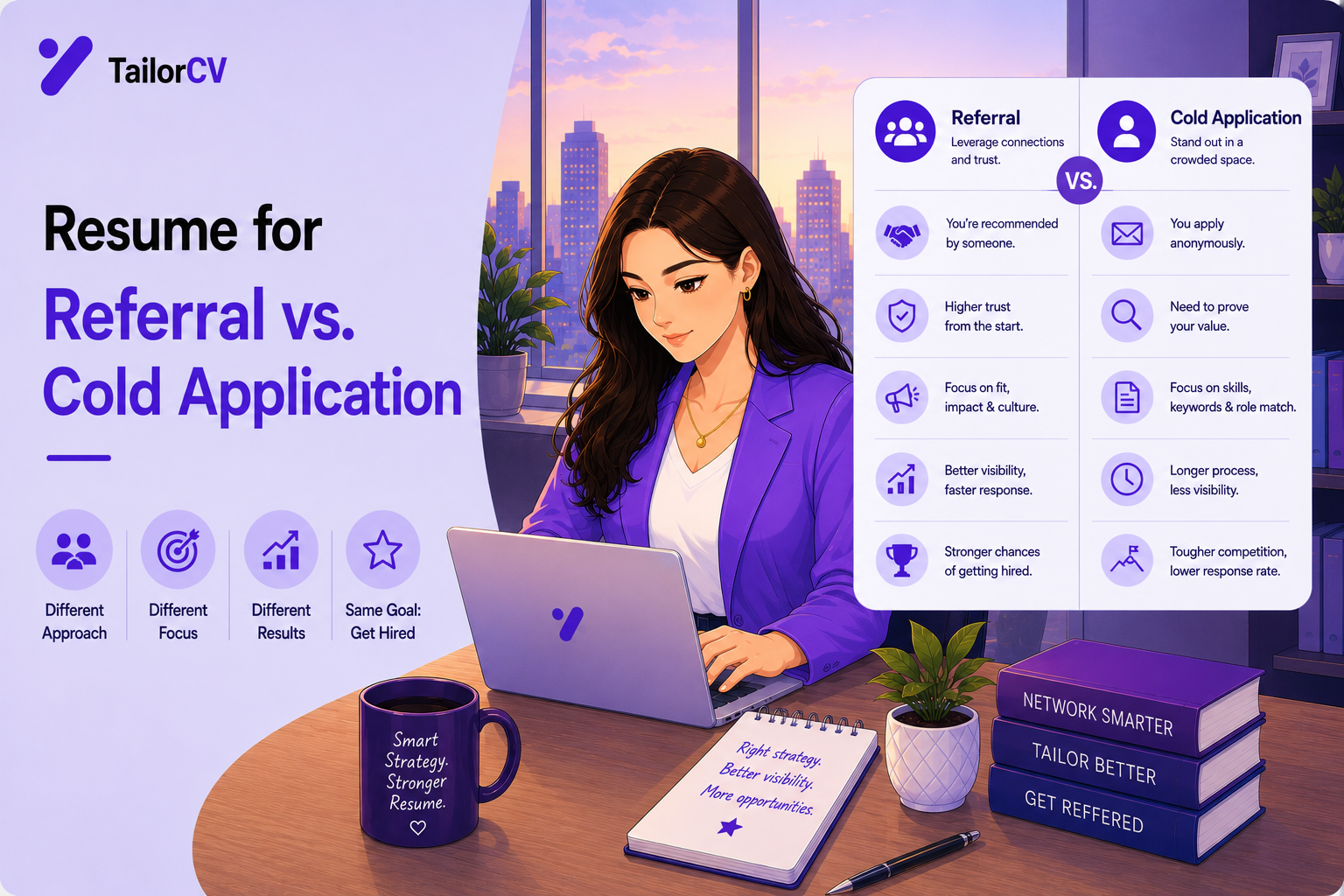
- Referral Versus Cold Application
- What Recruiters Actually Search For
- LinkedIn Profile Versus Resume
- LinkedIn Profile Optimization
- Job Description Red Flags
You can also check your resume's ATS score for free, generate a tailored cover letter, or build a portfolio website in minutes.
When the recruiter reaches out to you instead, the approach changes - tailoring when you're being poached covers what to ask before sending anything.
Frequently Asked Questions
Should I reply to a recruiter I am not interested in?
Yes, briefly. Say no clearly and mention what would interest you. Recruiters keep notes and change companies, and a courteous decline preserves a useful channel.
Should I send my resume straight away?
No. Ask about the role and the salary range first, then tailor your resume to what you learn. Sending a generic document immediately gives up your main advantage.
Can I ask about salary first?
Yes, and you should. You did not seek this conversation, so establishing whether it is worth having is reasonable and rarely resented.
How do I tell a real opening from list-building?
Ask one specific question about the role and the timeline. A recruiter with a live requisition answers it directly; one building a pipeline usually deflects.
Does being contacted mean I am a strong fit?
Not necessarily. Outreach reflects the recruiter's search criteria rather than a considered assessment, and many messages are sent to large numbers of people.
What if I am employed and want discretion?
Say so directly and specify how and when to contact you. Recruiters deal with this constantly and treating it as routine is entirely normal.
What is the difference between agency and in-house recruiters?
In-house recruiters fill their own employer's roles with direct information. Agency recruiters work for clients and are paid on placement, so give explicit permission for each submission rather than a general one.
How do I job search discreetly while employed?
Use personal contact details only, ask for discretion explicitly, avoid sudden public profile changes, schedule calls outside working hours, and keep your current performance steady throughout.
What is your resume scoring right now?
Scan it against a job description and get your ATS match score in about a minute.
Drop your resume here or choose a file
PDF only. Max 2 MB.
We never share your data or use it to train AI models.

Was this guide useful?
Be the first to rate it.