 SS
SS
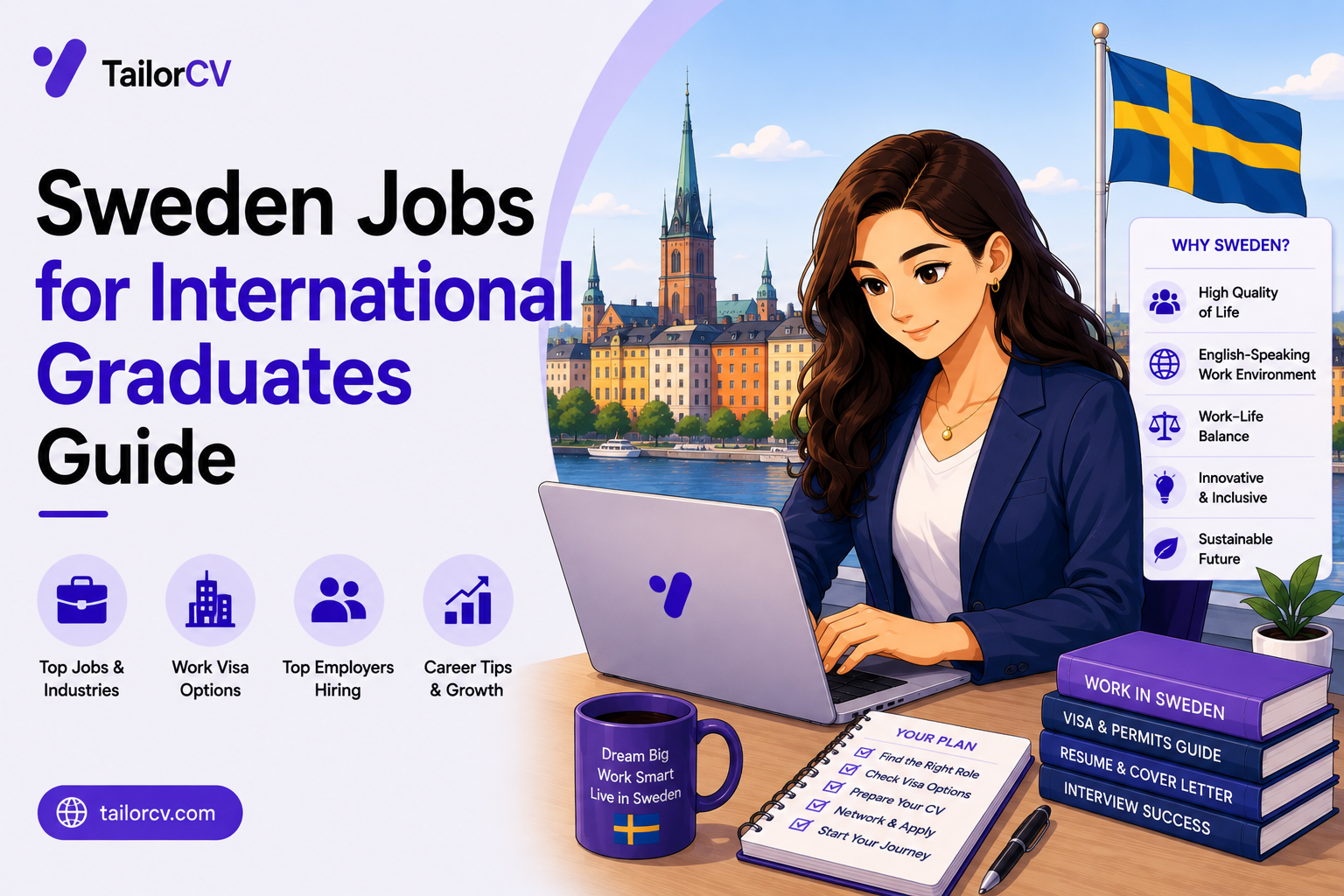
Key Takeaways
- Sweden's technology sector is disproportionately large for a country of ten million — Spotify, Klarna, King, Mojang, Northvolt and a deep startup ecosystem.
- English is genuinely sufficient for a large share of technology and international roles, though Swedish transforms your options everywhere else.
- Graduates of Swedish institutions can apply for a residence permit to look for work, and the standard work permit route requires an employer offer meeting union-approved terms.
- Flat hierarchy and consensus decision-making are real features, not brochure language, and they change how you should behave in an interview.
- Lagom, fika and work-life balance describe a workplace culture that is genuinely different from Anglo-American norms.
The Swedish technology story
Sweden produces globally significant companies at a rate that a country of its size should not.
Spotify is the obvious one, and it remains a major Stockholm engineering employer.
Klarna built European payments and buy-now-pay-later infrastructure from Stockholm.
King (Candy Crush) and Mojang (Minecraft) made Sweden a genuine centre of gaming.
Northvolt and the green industrial cluster in the north represent a serious bet on batteries and clean industry, with substantial engineering hiring in Skellefteå and the surrounding region.
Ericsson remains a major telecommunications employer with deep R&D.
Established industry — Volvo, Scania, Atlas Copco, SKF, ABB, IKEA, H&M, Electrolux — employs enormous numbers of engineers and commercial graduates and is consistently under-applied by international candidates chasing the startup names.
Why Sweden? Early and universal internet access, strong technical education, a small home market forcing companies to think internationally from day one, and a welfare system that reduces the personal risk of founding a company.
Cities and what they hold
| City | What concentrates there |
|---|---|
| Stockholm | Technology, fintech, gaming, finance, media — the dominant market |
| Gothenburg | Automotive and mobility (Volvo, Zenseact, Polestar), logistics, and Chalmers-driven engineering |
| Malmö / Lund | Life sciences, technology, and proximity to Copenhagen across the Öresund bridge |
| Uppsala | Life sciences, pharmaceuticals and university research |
| Linköping | Aerospace (Saab), simulation and engineering |
| Skellefteå / Luleå | Green industry, batteries, data centres |
Malmö deserves a specific note. It sits across a bridge from Copenhagen, and a substantial number of people live in one country and work in the other. That makes the Öresund region a genuinely binational job market — see the Nordic comparison for how the two sides differ.
The north is where the growth story is. The green industrial investment around Skellefteå and Luleå has created serious engineering demand in places that were not on anyone's list five years ago, and competition there is a fraction of Stockholm's.
Language, honestly
Technology and international companies run in English. Spotify, Klarna, King and the international operations of the large industrials all operate in English as a working language, and Swedes generally speak it to a very high standard.
Everything else is Swedish. Public sector, healthcare, education, most client-facing roles, and the large majority of small and medium employers.
Swedish is learnable and free. SFI — Svenska för invandrare — is publicly funded Swedish tuition available to residents, and it is genuinely good. Taking it seriously in your first year changes your medium-term options substantially.
The social argument is as strong as the professional one. Swedish workplaces are friendly and English-speaking, and Swedish social life largely is not. People who learn the language integrate; people who do not tend to leave after a few years.
Permits, and how they actually work
Three positions, and yours determines everything.
EU/EEA and Swiss citizens have free movement and need no permit. You register, get a personnummer, and work. Say so in the first line of any application.
Graduates of Swedish higher education institutions can apply for a residence permit to look for work or start a business after completing their studies. It is not tied to an employer, which removes the sponsorship obstacle for its duration — the same structural advantage as the Dutch and Irish schemes.
Everyone else needs a work permit, which requires a concrete job offer. The distinctive Swedish feature is that the terms of employment must be at least equivalent to those set by Swedish collective agreements for the role — pay, insurance and conditions. The relevant trade union is given the opportunity to comment on the offer.
Salary thresholds apply and have been raised, so check the current level with Migrationsverket rather than any secondary source.
Permits are initially tied to employer and occupation, becoming less restricted at renewal. Long-term residence follows a qualifying period.
Practical implication: an employer who has hired internationally before knows this process. One who has not may be discouraged by the union consultation step, so ask early whether they have done it.
Swedish workplace culture
The differences are real and they show up in interviews.
Flat hierarchy is genuine. Managers are approachable, first names are universal, and titles carry little weight. Deferring excessively to seniority reads as odd rather than respectful.
Consensus takes time. Decisions are made by discussion until broad agreement exists — the process can feel slow to someone from a decisive top-down culture, and pushing against it does not speed it up.
Lagom — roughly "just the right amount" — describes a cultural preference for moderation that shows up in how people present themselves. Loud self-promotion is uncomfortable here.
Fika is real. The scheduled coffee break is a genuine institution and a substantial part of how colleagues actually connect. Skipping it to look busy is a mistake.
Work-life balance is protected. Statutory paid holiday is generous, parental leave is extensive and shared between parents, and long hours are read as poor planning rather than commitment.
Direct but soft. Swedes are direct about substance and gentle in delivery, which is a specific combination — take the content seriously even when the tone is mild.
Getting set up in Sweden
The administrative sequence has hard dependencies, and getting it out of order costs weeks.
Personnummer first. Sweden's personal identity number, issued by Skatteverket once you register your residence. Almost everything downstream requires it, and processing takes time.
A coordination number (samordningsnummer) is the interim identifier if you are not yet eligible for a personnummer. It works for some things and not others.
Bank account and BankID. BankID is the digital identity used for banking, government services, healthcare booking and a great deal of daily life. It requires a personnummer and a Swedish bank account, and life without it is genuinely inconvenient.
Housing is the hard part in Stockholm. The first-hand rental market runs on queue systems where waiting times are measured in years, so most newcomers start in second-hand sublets. Budget for this and be cautious about sublet arrangements that are not properly registered.
Register with Försäkringskassan for social insurance entitlements once you are working.
Enrol in SFI for free Swedish tuition as soon as you have a personnummer.
Tax is deducted at source and most people file a simple pre-filled return in spring, frequently by confirming it on an app.
Applying, and what Swedish employers respond to
The mechanics are ordinary; the register is not.
Where to look. Arbetsförmedlingen (the public employment service) carries broad volume, LinkedIn works well for technology and Stockholm, The Hub and similar platforms cover startups, and company career pages carry the rest. Academic Work and specialist agencies are active in graduate placement.
Personal letter, not cover letter. Swedish applications typically ask for a personligt brev — one page, specific, and genuinely read. Generic enthusiasm reads badly in a culture that dislikes overstatement.
Keep the CV to two pages, plain, reverse chronological, no photo, no date of birth.
Understate and evidence. "Led a team of six through a migration that cut deployment time by half" works. "Passionate, driven, results-oriented leader" does not, and it triggers the lagom reflex.
Expect several interview rounds, often including a conversation with the team you would join rather than only with managers.
Ask real questions about the work. Swedish interviewers respond well to curiosity about how things are actually done, and poorly to questions only about progression and title.
Run the document through an ATS check — larger Swedish employers screen automatically like everyone else.
Mini checklist
- unchecked: Permit route identified — EU citizen, post-study permit, or work permit
- unchecked: Employer offer checked against union-approved terms if you need a permit
- unchecked: Established industrials included, not only startups
- unchecked: Northern green-industry employers considered
- unchecked: Personnummer application planned for on arrival
- unchecked: SFI enrolment planned
- unchecked: CV in Nordic convention, two pages
- unchecked: LinkedIn set to your target city
- unchecked: Interview prepared for a flat, consensus-oriented style
Scenarios
Scenario 1: You are an engineer and want the least competition
Look north. The battery and green-industry cluster around Skellefteå and Luleå has genuine demand and a fraction of Stockholm's applicant volume, with housing you can actually afford.
Scenario 2: You want a well-known technology name
Stockholm, and target Spotify, Klarna, King and the scale-ups directly. These run in English and hire internationally as a matter of course.
Scenario 3: You have no Swedish and are not planning to learn
Restrict to technology and international companies and be honest with yourself about the ceiling. Most of the Swedish labour market is not available in English, and the social side matters more than people expect.
Tip: Apply for your personnummer the moment you are eligible. Sweden's personal identity number is the key to banking, healthcare, phone contracts and most public services, and life without one is a series of small, grinding obstacles.
Do's and Don'ts
Do
- Include the large industrials, not just startups
- Consider the northern green-industry cluster
- Enrol in SFI and take it seriously
- Apply for a personnummer immediately
- Prepare for a flat, consensus-based interview style
- Check that an offer meets collective agreement terms
Don't
- Assume the whole market runs in English
- Chase only the famous startup names
- Underestimate how much Swedish affects social integration
- Oversell yourself in an interview
- Delay the personnummer application
- Ignore the Öresund region and Copenhagen
Common Mistakes
- Applying only to startups. Volvo, Scania, Ericsson, ABB and IKEA employ far more graduates.
- Overestimating English coverage. It works in technology; most of the market runs in Swedish.
- Skipping SFI. Free, good, and the difference between staying and leaving after two years.
- Delaying the personnummer. Almost everything practical depends on it.
- Overselling in interviews. Swedish culture reads self-promotion as a warning sign.
- Ignoring the north. Real engineering demand with a fraction of the competition.
Related Guides
Keep building on this with the related guides in this series:
- Graduate Jobs in Denmark
- Nordic Graduate Job Markets Compared
- Technology Jobs in Berlin and Munich
- Finding a Job in the Netherlands as an International Graduate
- A Practical Checklist for Your First Job Abroad
You can also check your resume's ATS score for free, generate a tailored cover letter, or build a portfolio website in minutes.
Frequently Asked Questions
Can I work in Sweden without speaking Swedish?
In technology and at international companies, yes. Most of the wider labour market — public sector, healthcare, SMEs, client-facing roles — runs in Swedish.
What is a personnummer?
Sweden's personal identity number. Banking, healthcare, phone contracts and most public services depend on it, so apply as soon as you are eligible.
What is SFI?
Svenska för invandrare — publicly funded Swedish language tuition for residents. It is free, genuinely good, and the single best investment in your first year.
Which Swedish companies hire internationally?
Spotify, Klarna, King, Northvolt and the scale-ups, plus the large industrials — Volvo, Scania, Ericsson, ABB, IKEA — which are consistently under-applied.
Is Stockholm the only option?
No. Gothenburg for automotive, Malmö and Lund for life sciences, Linköping for aerospace, and the northern green-industry cluster for the fastest-growing engineering demand.
What is the work permit process?
The standard route requires a job offer with terms meeting Swedish collective agreement standards. Graduates of Swedish institutions can also apply for a permit to remain and look for work.
Do I need a Swedish work permit?
EU/EEA and Swiss citizens do not. Graduates of Swedish institutions can apply for a permit to look for work. Everyone else needs an employer offer meeting collective agreement terms.
What is lagom?
Roughly "just the right amount" — a cultural preference for moderation. It is why loud self-promotion sits badly in a Swedish interview.
Is fika actually important?
Yes. The scheduled coffee break is a genuine workplace institution and a real part of how colleagues connect. Skipping it to appear busy misreads the culture.
What is BankID and why do I need it?
Sweden's digital identity, used for banking, government services and healthcare. It requires a personnummer and a Swedish bank account, and daily life is genuinely awkward without it.
How hard is finding housing in Stockholm?
Hard. The first-hand rental market runs on queues measured in years, so most newcomers start in second-hand sublets. Budget accordingly and check any sublet is properly arranged.
Find out where a fresher resume stands
Score yours against a real posting - no account, no cost.
Drop your resume here or choose a file
PDF only. Max 2 MB.
We never share your data or use it to train AI models.

Was this guide useful?
Be the first to rate it.