 TD
TD
Key Takeaways
- Japanese applications need two documents - the rirekisho for personal details and the shokumu keirekisho for what you actually did.
- The shokumu keirekisho is the one hiring managers read, and it is where you make the case for yourself.
- Two accepted formats exist: chronological, and role-based for people with varied or repeated experience.
- A summary block at the top is expected and is the highest-value part of the document.
- Two to four pages is normal, which surprises applicants used to one-page resumes.
Applying for a job in Japan requires two documents, and foreign applicants routinely submit only one - usually a Western-style resume that fills neither role properly.
The rirekisho (履歴書) is a standardised personal history form: name, photo, education, employment dates, qualifications. It follows a fixed template and there is very little scope for making it distinctive.
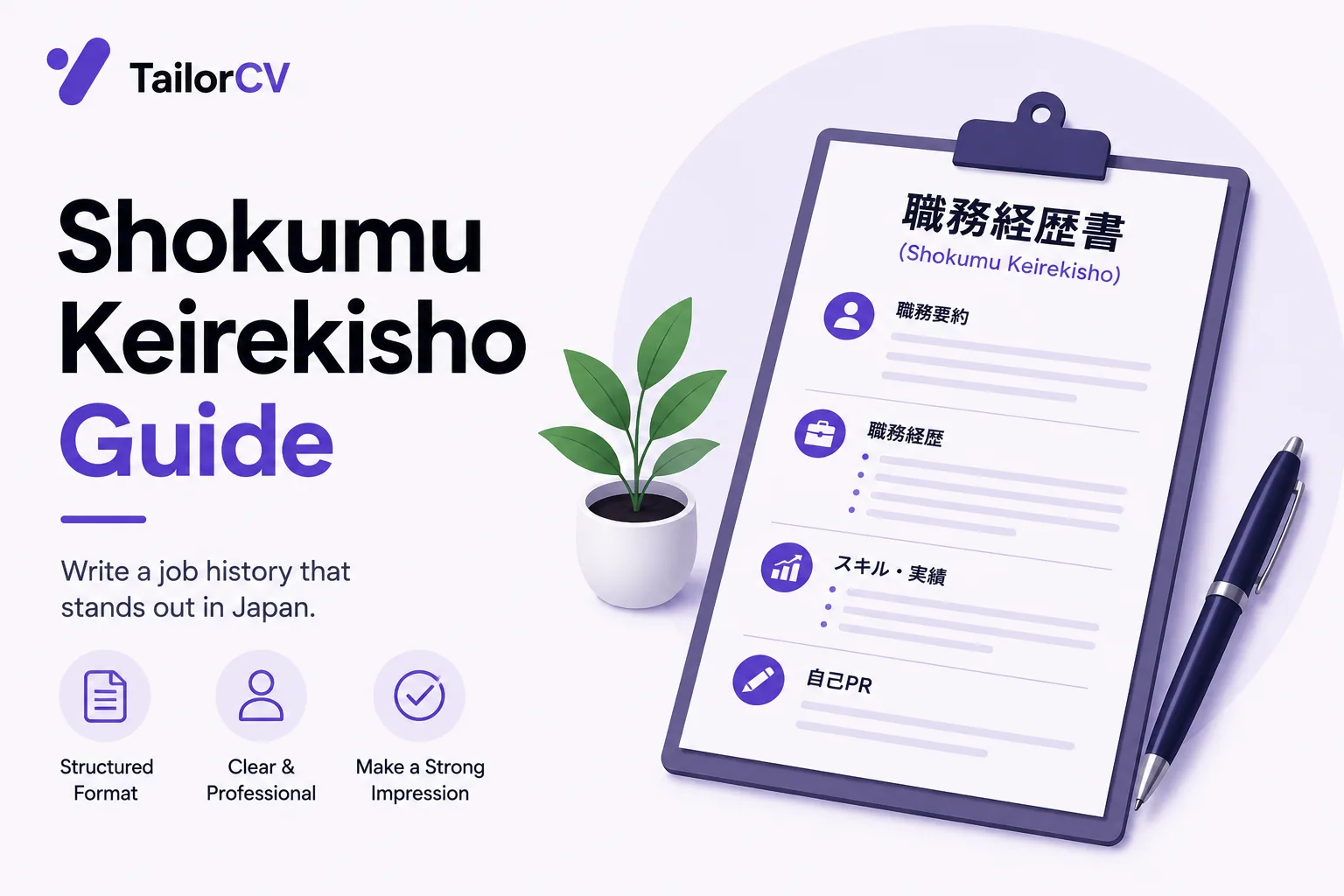
The shokumu keirekisho (職務経歴書) is the career history document, and it is the one that actually decides whether you get an interview. It is free-format, several pages long, and it is where you explain what you did, what you achieved, and what you can do for this employer.
Confusing the two, or omitting the second, is the most common mistake foreign applicants make in Japan.
This guide covers structure, format choice, and how to write it.
Before submitting anywhere, check what a parser extracts from your file - the free ATS score checker.
How It Differs From the Rirekisho
| Rirekisho | Shokumu keirekisho | |
|---|---|---|
| Purpose | Personal history and facts | Career history and capability |
| Format | Standardised template | Free format |
| Length | One or two sides | Two to four pages |
| Photo | Required | Not required |
| Content | Dates, schools, employers, qualifications | Responsibilities, achievements, skills |
| Who reads it | HR, for screening facts | Hiring manager, for assessment |
Submit both. The rirekisho conventions are covered in the rirekisho guide.
The Standard Structure
1. Title and date
職務経歴書 at the top, with the submission date and your name. Simple, and expected.
2. Summary (職務要約)
Three to five lines summarising your career - years of experience, field, and your strongest achievement. This is the highest-value block in the document because it is read first and it frames everything after it.
Weak:
I have worked in sales for eight years at several companies and have experience with clients.
Stronger:
Eight years in B2B software sales, most recently managing enterprise accounts at a SaaS company with an annual quota of ¥120 million, achieved for three consecutive years. Particular strength in long-cycle deals with manufacturing clients.
The same discipline as how to write a resume summary.
3. Career history (職務経歴)
The main body, in one of the two formats below.
For each employer, include the company name, a one-line description of the business, its size and industry, your period of employment, your department and title, and your responsibilities and achievements.
Describing the company matters more than foreign applicants expect. A Japanese hiring manager may not recognise your previous employer, particularly if it is overseas. One line naming the industry, rough revenue or headcount, and what the company does provides essential context.
4. Skills and qualifications (活かせる経験・知識・スキル)
Technical skills, tools, languages, certifications. Include your JLPT level if you have one - it is a concrete credential and it is looked for.
5. Self-promotion (自己PR)
A closing section, several sentences to a short paragraph, on your strengths and what you would bring. Confident but not boastful - the register matters, and this is where foreign applicants often misjudge.
Choosing the Format
Chronological (編年体式)
Employers listed in order, usually reverse chronological in modern practice.
Use when: your career has a clear progression, you have stayed in one field, and your recent work is your most relevant.
Advantage: easy for a reader to follow.
Role-based (キャリア式)
Organised by function or project type rather than by employer.
Use when: you have done similar work across several employers, you have moved between fields, or your relevant experience is not your most recent.
Advantage: groups your evidence rather than scattering it across five employers.
Caution: it obscures your timeline, so include the dates clearly somewhere. Japanese employers do pay attention to continuity, and a format that looks like it is hiding something works against you.
Most applicants should use chronological. Use role-based only if you have a genuine reason.
Writing the Content
Move from duties to achievements
The most common weakness. Japanese career documents traditionally lean descriptive, and many domestic applicants write duty lists - which means an achievement-focused document stands out.
Weak:
Responsible for managing client accounts and preparing monthly reports.
Stronger:
Managed 18 enterprise accounts worth ¥90 million annually; increased renewal rate from 78% to 91% over two years by restructuring the quarterly review process.
The technique is in how to write resume bullet points and how to quantify achievements on your resume.
Give the numbers scale
Team size, budget, revenue, client count, percentage change. Where you name a figure in another currency, consider adding an approximate yen equivalent - it removes a mental conversion step for the reader.
Explain foreign context
A Japanese hiring manager may not know your previous employer, your university, or your market. Brief context is not padding; it is what makes your experience legible.
Be careful with the register
Japanese business writing rewards clarity and appropriate modesty. Achievements should be stated factually with evidence rather than with superlatives. "I dramatically transformed the department" reads worse than the numbers alone would.
Language: Japanese or English?
Japanese for domestic employers and any posting in Japanese. If your Japanese is not strong enough to write it well, have a native speaker review it - awkward Japanese in a career document is more damaging than in conversation, because it is a written artefact that will be read closely.
English for foreign-owned companies, international teams, and English-language postings. Note that many international companies in Japan still expect the two-document structure, so provide an English shokumu keirekisho rather than a Western resume.
Both if the employer is ambiguous.
Do not machine-translate. Job titles and achievement phrasing translate particularly badly.
Which language a given employer expects, and the wider market picture, is covered in working in Japan without Japanese and IT jobs in Japan for foreigners.
Practical Formatting
Two to four pages. One page reads as thin; five or more as unfocused.
A4, which is the standard paper size in Japan.
Plain and readable. Heavily designed templates are not the convention and can parse badly. Standard structure beats visual flourish - the failure modes are in ATS resume formatting mistakes.
PDF unless asked otherwise, though note that some Japanese employers still request Word or Excel files, which is a genuine local convention rather than an oversight.
Name the file clearly with your name and the document type.
Proofread carefully. Attention to detail is weighted heavily in Japanese hiring, and errors in a document you had time to prepare are read as carelessness.
Common Mistakes
Submitting only a rirekisho, or only a Western resume. Japanese applications expect both documents, and each does a different job - omitting the shokumu keirekisho means omitting the part that actually argues for you.
Writing duty lists instead of achievements. Most domestic applicants do this too, which means an achievement-focused document with real numbers stands out immediately rather than blending in.
Omitting the summary block. It is read first and frames everything after it, so leaving it out wastes the most valuable space in the document.
Not describing previous employers. A Japanese hiring manager may not recognise an overseas company at all, and without one line of context your experience is difficult to weigh accurately.
Choosing role-based format without reason. It obscures your timeline, and Japanese employers pay real attention to continuity - a format that appears to hide gaps works against you even when you have nothing to hide.
Machine-translating from English. Job titles and achievement phrasing translate especially badly, producing text that undermines otherwise strong content in a document that will be read closely.
Compressing to one page. The one-page convention is American; here it reads as insufficient detail for a mid-career professional.
Overstating in the self-PR section. Superlatives land worse than the numbers alone, because the expected register rewards factual confidence rather than promotion.
Frequently Asked Questions
What is the difference between a rirekisho and a shokumu keirekisho?
The rirekisho is a standardised personal history form covering dates, education, employers, and qualifications. The shokumu keirekisho is a free-format career history explaining what you actually did and achieved. Japanese applications generally require both.
How long should a shokumu keirekisho be?
Two to four pages for most professionals. One page reads as thin, and beyond four it becomes unfocused.
Should I write it in Japanese or English?
Japanese for domestic employers, English for foreign-owned companies and English-language postings. If your Japanese is not strong enough to write it cleanly, have a native speaker review it rather than machine-translating.
Do I need a photo on the shokumu keirekisho?
No. The photo goes on the rirekisho, which has a designated space for it.
Which format should I use?
Chronological for most people. Role-based is worth considering if you have done similar work across several employers or your most relevant experience is not your most recent - but include clear dates either way.
Do international companies in Japan want this document?
Many do, even when hiring in English. Providing an English shokumu keirekisho rather than a Western resume shows familiarity with local convention and costs you nothing.
Should I include my JLPT level?
Yes, if you have taken it. It is a concrete credential that employers look for and it also contributes points under the Highly Skilled Professional system - see the Japan work visa guide.
Make sure the document parses cleanly before you submit it. Check your ATS score free.
Make This Practical
Write the summary block first, in three to five lines naming your years of experience, your field, and your single strongest quantified achievement. It is read before anything else and it frames how the rest of the document lands.
Then convert your career history from duties to achievements with numbers attached, and add one line of context for every employer a Japanese hiring manager might not recognise - industry, size, and what the company does. That context is what makes overseas experience legible rather than vague.
Finally, submit the pair properly. Pair it with a rirekisho built to convention using the rirekisho guide, include your JLPT level if you have one, keep to two to four pages on A4, and have a native speaker review the Japanese if you wrote it yourself. Then check it parses with the free ATS score checker and prepare for interview with Japan interview etiquette.
What is your resume scoring right now?
Scan it against a job description and get your ATS match score in about a minute.
Drop your resume here or choose a file
PDF only. Max 2 MB.
We never share your data or use it to train AI models.

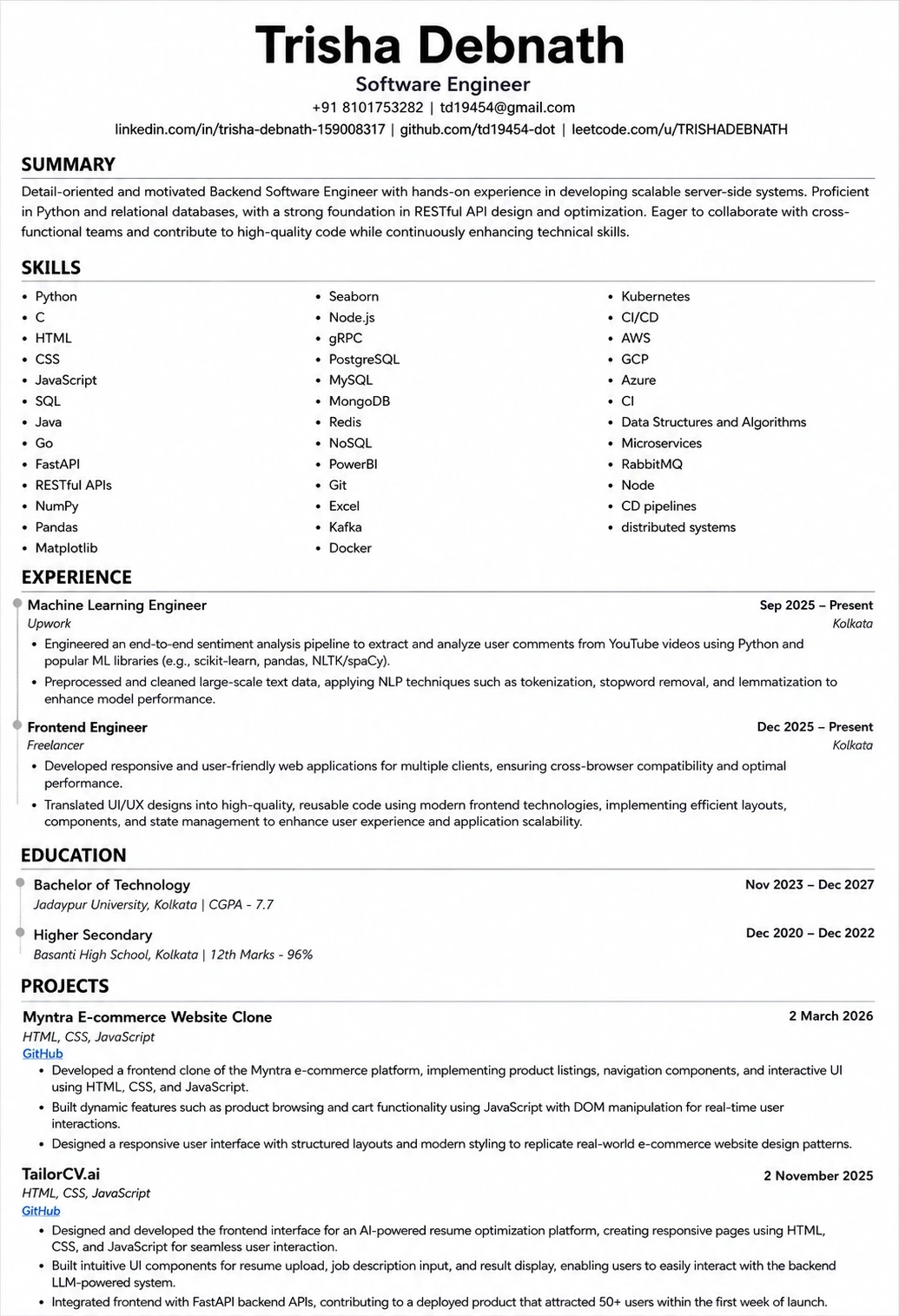
Templates that keep this structure intact
This template is ATS-tested — start from it and the formatting rules in this guide are already handled.
Was this guide useful?
Be the first to rate it.