 TD
TD
Key Takeaways
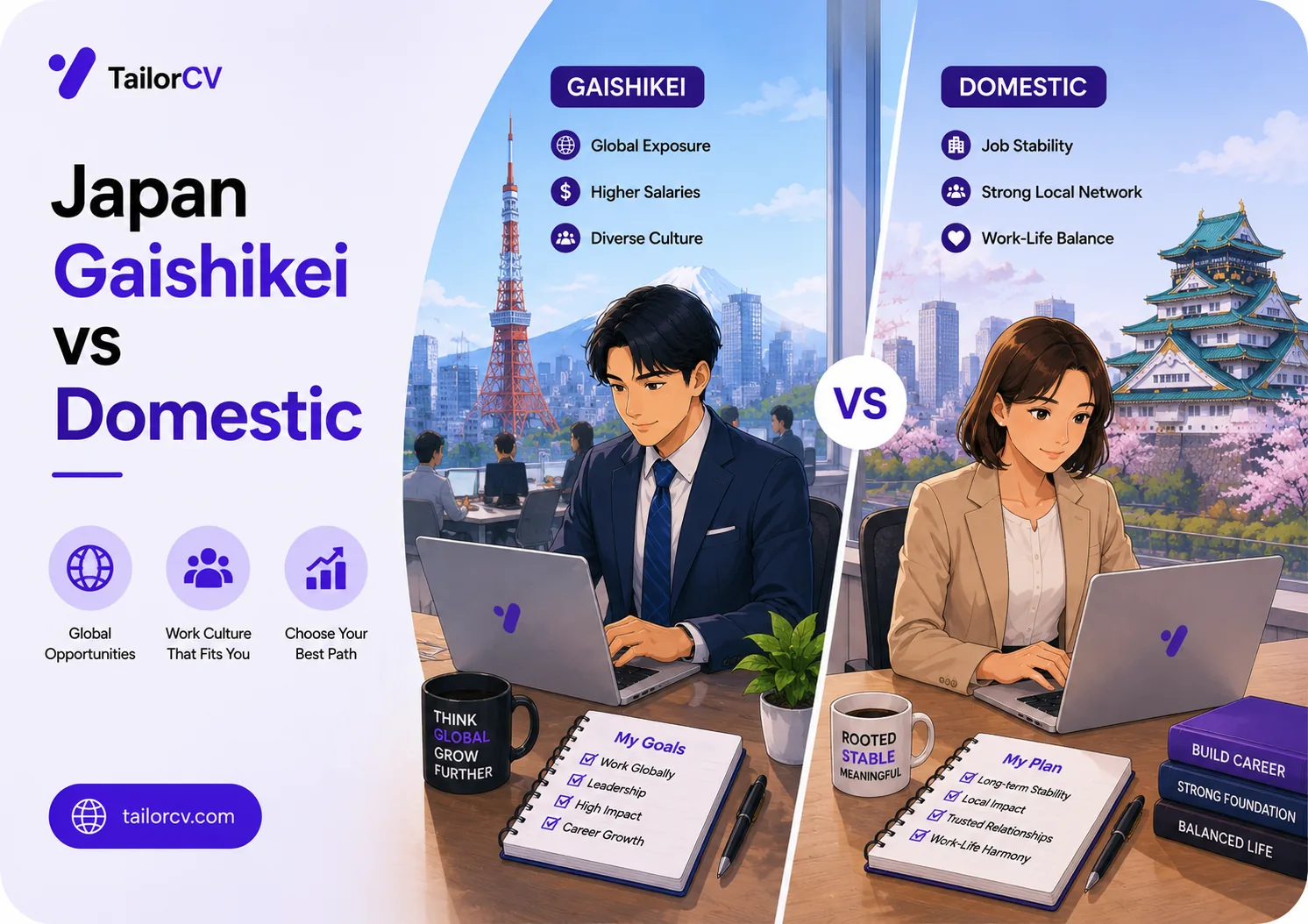
- Gaishikei — foreign-owned companies — generally pay more, operate more in English, and promote on performance rather than tenure.
- Japanese domestic companies offer stronger job security, structured training and a slower but more predictable path.
- Gaishikei carry higher restructuring risk, since a Japan office can be closed by a decision made overseas.
- Language requirements differ sharply: many gaishikei roles are viable at low Japanese, most domestic roles are not.
- Job security norms at domestic firms are real but weaker for mid-career foreign hires than the lifetime employment reputation suggests.
For a foreign professional in Japan, the gaishikei versus domestic question shapes almost everything — pay, language requirement, how you are promoted, and how secure the role is. The two operate on genuinely different logic, and the right answer depends heavily on your Japanese level and your risk tolerance.
This guide compares them on the dimensions that actually affect your working life.
Before applying, check your documents work — the free ATS score checker.
The core differences
| What differs | Gaishikei | Domestic Japanese |
|---|---|---|
| Working language | Frequently English | Japanese, usually N2+ |
| Pay | Generally higher | Lower, more tenure-linked |
| Promotion | Performance-based | Weighted toward tenure |
| Job security | Lower — office closures happen | Higher, culturally and structurally |
| Training | Less structured | Extensive, especially for new grads |
| Hours | Closer to parent company norms | Varies, historically longer |
| Foreign colleagues | Common | Fewer |
| Decision-making | Faster, more individual | Consensus-driven, slower |
Gaishikei in detail
Who they are: Japan offices of foreign multinationals — American, European and other. Finance, technology, pharmaceuticals, consumer goods and consulting are the strongest sectors.
Why foreign professionals gravitate there:
Language. Many roles genuinely operate in English, which makes them the realistic segment for anyone below N2 — see the JLPT for jobs guide.
Pay. Generally higher than domestic equivalents, and more directly tied to individual performance.
Familiar structure. Meetings, feedback and progression tend to follow the parent company's norms rather than Japanese convention.
Faster progression. Promotion follows results more than years served.
The trade-offs:
Restructuring risk is real. A Japan office exists at the discretion of a headquarters elsewhere, and offices get consolidated or closed for reasons unrelated to local performance. This is the single biggest downside and it is underweighted by candidates focused on salary.
Smaller organisations. Often a few hundred people rather than tens of thousands, which limits internal mobility.
Career capital in Japan. Long gaishikei-only experience can read as less relevant to domestic employers later, if you ever want to move that direction.
Judging restructuring risk before you join
Not every gaishikei carries the same exposure. These questions separate a Japan office that is structurally safe from one that exists at the mercy of a quarterly review elsewhere.
| Ask | Lower risk | Higher risk |
|---|---|---|
| Does Japan generate revenue or just serve HQ? | Sales and clients here | Back-office or support function |
| How long has the office existed? | Decades, through downturns | Opened in the last few years |
| Does the Japan head report locally or overseas? | Regional autonomy | Direct line to a cost centre abroad |
| Has the office restructured before? | Never, or once long ago | Twice in five years |
| Is Japan strategically named in company communications? | Yes, a growth market | Not mentioned |
| How large is the Japan office? | Hundreds, with real functions | A dozen people |
The first row matters most. An office that sells into the Japanese market has a reason to exist independent of headquarters' mood; a support or development centre placed here for convenience can be moved to a cheaper location by a decision nobody in Japan participates in.
This is not a reason to avoid gaishikei — it is a reason to know which kind you are joining, and to keep your network and Japanese progressing while you are there.
Domestic Japanese companies in detail
What they offer:
Job security. Stronger both culturally and structurally, and layoffs remain comparatively rare by international standards.
Structured training. Particularly for new graduates, where companies invest heavily in developing people over years rather than hiring for immediate output — see the Japan new grad vs mid-career guide.
Depth of domain knowledge. Long tenures produce genuinely deep expertise.
Integration. If you intend to build a life in Japan, working in Japanese with Japanese colleagues accelerates everything — language, network and understanding.
The trade-offs:
Japanese is required, usually N2 at minimum and N1 for progression.
Tenure influences pay and promotion, which disadvantages a mid-career joiner. The seniority system is weakening but has not disappeared — see nenko seniority explained.
Consensus decision-making is slower, and frustrating if you are used to individual authority.
The security is less absolute for you than the reputation suggests. Lifetime employment norms developed around new graduates hired into the company for life. A mid-career foreign hire is not in that category, and should not assume the same implicit protection.
Which to choose
Gaishikei suits you if: your Japanese is below N2, you want higher pay now, you value performance-based progression, or you are not certain you will stay in Japan long term.
Domestic suits you if: your Japanese is strong, you want to build a long-term career and life in Japan, you value security and structured development, or you work in a field where the leading companies are Japanese — manufacturing, automotive, gaming, and much of engineering.
A common pattern worth knowing: start at a gaishikei while your Japanese develops, then move to a domestic company later if you decide to stay. That sequence uses gaishikei to solve the language problem and domestic experience to build long-term standing.
A note on hiring processes: gaishikei recruit in a way that resembles international norms — CVs, interviews, mid-career hiring year-round. Domestic companies weight the shukatsu cycle for new graduates and treat mid-career hiring differently — see the Japan job change tenshoku guide.
By situation
| Your situation | Where to look first | Why |
|---|---|---|
| N3 or below, arriving now | Gaishikei, English-operating startups | Domestic firms will not screen you in |
| N2, five years' experience | Both — compare specific offers | Genuinely open on either side |
| N1, want to stay permanently | Domestic | Long-term standing and network compound |
| Strong engineer, uncertain about staying | Gaishikei | Pay now, portable experience, easy exit |
| Manufacturing, automotive, gaming | Domestic | The leading firms in these fields are Japanese |
| Finance, pharma, consulting | Gaishikei | Deepest foreign presence and highest pay |
| Family here, need stability | Domestic, or a well-established gaishikei | Restructuring risk matters more with dependants |
| Early career, want training | Domestic | Structured development gaishikei rarely match |
The row that surprises people is the fourth. A strong engineer unsure about staying long term is better served by gaishikei even at N2 or above, because the experience stays portable and leaving is straightforward — whereas the value of domestic experience is largely realised by staying.
Common Mistakes
Choosing gaishikei purely on salary. Restructuring risk is real, and a Japan office can be closed by a decision taken entirely overseas.
Not checking whether the Japan office generates revenue. A support function placed here for convenience can be moved somewhere cheaper; a sales office serving Japanese clients cannot.
Assuming domestic means lifetime security for you. Those norms developed around new graduates hired for life, and a mid-career foreign hire sits outside that implicit arrangement.
Applying to domestic companies below N2. Most require it, and applying broadly below that threshold produces very low response rates.
Underestimating consensus decision-making. It is slower by design, and finding it frustrating is a real adjustment rather than a minor irritation.
Ignoring the tenure effect on pay. The seniority system is weakening but still disadvantages mid-career joiners at many domestic firms.
Staying gaishikei-only while planning a long Japanese career. Domestic employers may read it as less relevant experience later.
Letting your Japanese stall at a gaishikei. The English-operating environment removes the pressure to improve, which quietly closes the domestic option later.
Expecting gaishikei to feel foreign throughout. Local practice still shapes a great deal, particularly in HR and client work.
Not weighing training value early career. Domestic firms invest in developing new graduates in a way most gaishikei do not.
Frequently Asked Questions
What does gaishikei mean?
A foreign-owned company operating in Japan — the Japan office of an overseas multinational.
Do gaishikei pay more?
Generally yes, and more directly tied to individual performance rather than tenure.
Can I work at a gaishikei without Japanese?
Frequently yes. Many roles operate in English, which makes them the realistic segment for candidates below N2.
How do I judge a gaishikei's stability?
Ask whether the Japan office generates revenue or supports headquarters, how long it has existed, whether it has restructured before, and whether the Japan head has regional autonomy.
Are Japanese companies really more secure?
Structurally and culturally yes, with layoffs comparatively rare. But those norms grew around graduates hired for life, so a mid-career foreign hire should not assume identical protection.
Which is better for a long-term career in Japan?
Domestic experience generally builds stronger long-term standing if you intend to stay, provided your Japanese supports it. Many people start gaishikei and move later.
I am a strong engineer but unsure about staying. Which?
Gaishikei, even at N2 or above. The experience stays portable and leaving is straightforward, while the value of domestic experience is mostly realised by staying.
Is promotion really slower at Japanese companies?
Tenure still carries weight at many domestic firms, though the seniority system has been weakening. Gaishikei promote on performance more directly.
Do gaishikei feel like working abroad?
Partly. Meetings and progression often follow the parent company, but local practice still shapes HR, client work and daily norms considerably.
Check your application documents. Check your ATS score free.
Make This Practical
Let your Japanese level make the first cut. Below N2, gaishikei and English-operating startups are your realistic market, and applying broadly to domestic companies wastes months. At N2 or above, both segments are genuinely open and the decision becomes about what you actually want.
Then judge restructuring risk properly rather than treating gaishikei as one category. Ask whether the Japan office sells into the Japanese market or exists to support headquarters, how long it has been here, and whether the Japan head has real autonomy — a revenue-generating office has a reason to exist that a support centre does not.
Finally, if you do start at a gaishikei, keep your Japanese moving. The English-operating environment removes the pressure to improve, and letting it stall is what quietly closes the domestic option two or three years later — which is precisely when many people decide they want to stay.
What is your resume scoring right now?
Scan it against a job description and get your ATS match score in about a minute.
Drop your resume here or choose a file
PDF only. Max 2 MB.
We never share your data or use it to train AI models.

Was this guide useful?
Be the first to rate it.