 TD
TD
Key Takeaways
- Four distinct routes exist - JET, ALT dispatch companies, eikaiwa conversation schools, and international schools - and they differ substantially in pay, conditions, and application timing.
- A bachelor's degree in any subject is effectively required, because the work visa depends on it.
- JET has a fixed annual application cycle that closes roughly a year before departure, so missing it costs a year.
- Classroom specifics - age groups, class sizes, curriculum - are what distinguish a teaching resume from three hundred identical ones.
- Teaching is a workable entry route into Japan, but transitioning out of it later is harder than people expect.
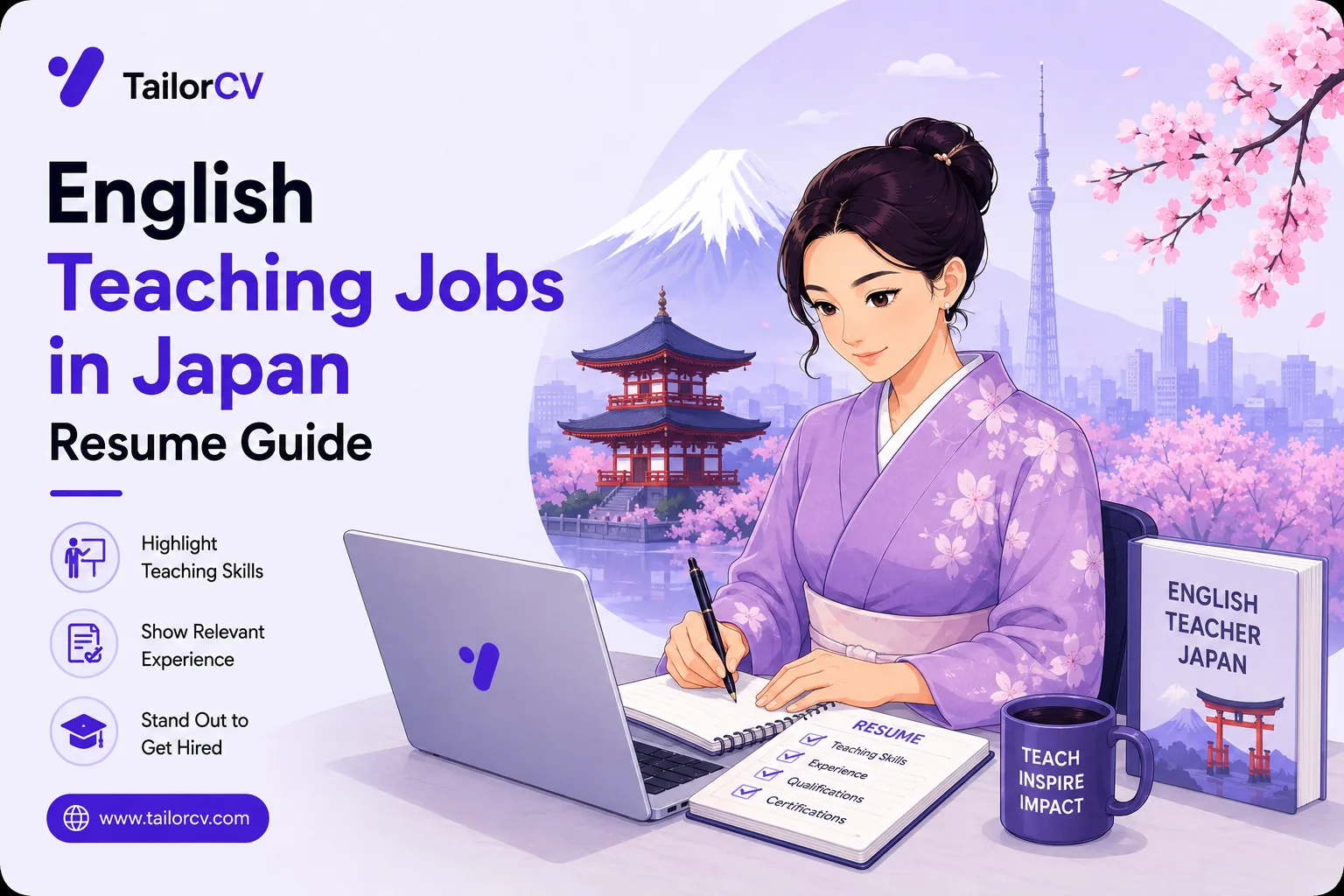
Teaching English is the most common way foreigners first come to work in Japan, and the routes into it differ enough that treating them as one category leads to poor decisions.
A JET placement, an ALT dispatch role, an eikaiwa position, and an international school job have different pay, different hours, different levels of support, and different application calendars. Some are genuinely good first jobs in Japan. Others are demanding work with modest compensation and high turnover.
This guide covers the routes, the requirements, and how to write the application.
Start by checking your resume parses cleanly - the free ATS score checker.
The Four Routes
JET Programme
A government-affiliated programme placing assistant language teachers in public schools, generally regarded as the best-supported entry route.
Advantages: relatively strong compensation for the category, structured support, a large community, placements in schools rather than commercial settings, and a well-organised process.
Constraints: you cannot choose your placement location, and you may be placed rurally. A fixed annual cycle with applications typically opening in autumn for a departure the following summer - roughly a year of lead time.
Requirements: a bachelor's degree in any subject, and nationality and other criteria that vary by country. Teaching qualifications are not usually required.
ALT dispatch companies
Private companies contracting assistant language teachers to boards of education and schools. A large share of ALT positions.
Advantages: hire year-round, more flexible on timing, and often more choice of region.
Constraints: generally lower pay than JET, and conditions vary considerably between companies. Some contracts are structured around the school year with unpaid or reduced-pay periods during long breaks, which materially affects annual income.
Research the specific company carefully. The range in quality within this segment is wide.
Eikaiwa (conversation schools)
Private language schools teaching children and adults, usually in commercial settings.
Advantages: hire year-round, urban placements, and steady work.
Constraints: evening and weekend hours, since that is when students attend. Often a sales or retention component to the role. Class sizes are small, which some people prefer.
International schools
Genuine teaching positions at international schools following foreign curricula.
Advantages: the best pay and conditions in the category by a clear margin, and real professional teaching work.
Constraints: a much higher bar - a teaching licence from your home country and classroom experience are usually required, not just a TEFL certificate. These are teaching careers rather than entry routes.
Requirements
A bachelor's degree in any subject. Effectively mandatory, because the Instructor status of residence depends on it. Offers suggesting otherwise generally involve visa problems - see the Japan work visa guide.
Native or near-native English. Many positions specify nationality from a defined list of countries, partly for visa reasons.
A TEFL, TESOL, or CELTA certificate. Not always required, but it strengthens applications and is sometimes a screening threshold, particularly at eikaiwa and better dispatch companies.
A clean criminal record check, typically required for the visa process.
Japanese ability is generally not required, and at some positions is deliberately not used in the classroom. It helps enormously with daily life - see working in Japan without Japanese.
Writing the Teaching Resume
Most teaching applications read identically:
Enthusiastic and passionate English teacher committed to helping students achieve their goals. Responsible for teaching English classes and preparing materials.
That describes every applicant. It gives a recruiter nothing to choose on.
Lead with classroom specifics
The details that actually distinguish you:
- Age groups - "ages 6-12" is information; "young learners" is a category
- Class sizes - handling 35 students demonstrates something different from one-to-one tutoring
- Curriculum and materials - named programmes, phonics systems, exam preparation
- Level range - beginner to intermediate, specific exam targets
- Outcomes - progression rates, test improvements, retention
Rewritten:
Taught English to 140 students aged 7-12 across seven weekly classes of up to 22, using a phonics-based curriculum; 82% of exam-track students advanced a level within the academic year.
That is a person rather than a category. The technique is in how to write resume bullet points and how to quantify achievements on your resume.
If you have never taught professionally
Many successful applicants have not. Use adjacent evidence and be specific about each:
- Tutoring, including informal and volunteer work
- Coaching, mentoring, camp work, scouting
- Training delivered in a previous job
- Public speaking or presenting
- Your TEFL practicum hours, which are real teaching hours
The general approach for building a resume without direct experience is in resume summary with no experience.
Show cultural adaptability
Employers are assessing whether you will cope and stay. Previous time abroad, cross-cultural work, language learning, and any prior connection to Japan all reduce perceived risk. Turnover is a real cost in this sector and applications that address it do better.
Format for Japan
Japanese employers generally expect a rirekisho, and larger organisations may want a shokumu keirekisho as well - see the rirekisho guide and the shokumu keirekisho guide. JET and international recruiters typically accept a standard resume, but check the specific requirement.
A photograph is conventional on Japanese application documents.
Evaluating an Employer
The quality range is wide and your visa is tied to your employer, so this matters.
Confirm before accepting:
- The employer will sponsor a proper work visa
- The contract states hours clearly, including any required office hours between classes
- How pay is handled during school holidays and long breaks
- Whether housing is provided or subsidised, and on what terms
- Flight reimbursement and contract completion bonus, if offered
- Who covers health insurance and pension enrolment, which are legally required
- Whether someone will meet you and help with initial registration
Be cautious if:
- You are asked to work before your status of residence is in order
- The employer is vague about which entity actually employs you
- You are asked to pay recruitment fees
- The contract arrives late or differs from what was discussed
- Reviews from former foreign teachers are hard to find or consistently poor
Speak to a current or former foreign teacher before signing. Reputable employers will usually connect you with one.
Common Mistakes
A generic passion statement. Every applicant is enthusiastic, and only some can describe an actual classroom - so the opening line that feels safest is the one that differentiates you least.
Omitting age groups and class sizes. These are the first specifics a recruiter looks for, and leaving them out makes an experienced teacher read like an inexperienced one.
Missing the JET application window. It is annual and closes roughly a year before departure, so a late realisation costs a full year rather than a few weeks.
Not checking how holiday pay works at dispatch companies. Some contracts reduce or suspend pay during long school breaks, which changes annual income substantially from what the monthly figure implies.
Assuming all ALT positions are equivalent. Conditions vary widely between dispatch companies, and researching the specific employer matters more here than in most sectors.
Sending a Western resume where a rirekisho is expected. Japanese employers have document conventions, and following them signals familiarity while ignoring them signals the opposite.
Treating an eikaiwa role as classroom teaching. The hours are evenings and weekends and there is often a retention or sales component, which is a different job from what many applicants expect.
Planning to transition out later without preparing for it. Teaching experience does not read as directly relevant to most professional roles, so the move requires building separate evidence while you teach.
Frequently Asked Questions
Do I need a degree to teach English in Japan?
Effectively yes, in any subject, because the work visa depends on it. Offers suggesting otherwise usually involve visa irregularities that create serious problems later.
Do I need a TEFL certificate?
Not always, but it strengthens your application and is sometimes a screening threshold, particularly at eikaiwa and better dispatch companies. It is comparatively quick to obtain.
Which route is best?
JET generally offers the best combination of pay, support, and conditions among entry routes, but it has a fixed annual cycle and no location choice. International schools are better again but require genuine teaching credentials.
Do I need to speak Japanese?
Not for most teaching positions, and some deliberately avoid it in the classroom. It matters greatly for daily life and for any eventual move out of teaching.
When should I apply for JET?
Applications typically open in autumn for departure the following summer, so roughly a year of lead time. Check the current cycle with your country's Japanese embassy or consulate.
Can teaching lead to other work in Japan?
It can, but the transition is harder than people expect, since teaching experience does not read as directly relevant to most professional roles. If that is the plan, build evidence for your target field while teaching - see IT jobs in Japan for foreigners and career change resume.
Is housing provided?
Sometimes subsidised or arranged, particularly on JET and at some dispatch companies, but terms vary considerably. Confirm the specifics in writing rather than relying on what was described verbally.
Make sure your resume shows a classroom rather than a category. Check your ATS score free.
Make This Practical
Choose your route deliberately rather than applying to everything, because JET, dispatch companies, eikaiwa, and international schools differ enough in pay, hours, and timing that they suit different people. If JET is your preference, check the application window now - it closes roughly a year before departure.
Then rewrite your teaching experience with specifics first: age groups, class sizes, curriculum, level range, and one measurable outcome per role. That single change separates your application from most of the pile, whether or not you have taught professionally before.
Finally, vet the employer and prepare the documents Japan expects. Confirm visa sponsorship, holiday pay arrangements, housing terms, and insurance enrolment in writing, speak to a current foreign teacher before signing, and build a rirekisho to convention using the rirekisho guide. Check the visa mechanics in the Japan work visa guide and verify your documents parse with the free ATS score checker.
What is your resume scoring right now?
Scan it against a job description and get your ATS match score in about a minute.
Drop your resume here or choose a file
PDF only. Max 2 MB.
We never share your data or use it to train AI models.

Templates that keep this structure intact
This template is ATS-tested — start from it and the formatting rules in this guide are already handled.
Was this guide useful?
Be the first to rate it.