 SS
SS
Key Takeaways
- One status of residence covers most foreign professionals in Japan, informally shortened to gijinkoku.
- The work must relate to your degree or documented experience — this matching rule causes most refusals.
- Ten years of relevant professional experience can substitute for a degree in some categories, three for translation and language work.
- Your employer applies for the Certificate of Eligibility before you apply for anything.
- The status covers a field of work rather than one employer, so changing jobs within the same field is straightforward.
Most foreign professionals working in Japan hold a single status of residence with an unwieldy name: Engineer / Specialist in Humanities / International Services, usually shortened in conversation to gijinkoku (技人国). Software engineers, marketers, designers, translators, consultants and analysts all sit under it.
The rule that catches people out is the matching requirement — your job must relate to what you studied or what you can document having done. Applications fail on this more than on anything else.
This guide covers what qualifies, what does not, and how to present it.
Immigration rules change. Verify current requirements with the Immigration Services Agency of Japan.
Before applying, check your documents work — the free ATS score checker.
What the status covers
The name is three categories in one:
Engineer. Work requiring knowledge of physical sciences, engineering or natural sciences. Software development, IT infrastructure, mechanical and electrical engineering, data work.
Specialist in Humanities. Work requiring knowledge of law, economics, sociology or other humanities. Marketing, accounting, planning, sales strategy, HR.
International Services. Work requiring thought or sensitivity based on foreign culture — translation, interpretation, language instruction outside formal schools, international business development, and some design work.
What it does not cover: manual labour, most service and hospitality work, and simple repetitive tasks. That distinction is enforced, and it is why a graduate cannot use this status to work in a convenience store or restaurant floor role.
The matching rule
This is where applications fail.
Your work must relate to your degree subject, or to documented professional experience.
Which pairings clear, and which get questioned
| Your degree | The job | Outcome |
|---|---|---|
| Computer science | Software engineer | Clean — the textbook case |
| Economics | Marketing analyst | Clean |
| Engineering (any) | Data analyst | Clean |
| Any degree | Translator, your native language | Clean, under International Services |
| Business / commerce | Sales planning, HR | Clean |
| History | Software engineer, no coding background | Questioned — needs documented experience |
| Fine arts | Software engineer | Questioned |
| Mechanical engineering | General sales, no technical element | Questioned — the job is the problem, not the degree |
| Any degree | Restaurant floor staff, factory line | Refused — outside the status entirely |
| Bootcamp only, no degree | Software engineer | Needs 10 years' documented experience |
Read the last three rows together. Two different things can go wrong: your background may not match the job, or the job itself may fall outside the status no matter what you studied. A mechanical engineer applying for a role with no specialist content fails for the second reason, and no amount of documentation fixes it.
How to resolve a mismatch:
Document experience instead of education. Ten years of relevant professional experience can substitute for a degree in the Engineer and Specialist in Humanities categories. For International Services work such as translation, three years is the common threshold.
Emphasise the relevant element of the role. A job description that foregrounds the technical or specialist content, rather than incidental duties, presents better.
Provide certificates of employment from previous employers stating dates, position and actual duties. These are the evidence that experience substitutes for a mismatched degree — and they take time to obtain, so request them early.
The process
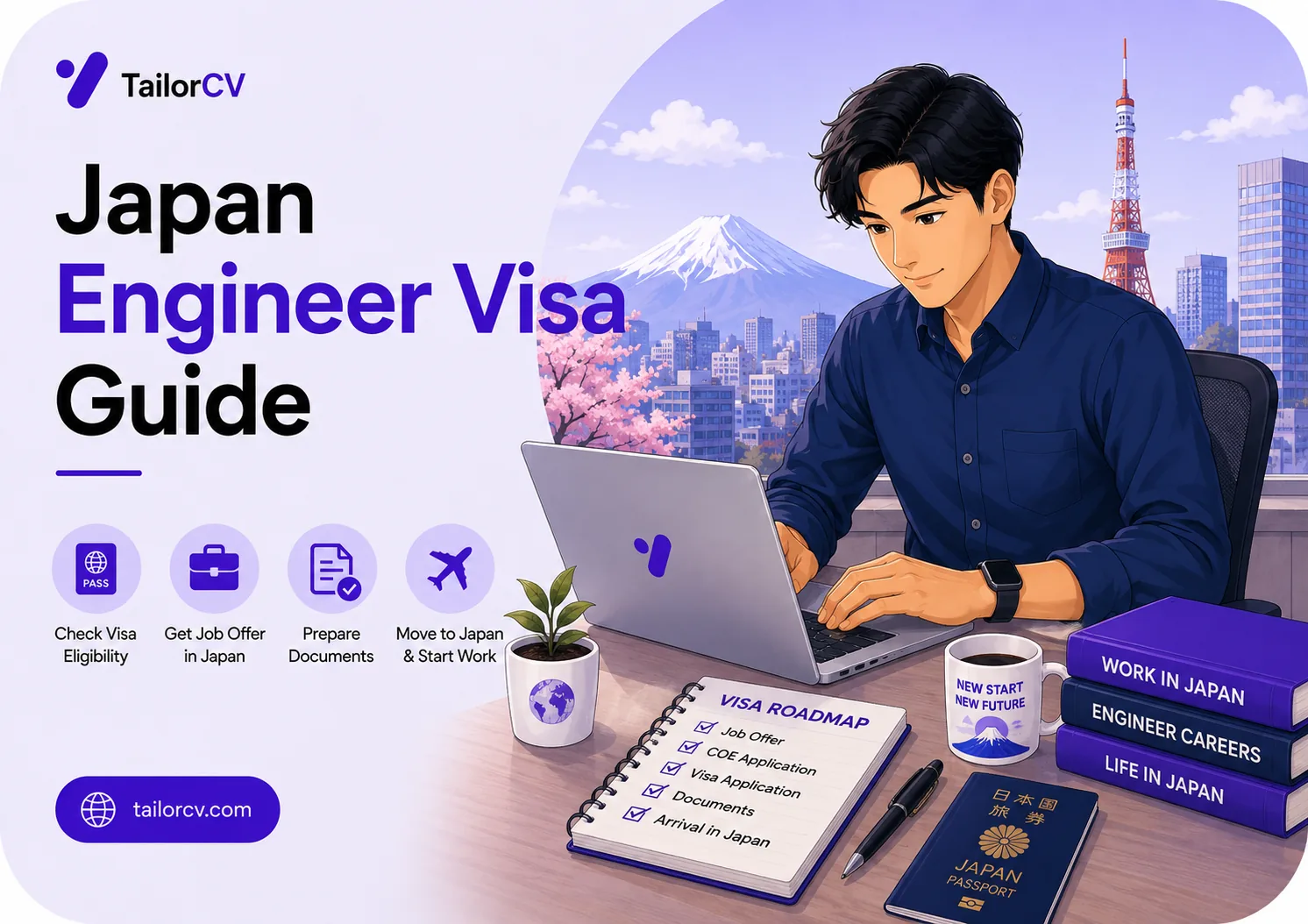
Your employer applies first. They submit for a Certificate of Eligibility (CoE) at their regional immigration bureau, providing both company documents and your personal documents. Approval typically takes one to three months.
Then you apply for the visa at a Japanese embassy or consulate with the CoE. This step is usually quick, often under a week, because the substantive assessment already happened.
On arrival, you receive a residence card at the airport, then register your address at your municipal office within 14 days and enrol in health insurance and pension.
The full sequence, including the Highly Skilled Professional route, is in the Japan work visa guide.
The timeline, and who does what
| Stage | Who acts | Typical time | What can delay it |
|---|---|---|---|
| Offer and contract | You and employer | — | — |
| Gathering your documents | You | 2–6 weeks | Employment certificates from old employers |
| CoE application | Employer, in Japan | 1–3 months | Queries about the matching rule |
| CoE posted to you | Employer | 1–2 weeks | International post |
| Visa application | You, at embassy | Under a week usually | Embassy appointment availability |
| Travel and landing | You | — | Residence card issued at the airport |
| Address registration | You, at city hall | Within 14 days | Missing this has consequences |
Realistically, plan for three to five months from signed offer to starting work. Employers hiring from abroad know this; candidates frequently do not, and resign from a current job far too early.
The step you control is the second row. Certificates of employment from former employers are the most common cause of delay, and the one part of the process nobody can chase but you.
Changing jobs on this status
A genuine advantage over employer-tied visas elsewhere.
The status covers a category of activity, not one employer. Moving from one software engineering role to another generally requires no new status — though you must notify immigration within 14 days of the change.
Where care is needed: moving to work outside the category. A software engineer becoming a sales manager, or moving into teaching, may need a change of status. Confirm before resigning.
A certificate of authorised employment can be requested from immigration confirming your intended new role falls within your current status. Worth obtaining before accepting an offer if there is any doubt — it converts uncertainty into a document.
The job-change process itself is covered in the Japan job change tenshoku guide.
Documents and consistency
Your employer handles company-side paperwork. You typically provide passport, photographs, degree certificate, certificates of employment, and your resume.
Consistency matters more than people expect. Immigration reads your resume, your certificates of employment and your contract together. Dates that do not match across documents generate queries and delay approval.
Which means: write your shokumu keirekisho with the same dates and duties your reference letters will state — see the shokumu keirekisho guide and the rirekisho guide.
What a certificate of employment needs to say
This is the single most important document in an experience-based application, and former employers routinely issue something too vague to be useful.
It must state:
- Exact dates of employment, start and end, month and year
- Your job title
- A description of your actual duties, specific enough to establish the specialist content
- The company's letterhead, stamp or seal, and a contact
What is not enough: "Ananya Sharma worked at our company from 2020 to 2024." That confirms employment and nothing about whether the work relates to your intended role in Japan.
What works: "Ananya Sharma was employed as a Backend Developer from March 2020 to August 2024, developing and maintaining server-side applications in Python and PostgreSQL, including database design and API development."
Ask former employers for this specific wording, in writing, and ask early. HR departments abroad have no reason to prioritise it, three weeks is a normal wait, and if your case rests on documented experience rather than a matching degree, this document is your case.
Common Mistakes
Applying for the visa before the Certificate of Eligibility. The CoE comes first and your employer applies for it in Japan; the visa step afterwards is largely administrative.
Ignoring the degree-matching rule. Work must relate to your degree subject or documented experience, and mismatches are the leading cause of refusal.
Assuming the problem is always your degree. A role with no specialist content falls outside the status regardless of what you studied.
Not documenting experience when the degree does not match. Ten years of relevant professional experience can substitute in the main categories, three for translation work — but only with certificates of employment to prove it.
Requesting employment certificates late. Former employers abroad are slow, and these are what make an experience-based application work.
Accepting a vague employment certificate. "Worked here from 2020 to 2024" proves employment, not that the work was specialist.
Resigning from your current job too early. Three to five months from offer to start is normal when hiring from abroad.
Inconsistent dates across documents. Immigration reads resume, certificates and contract together, and discrepancies trigger queries.
Changing to work outside the category without checking. Moving between software roles is fine; moving into sales or teaching may require a status change.
Missing the 14-day notification windows. Address registration on arrival and notification of a job change both have short deadlines.
Frequently Asked Questions
What is the gijinkoku visa?
Shorthand for the Engineer / Specialist in Humanities / International Services status of residence, which covers most white-collar foreign professionals in Japan.
Do I need a degree?
Usually, in a field related to the work. Alternatively, ten years of documented relevant professional experience can substitute in the main categories, or three years for translation and language work.
What if my degree does not match my job?
Document relevant professional experience with certificates of employment from former employers, and ensure the job description foregrounds the specialist content of the role.
What should a certificate of employment actually contain?
Exact dates, your job title, a specific description of your duties, and the company's letterhead and stamp. A letter confirming only that you worked there does not establish the specialist content.
How long does the whole process take?
Plan for three to five months from signed offer to starting work — one to three months for the Certificate of Eligibility, plus document gathering before it and the visa step after.
Can I change jobs on this status?
Yes, within the same category of work, with notification to immigration within 14 days. Moving outside the category may require a change of status.
Can I work part-time in a restaurant on this status?
No. Manual and simple service work falls outside the status, and this is enforced.
How do I check a new job qualifies?
Request a certificate of authorised employment from immigration confirming the intended role falls within your current status, before accepting the offer.
Check your application documents before submitting. Check your ATS score free.
Make This Practical
Check your own pairing against the matching table before anything else, and be clear about which of the two failure modes could apply — your background not matching the job, or the job itself having too little specialist content to qualify at all. The second one cannot be fixed with documentation.
Then request certificates of employment from every relevant former employer this week, with the specific wording spelled out: exact dates, job title, and a description of duties detailed enough to show the specialist content. If your case rests on experience rather than a matching degree, that document is your case, and HR departments abroad take weeks.
Finally, plan for three to five months from signed offer to first day, and do not resign from anything early. Register your address within 14 days of landing, and if a future move sits near the edge of your category, get a certificate of authorised employment before accepting rather than after.
What is your resume scoring right now?
Scan it against a job description and get your ATS match score in about a minute.
Drop your resume here or choose a file
PDF only. Max 2 MB.
We never share your data or use it to train AI models.

Was this guide useful?
Be the first to rate it.