 SS
SS
Key Takeaways
- Aptitude and psychometric assessments come in a handful of predictable formats - numerical, verbal, logical, situational judgment, and personality.
- Practising the format beats cramming content: familiarity with the question style, layout, and pacing is where the score gains come from.
- Numerical reasoning rewards fast, accurate work with percentages, ratios, tables, and charts rather than advanced maths.
- These tests are time-pressured by design, so answer and move on instead of getting stuck on a single question.
- Answer situational judgment and personality tests as the professional the role wants, and keep your resume, applications, and interview prep moving alongside.
Many employers — especially large firms, graduate schemes, and consulting and finance roles — use aptitude and psychometric tests to screen candidates before or between interviews. They feel intimidating, particularly under a timer, but here's the reassuring truth: they're highly coachable. Once you know the format and practice against the clock, your scores rise significantly. This guide walks through each test type and how to prepare for it.
These tests usually sit early in the process, sometimes right after your resume passes screening, so treat them as seriously as the interview itself. Prepare alongside your other interview prep with a free AI mock interview and the interview prep tool.
Know the common test types
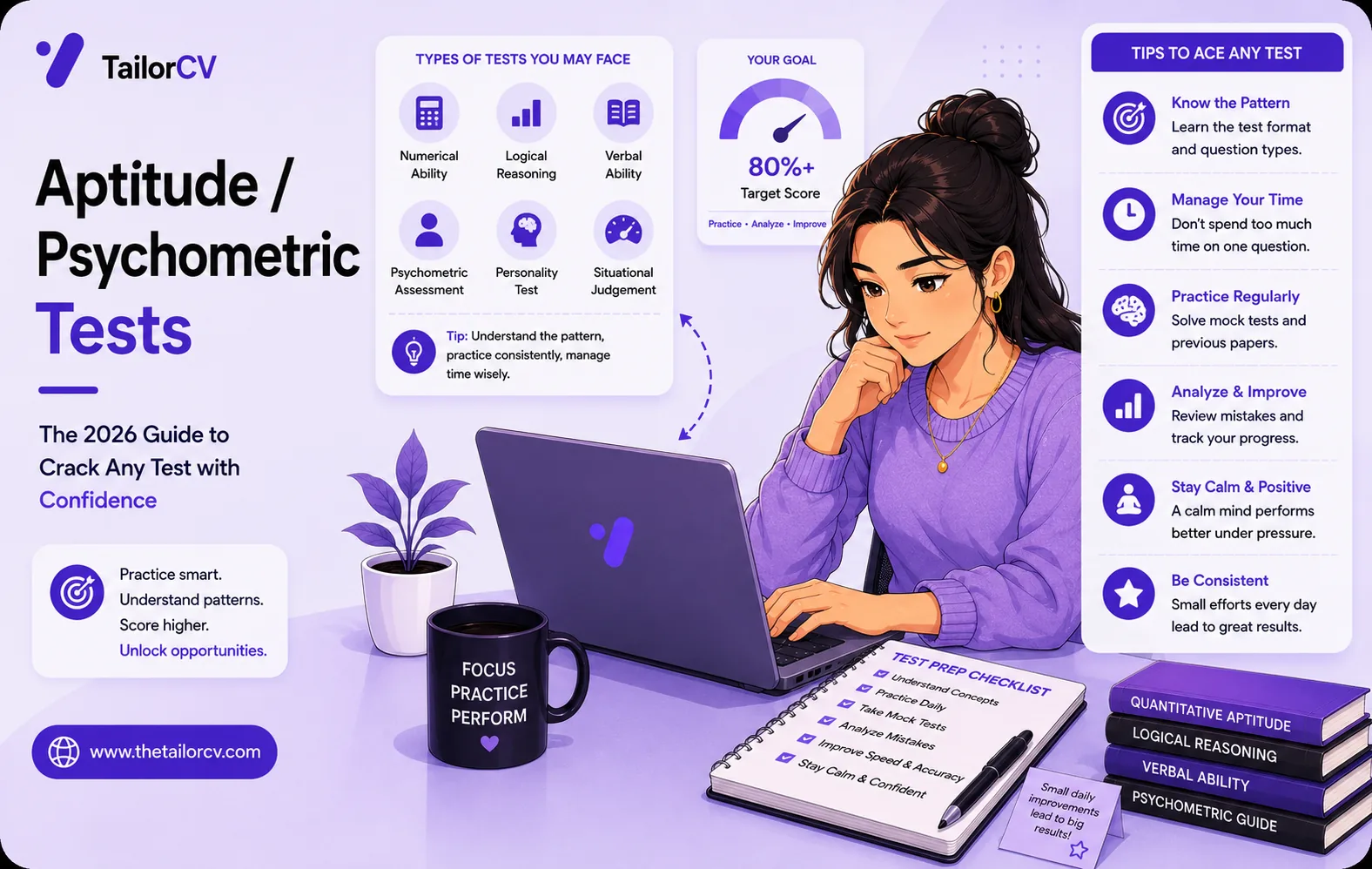
Aptitude and psychometric assessments come in a handful of predictable formats:
| Type | What it involves |
|---|---|
| Numerical reasoning | interpreting data, charts, and percentages under time pressure |
| Verbal reasoning | reading passages and judging whether statements are true, false, or cannot be determined |
| Logical / abstract reasoning | spotting patterns and sequences, often with shapes |
| Situational judgment tests (SJTs) | choosing how you'd respond to realistic workplace scenarios |
| Personality questionnaires | no right answers, but consistency and authenticity matter |
Knowing which types a role uses lets you focus your practice — research the company and process, as in how to research a company before an interview.
Practice the format, not just the content
The biggest score gains come from familiarity. When you already know the question style, the layout, and the pacing, the real test feels routine instead of shocking. Do timed practice tests for each format you'll face, review your mistakes, and learn the recurring question patterns. This is the same principle as rehearsing for a behavioral interview or a whiteboard interview — practice the performance, not just the knowledge.
Master numerical and verbal reasoning
For numerical reasoning, brush up on percentages, ratios, and reading tables and charts quickly. You rarely need advanced math — just fast, accurate arithmetic and data interpretation. Keep a calculator ready if allowed, and don't get stuck recomputing; estimate and move on.
For verbal reasoning, read the passage carefully and answer only from the information given — not your outside knowledge. The trap is inferring beyond the text. When a statement isn't supported either way, "cannot say" is often the correct answer.
Manage time ruthlessly
Most of these tests are time-pressured by design — they measure accuracy under pressure, not perfection. Don't get stuck on any single question; answer what you can quickly, flag the rest, and keep moving. If there's no penalty for wrong answers, never leave a question blank. Pacing is a skill you can practice, and it's often the difference between a good and a great score. This composure under time carries over to the interview and even to a take-home assignment.
Handle situational judgment and personality tests
Situational judgment tests ask how you'd respond to workplace scenarios. Answer as the professional the role wants — prioritizing safety, teamwork, integrity, and customer focus — while staying true to yourself. Reading the job description and company values helps you understand what "good judgment" means there.
Personality questionnaires have no right answers, and trying to game them usually backfires as inconsistency, which the test is specifically designed to detect. Answer honestly and consistently. If a role genuinely doesn't fit your personality, that's useful information for you too.
Keep the rest of your search moving
Assessments are one step, not the whole process. While you prepare, keep your resume sharp and ATS-scored, keep applying, and keep prepping interviews. If tests make you anxious, the interview anxiety tips and how to practice interviews at home guides help you stay calm. Treat each assessment as practice for the next.
Aptitude test checklist
To walk in ready:
- unchecked: Identify the test types the role uses and practice each.
- unchecked: Do timed practice to master the format and pacing.
- unchecked: Manage time ruthlessly — flag and move on, never leave blanks (if unpenalized).
- unchecked: Answer SJTs professionally and personality tests honestly and consistently.
Prepare this way and coachable tests become a strength rather than a hurdle. Keep the whole process strong with a tailored resume, the ATS checker, and a free AI mock interview for the rounds that follow.
Was this guide useful?
Be the first to rate it.